Tag: Rohingya

  • Myanmar Army Fires On Rohingya Villages In Rakhine Region

    Myanmar Army Fires On Rohingya Villages In Rakhine Region

    State media say two soldiers and six attackers died in clashes after an ambush on troops, which led to air support being called in.

    There are reports of villages burning in the northern region of Rakhine.

    Photos released by Human Rights Watch seem to show charred villages, with the group reporting 430 burnt buildings.

    The satellite photos were taken between 22 October and 10 November, following reports of fighting and civilians fleeing last month.

    rohingya-1

    Rohingya activists say the government is trying systematically to drive the Muslim minority from their villages.

    rohingya-2

    Attacking the Rohingya is a popular move for the military, the BBC’s Jonah Fisher reports from Myanmar’s largest city, Yangon.

    They are disliked by many, if not most, Burmese who consider them illegal immigrants from Bangladesh, our correspondent says.

    Media barred

    The latest outbreak in fighting was triggered by an attack on three police checkpoints just over a month ago.

    The Burmese government is not allowing independent journalists into Rakhine, so it is impossible to verify claims about the scale of the fighting.

    According to the latest official statement on Saturday, troops were ambushed and then clashed several times with armed men, presumably Rohingya Muslims, equipped with guns, knives and spears.

    At one point, when faced by about 500 men, the soldiers called in air support and two helicopter gunships fired on the Rohingya village.
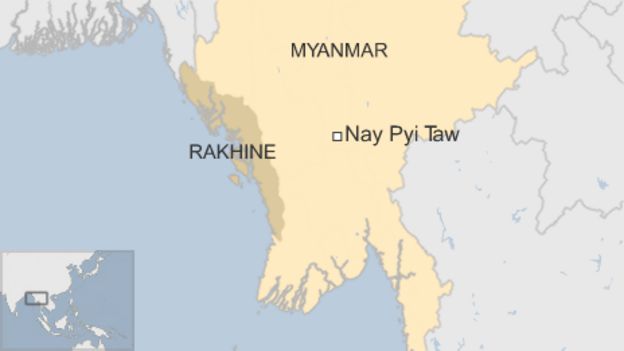
    BBC map

    Casualty figures vary widely, our correspondent says.

    Brad Adams, the Asia director for Human Rights Watch, said the new photos showed “widespread destruction” that was “greater than we first thought”.

    “Burmese authorities should promptly establish a UN-assisted investigation as a first step toward ensuring justice and security for the victims,” he said.

    The government – led by Aung San Suu Kyi – talks of “clearance operations” as part of the search for the attackers.


    Source: www.bbc.co.uk

  • The Myanmar Times Journalist Fired After Reporting On Military Rape In Rakhine State

    The Myanmar Times Journalist Fired After Reporting On Military Rape In Rakhine State

    A journalist was fired from The Myanmar Times after she reported on military rape in Rakhine State. More staff might be fired; others have resigned/are considering resignation. See: http://frontiermyanmar.net/…/reporters-sacking-followed-moi…

    To publicly indicate their anger and dismay, The Myanmar Times editorial staff took out an ad in their own paper.

    When you face censorship, quiet negotiations don’t address the systemic issue. Closed-door dialogue doesn’t challenge power; you’re playing by the rules of the powerful. You might get a story in the paper this time, or prevented a sacking another time, but it doesn’t mean you’ve won freedom. Here’s to journalists who aren’t afraid to take a stand together, and to let the public know about it.


    Source: Kirsten Han

  • Aung San Suu Kyi: Keadaan Di Wilayah Rakhine Disiasat

    Aung San Suu Kyi: Keadaan Di Wilayah Rakhine Disiasat

    TOKYO: Pemimpin Myanmar Aung San Suu Kyi berkata hari ini (4 Nov) siasatan sudah bermula terhadap keadaan di wilayah Rakhine, di mana ramai anggota minoriti Muslim menetap dan juga di mana para pekerja hak asasi manusia berkata konflik di sana membawa kepada penganiayaan awam oleh pihak tentera.

    Suu Kyi, bercakap semasa lawatan ke Tokyo, memberitahu sidang media bahawa pemerintah Myanmar tidak cuba menyembunyikan sebarang perkara dan sedang cuba untuk mencari punca masalah itu, dan tidak akan menuduh sesiapa sehingga siasatan selesai dijalankan.

    Sebarang tindakan akan dilakukan mengikut proses yang sah di sisi undang-undang, tambah beliau.

    Suu Kyi belum lagi memberi komen secara langsung mengenai pakar-pakar hak asasi manusia yang menggesa pemerintah Myanmar untuk menyiasat dakwaan-dakwaan penganiayaan.

    Ini termasuklah insiden rogol dan pembunuhan, atau mengenai kenyataan-kenyataan dikeluarkan para pemantau hak asasi manusia, walaupun beliau sudah menggesa pihak tentera untuk mengawal tindakan mereka.

    Source: http://berita.mediacorp.sg

  • New Fears Of Communal Violence In Myanmar

    New Fears Of Communal Violence In Myanmar

    NINE police officers were killed early on October 9th in a series of apparently co-ordinated attacks on border-guard posts in the troubled state of Rakhine in Myanmar’s west. The attackers were armed with knives, slingshots and only a few guns—and reportedly made off with dozens more guns and thousands of bullets. The Buddhist majority in Rakhine has long oppressed the state’s Muslim Rohingyas. Now the victims may be starting to fight back.

    Nobody has yet claimed responsibility, but police say the attackers—at least two of whom were captured and eight killed—were Rohingyas. One local official blamed the Rohingya Solidarity Organisation, a militant group that has been dormant for decades. The two who were detained reportedly told authorities that they planned the raids with fellow locals.

    The central government’s response has been reasonably level-headed. On the same day it held a press conference to appeal for caution and restraint. Two days later it dispatched high-ranking officials to talk to local leaders in the Muslim-majority townships where the attacks took place. Aung San Suu Kyi, the country’s de facto leader, did not cast blame, but reiterated her commitment to “peace and stability”. “Rakhine State’s problem is Myanmar’s problem,” said the information minister.

    Since the attacks in northern Rakhine, however, clashes have broken out there leaving at least a dozen people dead—including unarmed civilians, according to locals. The government has beefed up an already heavy military presence. Some worry that the stolen guns will be used in future attacks on security forces, or that in trying to retrieve the weapons, the police will target innocents.

    By far the biggest concern is that unrest could spread, as it did in 2012, when communal violence between Buddhists and Muslims killed scores and displaced tens of thousands. Many outside Myanmar have criticised Miss Suu Kyi for failing to speak up for the Rohingyas. Anti-Muslim sentiment runs deep among the Burman Buddhist majority. Wirathu, a virulently nationalist monk and master of social media, posted a video on his Facebook page this week that he claims shows the attackers calling for Rohingyas to join the jihad.

    In August Miss Suu Kyi invited Kofi Annan, a former UN secretary-general, to head a commission investigating human-rights abuses in Rakhine. Buddhist nationalists protested, and the Rakhine parliament passed a resolution condemning the commission. But as this week’s events have shown, efforts to bring about a just and durable peace in Rakhine are more urgent than ever.


    Source: www.economist.com

  • Myanmar Sends Troops Into Muslim-Majority Region After Deadly Attacks

    Myanmar Sends Troops Into Muslim-Majority Region After Deadly Attacks

    Myanmar has stepped up security in a Muslim-majority region near its border with Bangladesh, officials said on Monday (Oct 10), as authorities hunt for attackers who killed at least nine police officers.

    Officials believe that members of the Muslim Rohingya ethnic minority launched three separate attacks in the early hours of Sunday, in which dozens of weapons and more than 10,000 rounds of ammunition were seized from border police.

    Nine policemen were killed, one was missing and five were wounded. Eight attackers were killed and two captured, police said.

    The Rohingya, who are mostly stateless and are subject to severe restrictions on their movements, make up the majority of the population in the northern part of Rakhine State.

    Authorities in the township of Maungdaw on Sunday announced the extension of an existing order banning gatherings of five or more people and imposing a 7pm to 6am curfew.

    State media said the military – known as the Tatmadaw – had moved troops into the area by helicopter. Photographs on social media showed trucks full of infantry purportedly being deployed in the area.

    No detailed information has been released about the operation in the area near a border guard office at Kyiganbyin village, where as many as 90 assailants seized weapons and fled into the hills.

    “The Tatmadaw, the police force and the Ministry of Border Affairs are working together to ensure security and restore law and order,” said Min Aung, a minister in the Rakhine State government, who declined to disclose the size of the force sent to the area.

    Human rights advocates raised concerns that civilians may be caught up in the sweep. Unverified reports posted online by advocates for the Rohingya suggested that a violent crackdown may be underway.

    Ye Htut, administrator for Maungdaw, said he was not aware of the situation around Kyiganbyin village, which is under the control of security forces.

    Muslim residents of Maungdaw town closed their shops amid the heightened security presence, he said.

    “All of the security forces are deployed in Maungdaw, so we are not worried about security. Everything is fine,” Ye Htut said.

    BANGLADESH DEPLOYS BORDER GUARDS

    Matthew Smith, founder of campaign group Fortify Rights, said restrictions on the Muslim population already in place made northern Rakhine State “a police state, an apartheid state”.

    “Human rights violations in the context of counterinsurgency in northern Rakhine State are not new,” Smith said.

    “The authorities routinely accuse average Rohingya of involvement with armed extremists.”

    Authorities routinely dismiss accusations of rights abuses.

    Sunday was the bloodiest day in the state since 2012, when more than 100 people were killed in clashes between Rohingya and ethnic Rakhine Buddhists. Some 125,000 people, the majority Rohingya, remain displaced.

    Myanmar’s state counsellor and foreign minister Aung San Suu Kyi – who in August appointed former U.N. chief Kofi Annan to head an advisory commission into the situation in Rakhine State – discussed the attacks with security officials in an emergency meeting on Sunday, said foreign ministry official Kyaw Tin.

    “The state counsellor instructed us to handle this issue cautiously in accordance with the law,” Kyaw Tin told reporters.

    Officials in Bangladesh said Myanmar had closed the border after the attacks.

    Bangladesh deployed additional border guards, said Mohammad Tanvir Alam Khan, a Border Guard Bangladesh commander.

    Myanmar police chief Zaw Win has said his force was investigating possible links between the attackers and rebel groups.

    Zaw Win also mentioned big drugs busts by police in the area – some 6 million methamphetamine pills were seized in September – as a possible trigger for the attacks.


    Source: ChannelNewsAsia