Tag: Rohingyas

  • Gang Rape, Torture Claims As Rohingyas Flee Myanmar

    Gang Rape, Torture Claims As Rohingyas Flee Myanmar

    TEKNAF, Bangladesh: Horrifying stories of gang rape, torture and murder are emerging from among the thousands of desperate Rohingya migrants who have pushed into Bangladesh in the past few days to escape unfolding chaos in Myanmar.

    Up to 30,000 of the impoverished ethnic group have fled their homes, the United Nations says, after troops poured into the narrow strip where they live earlier this month.

    Bangladesh has resisted urgent international appeals to open its border to avert a humanitarian crisis, instead telling Myanmar it must do more to prevent the stateless Muslim minority from entering.

    The scale of human suffering was becoming clear Thursday, as desperate people like Mohammad Ayaz told how troops attacked his village and killed his pregnant wife.

    Cradling his two-year-old son, he said military men killed at least 300 men in the village market and gang-raped dozens of women before setting fire to around 300 houses, Muslim-owned shops and the mosque where he served as imam.

    “They shot dead my wife, Jannatun Naim. She was 25 and seven months pregnant. I took refuge at a canal with my two-year-old son, who was hit by a rifle butt,” Ayaz told AFP, pointing to a cut on the boy’s forehead.

    Ayaz sold his watch and shoes to pay for the journey and has taken shelter along with at least 200 of his neighbours at a camp for unregistered Rohingya refugees.

    ‘DEEP CONCERN’

    Many of those seeking shelter in Bangladesh say they have walked for days and used rickety boats to cross into the neighbouring country, where hundreds of thousands of registered Rohingya refugees have been living for decades.

    The Rohingya are loathed by many in majority Buddhist Myanmar who see them as illegal immigrants and call them “Bengali”, even though many have lived in Myanmar for generations.

    Most live in impoverished western Rakhine state, but are denied citizenship and smothered by restrictions on movement and work.

    As the crisis deepened, Bangladesh said late Wednesday it had summoned the Myanmar ambassador to express “deep concern”.

    “Despite our border guards’ sincere effort to prevent the influx, thousands of distressed Myanmar citizens including women, children and elderly people continue to cross (the) border into Bangladesh,” it said. “Thousands more have been reported to be gathering at the border crossing.”

    TORTURE AND RAPE

    Since the latest violence flared up, Bangladesh’s secular government has been under intense pressure to open its border to prevent a humanitarian disaster.

    Instead, Bangladesh border guards have intensified patrols and coast guards have deployed extra ships. Officials say they have stopped around a thousand Rohingya at the border since Monday.

    Farmer Deen Mohammad was among the thousands who evaded the patrols, sneaking into the Bangladeshi border town of Teknaf four days ago with his wife, two of their children and three other families.

    “They (Myanmar’s military) took my two boys, aged nine and 12 when they entered my village. I don’t know what happened to them,” Mohammad, 50, told AFP. “They took women in rooms and then locked them from inside. Up to 50 women and girls of our village were tortured and raped.”

    Mohammad said houses in his village were burned, echoing similar testimony from other recent arrivals.

    Human Rights Watch said Monday it had identified more than 1,000 houses in Rohingya villages that had been razed in northwestern Myanmar using satellite images.

    The Myanmar military has denied burning villages and even blamed the Rohingya themselves.

    Jannat Ara said she fled with neighbours after her father was arrested and her 17-year-old sister disappeared, she believes raped and killed by the army.

    “We heard that they tortured her to death. I don’t know what happened to my mother,” said Ara, who entered Bangladesh on Tuesday.

    Rohingya community leaders said hundreds of families had taken shelter in camps in the Bangladeshi border towns of Teknaf and Ukhia, many hiding for fear they would be sent them back to Myanmar.

    Police on Wednesday detained 70 Rohingya, including women and children, who they say they will send back across the border.

    “They handcuffed even young girls and children and then took them away with a view to pushing them back to Myanmar,” said one community leader who asked not to be named, adding they faced “certain death” if made to return.


    Source: www.channelnewsaia.com

  • Protests All Over Asia Against Myanmar’s Genocidal Persecution Of Rohingya Muslims

    Protests All Over Asia Against Myanmar’s Genocidal Persecution Of Rohingya Muslims

    DHAKA, Bangladesh — Thousands of Bangladeshis marched in the capital’s streets Friday to protest the persecution of Rohingya Muslims in Burma, one of several similar rallies in the region.

    Chanting “Stop killing Rohingya Muslims,” they marched in Dhaka as violence in Burma’s Rakhine state escalated, forcing thousands to leave their homes.

    The protesters from several Islamic groups burned an effigy of Burma leader Aung San Suu Kyi and a flag of Burma. They carried banners reading “Open border to save the Rohingya.” Bangladesh’s southeast borders Burma.

    Organizers said some 10,000 protesters joined the rally in Dhaka. Smaller protests occurred in Indonesia, Malaysia and Thailand.

    Also, rights group Amnesty International asked Bangladesh not to forcibly send fleeing Rohingya back to Burma.

    Up to 500,000 undocumented Rohingya have been living in Bangladesh after arriving from Burma in waves since the 1970s. Some 33,000 registered Rohingya refugees are lodged in two camps in southern Cox’s Bazar district.

    Local media reported that a few thousand Rohingya Muslims have entered Bangladesh this week with the help of smugglers, but authorities didn’t confirm that.

    Maj. Gen. Abul Hossain, director general of the Bangladesh Border Guard, said on Friday that “only some” arrived by boats.

    On Thursday, Bangladeshi border guards did not allow at least a dozen boats carrying Rohingya to enter Bangladesh, said Lt. Col. Abu Jar Al Jahid, a commanding officer of the border agency in Cox’s Bazar’s Teknaf area.

    Amnesty International condemned the persecution of Rohingya Muslims by Burma and Bangladesh’s unwillingness to accept them.

    “The Rohingya are being squeezed by the callous actions of both the [Burma] and Bangladesh authorities. Fleeing collective punishment in Burma, they are being pushed back by the Bangladeshi authorities. Trapped between these cruel fates, their desperate need for food, water and medical care is not being addressed,” said Champa Patel, Amnesty International’s South Asia director.

    Burma’s security forces are mounting indiscriminate reprisal attacks against Rohingya in response to an Oct. 9 assault on three border posts that killed nine border officers, the rights group said in a statement on Thursday.

    The group said it has heard accounts of Burma’s security forces, led by the military, firing at villagers from helicopter gunships, torching hundreds of homes, carrying out arbitrary arrests and raping women and girls.


    Source: www.usatoday.com

  • Mohamed Jufrie Mahmood: Why Does Singapore Continue To Do Business With Myanmar Despite The Gross Human Rights Violations On Rohingyas?

    Mohamed Jufrie Mahmood: Why Does Singapore Continue To Do Business With Myanmar Despite The Gross Human Rights Violations On Rohingyas?

    Just like their persecuted brothers in Mindanao, southern Thailand and elsewhere in the world, the Rohingyas are finally making moves to protect themselves.

    myanmar-fighting-back

    The question now is, will Singapore continue supplying arms to those who are persecuting and murdering them.

    The bigger question is, why did Singapore even start to work closely with and supply arms to the generals knowing very well that the arms would be used against the local population since the country was and is still not under any form of external military threat?

    Are we doing it for the money?


    Source: Mohamed Jufrie Mahmood

  • Malaysia Mass Graves: Villagers Tell Of Immigrants Emerging From Secret Camps

    Malaysia Mass Graves: Villagers Tell Of Immigrants Emerging From Secret Camps

    The residents of Wang Kelian sensed something was amiss when a number of people stumbled on to their streets, weak and injured, and began to beg for food and water.

    “They would walk into my shop, with injuries covering their hands and feet. Some were just too weak to even speak properly,” said Lyza Ibrahim, who runs a food stall in the town on the northern Malaysian border with Thailand.

    “One asked me, ‘[Is this] Malaysia?’ Then he pointed in the other direction, said ‘Thailand’ and shook his head to signal that he was not wanted there.”

    Wang Kelian is an unassuming settlement but it has been thrust into the global spotlight this week after the discovery in nearby jungle of dozens of secret camps used by people smugglers and nearly 140 grave sites.

    Police say some of those graves contain multiple bodies – raising the terrible prospect of hundreds of unexplained deaths. On Tuesday Malaysian authorities began the grim task of exhumation.

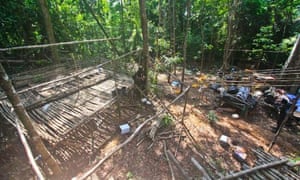
    Some of the campsites included wooden pens, some with barbed wire and guarded by sentry posts. In one pen, police found several parts of a decomposed body.

    A picture from Royal Malaysian Police shows an abandoned human trafficking camp where graves were found nearby, close to the border with Thailand at Wang Kelian, Malaysia.

    The camps appear to be part of a complex of bases stretching into Thailand on what had been a well-established route smuggling mostly Rohingya people from Burma and Bangladesh.

    But the trade has been in chaos since early May, when Thai authorities launched a crackdown after the discovery of mass graves on their side of the border.

    Thousands of migrants headed for Thailand started landing elsewhere in south-east Asia. And as the smugglers fled their jungle hideouts, migrants were spotted in Wang Kelian.

    Ibrahim said she had seen several migrants, whom she believed to be Rohingya, and heard stories about many others, including that they would go to a nearby mosque to ask for help.

    Others echoed her story. Another woman said she had spotted a Bangladeshi migrant wandering in the area and knocking on her neighbour’s door.

    “It is very sad. We have been hearing these stories, but we can’t do much,” said the woman, who declined to give her name. “We could only offer food, clean clothes, but we have to call the police and they will be taken away by the police after that.”

    Malaysian officials acknowledged the camps had been around for some time but defended themselves against criticism that no action was taken earlier. Authorities had previously vehemently denied there were any such sites in the country.

    “We have been building up intelligence and information,” the national police chief, Khalid Abu Bakar, told reporters on Monday, vowing tough action against any Malaysians involved.

    But anti-trafficking groups said the latest discovery came as little surprise and would cast an even harsher spotlight on Malaysia, which was listed as ‘tier three’ by the US State Department’s annual human-trafficking report, the worst ranking for countries which are failing to stop the trade.

    “There were stories about these camps that went back nearly 10 years,” Matthew Friedman, the former chief of the UN inter-agency project on human trafficking, told the Guardian. He now heads the Mekong Club, which campaigns against slavery in Asia. “We passed the information on to the local authorities, but there was no follow-up.”

    Bags with human remains at Wang Kelian, Perlis, Malaysia

    A report in 2009 by the US Senate committee on foreign relations found that “a few thousand” Burmese migrants had become victims of extortion and trafficking once they were deported across Malaysia’s border with Thailand.

    In addition, it said there were questions about the “level of participation” of government officials in Malaysia and Thailand.

    Villager Mahyuddin Ahmad said he has seen migrants in Wang Kelian for the past two years but more had been spotted in the past month – the largest group being about 10 people, including women and children.

    The 55-year-old businessman, who said he had given food such as instant noodles and clothes to migrants, added: “It is a common sight here. We didn’t suspect anything because we thought they just come from Thailand.

    “So we are really shocked to hear what the police revealed yesterday about the grave sites and jungle camps.”


    Source: www.theguardian.com

  • Here’s How You Can Help Our Fellow Muslim Rohingyas – Through Pergas

    Here’s How You Can Help Our Fellow Muslim Rohingyas – Through Pergas

    Assalamu’alaikum Wr Wbt,
    Brothers and Sisters,

    Referring to the plight of the Muslim Rohingya community, insyaAllah Pergas will be conducting Hajat Prayers this Sunday 9am at Masjid Alkaff Kampung Melayu. All are welcome to join us.

    Donations can also be made via bank transfer or cheque to :
    Pergas (OCBC Current: 629-704537-001)
    Please indicate “ROHINGYA”.

    Cut off date for bank transfer:
    05 June 2015

    Kindly email Ustaz Izzam at [email protected] with your transaction reference number (found on the receipt), bank account number and amount of donation for our verification.
    All proceeds will go directly to BAPA.

    Thank you for your kind contributions. May Allah be with the victims, lift their affliction and adversity, reward them for their patience and perseverance. Ameen.


    Source: Singapore Islamic Scholars & Religious Teachers Association – Pergas