The next Singapore General Election is expected to be held on 12 September, or latest before the year is out.
In this article, I will take a quick look at the different scenarios that can happen depending on how the votes swing, and also what kind of government each scenario will result in.
As you read through, perhaps you can think about the kind of government that you think should form, so that policies to protect Singaporeans can finally be implemented, and then how you would vote accordingly to achieve this government. You might want to focus on the constituency that you live in, and which party you would vote for at the coming election (i.e. PAP vs other parties), to allow Singaporeans to achieve the outcome you would look forward to.
One thing we need to take note of is that for Singapore’s electoral system, how the political parties do and how many votes they win on a national level is not as relevant. What is more important is whether the parties win at each constituency. Thus your focus is to think about how you want to vote in your constituency, so that the party that you want to win will win the seat(s) at your constituency, and then go into parliament to represent you.
Unlike in some other democracies, if Party A wins 60% of the votes, for example, it would also win around 60% of the seats. In Singapore, this is not the case. The PAP only won 60% of the votes at the last election but more than 90% of the seats. This means that Singaporeans do not have enough members of parliament from the other parties to represent us in parliament. Thus our focus should really be on how many seats the opposition parties should have to win.
As such, this is why this article and this exercise is important. You need to have a vision of the kind of government you want and how many seats you think the opposition should have. Then, we need to look broadly at trends over the past election and what might happen at this coming election, where the opposition have the best chances of winning the seats, and then vote decisively in our respective constituencies to let the opposition win enough seats to go into parliament to fight for Singaporeans.
How Many Seats Can the Opposition Win?
Let’s begin.
As I have written, the PAP has changed the electoral boundaries mainly in the constituencies where the opposition has won more than 40% of the votes at the last election. This shows the the PAP believes that the opposition can potentially win as much as 10% more of the votes at the next election, and that the PAP can lose as much as 10% of the votes, which is why they have changed the boundaries in the hope of confusing voters. So, let’s stay focused.
In addition, if you track the constituencies which did not change their boundaries drastically since the election in 2001, there have been a swing of 10% of the votes to the opposition at each subsequent election in 2006 and 2011, so we can expect that the votes will still swing by about 10% as well to the opposition at the next election, everything else being equal.
The PAP has also attempted to buy votes, such as via the Pioneer Generation Package (though it has been analysed that the “increased subsidies” have been offset by the increase in healthcare bills). Many commenters have also suggested that the PAP has been giving out new citizenships in the hope that new citizens will vote for them (this effect might be real or not), so as to help them win back the vote shares. The results at the next election will give us an indication of whether the PAP’s underhanded tactics will work. For those who are still uncertain as to which party they would vote for, this also means that if they want to balance out the effects of the PAP’s vote buying, they would have to vote opposition to pull back the votes.
Otherwise, if the PAP’s vote buying tactics work, then it might pull back about 5% of the votes. If so, there might only be a 5% swing of the votes to the opposition. Hopefully, the new citizens who become Singaporeans and who have also understood and been affected by the policies will realise that the PAP’s policies will not benefit them in the long term, and would vote for the opposition to improve the policies, to protect all Singaporeans.
Next, let’s take a look at the scenarios.
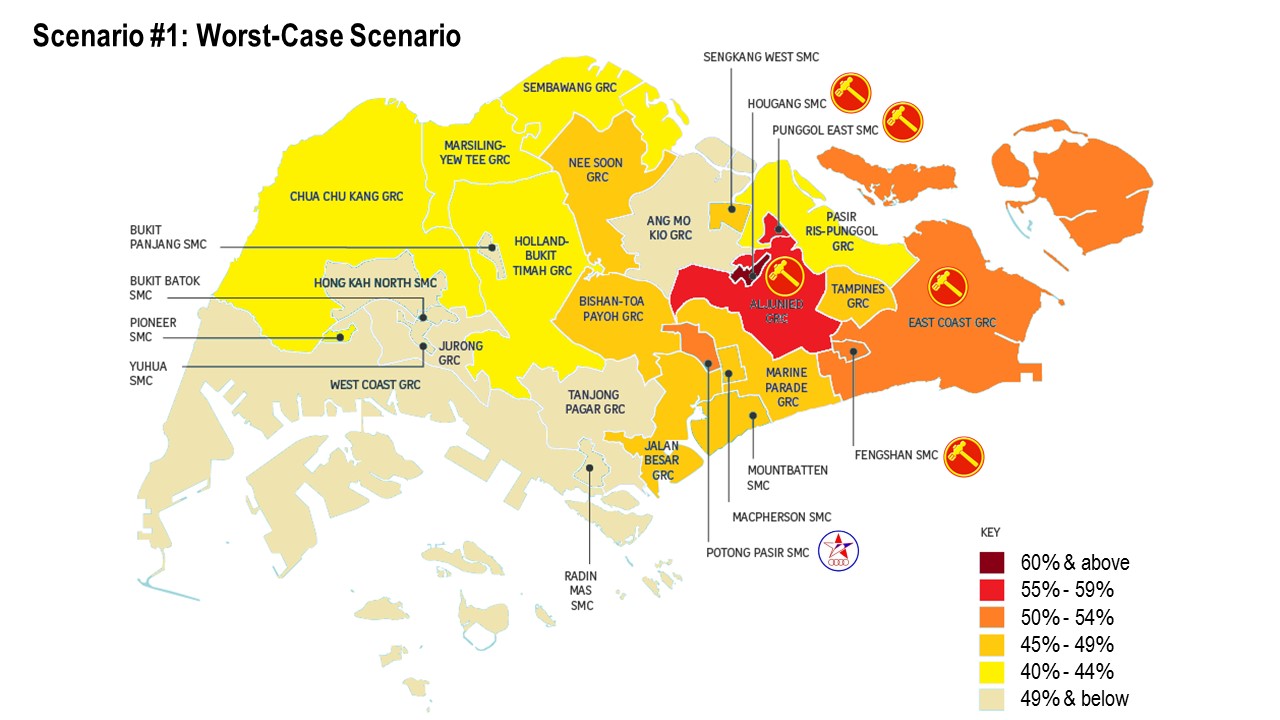
At the next election, if we assume that the votes for the opposition will increase by 5% in each constituency (if the vote buying works), the following outcome is what we will see. The opposition will win the seats in their current seats in Aljunied GRC, Hougang SMC and the Punggol East SMC, and also just a few more in East Coast GRC, Fengshan SMC and Potong Pasir SMC. This would mean that the Worker’s Party (WP) will win 12 seats and the Singapore People’s Party (SPP) will win 1 seat.
Note that the seats won by the opposition are shaded in dark red, red and orange.

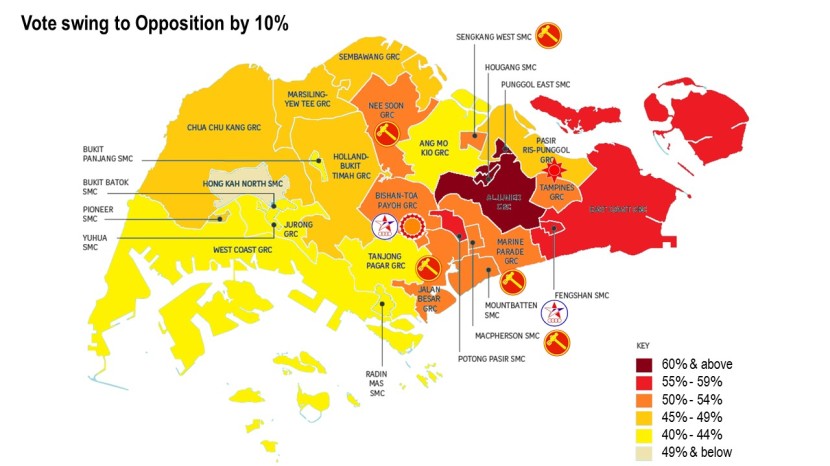
Now, if we assume that the votes for the opposition will increase by 10% in each constituency as would be the normal trend, then we will see the following outcome. On top of the constituencies won above, the opposition will also win the following additional seats: Bishan-Toa Poyah GRC, Jalan Besar GRC, MacPherson SMC, Marine Parade GRC, Mountbatten SMC, Nee Soon GRC, Sengkang West SMC and Tampines GRC. This would allow WP to win another 15 seats, the SPP to win another 2 seats, the combined SPP and Democratic Progressive Party (DPP) to win 5 seats and the National Solidarity Party (NSP) to win 5 seats.
At the last election, the Singapore Democratic Party (SDP) was also the party with the fastest improvement, where the votes that it garnered increased by more than 10%. This shows that SDP has a growing traction and influence among many Singaporeans, and could likely continue with its momentum of gaining support. This is also helped by the SDP having introducednumerous and credible alternative policies, which you can read here. If I may surmise, they have attracted Singaporeans largely due to having a clear vision and mission, as well as having clearly articulated their policy proposals for Singaporeans.
As such, for the SDP, if the votes to them would swing by 13% to 15%, this would mean that the SDP would be able to win the seats in Holland-Bukit Timah GRC and Marsiling-Yee Tee GRC, as the following shows.
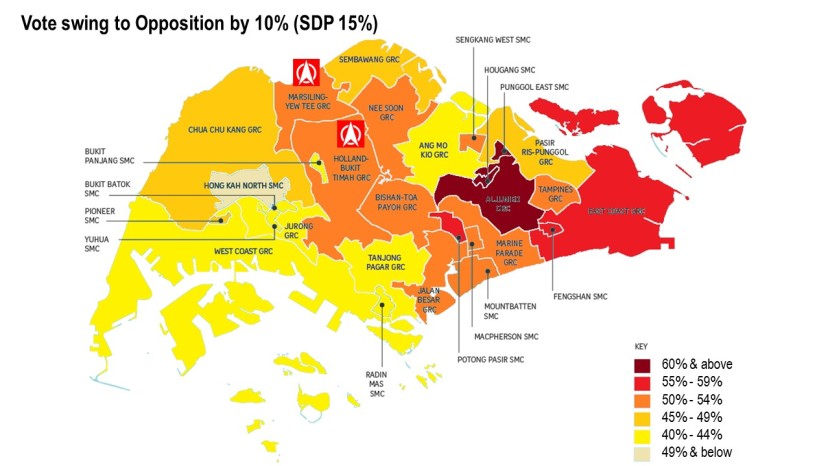
Next, if the other parties would field strong A Teams in the constituencies that they would be running in, there is a chance that the vote swing for these constituencies will be even higher.
If so, the People’s Power Party (PPP) would be able to win Choa Chu Kang GRC, Reform Party (RP) would be able to win Ang Mo Kio GRC and Singaporeans First (SingFirst) would be able to win Tanjong Pagar GRC, as below. (This is assuming RP would put its A Team in Ang Mo Kio GRC and SingFirst would put its A Team in Tanjong Pagar GRC. RP will also be contesting in West Coast GRC and SingFirst will also be contesting in Jurong GRC.)

Scenario #1: Worst-Case Scenario
Now, if you ask me, the worst case scenario would be where the PAP’s vote buying tactics actually work and the opposition only garners 13 seats. This would only give them 15% of the total 89 seats, which is not even one-third of the seats.
What this would mean is that the PAP would still have the free rein to push through any policies that it wants, such as the Population White Paper and no one will be there to block the PAP.
Is this the outcome that you want? It doesn’t change much from the current situation and the PAP has no need to listen to Singaporeans or respond to the needs of Singaporeans.


Scenario #2: PAP 2/3 Majority Seats Denied (Opposition Wins >1/3 Seats)
In the second scenario, if the votes do indeed swing by 10% to the opposition, this would give the opposition 40 seats, which would be about 45% of the total seats. This would give them more than one-third of the seats but would not be enough for them to form government. Theoretically, having one-third of the seats would allow the opposition to block policies that the PAP wants to pass.
As I have explained, even if the opposition has one-third of the seats, as long as it is not the government, this means that the PAP is still in control. What this means is the PAP still gets to decide the policies that it wants.
And as the PAP has shown, they would be able to bypass parliament to pass certain laws, so if the PAP is still the government, even if they do not have two-thirds majority, they can find ways to change or amend the laws without going through parliament, which means the PAP still gets to do what it wants, and not care about the needs of Singaporeans.
How to vote to achieve this scenario: (1) Vote for WP in all the constituencies that the WP would be running in, (2) vote for SPP for its constituencies in the central and eastern part of Singapore, (3) and vote for NSP in Tampines GRC.


Scenario #3: Opposition Wins >50% Seats(Slim Majority)
The third scenario would be where the SDP continues to be the best improving party and wins significantly more votes. This would enable to win the seats in the northwestern part of Singapore, and help the opposition win 48 seats. This would make up 54% of the seats or a slim majority. This means that the opposition would be able to come together to form a coalition government. However, in the event that this happens, because the PAP will have more than a third of the seats, if this new government made up of the current opposition parties want to enact new laws, the PAP can block them from doing so.
Thus if the new opposition-led government wants to implement new policies to protect Singaporeans, the PAP can sabotage these policies by blocking them from being passed, and hurting Singaporeans in that process.
How to vote to achieve this scenario: (1) Vote for WP in all the constituencies that the WP would be running in, (2) vote for SPP for its constituencies in the central and eastern part of Singapore, (3) vote for NSP in Tampines GRC, (4) and vote for SDP in the 2 GRCs that the SDP would be running in.


Scenario #4: Opposition Wins 2/3 Majority Seats
There is still a fourth scenario where the other parties would field strong A Teams in the constituencies that they would be running in and win them. If PPP, RP and SingFirst do so, this would allow the opposition to win 64 seats and more than two-thirds of the seats, which allow them to effectively have a majority-led government.
This way, they would be able to implement policies to protect Singaporeans and the PAP would not be able to block them. Will Singapore, for once, finally have a new government which will finally look into the needs of Singaporeans and implement policies to protect our citizens?
How to vote to achieve this scenario: (1) Vote for WP in all the constituencies that the WP would be running in, (2) votefor SPP for its constituencies in the central and eastern part of Singapore, (3) vote for NSP in Tampines GRC, (4) vote for SDP in the 2 GRCs that the SDP would be running in, (5) and vote for the PPP (Choa Chu Kang GRC), RP (Ang Mo Kio GRC) and SingFirst’s (Tanjong Pagar GRC) A Teams in the GRCs that they would be running in.


Scenario #5: Also Lose Khaw Boon Wan Scenario
If you look at Scenario #4, Sembawang GRC is shaded in yellow-orange, where only a few more percentage of the votes can tip the balance in the opposition’s favour. According to an online poll by The Online Citizen, Khaw Boon Wan (who leads the Sembawang GRC) ranks 4th as the member of parliament that Singaporeans most want to see step down.
If so, there is a chance that the NSP can win big at Sembawang GRC and win it.
If so, the opposition will win 69 seats or 78% of the seats.
How to vote to achieve this scenario: (1) Vote for WP in all the constituencies that the WP would be running in, (2) vote for SPP for its constituencies in the central and eastern part of Singapore, (3) vote for NSP in Tampines GRC, (4) vote for SDP in the 2 GRCs that the SDP would be running in, (5) vote for the PPP (Choa Chu Kang GRC), RP (Ang Mo Kio GRC) and SingFirst’s (Tanjong Pagar GRC) A Teams in the GRCs that they would be running in, (6) and vote for NSP in Sembawang GRC.


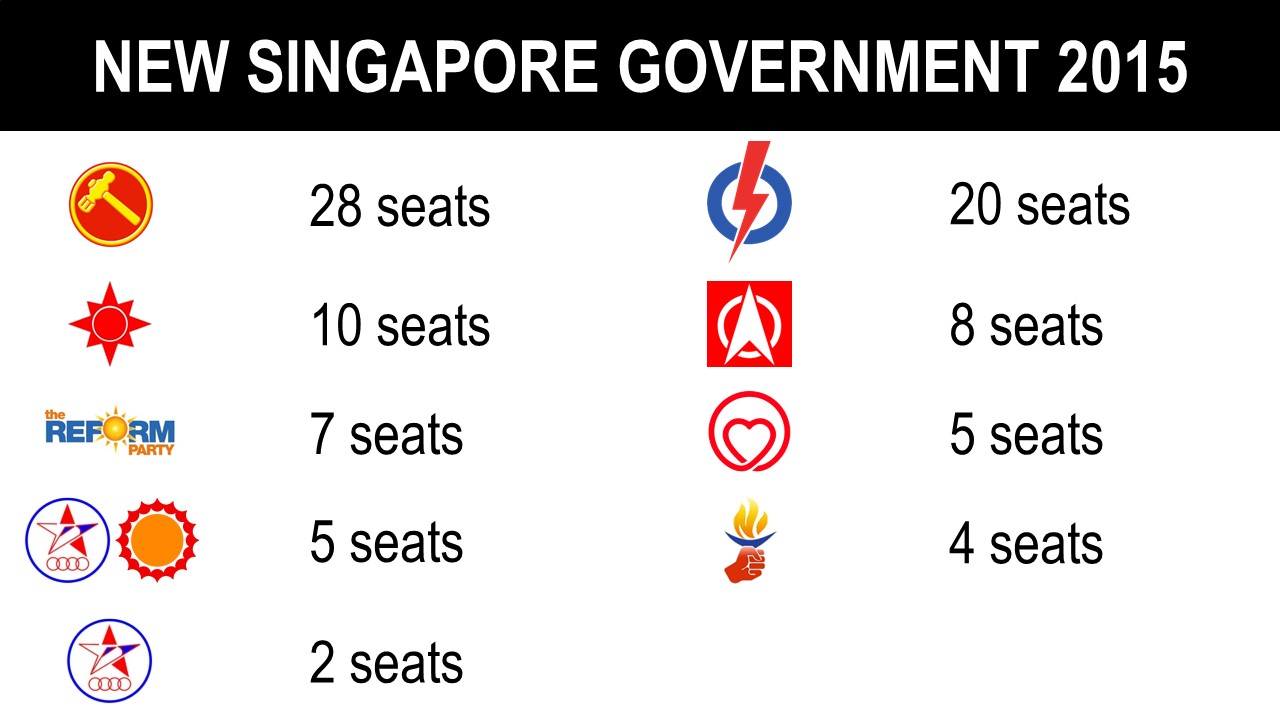
And what will this government look like, if the swing votes follow the historical trend and if the opposition parties would put their best teams in the constituencies strategically? Below is a possibility of what it can look like.


In this new government, WP will win all the 28 seats it plans on contesting, especially since WP has now established itself as a credible and stable party. Voting for it into parliament will give confidence to Singaporeans, and I am quite certain that WP can win all its seats, if the votes swing as they traditionally would.
But in this new government, PAP will still have seats. In fact, PAP will be the second biggest party with 20 seats. And the ministers overseeing the financial aspects of Singapore and the economy would still be retained, namely Finance Minister Tharman Shanmugaratnam, Minister for Trade and Industry Lim Hng Kiang, Second Minister for Trade and Industry S Iswaran.
SDP, having shown itself to have consistently improved over the past 5 years through the introduction of its thoroughly and well-researched policy proposals, would have gained a significant reputation and win it 8 seats. This would include Professor Paul Tambyah who has said that he would become a member of SDP, after having volunteered with SDP for so many years.
SingFirst, led by Tan Jee Say and Ang Yong Guan, could be expected to win 5 seats. Over the last few years, SingFirst has also worked hard and in fact, has even proposed a $6 billion social safety net, with outlined policy proposals to improve the lives of Singaporeans. They have also looked into the budget aspects and have explained how the budget would be met, without changing the current finances in Singapore.
NSP would be expected to win 10 seats and for Mr Chiam See Tong’s SPP, it looks like it can quite confidently win 7 seats, 5 of which in a GRC with DPP. Ms Lina Chiam has said that she would run in Potong Pasir SMC again and Ms Jeannette Chong-Aruldoss will be returning to Mountbatten SMC, both women respected by the constituents in their respective areas, having continued in their endeavours in these areas. SPP also performed well at Bishan-Toa Poyah GRC and could very likely win this GRC, this time round with DPP.
Finally, Kenneth Jeyaretnam’s Reform Party could win 7 seats. Kenneth has over the last few years written extensively about the Singapore economy and has questioned the government on its revenue and expenditure. Kenneth has also outlined his party’s policy proposals, as well as to similarly explain where the expenditure would come from. He has also shown how this can be done “without raising taxes or cutting defence spending”.
Indeed, if this could be our new government, Singaporeans can finally look forward to a new government which will finally look into improving the lives of Singaporeans, and which will finally implement policies to protect Singaporeans. For far too long, the PAP has gone too far with its pro-business objectives that it has increased profits for itself but this has come at the expense of Singaporeans, where it has been estimated that 30% of Singaporeans have languished into poverty, as wages have stagnated for the past 10 to 20 years.
In fact, Singaporeans today have to pay the most out of our own pockets for healthcare, after Switzerland. Singaporeans also have to pay the most expensive university fees in the world, for citizens. Not only that, Singapore is one of very few countries in the world still without minimum wage and unemployment benefits to protect the workers. And even thought the PAP makes Singaporeans pay the most out of our wages into social security for retirement (CPF) in the world, Singaporeans are left with the least adequate retirement funds because the PAP takes our CPF to let GIC and Temasek Holdings earn high profits from.
However, the opposition parties have said that they would implement minimum wage, they have also said that they would increase health expenditure so that Singaporeans would not have to forgo healthcare because they cannot afford it. SDP has even proposed putting a cap of $2,000, so that Singaporeans do not need to pay more than $2,000 in a year to see a doctor. This would be a huge relief for Singaporeans who have to pay tens and thousands for a single operation. The opposition have even proposed providing free education, up to university and unemployment benefits to protect Singaporeans. Not only that, they have also proposed to implement an old-age pension, on top of the CPF, so that Singaporeans will be able to save enough for our retirement needs.
As such, it is clear that it is the opposition parties which have the solutions to improve the lives of Singaporeans, and to protect Singaporeans. I look forward to seeing the opposition form a new coalition government in Singapore.
As a final note, after going through this exercise, take a look back at the scenarios again. After reading through this article, which scenario do you think would form a government that would finally implement policies to protect Singaporeans?
Last week, I conducted a survey to ask Singaporeans which government that would want to have. 50% of the respondents said that they would want a new government where the opposition makes up more than two-thirds of the seats. This is so that the new opposition-led government would be able to finally implement policies in the interests of Singaporeans.

For this to happen, it would mean that Singaporeans would have to vote strategically to work towards Scenario 4 or 5 and make our dreams come true.
How should we do that? For Singaporeans living in the dark red, red and orange areas, these are the areas where the opposition have the highest chance of winning the seats and going into parliament, according to the voting patterns at the last election.
If so, this also means that for Singaporeans who are living in these constituencies, we have to vote decisively for the opposition, so that we can send the opposition parties into parliament. As also mentioned, for the voters who are still undecided, it would be wise to vote for the opposition to balance out the effects of the PAP’s vote buying tactics so that the opposition would not be unfairly penalised.
I have tried to present to you a vision for Singapore’s new government. Do take some time to think about it and to share with your family and friends. It is important that we vote right to have the right government that we want, so that we can finally have policies which will benefit Singaporeans.
We need to know that our votes are more than just about what we feel or think. We need to look broadly and systematically on the whole, at the election trends and to imagine the kind of government we want. Our votes have to be guided by this. We need to take responsibility for our country’s future, by voting in such a way that will allow the government that we envision to come true. For this to happen, we have to be strategic.
Over the course of the next few weeks, I will observe the changes in the landscape and see if there is a need to make amendments to the scenarios, but do also analyse them for yourselves, so that we can then work towards voting in a manner that is focused on the seats that the opposition needs to win, and so that we can vote for a government that will be in the interests of Singaporeans.
We can do it. It is time for change. It is time for us to vote decisively for change to come, and for Singapore’s future, and for our children.

Source: http://thehearttruths.com