Tag: secular

  • Ustaz Noor Deros: Liberals Are Cherry-Picking The Quran To Justify LGBT Lifestyle

    Ustaz Noor Deros: Liberals Are Cherry-Picking The Quran To Justify LGBT Lifestyle

    1- You can see clearly in this misTafsir of the Secular and Liberal Muslims an astonishing similarity with ISIS and other extremist groups with regards to the methodology they employed in reading the text of the Quran and Sunnah, clearly both used the same unacademic, out of context, cherrypicking and incomprehensive reading of the sacred texts. We can say either the liberals employed Tafsir Daeshiy or Daesh employed Tafsir Libraliy.

    2- Ask any lay Muslim who actually have read the whole Quran, with technology they would easily quote you these three verses. Does these verses sound like a prohibition of rape? :

    إِنَّكُمْ لَتَأْتُونَ الرِّجَالَ شَهْوَةً مِّن دُونِ النِّسَاءِ ۚ بَلْ أَنتُمْ قَوْمٌ مُّسْرِفُونَ

    “Verily, you practise your lusts on men instead of women. Nay, but you are a people transgressing beyond bounds (by committing great sins).” (7:81)

    أَئِنَّكُمْ لَتَأْتُونَ الرِّجَالَ شَهْوَةً مِّن دُونِ النِّسَاءِ ۚ بَلْ أَنتُمْ قَوْمٌ تَجْهَلُونَ

    “Do you practise your lusts on men instead of women? Nay, but you are a people who behave senselessly.” (27:55)

    أَتَأْتُونَ الذُّكْرَانَ مِنَ الْعَالَمِينَ وَتَذَرُونَ مَا خَلَقَ لَكُمْ رَبُّكُم مِّنْ أَزْوَاجِكُم ۚ بَلْ أَنتُمْ قَوْمٌ عَادُونَ

    “You go in unto the males of the ‘Alamin (mankind), and leave those whom Allah has created for you to be your wives? Nay, you are a trespassing people!” (26:165-166)

    3- The wife of Lut a.s and the people of the city were punished due to their complicity and tacit approval of the crimes, it is that simple, really.

    4- The word ‘transgression’ (عادون and مسرفون) in the verses encompasses both sexual and non-sexual sins which includes rape as well as consensual sodomy and lesbianism. There is no evidence whatsoever to exclude consensual sodomy from the transgression of the people of Lut a.s, in the contrary, the textual, thematic as well as semantic evidences actually point to it as being one of the main reason that led to their destruction.

    وَلُوطًا إِذْ قَالَ لِقَوْمِهِ أَتَأْتُونَ الْفَاحِشَةَ مَا سَبَقَكُم بِهَا مِنْ أَحَدٍ مِّنَ الْعَالَمِينَ إِنَّكُمْ لَتَأْتُونَ الرِّجَالَ شَهْوَةً مِّن دُونِ النِّسَاءِ ۚ بَلْ أَنتُمْ قَوْمٌ مُّسْرِفُونَ

    “And (remember) Lut (Lot), when he said to his people: “Do you commit the worst sin such as none preceding you has committed in the ‘Alamin (mankind and jinn)?

    “Verily, you practise your lusts on men instead of women. Nay, but you are a people transgressing beyond bounds.” (7:80-81)

    5- The liberals were known to oppose literal reading of texts, but in this case it appears that they will only accept the criminal status of sodomy when there is a clear cut prohibition laid down in a verse with an explicit description of the act. Again, Tafsir Daeshy at work.


    Source: Noor Deros

  • Ismail Kassim: A Malay Triology – Part II – Why Can’t Malays Take Islam In Their Stride?

    Ismail Kassim: A Malay Triology – Part II – Why Can’t Malays Take Islam In Their Stride?

    To be a respected race, the Malays have to return to their roots. You don’t need to change your clothes or your culinary tastes but only change your minds. Discard the feudal thinking. Be modern, rational – not western, not Semitic.

    The irony is that the good customs that the Malays should keep they discard; those that should be changed they retain like the way they have to cringe and debase, calling themselves vermin and dogs, every time they come face to face with their Sultans.

    To his credit, Mahathir refused to indulge in such self-deprecating un-Islamic language during his long tenure as PM. The Sultans know better than to insist otherwise.

    I agree that choice of dressing and greeting is personal. If someone wants to walk the Semitic path, that’s their privilege and there really is no harm at all.

    What I disagree is the simplistic notion among some Muslims in this part of the world that behaving like Arabs bring them closer to the Lord and paradise. Some even seem to elevate such dressing into a cardinal principle of the faith.

    Islam does not belong to the Arabs or to the Malays. It is a universal religion; a gift to mankind. Do not diminish its appeal and reduce the faith into one fit only for the kampungs and the fearful, and for the bigots and the psychopaths.

    A good Muslim must also be a good human being, someone who is charitable, honourable, responsible, and upholds universal values that are shared across all ethnic and religious boundaries.

    All religions, especially the established ones, face the same challenge: How to enhance faith in their set of theological beliefs and at the same time encourage their faithful to become more spiritual and better human beings?

    In the case of the Muslims, I see many getting trapped in the religiosity of the faith, obsessed with the rituals and practices, the dos and don’ts and the can and cannot as laid down by long forgotten figures from the distant past.

    As a result, instead of becoming more spiritual and better human beings as they should be, they sometimes end up the opposite – the result of not practicing the rituals as a means to a more enlighten goal but as an end in themselves.

    For instance, the tudung is supposed to reflect the outward manifestation of an inner faith and not just a must-use piece of female attire to satisfy public opinion or to identify oneself with a particular religious group.

    But obviously this is not always the case, judging by the number of women in traditional head garb going behind bars for CBT or abusing their maids or some other crimes.

    How also to explain the endless supply of Sunnis volunteering for suicide missions? And mind you, not against infidels or imperialists but against fellow Muslims such as the long oppressed Syiahs.

    We cannot sweep under the mat these mindless acts as just the work of mentally unstable individuals or the sub-normal or the misguided fanatics. We have to raise and ask the pertinent questions.

    We cannot keep on excusing such actions by saying ‘tis the singer not the song. The time has come when we have to ask: Could it perhaps be a defect in the song? Or is it the way the song has been sung by the Al-Sauds that turns a perfect divine song into a defective one?

    We also have to ask the extent of culpability of the community for the acts of these individuals. Do we, perhaps, because of our obsession with religious practices unwittingly provide cover to the suicide bombers and the foolish youths seeking martyrdom?

    They cannot exist in a vacuum. Like fish that need water, these people could only survive in a sea of irrational religiosity, lying dormant most of the time until tipped over the precipice. We have to identify respectively both the push and pull factors.

    The Islamic religious authority too appears to be trapped in the same religiosity syndrome. I have yet to hear any local preacher or a Friday sermon making the connection between religious rituals and, moral and ethical values.

    Actually, as many atheists have demonstrated you don’t need to belong to any faith to become a good human being. Likewise, you don’t need to be very religious in your particular faith to travel the path of enlightenment.

    To me, religion, unless accompanied by high moral and ethical standards, is quite meaningless, and this holds true for all believers irrespective of what faith they adhere to.

    Religion is not meant just for the next world. The guidelines drawn up by the founders, the values they espouse and the obligations they impose on their followers are meant more to make life in this world more pleasant for all mankind.

    If practised in the right spirit, fasting, the five daily prayers, ritual cleansing will not only be a joy but also bring immediate health benefits to the faithful; regard anything else that you may accrue for the next world as a bonus.

    I believe if you take care of your life in this world, the next world will take care of it. You don’t have to worry needlessly.

    But Muslims, especially Malays, are a fearful lot when it comes to religious practice. One of their greatest fears in life is the ‘’takut aqidah rosak’’ (fear of their faith being undermined or corrupted) syndrome.

    That’s why many become blind followers, accepting everything thrown at them and reluctant to take any initiative on religious practice without first getting the blessings of their ulamas.


    Source: Ismail Kassim

  • Singapore A Secular State? Think Again

    Singapore A Secular State? Think Again

    By Michael Y.P. Ang

    In recent years, there have been loud calls to exclude religion from the public sphere in Singapore.

    Singapore is widely seen as a secular state because it has no official religion. But there’s more to secularism than the absence of a state religion.

    Secularism also involves the strict separation of the state from religious institutions and the equal treatment of all citizens under the law, whatever their religion or belief.

    Two weeks ago, Prime Minister Lee Hsien Loong reinforced the commonly held view of a secular Singapore: “To maintain harmony in Singapore’s multiracial and multi-religious society, the government … has got to be neutral, secular in its approach, and pragmatic in solving problems.”

    However, going by the definition of secular — not connected with religious or spiritual matters — it’s hard to see Singapore as a secular state.

    Let’s consider two points.

    1) Religion-based public holidays

    Have you noticed that more than half of the 11 public holidays you enjoy every year are related to religion? Good Friday, Vesak Day, Hari Raya Puasa, and Deepavali are some of these religion-based holidays.

    With the state giving official recognition to religious holidays, taxpayer money is used to pay public servants a full day’s worth of salary for taking a day off to celebrate a holiday related to a particular religion. Private companies too are legally bound to give their employees a paid day off.

    Doesn’t sound secular, does it? Let’s face it, religion has always been a part of the public sphere in Singapore.

    It’s baffling that Singaporeans who advocate secularism do not question state-sanctioned religious holidays. Perhaps they only believe in selective secularism, voicing their objections only when it is convenient.

    Have true secularists ever considered suggesting Total Defence Day, Mother’s Day, Father’s Day, Youth Day, Remembrance Day, or any other non-religious day to be observed as a public holiday? They could even argue that the official observance of such days has nation-building value.

    Personally, I like having the various religious holidays. In fact, I wish for more.

    2) Religion-based government agencies

    Another clear indication of Singapore being non-secular is the existence of religion-based statutory boards. Such bodies are government agencies under the care and budget of the Ministry of Culture, Community and Youth.

    One of them is the Hindu Endowments Board. Set up under the Hindu Endowments Act in 1968, itmanages four temples, among other functions. Another is MUIS (the Malay acronym for the Islamic Religious Council of Singapore), established when the Administration of Muslim Law Act came into effect in 1968.

    The mission of MUIS is “to work with the community in developing a profound religious life and dynamic institutions”, while its strategic priority is “to set the Islamic agenda, shape religious life and forge the Singaporean Muslim Identity”.

    With government agencies performing religious functions, how can a country consider itself a secular state?

    The lack of public opposition to religion-based statutory boards possibly means that Singaporeans, including secularists, either support or do not object to the allocation of taxpayers’ public resources for religious purposes. This is a positive sign.

    But once again, secularists’ apparent lack of opposition to having religion in the public sphere may mean they are not really serious about secularism.

    Proselytising isn’t only about religion

    Besides emphasising state neutrality on religious matters recently, PM Lee also raised some concerns. He said religious fervour, although in itself positive, could make people “proselytise more aggressively, offending others”.

    We should apply PM Lee’s statement to secular issues as well. Proselytising also means “trying to persuade someone to change their political beliefs to your own”.

    Proselytising per se is perfectly fine, but when people excessively promote their way of life or political beliefs and practically demand others to accept their views or change the status quo, they are crossing the line.

    Don’t cry foul just because others disagree with your beliefs or lifestyle. Social issues, whether they are of a religious or secular nature, are rarely simple and straightforward.


    Source: https://sg.news.yahoo.com

  • Diana Abdul Rahim: Not A Case Of Secular Fundamentalism

    Diana Abdul Rahim: Not A Case Of Secular Fundamentalism

    I refer to Mr Walid Jumblatt’s letter, “Don’t let secular fundamentalism be the norm” (May 15), which was a reply to Mr Hairol Salim’s letter, “Efforts of Pink Dot ambassadors should be lauded, not condemned” (May 13).

    Secular fundamentalism connotes scorn of religion and its adherents, and is usually accompanied by attempts to exclude and limit religious expressions in public. The burqa ban in France is an example.

    Secular fundamentalism seeks to trivialise the persecution faced by adherents of a certain religion who are confronted by structural disempowerment. This is, however, not the case in this debate.

    Mr Hairol’s point about “religious-driven emotions” was addressed to a particular group of “activists and individuals from certain religious communities”. It was not a sweeping statement against the legitimacy of religious voices.

    Indeed, he stated that “views of all faiths and belief systems should be given fair consideration”, which echoes Mr Walid’s sentiments.

    It is illogical to construe this willingness to provide fair consideration for all perspectives, religious or otherwise, as an expression of secular fundamentalism.

    If we are serious about being inclusive, then Mr Hairol’s appraisal of those who voice the concerns of the LGBT (lesbian, gay, bisexual, transgender) community should hold no controversy.

    Claims of respecting the democracy of dialogue have no legitimacy if we are unwilling to allow the people we disagree with the space to speak on their own terms.

    To me, there is much common ground between both writers. For dialogue to work in a reasonable, respectful and empathetic manner, however, interlocutors should be charitable and avoid misrepresenting the positions of their counterpart.


    *Article written by Diana Abdul Rahim was published in Voices, Today, on 22 May 2015

    Source: www.todayonline.com

  • Zara Faris: Why Are Malaysia’s Secular Liberal Groups So Afraid Of Debate?

    Zara Faris: Why Are Malaysia’s Secular Liberal Groups So Afraid Of Debate?

    A week ago I was in Malaysia, having been invited to deliver a series of lectures on Islam, women’s rights, and a critique of liberalism and feminism. The organisers, Wanita ISMA (an Islamic NGO), had hoped to supplement my tour by organising a panel discussion between me, ISMA, and two members of a small (but disproportionately vocal) secular liberal group deceptively calling themselves “Sisters in Islam” (SIS).

    SIS attempts to campaign for secular liberalism and feminism under the guise that these ideas are ‘compatible with Islam’, and claim to be open for debate, discussion and dialogue about ‘Islam’. However, to my knowledge, SIS have never actually invited people who hold different opinions (i.e. mainstream Islamic opinions, like ISMA) to discuss and debate with them on their platforms. Rather, SIS have been content purely to float their views – unopposed – from the safe distance of the internet and the media platforms they are given.

    Furthermore, ISMA informed me that previous attempts to hold a debate or discussion with SIS have ended up invariably with SIS pulling out at the last minute. As I have always thought that the best way to test the integrity of ideas is to subject them to scrutiny and debate, I nevertheless asked ISMA to setup a dedicated discussion event while I was in Malaysia, where ISMA and MDI could engage with SIS, on the topic, “Is the shari’ah male-biased, and do we need a feminist interpretation?”.

    Preparations for the Debate

    As SIS have been known to pull out of events in the past, ISMA wanted to do everything possible to prevent this from happening again: SIS were offered to bring a portion of the event attendees from their own supporters, and after SIS accepted a panel of three speakers (one from MDI, ISMA and SIS), I urged ISMA that it would be fairer to invite two speakers representing SIS (lest they claim after the event that the panel was unbalanced). To prevent SIS from claiming in the lead up to the event, that the event had become too sensationalised in the public, it was also decided hold the discussion as a “closed” event (i.e. not open to the public).

    SIS accepted the invitation with these conditions, saying that they would be sending Ratna Osman (Executive Director, SIS) andMohammad Afiq Noor (Assistant Manager for Legal Advocacy and Public Education, SIS). ISMA then went to work making costly and time-consuming arrangements for a suitable venue and video recording (to be uploaded afterwards for all to see and share in the discussion).

    Whilst I was in Malaysia, I asked ISMA if perhaps a panel of four people may be too cumbersome, and that it may be a better idea to facilitate even deeper investigation of the question at hand, by having a 1-on-1 event (between Ratna Osman (SIS) and myself (MDI)). The more speakers that there are on a panel, the more shallow a discussion ends up being; a 1-on-1 would allow each side more time to develop and discuss their views and ensure a deeper discussion of the issues at hand.

    ISMA emailed SIS to ask if they were happy to make this change. However, Ratna Osman (SIS) explained that she was not interested in engaging with a “foreign” speaker, and DECLINED to debate if it was not possible to keep to the agreed format

    Unfortunately the latest email from you that we got today of another change, does not have any ISMA speaker, but a foreign speaker from Muslim Debate Initiative, Ms Zara Huda. As much as we look forward to engage in a dialogue with Ms Zara Huda, I was under the impression that you initiated the forum so that SIS and ISMA would know more of each other’s work and views on Shariah.

    If it’s not possible for us to have direct engagement with a speaker from ISMA on 8th May as planned, then lets choose another date for us to meet up.

    – Ratna Osman (email dated 6 May 2015)

    ISMA, in a sincere wish for the event to go ahead, reverted to the original plan – a 2 on 2, to directly accommodate SIS’ demand to include ISMA. It is strange that SIS seemed to be so keen to discuss with ISMA when, prior to my arrival in Malaysia, they had never, to my knowledge, invited ISMA to any of their public events – nor ever followed through with any forums/debates that ISMA had agreed to attend.

    On a personal note, I also find it strange that SIS were so reluctant to debate me, a “foreigner” when they are totally happy to believe in and advocate foreign ideas – as well being founded by foreigners (i.e. the American arch-secular feminist Amina Wadud, no less)!

    Now that the racist demand of not wanting to deal with a “foreigner” had been resolved, and ISMA kept the originally agreed format, one would expect SIS to have no good reason to turn this opportunity down – wrong! Lo and behold, SIS, on the day of the event sent an email CANCELLING, causing ISMA not only financial loss, but sincere disappointment in watching SIS yet again turn away from discussing and subjecting their views to open debate, scrutiny and discussion.

    “Professionalism”

    Understandably, in response to the cancelling of the event, ISMA made a Press Release exposing SIS’ failure to turn up. Bizarrely, SIS responded that they pulled out due to ISMA’s supposed lack of “professionalism”.

    Screen Shot 2015-05-13 at 09.49.49

    When they were confronted on Twitter as to why they ran away from debating me, they petulantly and rather childishly responded:

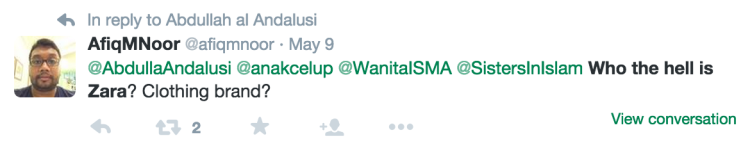
    Screen Shot 2015-05-13 at 09.43.56 copyScreen Shot 2015-05-14 at 22.43.45That’s strange, because they definitely seemed to know who I was in the lead up to the debate referring to me (three days before the above tweets) as ‘a foreign speaker from Muslim Debate Initiative, Ms Zara Huda’ and even whining in the same email to be included in a conference I had been invited to speak at:

    We also learned that Ms Zara Huda will be speaking at IMEC2015 International Muslimah Empowerment Conference on 9th May. It would have been good if a speaker from SIS was also included in such a dynamic Conference

    – Ratna Osman (email dated 6 May 2015)

    Indeed, “professionalism” does go a long way – for example, not dismissing candidates from discussion because they are “foreign”, keeping one’s word and promises, or even refraining from pettiness and childishness from one of the intended SIS panellists no less, Assistant Manager for Legal Advocacy and Public Education, Mohammad Afiq Noor, who ably demonstrates his ‘professionalism’ by piling on derogatory, and sexist remarks about this “foreign” speaker, referring to me as a “Clothing brand”, and a “fool” for whom the best response is silence (which they still failed to do! [unless they were perhaps advising me not to respond to them?]).

    Screen Shot 2015-05-13 at 09.43.56 copy 2

    If this is the “professionalism” and calibre of intellect one can expect from SIS, it is no surprise that they are reluctant to have their arguments challenged in a live event, away from the safety of their computer screens. One can only wonder if they were reluctant to debate someone who usually debates, in the West, the non-Muslim Secular Liberal and Feminist role models of SIS, and who SIS look up to and are just a pale imitation of. Or perhaps they were reluctant to debate someone who comes from the West and would disabuse the Malaysians of the false conception of the West being the “utopia” that SIS would portray it as.

    If SIS truly possessed the courage of their convictions, why are they so timid? Are they afraid that their own followers would hear of a new explanation which transcends their secular liberal dogmas (that they have blindly borrowed from the West), and encourage them to truly think outside of the box?

    A curious fact about SIS’ foreign founder

    IMG_5766 (1)

    The day after the debate was supposed to take place was the International Muslimah Empowerment Conference (IMEC) 2015, where I presented my lecture entitled, “Feminism: Heroin(e) of the Masses” (now available to view here). Within this lecture, I discussed feminism and secular liberalism and propounded rational critiques of these philosophies, including whether or not they had truly produced success and happiness in the West. I exposed the so-called “Islamic Feminism” espoused by secular groups plaguing the Muslim world (usually set up with foreign Western support), for what it really is: the ‘reconciling’ of liberal values with Islam, by substituting it in place of the Qur’an’s values, under the guise of “interpretation”.

    Secular Feminist reformists in the Muslim world have realised that their feminist claims cannot be satisfied through the reinterpretation of texts alone – rather, they now go so far as to claim that the problem is with the sources themselves – i.e. the Qur’an itself, and the Prophet himself . And to this end, SIS are a case in point.

    I mentioned during my speech, the American Amina Wadud, one of the original founders of the feminist organisation, SIS, claims that forexplicit verses of the Qur’an that feminists are unable to ‘reinterpret’ (i.e. twist), the possibility of rejecting these verses should be considered.

    Wadud states that she has “come to places where how the [Quranic] text says what it says is just plain inadequate or unacceptable, however much interpretation is enacted upon it”[1]. She continues to propose that because particular articulations in the Qur’an as a textare problematic, there exists the “possibility of refuting the text, to talk back, to even say “no”” [2] to the Qur’an! Wadud is proposing that rejecting the text of the Qur’an itself is a possible solution when the text of the Qur’an does not live up to feminist ideals. I mentioned in my speech that this founder of “Sisters in Islam” seems by her claim to want to be out of Islam. 

    Just in case anyone was in any doubt, Wadud further explains what she meant. She was not questioning whether the verse was from Allah (swt), but rather asserting some self-appointed right to disobey the verse – she would hear but disobey:

    As for “no” to the Qur’an, let me summarize the work I have been doing to overcome some of the apologia of Qur’an and Woman. Yes the Qur’an, I believe and love is considered a form of Allah’s self disclosure, but I do not believe God is locked into the 7th century Arabian context. […] When I say “no” it is not the integrity of the literal text, it is to the implementation of some practices which is a 14 centuries long debate.” [3]

    And just in case we’re still misreading Wadud, let us see what her fellow “feminist interpreters” make of Wadud’s words. Omaima Abou-Bakr (whose work is also featured on SIS’ website), Wadud’s own fellow contributor to the recent publication by the Musawah Knowledge Building Initiative, “Men in Charge”, more recently cites and explains:

    Wadud’s recent work, represents a fourth interpretive philosophy […] to transcend ‘textual’ interpretation altogether […]. This development is clearly articulated by Amina Wadud in her second book, Inside the Gender Jihad (2006), which records the change in her interpretive orientation. […] The inspiration of the Qur’anic worldview remains, but because particular articulations in the Qur’an as a text are problematic, there exists the ‘possibility of refuting the text, to talk back, to even say “no”‘ (Wadud, 2006, p.191). Wadud here tries to find a solution to the persisting problematic faced by Islamic feminist interpreters in dealing with difficult, explicit texts.” [4]

    Omaima Abou-Bakr continues, explaining Wadud’s approach to the Quran:

    Whereas previously such researchers have tried to resolve this difficulty by drawing attention to the general ‘principles’ of the Qur’an as a frame of reference, in light of which specific texts and injunctions should be understood and interpreted, Wadud takes the issue to another level. The ‘letter’ of the divine text remains a problem, and it is time to stop grappling with it […]. This new perspective would be a means to avoid literal application or implementation of a text when it opposes our current, more progressive human development and understandings […] in this sense the Qur’an is a text ‘in process’.” [5]

    Considering that this is the position of SIS’ foreign founder, who SIS describe as being one of seven founders who ‘formed the core of what was to become Sisters in Islam’, it is hard to imagine why they would not be reluctant for someone to point this out in public, and make them answer to scrutiny over just how faithful to Islam and its texts they truly are. Of course, any pretence of basing their ideas on Islam, is merely a smokescreen to facilitate the acceptance by Malaysians of what are, in essence, foreign and un-Islamic ideas that have no basis in the Quran, or rationality.

    So, why are Malaysia’s secular liberal groups so afraid of debate? Malaysia’s secular liberals are all for “debate” it seems – as long as their side are the only ones speaking.


    Notes:

    [1] Amina Wadud, Inside the Gender Jihad, 2006, p.192

    [2] Ibid., p.191

    [3] Amina Wadud’s Response to Tarek Fatah, 23/2/2005 

    [4] Omaima Abou-Bakr, The Interpretive Legacy of Qiwamah as an Exegetical Construct, Men in Charge, Ed. Ziba Mir Hosseini, 2015, p.60-61

    [5] Ibid.

    Source: http://zarafaris.com