The response to my previous article on Amos Yee, was not altogether unexpected. Many would agree, but there will be those who are so virulently anti-PAP, that any article that calls into question the actions of persons who are in some political or anti-establishment matter, will be met with derision.
Some people are making Amos Yee into a political figure. Have they taken leave of their senses? He’s 16 for crying out loud. Which 16 year old should be a political figure?
Anyone who ‘langgars’ (Malay for crashes into) the Govt, is a hero and must be supported at all costs. If you disagree, don’t support or worse condemn and question the actions of this person, you too must be condemned. But these people miss 1 key point, if you say the PAP is so bad that it disallows dissent and freedom of expression (and this is not altogether untrue), then by opposing anyone who disagrees with your point of view, you’re actually no better than the PAP. 1 must support all opposition parties or every single action by those who rail against the PAP. You cannot be different, you cannot support some policies or even like some PAP men, you must oppose all.
Whatever happened to freedom to disagree? Why must I support Roy Ngerng, just because I also am not a PAP fan? Why can I not question Amos Yee’s actions since his arrest or offer a caution as in the article? Why must I only subscribe to your point of view – all out support? Some think by attacking the PAP at every turn, in the same vein as sites like FAP and others attack the Worker’s Party (WP), SDP and certain prominent opposition figures and political activists, they are combatting the PAP and cementing the ground in favour of the opposition.
Some hardcore opposition supporters don’t realise the damage that people like Roy Ngerng and Leong Sze Hian are doing in regards to swing voters, whose votes are crucial.
I beg to disagree, I think there’s a considerable middle ground, those who hardly comment on politics online, don’t follow either pro or anti-establishment or alternative sites or don’t really give a toss. Sure many of those in this segment of society, have also felt the effects of bad PAP policies in particular those concerning public housing, immigration, health care and transport costs, but their only action or input in politics will be that singular action – casting a vote. And there’s no guarantee whether they will vote opposition.
Observing the conduct of some people who are very vocal, both online and in real life (attending protests, forums or speaking out), I am very worried that they are not doing the opposition cause as a whole any good. By being so extreme in their views, and the easy way they simply condemn and dismiss everyone who disagrees, they are putting off many swing or neutral voters. Worse they could be scaring them into not taking the plunge at the ballot box.
I am not concerned by attacks or condemnation of what I write – I am not campaigning for anything and it won’t bother me if my blog is well read or not. In fact I’m quite amused by some of them. Take some the latest – that old chestnut – this blog is helmed by a PAP IB (Internet Brigade) or PAP supporter. (Which PAP IB/supporter calls for Lee Hsien Loong to resign? Calls the actions of PAP supporters reprehensible, condemns LKY for stifling dissent). My post is too long winded (I agree). Roy and Alex Tan are heroes for speaking out (but do their content have substance, or is it generated to increasing viewership of their websites?). All these doesn’t bother me, it makes a good laugh between me and my friends. What concerns me is that these people think Amos has done nothing wrong and must have full unequivocal support.
The Fault Lies with the Law.
They slam the Govt for prosecuting Amos. In actuality, 1 must first question the Police and then the AGC for acting so swiftly. No Govt Minister or MP called the Commissioner of Police or the DAG and specifically directed them to proceed all out to ‘whack’ Amos. This is always the misconception – if there is any evidence of this, it must be raised. Has any former police officer or DPP ever come forward to say, they were pressurised to act in a certain way by a politician? There cannot be political interference in the legal process. I have met many police officers and legal officers, they do not ‘receive a phone call’ and then given instructions. They do what they do, based on police reports filed (for the police) and the case filed submitted (for DPPs).
Of course it’s open to speculation that these officers know which side ‘to butter their bread.’ But the real culprit is how the Law is fashioned. These officers are duty bound to follow the Law as it stands. I have met the case officers who handled some of the cases involving the SDP leadership and even knew personally 1 of the officers who had to detain Dr Chee Soon Juan. He like many of those mentioned are actually opposition supporters. They vote opposition, but when it comes to their duty, they are obliged to follow the Law.
Ok let’s just agree with this TRS snapshot and blame the PAP, the question next is: Do you think the charges will be dropped just like that?
Now this you can blame the PAP, for introducing/enacting such Laws. But the point is, having voted them in and given them a free hand to pass draconian laws, whose fault is it? You disagree with the Law, you should do 2 things, canvass widespread support and write in to the PAP or your respective MP saying why you disagree with the Law and want it changed. Not some anonymous online petition, actually writing in under your hand and name. The other is obvious – vote for someone else. But until either happens – you cannot simply disregard the Law as it stands merely because you disagree with it or think it’s unjust.
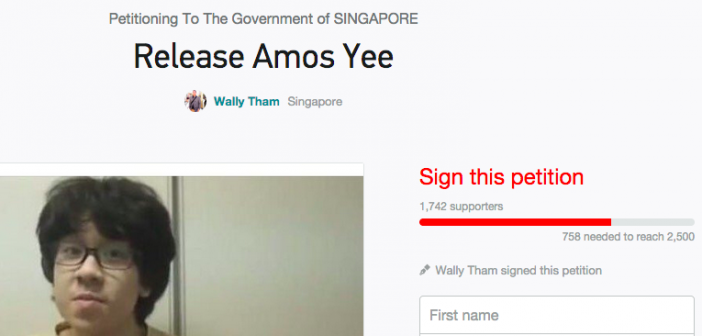
Some people think online petitions like this have an effect. The answer is no, it’s just a gimmick that serves no real purpose. I read in Australia, MPs get sometimes 2,000 letters a week from their constituents telling them not to support something or change a law. This frightens politicians, voters in their constituencies writing in telling them won’t vote for them if they continue down a certain path.
Ask yourself this, you say Amos is unfairly targeted, but will you go and do the same? Will go and produce a video in the same fashion? Will you and demonstrate outside the Court? You won’t right? Why? Because you know you will be on the wrong side of the Law.
Amos Yee is not Blameless Either.
I read somewhere someone disagreeing with my take that Amos would not be prosecuted if this was in a ‘real Western democracy,’ saying my reference to ‘hate speech’ was wrong. Amos obviously did not produce hate speech, it’s merely ‘offensive.’ But my referencing that is to show, that there is no such thing as total freedom of speech even in the West. And given Amos’ conduct, even if he was in the West, it’ll be only a matter of time before he ups the ante and descends into that as well. Or if he’s smart enough to avoid that, the offensive nature of his content will eventually lead him down to a path of no return. He would go on insulting Christianity more and more, before next attacking Islam.
Eventually he would piss the wrong people off and be subjected to violence, much worse than a mere slap.
The Whole Point of that Article.
I can summarise that article under 3 key points:
1) He’s being badly advised or no one is advising him correctly
2) He’s not grasping the severity of his case.
3) He’s in real danger of going to the Reformative Training Centre (RTC).
You can dismiss me or my whole article, but you cannot make the case go away like that. You can blame the Police and Prosecution for acting so hastily. You can accuse them of double standards and mention other cases like Jason Neo’s, the RC member who threatened him with violence, the NTUC woman mocking a Malay wedding etc. And you have valid points there. But no matter how unfair it is, the lack of freedom of speech and the heavy handed manner, it will not make the charges disappear. At the end of the day the charges must be faced and combatted, if not, a clear and present danger exists.
Amos Remains Defiant and Stubborn.
Amos continues to remain defiant. In a bail hearing (Wednesday) before his trial commenced yesterday, there was a major climb down by the prosecution. Here’s some excerpts from a Today article:
‘Prosecutors offered to lower his bail amount by one-third to S$10,000 and not require him to report daily to Bedok Police Divisional Headquarters, provided the 16-year-old continues to go for psychiatric counselling. The ban on making postings on social media before his trial concludes, however, must still stand, while those that he had posted in breach of bail conditions have to be taken down.
Amos, however, refused to budge on all three fronts.
Decked in purple prison garb, Amos, who appeared in good spirits, frowned and shook his head when Deputy Public Prosecutor Hay Hung Chun called him a troubled person needing psychiatric help.
When Mr Hay mentioned Amos’ blogged about his bail conditions in “not-too-polite terms”, Amos grinned.
High Court judge Tay Yong Kwang questioned why it was so difficult to temporarily refrain from public online posts, and said the teenager would just have to learn to curb himself. With Amos’ refusal to go for psychiatric counselling, Justice Tay said he saw no reason to vary the bail conditions.’
Sources close to his legal team have revealed that they have encouraged him to go psychiatric help/assessment and accept the lower terms. But he continues to be stubborn and maintain his own warp sense of right and wrong.
Take his argument for not taking down the posts – it’ll still be available online! Simply put if I found an article that’s defamatory or inflammatory and posted it on my blog, I should ignore calls to remove it because it’s still available online. This cannot be correct. If the posts and video remains online, it will not be his fault anymore, so long as he himself doesn’t upload or post it.
Lawyer Alfred Dodwell is doing his best and the latest argument on the legality of the obscenity charge is a valid one. But at the end of the day, he can only act on the instructions of his client, even if it’s a 16 year old kid. I’ve been told he’s been giving the correct advise to Amos who refuses to listen to the 1 person he should.
And he’s taking it like some kind of game, grinning and smiling in court, when serious matters are being raised against him. Does he honestly believe that the Court will not take his demeanour and defiant attitude into account when determining what sentence to impose if it finds him guilty?
Even the issue of going for psychiatric assessment is not a bad idea. If he’s found to be suffering from some kind of illness like an attention disorder or as I was informed, Asperger’s (his mother thinks so), it’ll help a lot in any sentencing. A court might be inclined to refer him for continual psychiatric help and as such agree to probation.
Adults Behaving Badly.
On Day 1 of his trial, it was revealed he decided to post the video even though he knew it will cause offence to Christians. And it was revealed he had consultations with some SDP members, who also directed him to watch Roy Ngerng’s videos and speeches. Roy also contacted Amos and wrote a really stupid article called ‘My friend Amos Yee.’
Take a step back, read some of the rubbish Roy has posted. Do you think he’s been doing right by Amos? Shouldn’t he of all people advise Amos of the dangerous path he’s taking and not end up like him? Shouldn’t he of all people be vehemently encouraging Amos to comply and live to fight another day?
I find these actions very troubling and reprehensive. What were these people thinking? Here’s a naïve 16 year old kid with no knowledge of politics and you encourage him? And Looney Fringe Roy instead of being a responsible adult and telling Amos, ‘No, this is my battle, I don’t need you to support me, please consider your future, you’re are in serious trouble. I too was arrested and charged in court, it’s a very serious matter, you should just cooperate, try and mitigate and hope to get off with a warning or probation.’
What does Roy do? He writes in support of Amos, praising him for his honesty! He doesn’t chide or advise Amos to be respectful to his parents. (I read somewhere he called his mother a ‘bitch once’ and openly defied his father, provoking him into assaulting him). This is the same Roy that some people think is a hero! A hero who associates with kids and openly encourages them to continue down a dangerous path instead of warning them of the seriousness of the matter and consequences.
What Advise/Action would People Egging him on do if it was their kid?
As mentioned earlier, the extreme elements are all praising Amos, encouraging him and egging him on, just because he’s in a battle with the PAP. What effect do you think this will have on him, together with the actions of Roy and others? Instead of realising he’s made a mistake, he will think he’s doing the right thing and should stick to his guns, which so far he has.
But let’s for argument’s sake, agree with them – Amos is doing the right thing and should be praised, encouraged and egged on. The question to ask is whether they would do the same if it was their kid? Will they now tell or teach their sons and daughters to do what Amos has done? I think the answer is obvious.
And how would they react if their own kid behaved like Amos? Refusing to listen (his mother told him not to upload the video, he wanted to wear pyjamas in court and purposely provoked his father until he snapped). The prosecution has made an offer to reduce bail and even his lawyers recommend going for psychiatric treatment. What will all these people do if their kids did the same, being openly stubborn, defiant and insisting on getting their own way?
This is the image of Amos Yee people should take into account – just a kid. Not someone with worldly experience to battle the system.
You want Amos to be your hero, but not your own kids. As I wrote in the earlier article, Amos is becoming a rebel for someone else’s cause. But just imagine if everyone he met, every adult including Roy, all tell him, ‘Never mind boy, you’ve already raised the issue of freedom of speech. You should be careful about insulting religion and there’s no point at this stage getting involved in politics. This is very serious, you can go to RTC, you better back down and just go through the motions the system requires. When you’re older, you can come back and be more involved in politics.’
If everyone he interacts with tell him the danger and wrongdoings he committed (insulting religion, being disrespectful to his parents and even quitting school), you think he won’t be sceptical? He won’t hesitate and take stock?
All those who egg him on should be ashamed of themselves. They are not discharging their duties as a responsible adult.
RTC is very much on the cards, if not now then later.
I came across a comment saying I’m over-reacting, this is usually a fine case. Yes that’s possible, but only if you’re an adult. The guiding principle as far as the Courts are concerned with youthful offenders is rehabilitation. Of course the Court can if he’s found guilty, impose just a fine on all 3 charges.
However the question 1 must ask, what is the prosecution going to ask for? You think after he thumbed his nose at every request they demanded he comply, they will be willing to recommend just a fine? After being told not to upload/take down or post further, he blatantly ignores. What if they agree to a fine and he goes and does this again? A fine looks very unlikely, most probably the judge will call for either a probation or RTC report.
Ordinarily for a 1st time offender not involved in violent crime, probation is the norm. But before the officer recommends probation, there has to be certain things to suggest it’ll work. These includes:
a) Supervision at home
b) An ability to follow parent’s advice and instructions
c) Avoid mixing with person’s of doubtful character.
d) Interacts with similar minded disciplined kids his age, and not adults with no relation to him.
e) Is either studying or finds a proper job.
f) Will comply with terms of probation
g) Will not be a spoilt brat who must always have his way.
In the above (a), (b), (e) and (f) are the key factors. Has there been any indication up to now that Amos is prepared or capable of abiding by any of these? There has been none, and in that case, the RTC report will show:
1) Will be under supervision 24/7
2) Will have to undergo psychiatric treatment, if so directed
3) Will be subject to discipline 24/7
4) Can attend classes within RTC including doing his A levels.
So Amos likes bananas. He thinks it’s funny to be photographed eating one outside court. A judge might assist him in his crave for bananas. I’m told bananas are often served in the RTC.
Which of the 2 looks more likely based on all that has transpired? Even if he gets probation, but then goes and breaks the terms, he will go to RTC.
Amos hasn’t done something that in normal circumstances will result in reformative training, but the conduct he has shown, the contempt, the disregard to instructions laid out by the Court and his refusal to listen to his parents, even his lawyers who are trying their best. All these are factors the judge may very well take into consideration and decide the only recourse is to send him to the RTC.
Conclusion.
So to everyone who thinks he’s a hero, and deserves to be encouraged – you are doing more damage than good. He’s too young, naïve and immature to be your hero. He needs to be guided and given advice. You can condemn me, condemn my article – by all means, but are you doing the right thing for him? You will be terrified if your own 16 year old kid or brother did something like this. You’d never accept the kind of defiance, rudeness and total disregard for your authority. Why should it be any different with Amos Yee?
Source:http://anyhowhantam.blogspot.sg