Tag: Singaporean

  • Dzar Ismail: Syukur Dilahir Seorang Muslim Di Singapura

    Dzar Ismail: Syukur Dilahir Seorang Muslim Di Singapura

    Kalau di China, orang Islam dilarang berpuasa, sampai ada yg sembunyi sembunyi bershaum. Disini, kita bebas berpuasa, itu pun ada orang tak puasa.

    Kalau di Perancis, keselamatan seseorang yg berhijab itu sering terancam. Siap ada undang-undang lagi melarang orang berhijab. Tidak disini. Sapa nak berhijab silakan, siapa tak nak, takder paksaan. Sendiri jawab.

    Kalau di England, sembahyang kat stadium, orang amek gambar, upload internet, label ‘disgrace’. Tidak disini, ada yg siap berjemaah satu sudut di stadium, sebelum game bermula. Sholat Hari Raya dalam stadium lagi ada.

    Kalau di Jerman, peh susah nak cari makanan halal. Ada bila melancong, siap tarpao biskut dengan Meggi, was was punya pasal. Tidak disini. Senang nak cari makanan halal. Bacon pun halal. Turkey baconlah.

    Kalau di Korea Selatan, peh susah nak cari masjid, Korea Utara jgn cakap lah. Disini, hampir satu masjid di setiap estet perumahan. Sampai belia masjid boleh buat acara touring naik basikal dari masjid ke masjid.

    Aku tinggal di Singapura. Pemerintah sekular, bukan pemerintah Islam. Tapi kadang kadang sifat mereka lebih Islam dari yg sekian ada di merata dunia.

    Penjualan arak diharamkan dibeberapa tempat dan waktu tertentu. Untuk menjaga keamanan dan keselamatan.

    Aktiviti menghisap rokok diharamkan dikebanyakkan tempat. Sampai bawah blok, corridor rumah pun tak boleh.

    Aktiviti hubungan sejenis diharamkan menurut undang-undang.

    Kita bebas berdakwah, nak buat ceramah, forum perdana, kelas agama, maulid, ibadah korban, silakan, asalkan dgn yg bertauliah dan mengikut garis panduan yg disarankan.

    Aku bersyukur dilahirkan seorang Muslim di Singapura. Bebas. Tiada halangan ketara. Hujan emas di negeri orang, hutan batu di negeri sendiri, lebih baik di negeri sini.


    Source: Dzar Ismail

  • Cherian George: Lee Kuan Yew Was Bulwark For Singapore Minorities

    Cherian George: Lee Kuan Yew Was Bulwark For Singapore Minorities

    Unlike-Lee admirers around the world may be missing significant details.

    In an amusing case of mistaken identity, a banner honouring Lee Kuan Yew has appeared in India, bearing a photo of another Singaporean elder statesman, President Tony Tan. Both are white-haired ethnic Chinese males, but Tan, as you have may noted from Channel NewsAsia’s coverage of Lee’s funeral today, is rather more alive.

    The picture has been making the rounds on social media in Singapore, bringing smiles to an otherwise sombre day. It serves as a useful reality check for Singaporeans, that although Lee has been lauded by world leaders as a 20th century giant, not everyone can recognise him from Tom, Dick or Tony.

    Some other cases of mistaken identity are less trivial. It’s nothing new. For at least a couple of decades, he has been all things to all men who aspire to a certain kind of leadership. They see in him a model, a kind of proof-of-concept that they can point to when defending their own missions and methods. Leader X is Country A’s Lee Kuan Yew. How often have you heard that line.

    As a Singaporean born in the year of the republic’s independence, I’ve benefited from Lee’s global brand, most tangibly in the fact that my red passport travels extremely well. But the way that brand is sometimes used is cringeworthy.

    Most of the parallels that foreign politicians and their acolytes draw with Lee Kuan Yew are selective and self-serving. His name is evoked by anyone who wants to apply less-than-democratic means in the name of strong, decisive leadership in order to achieve high economic growth. But there was a lot more to the man and his formula for success.

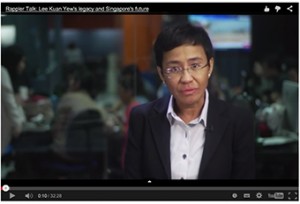
    My interview with Maria Ressa of Rappler.com.

    The most obvious was the zero tolerance of corruption that he embodied and instituted in the Singapore system. That is probably a chapter in his bestselling memoirs that admirers like former Thai prime minister Thaksin Shinawatra skipped. Similarly, fans of Indonesia’s late president Suharto who cite his friendship with Lee conveniently ignore the fact that Suharto topped the world league table of corrupt leaders, according to the same organisation that routinely names Singapore as the cleanest in Asia.

    Less noticed is the fact that Lee, while loudly dismissive of the liberal brand of democracy, never deviated from electoral authoritarianism – the belief that regular multi-party elections are ultimately the only way for a government to win legitimacy, and are not bad at keeping a dominant party on its toes. Of course, he did his best to insulate his government from distractions like short-term public opinion, an adversarial press and protest movements; he also treated the opposition unfairly, to put it mildly.

    But, to this day, elections in Singapore remain competitive enough and credible enough to make democracy “the only game in town”, as political scientists would put it. As a result, opponents of the regime plot election strategy, not extra-parliamentary struggle; and Singaporeans accept the government’s authority as legitimate, even if they disagree with its policies. The thousands of Chinese officials who pass through Singapore to learn the Lee model may think this lesson can’t apply to the People’s Republic, but shouldn’t overlook how important it has been to Singapore’s success.

    Back to India. When its government decided to fly the tricolour at half-mast today, I wonder which Lee they were honouring. I hope – but I doubt – that it was the leader who stood resolutely against sectarian politics and majority domination. Among all his core principles, this is the one least talked about abroad. Yet, to minorities like me – and, thankfully, most members of the majority race as well – this may be the single most precious aspect of the legacy.

    Not that he got everything right. Older Indian Singaporeans still bristle at the way he labelled us as “fractious and contentious”. The stereotype might not have been off the mark (note Amartya Sen’s Argumentative Indian thesis), but if only he had seen it as a positive contribution to Singapore’s national culture rather than a weakness. Similarly, his open suspicion of Muslim Singaporeans’ growing religiosity was hurtful. Some of such straight-talking about race and religion could come back to haunt Singapore, should future bigots exploit his words to justify their prejudices.

    But minorities never needed to doubt this: Lee was an unshakeable bulwark against majoritarian tendencies that could have easily overwhelmed Singapore. Malay/Muslims make up only 15% and Indians 7% of the population. For decades, the risk of a Chinese chauvinist party playing the race/language card posed the single biggest threat to PAP dominance. This fact is lost on most of the Western press, who self-aggrandisingly like to believe that they were Lee’s bête noire. They were more like sparring partners, compared with champions of the Chinese-speaking ground, who were the main victims of both detentions without trial as well as flagrant censorship.

    Lee went to the extent of amending the republic’s Constitution to stop any party from sweeping into power without minority support. For most Parliamentary seats, candidates are forced to contest as small teams that must include minorities. Thus, no Chinese party could do in Singapore what the BJP did in India last year – come to power without a single MP from the country’s largest minority group.

    Thankfully, Lee and his comrades were influenced by an older Indian tradition, the Nehruvian secular ideal that accommodated minorities – the same tradition that the BJP and the larger Hindutva movement is bent on dismantling.

    Singapore should not presume that it can serve as a model for any other country, least of all India. The world’s largest democracy is 200 times larger than the city state that Lee ran, and its challenges are profoundly more complex.

    But if foreigners do choose to honour Lee Kuan Yew, they shouldn’t fall into the mistaken-identity trap. Yes, he was a firm leader who stretched the limits of democratic government to breaking point in order to get things done.

    But a leader who makes minorities feel unwanted, insecure and fearful?

    That’s not a face that Singaporeans recognise.


    Source: www.airconditionednation.com

  • Top 10 Searches On Yahoo Singapore Were Related To Lee Kuan Yew

    Top 10 Searches On Yahoo Singapore Were Related To Lee Kuan Yew

    On the day Singapore bid farewell to Lee Kuan Yew, the former Prime Minister was obviously on the minds of everyone in the country. The top 10 searches on the Yahoo Singapore search engine were all connected in some way to him and his funeral.

    Here they are:

    Lee Kuan Yew Funeral

    The state funeral of the late Lee Kuan Yew took place on Sunday. Tens of thousands braved the heavy rain to line the route of the funeral procession.


    Lee Hsien Loong

    He delivered the first eulogy for his father and at times, he had trouble choking back his tears.


    Lee Wei Ling

    The only daughter of the late Lee Kuan Yew, the director of the National Neuroscience Institute was rarely seen during the Lying-in-State of her father.

    Lee Hsien Loong and family walking during funeral procession. 


    Lee Hsien Yang

    The younger son of the late Lee Kuan Yew and the chairman of the Civil Aviation Authority of Singapore, he delivered the final eulogy and spoke on behalf of the Lee family.

    Lee Hsien Yang, son of former leader Lee Kuan Yew, delivers his eulogy during the funeral service at the University Cultural Centre at the National University of Singapore March 29, 2015. Grieving Singaporeans were joined by world leaders on Sunday to pay their final respects to the country's first prime minister, Lee Kuan Yew, as the nation came to a near-halt to honour its "founding father". REUTERS/Edgar SuLee Hsien Yang, son of former leader Lee Kuan Yew, delivers his eulogy during the funeral service at the University …


    Remembering Lee Kuan Yew

    A website and Facebook page called“Remembering Lee Kuan Yew” was set up to provide important information to mourners. Details such as queue updates to the Lying-in-State and funeral procession can be found on the site. It was also a trending term on Twitter after Lee’s death.

    Screengrab of the Remembering Lee Kuan Yew website.


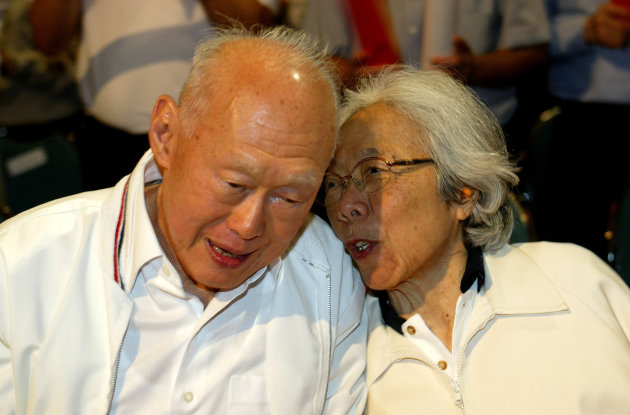
    Kwa Geok Choo

    She is the deceased wife of the late Lee Kuan Yew, who passed away before him in 2010. After her death, Lee was never quite the same.

    FILE - In this May 1, 2006, file photo, Singapore's then Minister Mentor Lee Kuan Yew, left, shares a light moment with his wife, Kwa Geok Choo, right, during the Labour Day Rally in Singapore. Lee Kuan Yew, the founder of modern Singapore who helped transform the sleepy port into one of the world's richest nations, died Monday, March 23, 2015, the government said. He was 91. (AP Photo/Wong Maye-E, File)


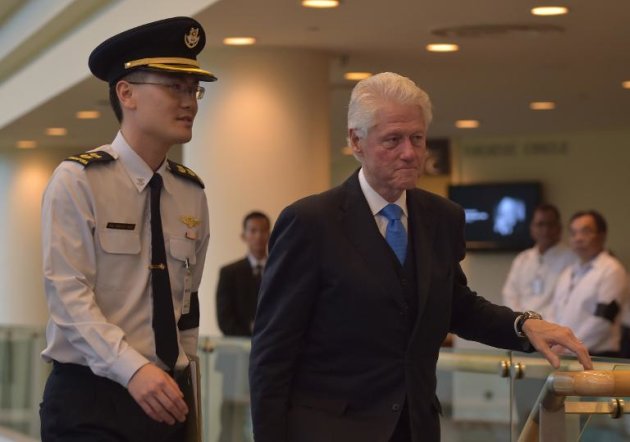
    Bill Clinton

    The former US president lead a high-powered delegation from the US who included Henry Kissinger, the former US Secretary of State.

    Former US president Bill Clinton arrives at the University Cultural Center (UCC) for the funeral services for Singapore's former prime minister Lee Kuan Yew in Singapore on March 29, 2015


    Goh Chok Tong

    Goh Chok Tong is the emeritus senior minister of Singapore. He succeeded Lee as the second prime minister of Singapore from 1990 to 2004. In his eulogy, Goh said, “For me, he would always be my teacher.”

    Emeritus Senior Minister Goh Chok Tong and wife paying their respects to Mr Lee Kuan Yew at the Family Wake on 23 Mar 2015 at the Sri Temasek, Istana. (Photo courtesy of Ministry of Communications and Information, Singapore) 


    Lee Kuan Yew Biography

    The late Lee Kuan Yew has written a two-volume set of memoirs, among many other books and essays.


    King of Bhutan

    The King of Bhutan, Jigme Khesar Namgyel Wangchuck, came to Singapore to pay his respects to the late Lee Kuan Yew and attend his state funeral.

    The King of Bhutan pays his respects to the late Lee Kuan Yew. 
    Source: https://sg.news.yahoo.com


  • Black Nights Could Not Peform Missing Man Formation During State Funeral

    Black Nights Could Not Peform Missing Man Formation During State Funeral

    The “Missing Man” formation by the Republic of Singapore Air Force’s Black Knights, one of the most anticipated elements of the State Funeral procession for Mr Lee Kuan Yew, was not performed on Sunday.

    Four Black Knights F-16C aircraft were to fly the Missing Man formation to honour the late Mr Lee as the funeral cortege drove pass Esplanade Bridge.

    The Straits Times understands that the jets did an aerial flypast above cloud cover, but could not do the formation due to rainy weather and low visibility.

    The planes were likely not visible to the crowds who lined the bridge despite the downpour.

    A video of Black Knight aircraft doing a Missing Man formation had gone viral on Sunday, but it was recorded at the rehearsal on Saturday, and not at the State Funeral procession.

    The 28-second video, which was uploaded on Facebook, received almost 2,000 likes and was shared almost 4,000 times.

    Mr Lee embarked on his final journey at 12.30pm from Parliament House to the University Cultural Centre where the State Funeral service was held.


    Source: www.straitstimes.com
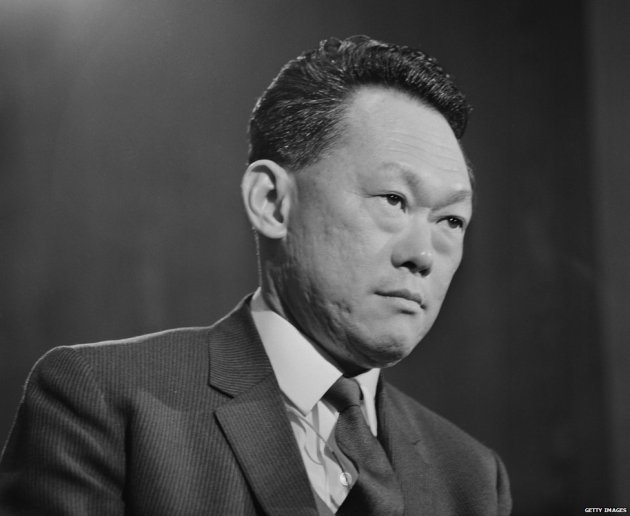
  • Dr Lee Wei Ling’s Eulogy To Lee Kuan Yew At The Mandai Crematorium

    Dr Lee Wei Ling’s Eulogy To Lee Kuan Yew At The Mandai Crematorium

    The late Mr Lee Kuan Yew had developed Parkinson’s disease three years ago which severely limited his mobility, said his only daughter Lee Wei Ling at the family’s private cremation service on Sunday evening.

    “He had great difficulty standing and walking. But he refused to use a wheelchair or even a walking stick. He would walk, aided by his SOs,” Dr Lee said at the Mandai Crematorium.

    He was also plagued by bouts of hiccups, and his ability to swallow both solids and liquids was impaired.

    Mr Lee, who died at the age of 91 on March 23, “searched the Internet and tried a wide variety of unorthodox hiccup therapies”.

    “For example, he once used rabbit skin and then chicken feathers to induce sneezing, so as to stop the hiccups. Although the sneezing sometimes stopped his hiccups, it did not do so consistently enough,” she told a gathering of family and people who had worked closely with Mr Lee.

    She said Mr Lee also tried reducing his food intake because he felt that eating too much could precipitate hiccups, “hence he lost a lot of weight, and appeared thin and gaunt”.

    She said her father was stubborn and determined. He would insist on walking down the steps at home, from the verandah to the porch where the car was parked.

    Mr Lee’s daughter-in-law Ho Ching had a lift installed so he need not negotiate those steps. But when he was aware and alert, he refused the lift though it was a struggle for him to walk down those steps even with three security officers (SOs) helping.

    “But the lift was not installed in vain,” she said. “On several occasions when he was ill and needed to be admitted to SGH, he did not protest when the SO guided him onto the lift. Still, even when ill, if he was asked if he wanted to use the lift, the answer would invariably be ‘no’.”

    Dr Lee devoted a part of her eulogy to thanking the SOs whom she said were an integral part of Mr Lee’s life, even more so in the last five years.

    “They looked after him with tender loving care, way beyond the call of duty. One doctor friend who came to help dress a wound Papa sustained when he fell, noticed this and said to me: ‘The SOs look after your father as though he is their own father.’”

    She said her father was also very considerate towards his SOs. During an official trip to Saudi Arabia, an SO came down with chicken pox. Rather than leave him behind in a hospital there as doctors suggested, he insisted the SO return to Singapore with the rest of the delegation.

    “He wasn’t going to leave any Singaporean behind, not least an SO.”

    Sensing he was special, all the SOs have been very kind to Mr Lee she said, adding: “On behalf of my family, I would like to thank all of them. I know each of them well, even the number of children they have. To me, they were not only staff whose job was to look after Papa, but also friends of the family. They helped me pull out the SIM card from my blackberry when it hung; they were friends for me to share food and goodies with whenever the opportunity arose.”

    She said that soon after her father died, one of the SOs, Yak, called to inform her of it.

    “After being in my room alone and unable to go back to sleep, I went downstairs to the SOs room, and sat with the two SOs on duty, watching black and white footage of Papa in his younger days. I needed the company of friends. Junji jichaou dan ru shui. There is a Chinese saying that the relationship between two honourable gentlemen is as understated as plain water. That was the relationship between the SOs and me,” she said.

    She also revealed that once, Mr Lee choked on a piece of meat. The quick-thinking SOs – Liang Chye, ASP Yak and Kelvin – managed to save him through the Heimlich manoeuvre.

    “They coordinated their pull, and after several attempts, the piece of meat was finally ejected. By this time, Papa had already turned purple. But within seconds of the meat being dislodged, he was mentally alert.”

    She gave special thanks to Liang Chye and Kelvin, and especially ASP Yak, whose presence of mind saved Mr Lee’s life, she said.

    “To all the SOs who have served Papa over the years, I thank you on behalf of my family,” she said.

    She also thanked all the nurses, doctors and specialists who had looked after Mr Lee over the years, especially those involved in the last five years of his life, when his medical problems multiplied and became more complicated.

    “I am grateful to each and every one of them for all the care they have provided to Papa,” she said. “Thank you all – doctors, nurses and physiotherapists – who have helped Papa be as comfortable as possible in his final days. My family is extremely grateful to all of you.”

    Dr Lee also thanked the staff of the Prime Minister’s Office who kept the office running smoothly in Mr Lee’s absence. “Thank you all for being with Papa and for helping to ease his suffering in the last five years of his life. Thank you for being here with us today, to bid farewell to Papa.”

    She spoke about the influence her father had on her, and how they were similar temperamentally, for example their determination to exercise.

    Mr Lee would complete his 12 minutes on the treadmill, even on days that he was tired, she said. “The SOs were amused because they knew I was equally fanatical about exercise. Today, I have run up and down my 20 metre corridor 800 times, making it to 16 km.”

    She also said: “Papa, I know you would have preferred if I had married and had children. But I have no regrets, no regrets I was able to look after you and Mama in your old age.”

    The most important lesson she learnt from her father, she said, was “never to push around anyone simply because he or she is weaker than me or in a socially inferior position”. Also, “never to let anyone bully someone else if I am in a position to stop such bullying.”

    She added on a poignant note: “This morning I noticed that the maid, in setting the dining table, had moved away Papa’s chair and placed it against the wall. It was a poignant reminder that this farewell is for ever. I have been controlling my feelings for this past week, but looking at this unexpected scene, I nearly broke down. But I can’t break down, I am a Hakka woman.

    “Farewell Papa. I will miss you. Rest in peace.”


    Source: www.straitstimes.com