Tag: Studio Jalan Ampas

  • Reliving The Golden Age Of Malay films

    Reliving The Golden Age Of Malay films

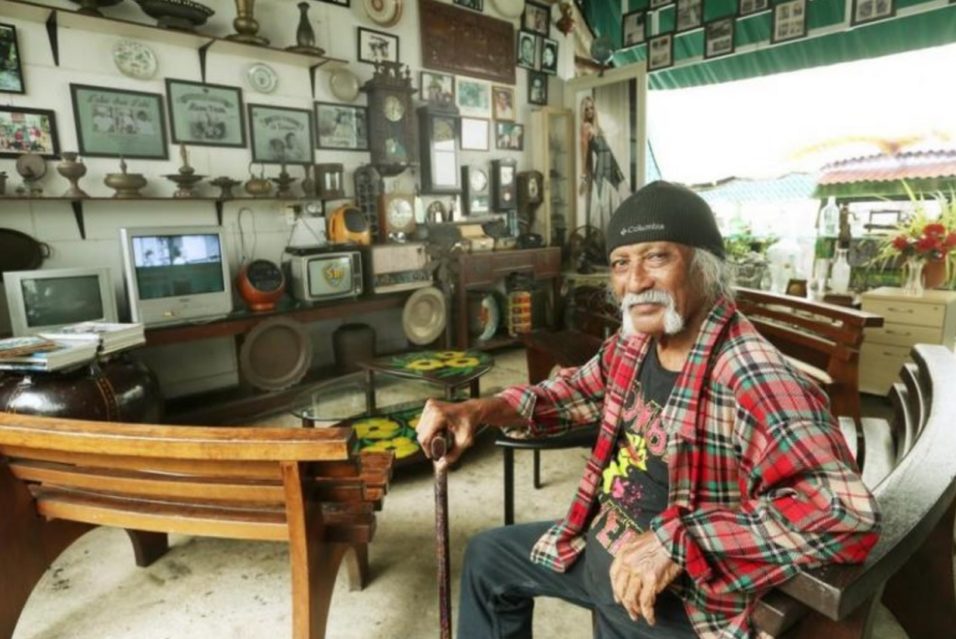
    As a teenager, Mr Jumahat Abu Bakar would peer through the gates of the Malay film studios in Jalan Ampas, hoping to catch a glimpse of actors such as the famed P. Ramlee.

    In 2012, when he was offered a caretaker job at the studios, located off Balestier Road, he leapt at the chance, even at the age of 70.

    The first thing he did was spruce up the studios, which stopped operating in 1967. He put up photos of old artists and painted the walls with a nostalgic motif featuring bamboo shoots and sugar cane.

    On Sunday (Aug 13), Mr Jumahat, now 75, showed off his work as over 160 visitors went there to relive the golden era of the Singapore Malay film industry, from the 1950s to 1960s.

    The visit was part of the Jejak Warisan tour, an initiative by Woodlands grassroots volunteers to run heritage trips for the Malay community to promote the cultural legacy.

    Sunday’s tour, the third since the effort began in February, saw the largest number of participants. It was conducted by local lyricist and film researcher Yusnor Ef, 80, once a student of P. Ramlee, who was also a musician and film-maker.

    He said: “This place holds a lot of pride for the Malays. Great artists were nurtured here. They worked from the heart. I hope it can be kept as a reminder of our heritage.”

    Parliamentary Secretary for Health and Home Affairs Amrin Amin, who was at the event, said Malay films that showcase tradition and heritage remain relevant even in a modern world dominated by Hollywood blockbusters.

    He added that “Hollywood can’t touch the heart like they can” with “their simple everyday language”.

    He said he was certain such films could be made again. “We just need to have the cultural confidence.”

    Veteran actors Zaiton Abdullah, K. Fatimah and Zaini Sattar were there to answer questions during the tour.

    Mr Jumahat said it made him very happy to see the usually empty studios filled with people. He said: “This place holds so much meaning for me, and I hope more Singaporeans will know about it and visit it.”


    Source: http://www.tnp.sg/

  • Throwback: No.8 Jalan Ampas

    http://1.bp.blogspot.com/_Ga7D7K5SM7Y/SYxryd7JyoI/AAAAAAAABAI/FweGRxNXqwI/s1600/Batu+Peringatan+di+8+Jalan+Ampas.JPG

    http://4.bp.blogspot.com/_Ga7D7K5SM7Y/SYxrx1e-DTI/AAAAAAAAA_4/Z6LOONsLf78/s1600/Bangunan+pengurusan+studio+Jalan+Ampas.JPG

    The founder of the group called Singapore Malay Film Society (in Facebook and Friendster but now with an impressive website (www.smfs.sg) left a comment in one of the earlier posts which was about us not considering film as part of our cultural heritage. In response, I would like to post this little trip down memory lane.

    I went to Singapore a couple of years ago to help get some pics for my father’s autobiography. These were photos of the famous Malay Film Production studios in Jalan Ampas. When I headed there, I’m not really sure what to expect or if the studio still existed. The last time I set foot in the studio was in the mid 60s during the shoot of my father’s movie Raja Bersiong.

    I took along my family as I planned it during the holidays. When we reached the destination, what I saw was a fence covering the famous entrance to the studio. The address? No 8 Jalan Ampas. Trust Run Run Shaw to find an auspicious address for his studio.

    I stepped out of the car and stared at the entrance. All locked up. This was the exact junction where once a coffee shop stood – the infamous coffee shop owned by one woman named Siput (no relation to the famous Siput Sarawak). It was here that many actors, including the late Tan Sri P. Ramlee had coffee and played dam or checkers for money.

    Now, the junction is empty and nondescript. But I saw what seemed to be a fairly new pillar erected right in front of the fenced gate. I approached it and found that it was actually a signboard built to commemorate the existence of the once famous studio. On it was a photo of my father directing a scene from the movie Raja Bersiong.

    I looked through the chained fence and saw the studio which I still remembered clearly. I saw a guard approaching me. He was a Malay guard. When he approached, I asked him politely if I could enter the premises to take the photograph. He refused at first as I had no official permission to do so, but when I mentioned that I was Jamil Sulong’s son, he gladly allowed me access to the old studio.

    As I entered, I felt strange. Vivid memories popped into my mind. I remembered the area where my parents played badminton with the studio staff. I remembered where the studio boss’s office was – he was Mr Kwek.

    I walked around and took photos of the mostly dilapidated studio. Sadness overcame me as I wondered why this historical place was not turned into a museum of sorts.

    One of the buildings still had the Shaw Brothers logo on it. And in another, film processing equipment still existed! One would have thought that after nearly 50 years, the equipment would have been destroyed or taken away, but no, it was still there. In one of the film processing machine, I can clearly see some celluloid still entwined in between reels. I wonder what movie the celluloid reels were from.

    I wanted to enter the rooms, but was afraid that I had overstayed my welcome. So, I quickly took all the shots I needed and thanked the jaga and left the studio feeling elated and yet despondent at the same time.

    As the son of Jamil Sulong, I was glad to have made this journey back to the studio, and as a filmmaker, I felt that I had paid tribute to the place where it (the Malay film industry) all began. My parents were part of this history. Now, so am I.

    Authored by Anwardi Jamil*

    *Anwardi Jamil is the son a of creative genius, Jamil Sulong.

    Source: http://sayaanakwayang.blogspot.sg/2009/02/malay-film-studios-jalan-ampas.html

    Anwardi Jamil

    EDITOR’S NOTE

    Thank you Anwardi Jamil for rehashing this beautiful gem of a place. We admire your dad’s works and his contribution to the film industry.

    Time for SuriaChannel to do a TV programme and explore the glorious places in Singapore like Jalan Ampas.

    letters to R1C banner