Saudi Arabia’s top cleric has declared that Iran’s leaders are not Muslims and regard Sunni Muslims as their enemy.
Grand Mufti Sheikh Abdul-Aziz ibn Abdullah Al ash-Sheikh was responding to Iran’s supreme leader, who denounced Saudi Arabia’s handling of the annual Hajj pilgrimage to Mecca.
The Grand Mufti said the claims of the Iranian Ayatollah were “not surprising” and accused Iran’s leaders of being Zoroastrians, an ancient pre-Islamic Iranian religion.
Saudi Arabia’s population is nearly 90 per cent Sunni and has long been at odds with the 95 per cent Shia Iran – two denominations that have been in conflict since the 7th century.
In remarks published on Wednesday, Sheikh Abdul-Aziz Al ash-Sheikh said: “We must understand these are not Muslims.
“They are the son of the Magi and their hostility towards Muslims is an old one, especially with the People of the Tradition [Sunnis].”
Iran’s Ayatollah Ali Khamenei accused the Saudis on Monday of “murdering” pilgrims caught up in the stampede during last year’s Hajj.
At least 2,426 people, including 464 Iranians, were killed in the stampede. According to Saudi authorities, only 769 were killed.
Without providing evidence, the Ayatollah said: “The heartless and murderous Saudis locked up the injured with the dead in containers.
“Instead of providing medical treatment and helping them or at least quenching their thirst. They murdered them.”
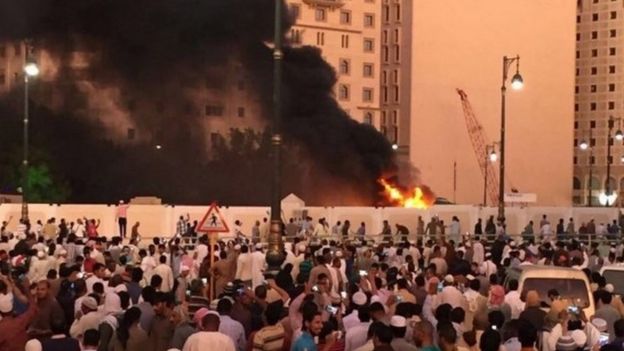
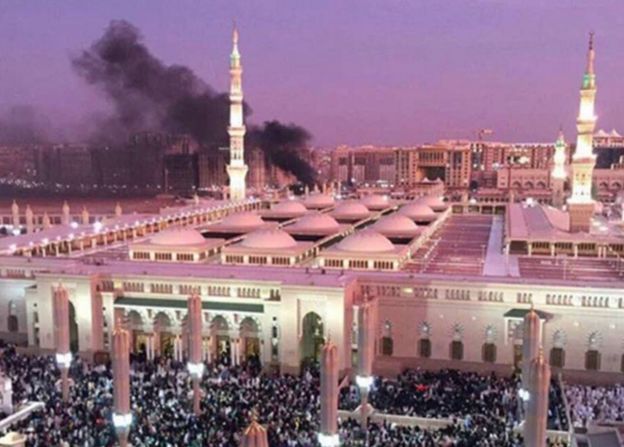
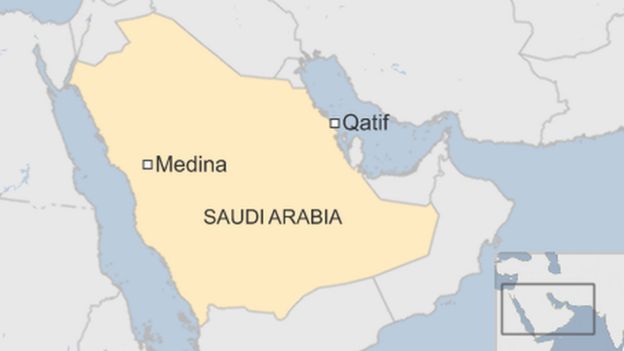
A suicide bomber has killed four security officers and injured five others near one of Islam’s holiest sites in the Saudi city of Medina, according to the interior ministry.
The bomber detonated his explosives after being stopped outside the Prophet’s Mosque, a statement said.
The mosque is the burial place of the Prophet Muhammad and Medina the second-holiest city in Islam after Mecca.
Blasts also struck two other Saudi cities on Monday.
That the attack happened in Medina at such a place is likely to leave Muslims around the world aghast, BBC World Service’s Middle East editor, Alan Johnston, says.
Suspicion is likely to fall on so-called Islamic State (IS), he adds.
Al-Arabiya gave a different account of the incident, saying the bomber had targeted the security officers by pretending he wanted to break his Ramadan fast with them.
Qari Ziyaad Patel, 36, from South Africa, who was in the mosque, told the Associated Press news agency people had at first thought it was the sound of the cannon fire that marks the breaking of fast.
The ground shook, he said, adding: “The vibrations were very strong. It sounded like a building imploded.”
Earlier, at least one explosion rocked Qatif, an eastern city which is home to many minority Shia Muslims.
The blast appeared to target a Shia mosque. The attacker was killed but no other casualties were reported.
Sukan tinju dunia dikejutkan dengan berita kehilangan seorang lagenda apabila Muhammad Ali disahkan meninggal dunia, 4 Jun 2016.
Ali yang dilahirkan pada 17 Januari 1942 di Louisville, Kentucky, Amerika Syarikat menghembuskan nafasnya pada usia 73 tahun, dipercayai kerana menghidap masalah pernafasan.
Beliau yang pernah menjadi peninju juara heavyweight dunia sebanyak tiga kali sememangnya merupakan salah seorang tokoh sukan terbesar pada abad ke-20.
Dalam namanya sedang meningkat naik, Ali tiba-tiba mengejutkan dunia apabila memilih untuk memeluk agama Islam dan menukar nama asalnya, Cassius Marcellus Clay, Jr, pada tahun 1964.
Pengumuman pertukaran agamanya itu didedahkan kepada umum buat pertama kali di arena gelanggang selepas Ali berjaya menjuarai heavyweight dunia menumpaskan Sonny Liston.
Petukaran agamanya itu juga membuatkan ada yang menggelarkannya sebagai ‘Black Muslim’.
Ali yang awal merupakan mualaf ketika itu dikatakan mempunyai pegangan yang berubah-ubah terhadap Islam.
Namun, selepas itu Ali mula mendekati ajaran Islam dengan menyertai Nation of Islam, sebelum mengambil keputusan berada dalam aliran Islam Sunni pada tahun 1975, kemudian kepada mazhab Sufi pada tahun 2005.
Sementara itu, ramai peminatnya percaya Ali memeluk Islam ekoran pengaruh rakan baiknya yang dikenali Malcolm X.
Malah, ada sumber yang memberitahu, lagenda itu menerima hidayah ketika menemani rakannya mendengar ceramah ajaran Islam.
Keyakinan Ali terhadap Islam semakin utuh apabila beliau merasakan agama itu tidak membezakan warna kulit, etnik, kekayaan dan semuanya sama di mata Allah SWT.
Setelah pertukaran agamanya, Ali yang popular dengan gelaran ‘The Greatest’ meminta orang ramai tidak lagi memanggilnya sedemikian kerana mahu bersederhana seperti yang dituntut oleh ajaran Islam.
Sepanjang hayat, Ali sememangnya cukup terkenal dengan suara lantangnya demi mempertahankan isu-isu kaum, agama dan politik.
Awal Disember lalu, Ali sekali lagi memainkan peranannya menegakkan hak Islam apabila menyelar pendirian calon presiden Amerika Syarikat, Donald Trump yang mahu menghentikan imigrasi umat Islam ke negara itu.
“Saya seorang Muslim dan tidak ada orang Islam mahu membunuh orang yang tidak bersalah di Paris, San Bernardino, atau di mana sahaja di dunia. Penganut Islam yang sebenar tahu bahawa keganasan yang kejam bertentangan dengan ajaran agama Islam,” ujarnya.
Sesungguhnya, insan bernama Muhammad Ali ini sukar dicari ganti dan akan kekal diingatan setiap peminatnya.
Semoga roh Muhammad Ali berada dalam kalangan orang-orang yang soleh. Al-Fatihah.
Muslims from the religion’s two major sects in Singapore have been living harmoniously with a sense of mutual respect for over a century, said Syed Hassan Al-Attas, a respected Sunni imam (Islamic leader).
The comments by the imam from Ba’alwie Mosque came amid tensions in the Middle East arising from the recent execution of Shiite cleric Nimr Baqr al-Nimr by Saudi Arabian authorities, which has highlighted a schism between Sunni and Shiite Muslims in the region.
“For Sunnis and Shiites in Singapore, the relationship is very deep, and has existed in Singapore for more than 100 years… we don’t identify ourselves as Sunnis or Shiites in Singapore, we identify ourselves as Muslims. We’ve never pointed fingers (at each other),” said Syed Hassan in a recent interview with Yahoo Singapore.
When asked about the perception of some Sunnis around the world that Shiites are not true believers, the imam disagreed.
“If they are not Muslims, how can the Saudi government approve their visas to enter Mecca? They are Muslims too,” he said.
He felt that the squabbles between Sunni-majority Saudi Arabia and its allies, and Shiite-majority Iran are political in nature and have nothing to do with religion.
About 15 per cent of the Singapore population practice Islam, with the majority being Sunnis, according to the 2010 Census of Population statistics.
Of the 70 mosques in Singapore, only the Burhani Mosque at Hill Street belongs to the Shiites.
View photos
Photo: Ba’alwie Mosque on Lewis Street
Historical background of Sunnis and Shiites
Sunni and Shiite Muslims believe in Prophet Muhammad and that he revealed the monotheistic religion to the people of Mecca. The key difference in the beliefs of the two sects is over the choice of the prophet’s immediate successor.
Sunnis believed that the successor should be Abu Bakar, who was the prophet’s father-in-law, while Shiites believe Ali ibn Abi Talib, who was the prophet’s son-in-law, should be chosen instead.
Both sects share similarities in terms of some of the obligations of Muslims, such as the performing of the Haj, fasting and reading of the Koran.
Sunnis and Shiites working to build the Muslim community
Syed Hassan said the believers from both sects in Singapore see each other as part of one religion and have joined together in building the Muslim community.
For instance, both Sunnis and Shiites in Singapore had worked together to establish the Islamic Religious Council of Singapore (MUIS).
“(During) the formation of MUIS in 1970, the legal adviser was the late (prominent Persian lawyer) Mohamed Javad Namazie, who is a Shiite.”
Other Shiites have also contributed to the Sunni-dominated Muslim community here, Syed Hassan pointed out.
“MKAC (Muslim Kidney Action Association) Ameerali (Abdeali), he’s a Shiite. Jumabhoy, the one from Scotts, Dr Kutubuddin, Mr Tayebali, and many others, are all Shiites who contributed to the betterment of Singapore, but nobody goes around saying ‘I’m Shiite, I’m Sunni’,” he said.
Ameerali Abdeali is the president of MKAC while the Jumabhoy family once owned property developer Scotts Holdings (now called The Ascott Limited) from 1975 to 1984.
J.M. Jumabhoy, who was the minister for commerce and industry between 1956 and 1959, was a Shiite too.
A Shiite with deep roots in Singapore
Gholamreza Kashkooli, a 58-year-old Iranian Shiite who has lived in Singapore for 35 years, is happy to see Sunnis and Shiites in the country working together.
The relationship between the two sects is peaceful, contrary to how it is depicted in the media, Gholamreza told Yahoo Singapore.
“In Iran, the majority of them (citizens) are educated. They do not look into this matter and create problems between themselves,” said Gholamreza, the owner of an import and export company.
Gholamreza pointed out that there are many Sunni scholars in Iran, and there is no discord between the minority Sunnis and the majority Shiites in the country over the differences in their beliefs.
Sunnis and Shiites agree that there is “one God, Muhammad is a prophet, and the Koran”, he said.
Singapore’s strong legal framework protects religious harmony
Lawyer Noor Mohamed Marican, who is a Sunni Muslim, said the violence that was seen in the Middle East recently would never happen in Singapore.
He said the strong legal framework in Singapore is in place to prevent such a scenario. In any event, there is no reason for concern as the local Muslim community’s relations are cordial.
“You are given your space (to worship), so don’t abuse your space. If you are here to create disharmony, the law will come in,” said Marican in a recent interview with Yahoo Singapore.
“We are all Muslims living together; our fundamentals are the same,” he added.
A: The split emerged over a disagreement on who should succeed the Prophet Mohammed, who died in 632.
Some felt his successor should be chosen from among his followers, while others — the “Shiite Ali” or Partisans of Ali — believed the position should stay within the prophet’s family and that Mohammed had backed his cousin Ali for the post.
Eventually, Abu Bakr, a confidant of the prophet, became the first caliph, and was succeeded by two other members of Mohammed’s inner circle before Ali assumed the post.
Shiite Muslims hold all of the prophet’s family, and particularly Ali and his sons Hassan and Hussein, in high esteem.
Hussein’s murder in 680 along with most of his family is commemorated each year by Shiite Muslims in the Ashura ritual, a day of mourning.
Q: What are the religious differences?
A: Sunni and Shiite Muslims share many practices and beliefs, including the so-called five pillars of Islam that encompass fundamentals such as five daily prayers and the pilgrimage to Mecca.
Shiite Muslims, however, consider Ali to be the first of a series of imams, who are successors to the prophet and provide models and guidance for the faithful.
As a result, Shiite Islam has a stricter clerical hierarchy, exemplified with the ayatollahs and imams of Iran and Iraq, than does Sunni Islam.
Shiites believe in an unbroken line of 12 imams who succeeded the prophet, beginning with Ali, and that the twelfth imam is in occultation but will return to restore justice on earth before the day of judgment.
While Sunni Muslims deem the four men who succeeded Mohammed to be the “rightly guided” caliphs, they do not place any particular significance on the religious practices of the leaders who came after them.
Shiite Muslims also incorporate mention of Ali into the Muslim shahada, or profession of faith, and have several religious holidays distinct from Sunnis that are based on their reverence for Ahl al-Bayt, or the family of the prophet.
These include Ashura and Arbaeen, which commemorate the deaths of Ali’s son Hussein and the suffering of his surviving family members respectively.
They also go on pilgrimages to several holy sites specific to Shiites, in addition to the Haj pilgrimage to Mecca in Saudi Arabia.
Q: What are the demographics?
A: According to a 2015 study by the Pew Forum, there are just under 1.6 billion Muslims worldwide.
Sunnis are generally thought to constitute up to 90 percent of the population of Muslims, with the rest divided between different Shiite branches.
The balance is less stark in the Middle East because of large Shiite populations in countries such as Iran, with some 80 million adherents to the branch.
Iran is traditionally regarded as the most powerful and important Shiite-majority country in the world, with Shiites also forming a majority in neighbouring Iraq and Bahrain.
There are large Shiite populations elsewhere, including in Yemen, Pakistan and Lebanon. Offshoots and branches of Shiite Islam are present in other countries too, including Syria and India.
Saudi Arabia, home of the pilgrimage sites of Mecca and Medina, is often regarded as the centre of Sunni Islam and the ruling king is known as “custodian of the two holy mosques” in reference to mosques at the two sites.
The Al-Azhar institution in Egypt is often regarded as Sunni Islam’s most important academic institution and a reference for the faithful.