Tag: Syawal

  • Mufti Negara: Umat Islam Singapura Sambut Aidilfitri Rabu, 6 Julai

    Mufti Negara: Umat Islam Singapura Sambut Aidilfitri Rabu, 6 Julai

    Umat Islam di Singapura akan menyambut Aidilfitri lusa, Rabu 6 Julai ini.

    Demikian diisytiharkan oleh Mufti Negara, Dr Mohd Fatris Bakaram, selepas terbenam matahari malam ini tadi (4 Jul).

    Menurut beliau: “Mengikut kiraan hisab, anak bulan Syawal tidak mungkin dapat dilihat di atas ufuk Singapura setelah matahari terbenam petang tadi (4 Jul) kerana bulan terbenam lebih awal.

    Ini bererti, esok adalah hari pencukup bulan Ramadan 30 hari dan awal bulan Syawal bagi tahun 1437H jatuh pada lusa, Rabu bersamaan 6 Julai 2016.

    Ustaz Dr Fatris juga mengucapkan Selamat Hari Raya Eidul Fitri kepada sekalian Muslimin dan Muslimat Singapura.

    Semoga Allah menerima segala amal ibadah yang sudah kita lakukan sepanjang Ramadan ini dan semoga Allah melanjutkan umur kita sehingga bertemu Ramadan tahun hadapan,” ucap beliau lagi.

    Source: http://berita.mediacorp.sg

  • Terrorist Launched Suicide Bomb Attack At Nabawi Mosque

    Terrorist Launched Suicide Bomb Attack At Nabawi Mosque

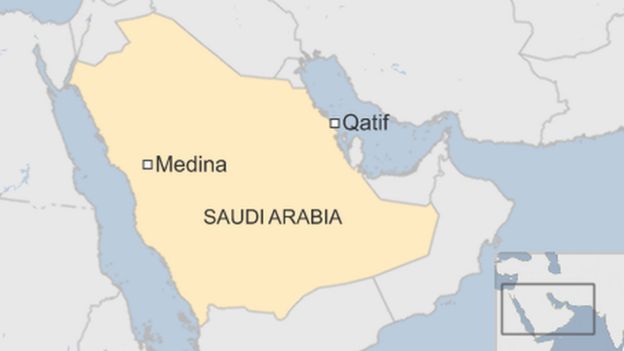
    A suicide bomber has killed four security officers and injured five others near one of Islam’s holiest sites in the Saudi city of Medina, according to the interior ministry.

    The bomber detonated his explosives after being stopped outside the Prophet’s Mosque, a statement said.

    The mosque is the burial place of the Prophet Muhammad and Medina the second-holiest city in Islam after Mecca.

    Blasts also struck two other Saudi cities on Monday.

    That the attack happened in Medina at such a place is likely to leave Muslims around the world aghast, BBC World Service’s Middle East editor, Alan Johnston, says.

    Suspicion is likely to fall on so-called Islamic State (IS), he adds.

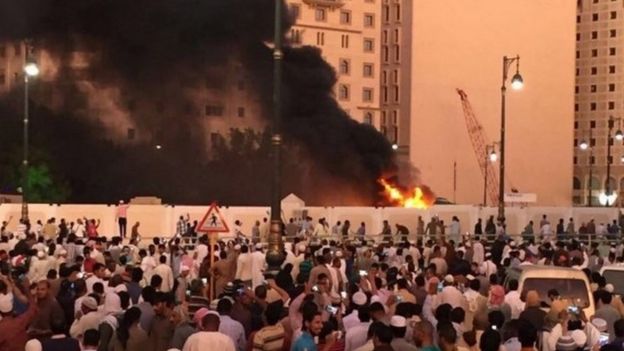
    Bomb blast site in Medina, 4 July

    Al-Arabiya gave a different account of the incident, saying the bomber had targeted the security officers by pretending he wanted to break his Ramadan fast with them.

    Qari Ziyaad Patel, 36, from South Africa, who was in the mosque, told the Associated Press news agency people had at first thought it was the sound of the cannon fire that marks the breaking of fast.

    The ground shook, he said, adding: “The vibrations were very strong. It sounded like a building imploded.”

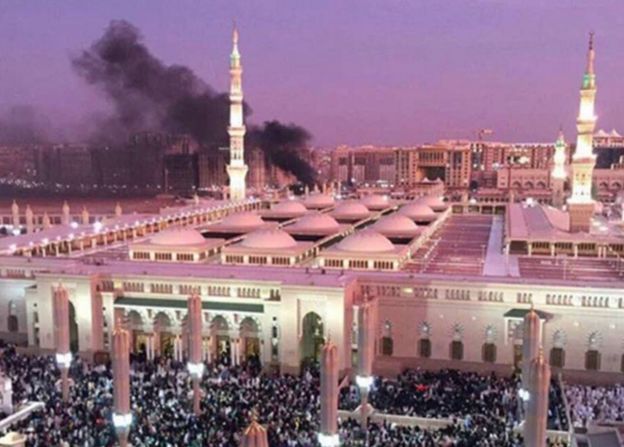
    Smoke rises behind the Prophet's Mosque in Medina

    Earlier, at least one explosion rocked Qatif, an eastern city which is home to many minority Shia Muslims.

    The blast appeared to target a Shia mosque. The attacker was killed but no other casualties were reported.

    A suspected suicide bomber also died after detonating a device near the US consulate in the city of Jeddah. Two security officers were slightly injured as they tackled the man, but no-one else was hurt.

    No-one has yet said they were behind any of the attacks.

    They come with the holy month of Ramadan drawing to a close and ahead of the Eid al-Fitr holiday.

    Saudi Arabia has been the target of attacks by IS over the past two years.

    In June, the interior ministry said there had been 26 “terror attacks” in the kingdom in that time.

    Map of Saudi Arabia

    A series of deadly attacks worldwide were either claimed by, or blamed on, IS over the past week:


    Source: www.bbc.com

  • What If You Are Not Forced To Fast?

    What If You Are Not Forced To Fast?

    In a country where fasting during Ramadan is a given among Muslims, many forget that the ritual is not as universal among adherents worldwide.

    After all, 99 per cent of Malaysian Muslims observe fasting, according to a Pew Research Center Forum on Religion and Public Life survey of more than 38,000 Muslims in 39 countries, released in 2012.

    The survey found that fasting is generally observed by most Muslims in Southeast Asia, South Asia, the Middle East, North Africa, and Sub-Saharan Africa. In such countries, observance is 85 per cent and above, except for an outlier — the Democratic Republic of the Congo, where only 69 per cent Muslims fast.

    But it is a different story in Central Asia and Southern-Eastern Europe.

    While more than 84 per cent fast in Turkey and Tajikistan, just half of the Muslims fast in Uzbekistan and Kyrgyzstan. Just 43 per cent observe it in Azerbaijan, and a mere 30 per cent of Muslims fast in Kazakhstan.

    While most Muslims in Kosovo and Bosnia-Herzegovina fast (76 per cent and 75 per cent respectively), it is not so in Russia (56 per cent) and Albania (44 per cent).

    There is a sizeable portion of Muslim populations in the latter area. Seven in 10 of Kazakhstan citizens are Muslims. More than half of Albanians are too, compared to the second biggest religion there (Christianity, at 10 per cent).

    Despite that, Muslims elsewhere are always ignored in conversations about Islam — either by Muslims themselves, or in critical discourse from the West. Although the cradle of Islam is in the Middle East, we take for granted the diversity of Muslims and how the religion is practised differently by different groups of people.

    Free ‘iftar’ meals are laid out before Muslims arrive to break their fast during the holy month of Ramadan at Masjid India in Kuala Lumpur on June 7, 2016. — Picture by Yusof Mat Isa

    Despite that, it might seem surprising that fasting is actually the second most observed ritual in the five pillars of Islam. Around 93 per cent of Muslims worldwide fast, following 97 per cent who declare their faith in the oneness of Allah and Prophet Muhammad being the last messenger.

    (The fact that three per cent of Muslims do not even believe in the Declaration of Faith might shock some; while some might argue those are not even technically Muslims.)

    Compared to that, only 77 per cent give zakat, or alms; just 63 per cent perform the five daily prayers; and a mere nine per cent perform the hajj to Mecca — which is itself only mandated for those who can afford it.

    It should be noted here that Muslims in Central Asia and Southern-Eastern Europe also find religion less important in their lives. Only 15 per cent of Albanian Muslims believe religion is “very important”, and just 18 per cent in Kazakhstan. Except in Turkey, Muslims in those countries who place such importance in religion do not reach even half of the population.

    What does this really say about fasting? That perhaps compelling Muslims to fast does not correlate with Muslims voluntarily doing so.

    There were two countries where 100 per cent of Muslims surveyed observe fasting. Guess where?

    It was in Thailand, where Muslims are minorities concentrated in the southern provinces. And Cameroon, a Christian-majority country.

    Would making fasting mandatory for Muslims in Central Asia and Southern-Eastern Europe by decree of the state increase the level of observance there? Unlikely, considering the minor role religion plays there.

    Whereas in Malaysia, fasting is enforced by state religious authorities. Skipping it is considered a punishable crime.

    In the Federal Territories, Muslims caught openly eating, drinking, or smoking during Ramadan can be fined not more than RM1,000 or jailed not more than six months or both for first offence, under Section 15 regarding “not respecting Ramadan”, in its Shariah Criminal Offences Act 1997.

    Other states also have almost the same provisions in their respective Shariah Criminal Offences Acts.

    In some states, the offence also covers those who sell food, drinks etc. for immediate consumption by Muslims during Ramadan. The seller is also liable to face the same punishment.

    In theory, this would be impossible to implement fairly, considering that the Shariah laws are supposed to apply only to Muslims. In theory, of course.

    However, with Islam as entrenched here, this practically means that a restaurant — although itself has no religion — would usually refuse service to Muslims outright during fasting hours, completely ignoring that there are many valid reasons for skipping fast: illness, menstruation, travelling, just for instance.

    It has been years since fasting was made mandatory for Muslims here. And still, not 100 per cent of Muslims observe it.

    And yet, considerable resource is being devoted to this exercise that some may even consider almost impossible (Thailand and Cameroon, notwithstanding). Add to that, skipping fasting is yet another “crime” in the Shariah laws where nobody is a victim.

    Malaysia is already pandering to Muslims during Ramadan — office hours end an hour early so Muslims can afford to return home for breaking fast, only for most of them in the Klang Valley to be stuck in unusually bad traffic jams during the daily evening commute.

    If not observing fasting is no longer a crime, would the level of those fasting tumble from 99 per cent? Perhaps it would. But then again, perhaps it would not, as 93 per cent of Muslims here already consider religion to be very dear to their lives.

    This summer, some Muslims would be subjected to long hours of fasting in certain countries, especially in the West. There are tales of those who only have five hours between breaking fast and resuming fasting. Some of those Muslims still steadfastly observe their fast.

    Canadian MP Mark Holland’s vow to fast in solidarity with Muslims was applauded by many Muslims. Some even prayed for Holland to one day see the light and embrace Islam.

    Just like Holland, and many more who choose to fast despite gruelling conditions, they do so not out of coercion, not because they are afraid of getting caught.

    It is only then that one can witness a Muslim who is sincere with his/her faith. As long as fasting is forced, ending up a burden on Muslims nationwide, such a thing is rarely possible.

    * This is the personal opinion of the columnist, Zurairi AR.


    Source: www.themalaymailonline.com

  • Mencuri, Edar Dadah, Demi Persiapan Hari Raya

    Mencuri, Edar Dadah, Demi Persiapan Hari Raya

    INDONESIA: Hari Raya akan menjelma tidak lama lagi. Antara yang menjadi kebiasaannya pada waktu-waktu ini adalah mencari pakaian baru.

    Sebaiknya membeli mengikut kemampuan masing-masing malah tidak semestinya semua perlu serba baru.

    Namun, ada yang nekad melakukah jenayah semata-mata untuk mendapatkan yang baru pada Hari Raya.

    SURI RUMAH CURI DOMPET SEORANG NENEK

    Seorang suri rumah di Palembang Indonesia mencuri dompet seorang nenek yang bernama Hajah Rokiah semasa beliau sedang memilih baju muslimah di sebuah kedai.

    Menurut maklumat yang diterima laman Merdeka.com, suspek bertindak semasa mangsanya sedang leka lantas dia melanggar mangsa sehingga mangsa hampir terjatuh sebelum mencuri dompet nenek berkenaan.

    Mujur pemilik kedai itu mula berasa curiga dan memberitahu mangsa, menyebabkan mangsa segera menjerit.

    Meskipun suspek cuba melarikan diri, dia akhirnya berjaya ditangkap dan berkata: ‘’Saya mahu membeli baju Hari Raya.’’

    TERTARIK JADI PENGEDAR DADAH DEMI WANG BELANJA HARI RAYA

    Dalam satu lagi kes berasingan, gara-gara terdesak mahukan wang untuk berbelanja sempena Aidilfitri, Erpin, 45 tahun sanggup menjadi pengedar dadah.

    Dia ditangkap semasa sedang berurus niaga di Jalan Taman Kenten, Palembang.

    Apabila polis memeriksanya, dia cuba menjatuhkan sebungkus plastik ke arah belakangnya namun diketahui oleh seorang pegawai.

    Menurut suspek, dadah tersebut adalah milik rakannya dan dia begitu terdesak memerlukan wang untuk membuat persiapan Hari Raya sehingga tertarik menjadi pengedar.

    SUSPEK CURI 4 KALI DARI KEDAI YANG SAMA

    Dalam kedua-dua insiden itu suspek sudahpun ditangkap, namun berlainan pula dengan satu lagi kes di mana suspek masih berleluasa malah perbuatannya mencuri hanya diketahui setelah telefon bimbit pemilik kedai pakaian hilang dan mereka memutuskan untuk melihat rakaman CCTV.

    Menerusi rakaman CCTV, salah seorang pekerja kedai Toko Rahmad Ilahi yang sibuk dengan orang ramai yang sedang berbelanja sempena Aidilfitri itu berkata, seorang lelaki yang mencurigakan dilihat memasuki kedai tersebut.

    Oleh kerana kedatangannya ke kedai itu tidak disedari keempat-empat pekerja kedai, suspek mencuri sebanyak empat kali dari kedai yang sama.

    “Menerusi rakaman kami lihat lelaki itu pada mulanya memasuki kedai dan mengambil beberapa set pakaian kanak-kanak, yang kedua mengambil rok, yang ketiga mengambil sepasang seluar dan yang keempat telefon bimbit serta pakaian lain,” menurut Anwar, pemilik Toko Rahmad Ilahi, seperti yang ditukil Antara.

    Beliau sudahpun membuat aduan polis berhubung insiden itu.

    Source: http://berita.mediacorp.sg

  • Orang Sibuk Berterawih, Pasangan InI Ditangkap Basah

    Orang Sibuk Berterawih, Pasangan InI Ditangkap Basah

    INDONESIA: Sedang umat Islam sibuk menunaikan ibadah terawih di masjid setelah seharian berpuasa, sepasang kekasih juga sibuk memadu asmara di sebuah rumah sewa di Jawa Barat.

    Pasangan itu, Ahan 35 tahun dan Lis Hermawati 29 tahun, bagaimanapun ditangkap penduduk kampung semalam (19 Jun) semasa orang lain sedang bersolat terawih di masjid.

    Serbuan ke atas mereka itu dibuat hasil daripada rasa curiga pemilik rumah sewa tersebut yang sering melihat Ahan masuk ke rumah itu semasa suami Lis tidak ada.

    Semasa serbuan dijalankan, pasangan yang pada ketika itu hampir tidak memakai seurat benang pun, cuba untuk mengelak ditangkap basah dengan bersembunyi di dalam sebuah almari.

    “Semasa serbuan dibuat rumah itu seperti tidak ada sesiapa, tetapi apabila saya memeriksa di dalam, mereka sedang bersembunyi di dalam almari,” menurut Soleh pemilik rumah tersebut.

    Pasangan itu kemudian dipaksa keluar dan hanya dengan berpakaian dalam, mereka diarak keliling kampung sebelum dihantar ke balai polis.

    Pasangan itu masing-masing sudah berkahwin bahkan semasa di balai polis, isteri Ahan dan suami Lis turut hadir.

    Source: http://berita.mediacorp.sg