Tag: Thailand

  • Two Men Charged With Selling Fake Tickets To SEA Games Football Match Between Thailand And Vietnam

    Two Men Charged With Selling Fake Tickets To SEA Games Football Match Between Thailand And Vietnam

    Two men, aged 29 and 31, have been arrested for allegedly selling fake tickets to the 28th Southeast Asian (SEA) Games football match between Thailand and Vietnam, said Police on Tuesday.

    The match is scheduled to take place at Bishan Stadium on Wednesday, June 10.

    Police investigations are ongoing. If convicted, the duo can be jailed up to 10 years and fined.

    Tickets with the serial numbers listed below may have been duplicated and those holding on to these tickets may be denied entry into the stadium, police said.

    The public is advised to purchase official Games tickets from the 28th SEA Games website at tickets.seagames2015.com, the official ticketing hotline at +65 3158 8080, at any SingPost Outlets island-wide, and at the Box Office at Singapore Indoor Stadium.

    The Police have urged the public to be mindful of purchasing tickets through unauthorised vendors and report this to the organising committee via the official ticketing hotline.


    Source: www.straitstimes.com

  • Malaysia Mass Graves: Villagers Tell Of Immigrants Emerging From Secret Camps

    Malaysia Mass Graves: Villagers Tell Of Immigrants Emerging From Secret Camps

    The residents of Wang Kelian sensed something was amiss when a number of people stumbled on to their streets, weak and injured, and began to beg for food and water.

    “They would walk into my shop, with injuries covering their hands and feet. Some were just too weak to even speak properly,” said Lyza Ibrahim, who runs a food stall in the town on the northern Malaysian border with Thailand.

    “One asked me, ‘[Is this] Malaysia?’ Then he pointed in the other direction, said ‘Thailand’ and shook his head to signal that he was not wanted there.”

    Wang Kelian is an unassuming settlement but it has been thrust into the global spotlight this week after the discovery in nearby jungle of dozens of secret camps used by people smugglers and nearly 140 grave sites.

    Police say some of those graves contain multiple bodies – raising the terrible prospect of hundreds of unexplained deaths. On Tuesday Malaysian authorities began the grim task of exhumation.

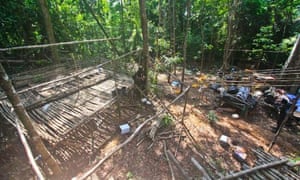
    Some of the campsites included wooden pens, some with barbed wire and guarded by sentry posts. In one pen, police found several parts of a decomposed body.

    A picture from Royal Malaysian Police shows an abandoned human trafficking camp where graves were found nearby, close to the border with Thailand at Wang Kelian, Malaysia.

    The camps appear to be part of a complex of bases stretching into Thailand on what had been a well-established route smuggling mostly Rohingya people from Burma and Bangladesh.

    But the trade has been in chaos since early May, when Thai authorities launched a crackdown after the discovery of mass graves on their side of the border.

    Thousands of migrants headed for Thailand started landing elsewhere in south-east Asia. And as the smugglers fled their jungle hideouts, migrants were spotted in Wang Kelian.

    Ibrahim said she had seen several migrants, whom she believed to be Rohingya, and heard stories about many others, including that they would go to a nearby mosque to ask for help.

    Others echoed her story. Another woman said she had spotted a Bangladeshi migrant wandering in the area and knocking on her neighbour’s door.

    “It is very sad. We have been hearing these stories, but we can’t do much,” said the woman, who declined to give her name. “We could only offer food, clean clothes, but we have to call the police and they will be taken away by the police after that.”

    Malaysian officials acknowledged the camps had been around for some time but defended themselves against criticism that no action was taken earlier. Authorities had previously vehemently denied there were any such sites in the country.

    “We have been building up intelligence and information,” the national police chief, Khalid Abu Bakar, told reporters on Monday, vowing tough action against any Malaysians involved.

    But anti-trafficking groups said the latest discovery came as little surprise and would cast an even harsher spotlight on Malaysia, which was listed as ‘tier three’ by the US State Department’s annual human-trafficking report, the worst ranking for countries which are failing to stop the trade.

    “There were stories about these camps that went back nearly 10 years,” Matthew Friedman, the former chief of the UN inter-agency project on human trafficking, told the Guardian. He now heads the Mekong Club, which campaigns against slavery in Asia. “We passed the information on to the local authorities, but there was no follow-up.”

    Bags with human remains at Wang Kelian, Perlis, Malaysia

    A report in 2009 by the US Senate committee on foreign relations found that “a few thousand” Burmese migrants had become victims of extortion and trafficking once they were deported across Malaysia’s border with Thailand.

    In addition, it said there were questions about the “level of participation” of government officials in Malaysia and Thailand.

    Villager Mahyuddin Ahmad said he has seen migrants in Wang Kelian for the past two years but more had been spotted in the past month – the largest group being about 10 people, including women and children.

    The 55-year-old businessman, who said he had given food such as instant noodles and clothes to migrants, added: “It is a common sight here. We didn’t suspect anything because we thought they just come from Thailand.

    “So we are really shocked to hear what the police revealed yesterday about the grave sites and jungle camps.”


    Source: www.theguardian.com

  • Singapore To Offer US$200,00 For Countries Providing Help To Rohingya

    Singapore To Offer US$200,00 For Countries Providing Help To Rohingya

    The Singapore Government will offer an initial contribution of US$200,000 through ASEAN to support the efforts of countries such as Thailand, Malaysia and Indonesia that have been aiding Rohingya refugees, said Foreign Affairs Minister K Shanmugam on Saturday (May 23).

    Singapore is concerned about the situation and welcomed efforts by countries, in particular Malaysia and Indonesia, which agreed to provide temporary shelter for the Rohingyas, said Mr Shanmugam.

    He said the financial aid is part of an ASEAN-led initiative, adding that Singapore is prepared to consider further assistance, if there are specific requests.

    Mr Shanmugam said the Rohingya crisis has raised two key issues – one is how to help those currently on boats and stranded at sea, while the other is the need to deal with the problem at its source.

    This would require looking at living conditions created by countries of origin as well as the criminal organisations putting them on boats, subjecting them to terrible conditions. That, he added, is a “more serious problem” because tens and thousands of refugees could potentially suffer.

    Mr Shanmugam stressed that the countries where the refugees originated from should take responsibility, and both ASEAN and the international community needs to address this issue.

    Singapore’s contribution comes days after the Government said it is unable to accept any refugees or those seeking political asylum because it is a small country with limited land.

    Over the past week, countries such as Thailand, Malaysia and Indonesia have provided shelter to Rohingya refugees who have landed on their shores. Food and medical aid were also provided.

    Up to 2,000 migrants are thought to be stranded in the Bay of Bengal, many at risk of falling victim to people smugglers. Most are Muslim Rohingyas from the western Rakhine state in Myanmar.

    United Nations Secretary General Ban Ki-moon has said finding and saving the lives of those migrants should be a “top priority”.


    Source: www.channelnewsasia.com

  • Farish A. Noor: Give Dignity Back To The Rohingyas

    Farish A. Noor: Give Dignity Back To The Rohingyas

    Today the Asean region is confronted with the challenge of coping with Rohingya who have taken to the seas to seek a safer life elsewhere. At the same time, the European Union is forced to deal with the phenomenon of Africans fleeing their continent to seek a better life in Europe.

    In both these cases, the refugees concerned have been portrayed as vulnerable, homeless people who present a challenge to other countries that have become the destinations for them.

    For reasons that I will elaborate on, I find this depiction of the Other as the “vulnerable victim” problematic; and I would argue that at this critical juncture we need to seriously interrogate the very language that we use to describe and understand such crises.

    Let us be honest from the start and call a spade a spade: The crises in North Africa and Myanmar are not natural disasters to begin with.

    Even in cases where natural disasters have struck, I have been amazed by the resilience and fortitude shown by ordinary human beings who demonstrate the capacity to cope under extraordinary circumstances.

    I recall, while working in Kashmir as part of the post-earthquake relief operation there in 2005, how a young couple in the devastated town of Muzaffarabad managed to hold their wedding ceremony in the midst of carnage and destruction.

    Practically every family I met had lost at least one relative, and in one village every woman and child had been killed, leaving the men alone and destitute.

    Yet in the midst of this loss and pain, a young couple could still proceed with their wedding – proof of the incredible strength of the human will and humankind’s capacity to rise above disasters.

    Upon my return to Europe, I was asked by my colleagues and students about what I saw and what I had learnt in Kashmir, and my reply was simply this: I learnt that human beings, in times of crisis, can rise to the level of the superhuman. The crisis in Kashmir was, however, a natural disaster, on a par with the tsunami of 2004. There was no one to blame for these disasters, as no agency was involved.

    A natural or man-made disaster?

    WHAT is happening now in South-east Asia and the Mediterranean is not a natural disaster though, but rather the result of political will and contestation that necessarily involve human agency, and thus entails the element of moral-political responsibility as well.

    To describe the phenomenon of boat people – be they drifting across the Mediterranean or the Indian Ocean or the South China Sea – as a “disaster” suggests an inevitability to the situation that begs the question: Surely, thousands of people would not rush out to sea, braving hazardous conditions that imperil their lives, for the sheer sake of it?

    But this is where a disconnect seems to have appeared: The developed countries in the West bemoan the fact that refugees from Africa are running to them, but have not asked why these people are running in the first place.

    For the deteriorating security conditions in countries like Libya today are not the result of some natural disaster but rather the outcome of political intervention gone wrong, leading to crises that are political in nature.

    The answer to the problem seems simple enough: If you do not want to have economic or political refugees rushing in your direction, perhaps it would be wise not to stir economic or political problems abroad in the first place.

    Likewise, the phenomenon of Rohingya taking to the seas today is not the result of an earthquake or a tsunami, but rather the outcome of a political crisis that has been brewing for years now.

    To describe the Rohingya as “homeless” obfuscates the fact that they have a home, or rather had a home, and that they have been forced to leave as a result of a domestic political crisis that likewise involves actors and agents who are local.

    As long as we refer to such people as “homeless”, we will perpetuate the notion that the Rohingya are a stateless community with no homeland of their own, and thus deny them their history, culture and identity as well.

    Not an Asean problem

    COMPOUNDING matters is the tendency to label this as an “Asean problem”, as if all of South-east Asia was implicated in the humanitarian crisis that led to this situation, when the honest approach would be to identify the actors and agents who have been responsible for this state in the first place.

    Some reports have bemoaned the fact that the Asean region has been slow to act, or suggested that Asean has proven itself powerless in the face of crisis. Yet again this blurs the distinction between those who are primarily responsible for the flight of the Rohingya and those who are now faced with the challenge of coping with this human exodus.

    The former are those who caused the crisis in the first place, and they include the right-wing ethno-nationalists and sectarian groups in Myanmar who have demonised the Rohingya, and in our analysis of the current situation we need to be clear on where the responsibility for this crisis lies, and who ought to take primary responsibility.

    The other countries of Asean may have been slow in their response to the flight of the Rohingya, but none of the other countries of Asean is directly responsible for their flight.

    The real test for Asean at the moment is thus two-fold: On the one hand, there is the growing need to find some means to deal with a crisis that can be compared with the flight of the Vietnamese boat people in the past, which requires Asean to get its act together and emphasise, yet again, the spirit of Asean cooperation on the basis of a common Asean history and shared destiny.

    Asean needs to speak up

    BUT Asean also has to be aware that its policy of non-intervention in the affairs of member-states has been problematic for some, and during times of crisis such as these the norm of non-intervention has been used to discredit Asean as a whole and paint a disparaging picture of the grouping as little more than a talk shop.

    In the way that Asean states today have become more assertive when dealing with non-conventional security issues such as cross-border pollution, and more willing to speak up when one country’s environmental problems become the problems of other countries, so should Asean states recognise that political crisis in one state may well become a shared crisis for the region as a whole. This can happen, however, only when we accept that some crises – such as the flight of the Rohingya – are not disasters that happen “naturally”.

    The Rohingya issue is also an occasion for the communities of Asean to reflect upon themselves and how they view the world around them. On a positive note, it should be recognised that in many countries across Asean at the moment, there has been an outpouring of concern and sympathy, which affirms a commitment to a sense of common humanity that we all share, regardless of differences in culture or nationality. We are not, after all, heartless and indifferent to the plight of others.

    But we should also be wary of over-emphasising the victimhood of the Rohingya, or casting them permanently in the role of the unfortunate and vulnerable, for such discourses of victimhood – when overplayed – can also hobble the Other and reduce others to the status of the perpetual victim.

    The Rohingya crisis is a man-made problem, with human actors and agents responsible. Concerted effort by nations and national actors is needed to resolve the crisis at that level.

    But the victims happen to be human too, and we should never forget that. Consider the fact that many of these refugees – be they the ones from Africa or from Myanmar – have spent weeks, perhaps even months, at sea; and have been forced to survive on sea water or even urine.

    What is that, if not a testimony to their strength and their enduring will to survive at all costs?

    Do not brand them homeless illegal immigrants. Do not dismiss them as boat people, as though their desperate bid for a better life in a vessel defines their identity and their existence.

    The very least that we need to do for these people is to recognise them for what they are: human beings with a cultural identity and history, endowed with dignity and who deserve a modicum of respect rather than condescension.


    Source: www.straitstimes.com

  • HOME: Ihumane To Turn Away Refugee Boats

    HOME: Ihumane To Turn Away Refugee Boats

    By Humanitarian Organization for Migration Economics (HOME)

    Singapore should demonstrate leadership to the humanitarian crisis that is happening with the Rohingyas, who have been victims of systemic persecution, discrimination and rampant abuse. We also urge the Myanmar government to stop persecuting them to prevent the mass exodus of asylum seekers.

    Even though Singapore did not ratify the 1951 Convention on the Status of Refugees, under international law the Singapore government has to adhere to the principle of “non-refoulement” – not to expel anyone back to places where they may experience persecution.

    The crisis involving the Rohingyas is one that has to be resolved by ASEAN and not one country alone. But for Singapore to say that it is not in a position to accept refugees goes against the values of cooperation and humanitarianism and we urge the government to re-consider its decision.

    Singapore need not accept and re-settle all who seek political asylum. It can work with other ASEAN governments and civil society, both locally and abroad, to ensure that the asylum seekers have temporary housing, food and medical attention while their cases are processed by the the United Nations High Commissioner for Refugees (UNHCR). The solution should not be to turn these boats away as the Singapore government did in 2012 when it refused entry to 40 stranded asylum seekers after their vessel sank off the coast of Myanmar on December 5 and sought to dock in Singapore waters.

    An ASEAN inter-agency framework for action should be established and all countries should work together to resolve this crisis in a sustainable way. But even as this framework is being put in place, rather than abandoning them to their deaths, Singapore should do its part and provide them with protection.

    This statement has the support of the following individuals:

    Lynn Lee, Terry Xu, Jennifer Teo, Rachel Zeng, Joshua Chiang, Shelley Thio, Roy Ngerng,


    Source: www.theonlinecitizen.com