Tag: Tharman Shanmugaratnam

  • Tharman Shanmugaratnam: We Cannot Be Complacent With The Harmonious State Of Affairs

    Tharman Shanmugaratnam: We Cannot Be Complacent With The Harmonious State Of Affairs

    As a young nation, Singapore should avoid the mistake of being complacent when it comes to being a harmonious society, said Deputy Prime Minister Tharman Shanmugaratnam at a fellowship gathering by the Inter Religious Organisation (IRO) on Tuesday evening (May 19).

    Singaporeans becoming more aware and concerned about problems in the world is a positive development, as it shows a strengthening of the society, Mr Tharman said.

    “We want to keep reminding ourselves that keeping our society resilient and harmonious is continuous work. It’s not about doing things when problems happen, but it’s about strengthening our society upstream, particularly when the kids are young and growing up, and through a whole range of fundamental policies, education, housing, no discrimination at work and of course the good work of our IROs and our Inter-racial and Religious Confidence Circles (IRCCs) throughout the island. That’s really what makes us Singapore,” said Mr Tharman.

    The gathering at the Inter Religious Organisation headquarters at Palmer Road was themed “Compassion Across Religions, Around the Region”.

    At the event, Mr Tharman also received a S$100,000 donation on behalf of the IRO for quake victims in Nepal. He added that when it comes to emergency relief, Singapore has a range of avenues available for help, such as the Singapore Red Cross, Singapore Civil Defence Force, Ministry of Defence and the private sector.

    The S$100,000 donation was from one of the council members of the IRO who wished to remain anonymous.

    The IRO will partner Singapore’s Corporate Citizen Foundation, which was in Nepal two days after the devastating earthquake of Apr 25 to support the rescue and relief operations there. The funds will be used to provide shelter to the victims, in particular, the affected children.


    Source: www.channelnewsasia.com

  • Tharman Shanmugaratnam: Budget Is For Future, Not For Getting Votes

    Tharman Shanmugaratnam: Budget Is For Future, Not For Getting Votes

    While some may be dissatisfied with certain aspects of government spending, budgets cannot be “all sweetness and light”, said Deputy Prime Minister Tharman Shanmugaratnam.

    The Government shapes the Budget in the interest of Singapore’s future and not to win elections, and this may involve some measures that are unpopular, Mr Tharman said, speaking at a dialogue with about 400 youths organised by the People’s Association Youth Movement yesterday.

    “You should be very worried if you have a government that disburses only nice measures … because that never lasts,” said Mr Tharman, who is also Finance Minister. When countries reverse policies, it is the poor who will be most affected and the Budget this year ensures the Government will not have to do that in years to come, he added.

    Mr Tharman’s comments echo earlier remarks he made when wrapping up the Budget debate last Thursday, when he said the Republic has to sustain a fair and inclusive society for generations, “not one election at a time”, as has been the case in the United Kingdom and other advanced economies.

    Yesterday, more than 30 questions were posed in the 90-minute dialogue on policies introduced in the Budget, including concerns about the SkillsFuture scheme, the Silver Support Scheme and the petrol duty hike.

    Mr Tharman said SkillsFuture, which will provide credits to Singaporeans for use in training and enhancing vocational education through better internships and paid apprenticeships, will not only help make Singapore a more competitive economy, but also enhance social mobility. This is because it will provide learning opportunities for all Singaporeans throughout their lives, regardless of their education qualifications.

    Mastery of skills is essential to keep Singapore competitive in the global economy and is possible regardless of one’s academic achievements, he said. Currently, learning is too “front-loaded” and involves too much “information cramming” and competition in the first 10 years of life. However, he said life beyond school is not a race, but a continuous discovery of one’s potential.

    “SkillsFuture is for everyone: Those who dropped out early, those who went to university, those who are in mid-career, those who already have a Masters degree … If you’ve got a university degree, after a while, frankly, it doesn’t mean very much. So it’s for everyone regardless of qualifications,” said Mr Tharman.

    Asked why the S$500 SkillsFuture Credit is not offered to Singaporeans before the age of 25, Mr Tharman said it is important for those fresh in the workforce to spend time learning on their jobs.

    While he acknowledged the value of developing multiple specialisations, particularly how synergies among different skill sets can lead to innovation, Mr Tharman said that mastery takes time.

    “To develop deep skills, you really need time … so don’t move too quickly,” he said.

    In terms of education and career counselling, the minister said it is important for those as young as secondary-school age to gain exposure to the real world. For older students, career guidance can be geared more towards specialisations and internships.

    Junior colleges should also explore offering some courses centred on applied learning, he said. “I think that provides a bit more fluidity because people don’t know for sure at that age if they are more interested in an applied pathway or a more conceptual route. So having a bit of both is useful.”

    Mr Tharman added that getting employers on board SkillsFuture is vital but also challenging, because many small and medium enterprises may not have sufficient resources to invest in training and development. He added that employers must also adopt an “enlightened attitude” towards training.

    “If we all keep thinking short term, we will be caught in a vicious circle, where the employer does not invest in the employee, and the employee as a result feels he does not have an important future in the firm and moves,” he said.


    Source: www.todayonline.com

  • Singapore Has Done Relatively Well In Social Mobility

    Singapore Has Done Relatively Well In Social Mobility

    As part of its move to build a fair and inclusive society, and enhance social mobility, the Government has made a deliberate tilt towards supporting the lower- and middle-income group over the past five years, through a progressive tax system, said Deputy Prime Minister and Finance Minister Tharman Shanmugaratnam as he wrapped up the Budget debate in parliament on Thursday (Mar 5).

    This is where higher income earners contribute the bulk of taxes, the lower-income group receives the most benefits, and the middle-income group receives more than they used to.

    SINGAPORE HAS DONE ‘RELATIVELY WELL’ IN SOCIAL MOBILITY 

    Mr Tharman said that social mobility is the defining challenge of every advanced country today. But he said that Singapore has done relatively well, staying more fluid than most other countries.

    In the US for example, among those who were in their mid-20s and early 30s, and who started off in the bottom 20 per cent, only 7.5 per cent eventually moved up into the top 20 per cent of the population. In contrast, Singapore saw 14 per cent of those who started off in the bottom 20 per cent, move up to the top 20 per cent of the population.

    But Mr Tharman acknowledged that with each decade, it gets harder to improve social mobility. The Government has introduced a range of measures to address this. These include investing in education, diversifying pathways and promoting home ownership.

    There have also been “significant moves to temper inequality”, such as the introduction of Workfare and the progressive wage model to raise the salaries of low-wage workers.

    Mr Tharman added the Government has also shifted significantly to permanent schemes such as GST vouchers and the Silver Support Scheme. In fact, he said 90 per cent of transfers last year comprised permanent schemes.

    PROGRESSIVE TAX SYSTEM 

    The progressive tax system also means that most benefits flow to those who truly need it.

    To illustrate, he said that the top 20 per cent of households pay 55 per cent of all taxes and receive 12 per cent of benefits. The middle 20 per cent pay 11 per cent of all taxes, and receive 20 per cent of benefits. Correspondingly, the lowest 20 per cent of households pay 9 percent of all taxes, largely through GST, and receive 27 per cent of all benefits.

    Said Mr Tharman: “The system is not just about redistributing from the rich to the poor. It is also about the middle income. The middle income group in Singapore are net beneficiaries of our system and there has been a significant increase in the amount the middle-income group has received over the last 10 years.”

    He said that for every dollar of tax paid by the middle-income group, they now get back S$1.70 – a sum that has been increasing over the years. That is much more that what the middle-income group in countries like Finland, US and Britain gets back in benefits.

    Mr Tharman said: “The benefits that our middle income get are not what you see like in the Scandinavian countries or the UK or many other advanced countries. Some of them have free healthcare, free tertiary education, free many things. But they are paying for it. It is not free, it is never free.

    “And in most of these societies, with the Scandinavian countries being the classic example, in fact their tax system are not particularly progressive. They rely mainly on the VAT and high income tax for everyone to be able to flow back the benefits. Everyone is paying for the free benefits that they are getting.”

    STRENGTHENING VALUE OF FAIR, INCLUSIVE SOCIETY 

    But while the Government is playing a more active role in redistribution, Mr Tharman noted that what is important is how it goes about strengthening the value of a fair and inclusive society.

    He said: “The key to building a stronger society is not how much we are doing to redistribute, it is about how we strengthen the values that undergird and sustain a fair and inclusive society. It is not how much we are doing but how we do it, and whether how much we are doing strengthens the value of a fair and inclusive society.”

    He said the Government is seeking to build a stronger social compact, where personal and collective responsibility go hand in hand. And it is doing so by empowering people and aspirations as well as rewarding responsibility throughout life.

    “Our whole approach therefore is to avoid a zero sum game between personal and collective responsibility and get a compact where personal and collective responsibility reinforces each other,” he said.


    Source: www.channelnewsasia.com


  • Singaporeans First Party’s Chance Encounter With DPM Tharman Shanmugaratnam In Taman Jurong

    Singaporeans First Party’s Chance Encounter With DPM Tharman Shanmugaratnam In Taman Jurong

    When Mature People Meet….. Collaboration Becomes Possible

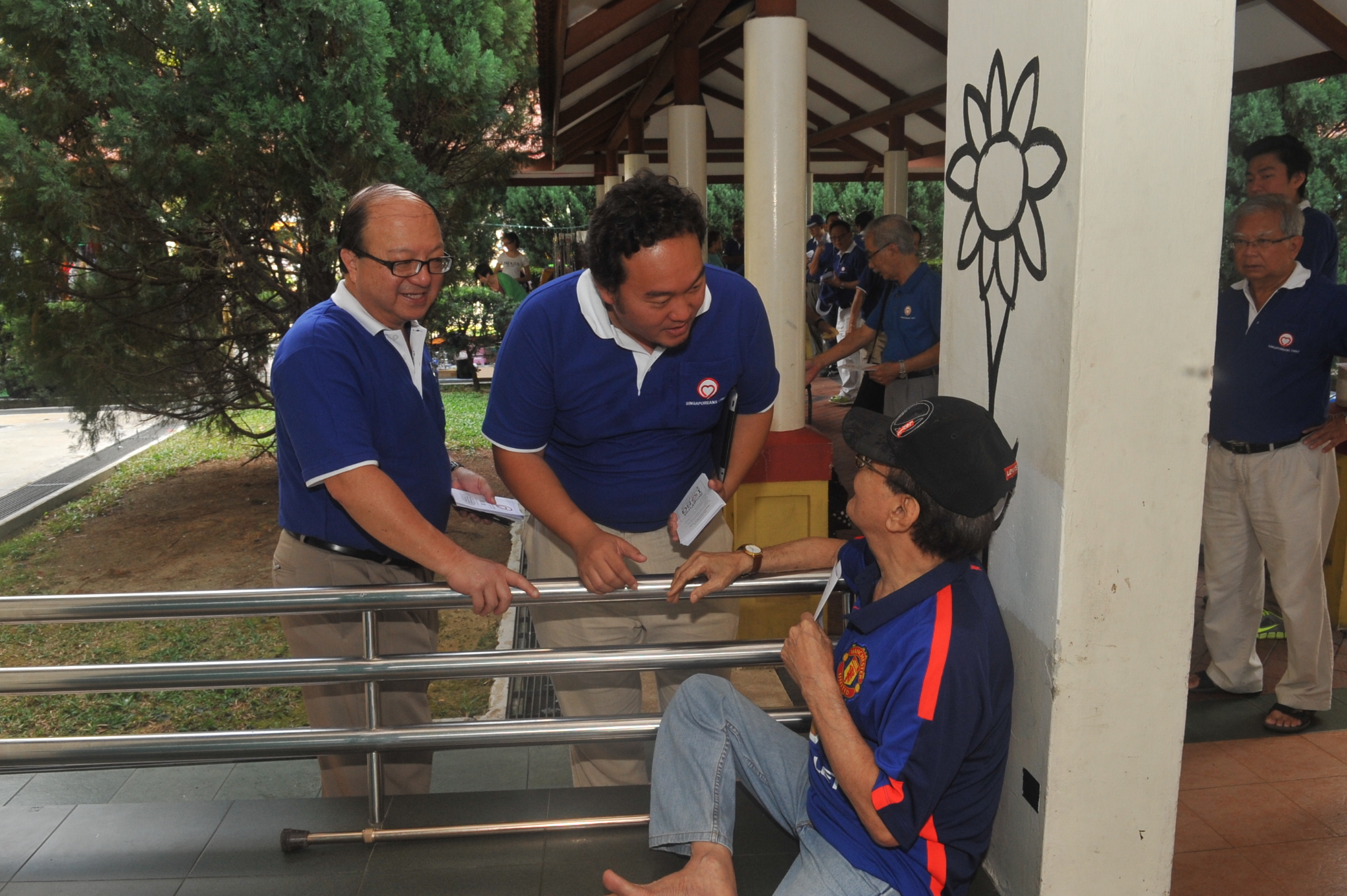
    The walkabout at Taman Jurong Market and Food Centre on Sunday saw SingFirst achieving several “firsts”. This is what we mean:

    1. First walkabout when we met a minister making his round at the same location

    DSC_9553

    DSC_9551

    2. First attempt in getting the members and supporters to take public transport to the walkabout location

    DSC_9488

    DSC_9498

    DSC_9500

    DSC_9484

    3. First largest turn out by our members and supporters

    DSC_96434. First ever longest walkabout route

    DSC_95095. First ever most photo requests by members of the public with our chairman and secretary general

    DSC_9497

    DSC_9637DSC_9636DSC_9624Taking the public transport to the location was our first attempt in building the bond and rapport between the members and supporters. This arrangement also allowed us to gain exposure and to publicise our party name. Everyone was enthusiastic and admitted that it was indeed a refreshing idea.

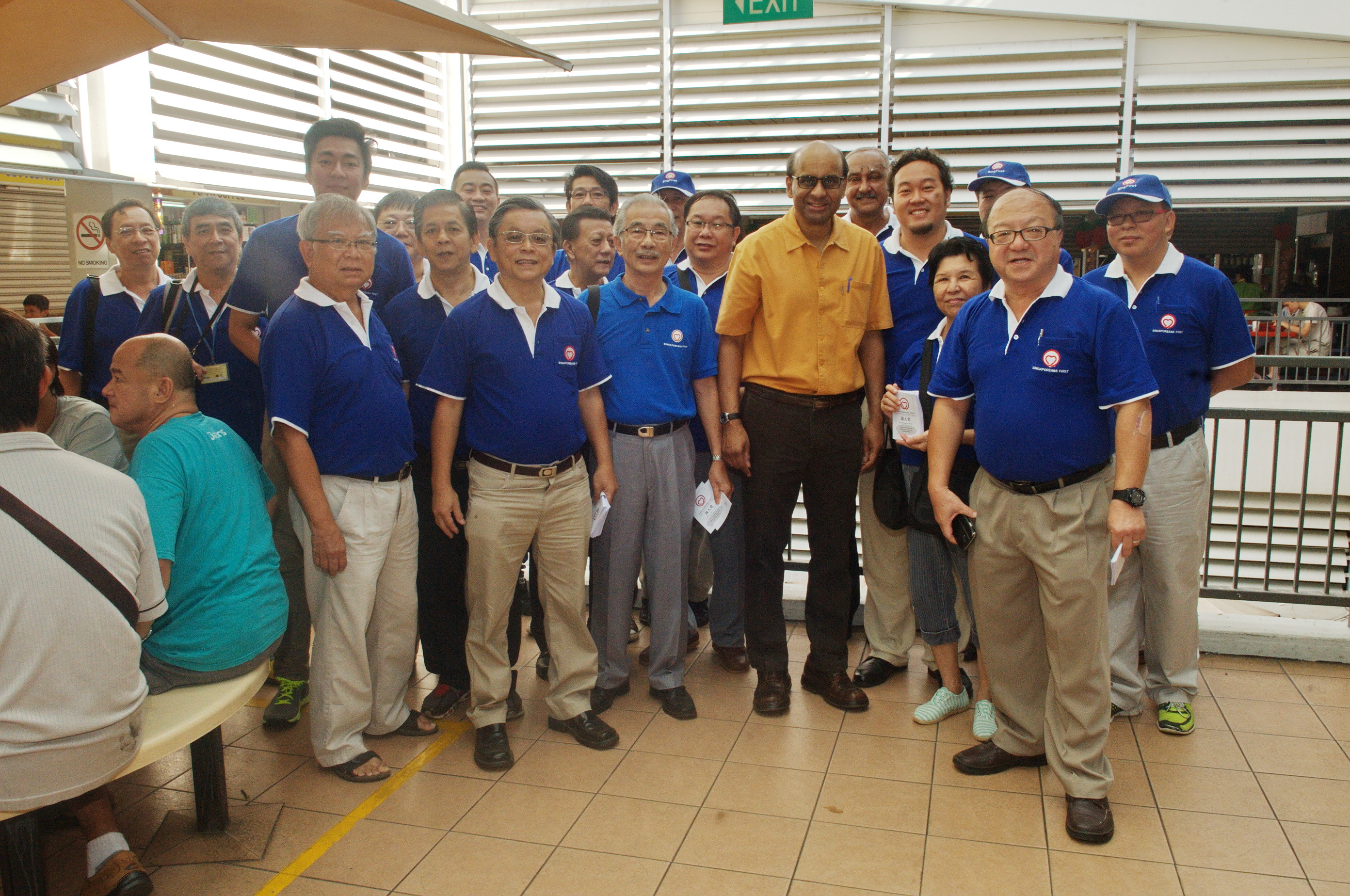
    This walkabout was by far the largest turn out by our member and supporters. A total of 25 of us gathered at Lakeside MRT before making our way to Taman Jurong Market and Food Centre. SingFirst is encouraged by the great support by our members! It goes to show that we are growing in terms of membership.

    As the market and food centre occupies 3 storeys with several units on each floor, it made its way into our record book for the longest walkabout route. Apart from the market and food centre, we also seized the opportunity to visit the nearby flea market. We were pleasantly surprised that many patrons at the market and food centre immediately recognized our chairman, Dr Ang Yong Guan and secretary general, Mr Tan Jee Say. We were even more surprised when several of them came up to the duo and asked for their pictures to be taken together.

    The most pleasant encounter during this walkabout was the chance meeting with the finance minister, Mr Tharman Shanmugaratnam. He too was at the food centre greeting the residents. He was pleasant and greeted us with warm smiles and handshakes. We suggested having a photo together and he agreed without any hesitation. That wasn’t the end of our encounter with him. While taking a break from the walkabout at a nearby coffee shop, he came to us and said that the coffee shop has the cheapest food in the area.

    DSC_9647

    From this walkabout, we would like to highlight some interesting points from the residents and our brief meeting with Mr Tharman Shanmugaratnam:

    • The residents recognized that there is a need for a political change in Singapore. They are also curious who will be the candidates for SingFirst and whether we are up to the mark to take on the ruling party in the next election. Many still bear the scars from the memory of the 1960s and 1970s during the tussle between Barisan Socialis and the PAP.

    DSC_9545

    DSC_9597

    • They are sincere in their response when approached. The residents either stand up to greet or putting away their utensils to have a brief word with us. They also hope that SingFirst is able to do more to help the citizens.

    DSC_9615

    DSC_9573

    • They hope to see in the coming election younger candidates with a credible party running for the public office and who can take on the PAP.

    DSC_9629

    DSC_9519

    • MPs need to speak their language from the ground to represent them in parliament. They hope the MPs truly understand their plight.

    DSC_9588

    • There is no need for scholars to stand for elections or be MPs. They just need someone who is able to understand their concerns and have a heart to feel and fill their needs. The Punggol East by-election is a good example where a caring candidate won despite a four-corner fight.

    DSC_9566

    DSC_9583

    DSC_9602

    • The SingFirst logo is being etched into the minds of the Singaporeans. One elderly man said he recognized the logo because it resembles an ice cream brand.

    3

    Mr Tharman’s encounter was an encouraging one as he is so open. SingFirst hopes to see more of such PAP politicians to engage alternative parties. Only with such openness can we then build a better Singapore and move Singapore forward.

    DSC_9555e

    Taman Jurong walkabout was a new milestone set for SingFirst. We hope we will set a higher benchmark and be fortunate enough to meet more ministers or MPs in our future visits to the various GRCs.


    Source: http://singfirst.org

  • Budget Should Look To Future, Help Middle Class

    Budget Should Look To Future, Help Middle Class

    Sandwiched between raising a family and caring for their ageing parents as the costs of living rise, the middle class could receive more attention in the Budget this year, which will be delivered by Finance Minister Tharman Shanmugaratnam this afternoon.

    And while there have been predictions from some quarters of an election Budget with goodies in the offing, some observers have cautioned against focusing too much on the short term, saying the Budget should be assessed on whether it delivers a convincing long-term plan for the Republic.

    Employment and income insecurity, wage stagnation and inflation, as well as anxiety about their own and their children’s financial future are some of the chief concerns of middle-income earners — who are the largest stakeholders in the country, said Institute of Policy Studies sociologist Tan Ern Ser. “If Singapore aspires to be a middle-class society … then there are good reasons to address (the middle-income group’s) concerns,” he added.

    Subsidies to help people look after their elderly parents or for childcare and their children’s education would go a long way for middle-income earners, because these are their heaviest burdens, said Mr Vishnu Varathan, a Singapore-based economist at Mizuho Bank. He added that more rebates could also be expected for middle-income households, with income earners taking on skills training or further education.

    Earlier this month, Mr Tharman, who is also Deputy Prime Minister, indicated that this year’s Budget would focus on building Singapore’s future in terms of addressing retirement adequacy and helping Singaporeans, both those still in school and mid-career, have good careers.

    Mr Tharman chairs the 25-member SkillsFuture Council, a national panel set up last September to develop a system of education, training and progression for Singaporeans. He also said the Government was putting the final touches to the Silver Support Scheme, along with other measures to help the low-income elderly.

    The needs of the “sandwiched” class must be addressed as they do not qualify for schemes that help the poor, nor do they have the financial capability of upper-income earners, said Associate Professor Eugene Tan from the Singapore Management University School of Law.

    “If you talk about trying to ensure Singapore is ready for the future, it becomes critical to ensure this group is well equipped and has confidence in the future of the country. If the Budget can lift this broad middle class … who occupy the heartlands of Singapore … then the future of Singapore will become secure as well,” he said.

    Associate Professor Bilveer Singh from NUS’ Department of Political Science said public expectations for this year’s Budget are high, given that it is Singapore’s Golden Jubilee and that there is talk of the elections looming. The next General Election must be held by January 2017.

    “Partly, the Government created these expectations for itself … People will say, ‘Okay, what is there for me after 50 years?’” he said. “Budget is when people will see the political will from the Government — can this Government really deliver? Is the Government really caring?”

    In a research note published last week, Barclays economists Leong Wai Ho and Bill Diviney pointed to previous incentives that had preceded elections, such as the S$3.2 billion Grow and Share package in 2011.

    Dr Tan Ern Ser noted that, increasingly, Singaporeans expect the Government to provide support not only in weathering economic storms, but also in buffering them against risks of inflation, employment and income insecurity as well as wage stagnation. “In short, harping on self-reliance and focusing on job creation and skills training alone are not sufficient,” he said.

    Assoc Prof Tan said the Government would have to show that the Budget would not be about short-term measures. “I hope we measure the worth of the Budget by looking at what it actually does to strengthen our capabilities and capacity to do even more and to do well in the years ahead,” he said.


    Source: www.todayonline.com