Tag: transparency

  • PhD Candidate Nida Khan: Coding The Future Of Islamic Finance

    PhD Candidate Nida Khan: Coding The Future Of Islamic Finance

    [Credit: Salaam Gateway ]

    Early this month we reported a new fintech project had kicked off to build an open marketplace for Islamic and ethical finance, and built on the blockchain protocol. One of the first outputs from the programme is due this year and will involve tracking charity and zakat donations. The platform is being built by University of Luxembourg PhD candidate Nida Khan, who is an Islamic finance expert and developer of two Islamic finance apps.

    Salaam Gateway speaks to Khan about three key issues:

    1) The fintech scope and potential for Islamic finance to “break” traditional banking, capital market, takaful and social finance

    2) Education and the Islamic Economy, and

    3) Muslim women in fintech

    Q: What do you hope to happen with the platform you’re developing?

    Nida Khan: The most important output would be the implementation of Shariah in a transparent manner to increase the access of Islamic financial services to more consumers and untapped markets in a cost-effective manner.

    Secondly, I envisage a greater revenue generation for the firms involved in this research project on account of incorporation of data analytics to aid them in their business actions and decisions.

    An open marketplace is in the pipeline, where the research project is open to be joined by other Islamic financial institutions (IFIs) interested in similar deliverables. As such the platform has a very big possibility of being owned by a group of IFIs that collaborate with the existing partners and would be for all those consumers, who are interested in investing in profit sharing investment accounts.

    Besides, the platform also aims to optimize the zakat collection and distribution process and the transparency provided by blockchain would prove to be invaluable to the Muslim consumers to track the money from its inception till the end. The platform on account of its being technologically in sync with times and catering to the inherent needs of the consumers would lead to a global acceptance by millennials.

    Q: How big is the gulf between Islamic banking and finance and Islamic fintech or fintech that serves Islamic banking and finance? Which sector has the steeper learning curve?

    Nida Khan: The gap is huge and more than for the conventional sector. Islamic banking and finance is a nascent industry and till now is trying to gain a strong foothold in the market competing with the already established conventional finance. The challenge of incorporating fintech amidst this is more than that faced by the conventional industry. Fintech or financial technology needs a thorough understanding of both finance and technology and thus definitely has a steeper learning curve.

    Q: Do you think fintech can break Islamic banking and finance to achieve the maqasid, or goals of Shariah?

    Nida Khan: Fintech can definitely support Islamic banking and finance to achieve the goals of Shariah by bringing in transparency to the business transactions and facilitating justice by vesting the power in the hands of the consumers in the market.

    I would not say that we can do away completely with Islamic banks in the coming years. At least that’s not how I see it. I see Islamic banks as the foundation on which fintech would rest to deliver products and services to the market building upon and enhancing the already established trust in the market. I see a collaboration between Islamic banks, start-ups and MSMEs to harness the full potential of new technologies.

    Q: Do you see it in the same way for other sectors as well?

    Nida Khan: Definitely, yes. Consider the case of capital markets for example. Securities that are based on payments and rights, which are executed according to pre-defined rules can be coded as a smart contract in capital markets.

    Q: How about takaful? Is takaful the next big thing in Islamic fintech?

    Nida Khan: Takaful is a very good sector for incorporation of smart contracts as it involves peer-to-peer insurance with policyholders supporting each other in times of crisis managed by a takaful operator. The same can be accomplished by having a smart contract manage a pool of policyholders in a distributed blockchain comprising of ‘permissioned’ ledgers, which also foretell greater adherence to regulations.

    Automated underwriting and claims processing through smart contracts will speed up the whole process. Fraudulent claims can be detected more easily and power would go in the hands of the policyholders as opposed to the takaful operator.

    Takaful could be the next big thing in Islamic fintech if both smart contracts replicated and executed on a blockchain, and Internet of Things (IoT) are used together with data from IoT devices serving as a subset of the input data for the execution of the computer coded smart contract.

    Q: Is there any fintech scope for Islamic social finance?

    Nida Khan: There is definitely scope for Islamic social finance. As I said before, smart contracts are executed based on certain conditions and these conditions can be anything coded by the programmer. Islamic finance has the Shariah law as its base so the applications can be in nearly all sectors with customized codes and support of other emerging technologies.

    Waqf is also a very good model for using the output of my current research as a template for further modification and customization as per need. Waqf ahli, for example, can easily be coded in a smart contract by the founder at the time of creation of the waqf with due consideration to inheritance law if needed. The founder of any waqf, in general can get a smart contract programmed such that it leaves no scope of giving anybody access to modify the computer code later on.

    This smart contract would become irrevocable once deployed on the distributed ledger preventing fraud, tampering or distribution of benefits from the waqf fund to beneficiaries other than the designated in the smart contract.

    The smart contract can be coded to be effective after a certain event or time or date as the case may be. The benefits can be traced leaving no scope for any ambiguity as to their distribution.

    EDUCATION AND THE ISLAMIC ECONOMY

    Q: What are your qualifications and how did they lead you to this PhD programme to develop a fintech platform for ethical and Islamic finance?

    Nida Khan: I have a Master Diploma in Islamic Finance from AIMS, UK and a Master’s degree in Information and Computer Sciences from the University of Luxembourg. I also have a Bachelors in Computer Science and Engineering (Honors) from Uttar Pradesh Technical University, India.

    While doing an online course from Harvard University through edX I developed the world’s first Islamic finance education iOS app as a final project for the course on computer science. Last year I developed the first-of-its-kind Islamic finance android app.

    I am a certified Islamic Finance Expert, a certified takaful professional and hold a certificate in Islamic finance from AUSCIF, Australia. I am also in my fifth year of a long-term study programme from ‘Prophetic Guidance’, UK.

    Q: As the holder of many academic and professional qualifications, how have all of your achievements also been grounded in “Islamic sciences” as opposed to the secular?

    Nida Khan: My focus has always been on Quran and Sunnah as far as Islam is concerned. My foray into Islamic finance was because of the push given by my husband who saw my existing Islamic knowledge as a base for my input to the Islamic economy and then I started the Master Diploma course in Islamic finance.

    Q: How do you reconcile “religious Islam” and the prevalent secular, modern higher education system to drive the Islamic Economy?

    Nida Khan: This is a very pertinent question and something many are struggling with in the present times. Islam is a very progressive religion. Islam does not stop one from assimilating knowledge and advancing technologically.

    The prohibitions that exist in Islam are for the betterment of the individual himself and steer the person towards a healthy, balanced and a stress free life. The majority of the people do not read the authentic religious scriptures from which knowledge should be derived and rely on the speakers of Islam believing blindly their interpretation of the religion. The need for an inquiry into the background of what is said is not present and hence the resulting disputes so prevalent nowadays in our community.

    MUSLIM WOMEN IN FINTECH

    Q: There has been a buzz in the Islamic fintech space in the last couple of years, led by a handful of people in different countries, e.g. Umar Munshi and Ethis, Raafi Hossain and Finocracy, Chris Blauvelt and LaunchGood. They have even set up the Islamic Fintech Alliance. Is it a problem that there’s a dearth of women in Islamic fintech?

    Nida Khan: It is definitely a problem because when we leave out women from a certain economic activity we are deprived of the expertise and inputs from one of the biggest emerging markets. Women are not just contributors to the global economy through their business initiatives but they also form the pillars of the family on which the future generation thrives.

    If there is more inclusion of women in diverse sectors then apart from the women think tanks, one would see more future innovators and leaders in that sector through the education imparted by those women to their children. Having a woman contributing to the economy implies you are training an entire generation to be raised through her, which in terms of investment has far-reaching economic benefits.

    Q: What have held back Muslim women in fintech and what can be done to lower or even break down these barriers?

    Nida Khan: The problem is not specific to Muslim women. We have a glaring lack of women in general in STEM (Science, Technology, Engineering and Math) with figures of women PhDs in Mathematics and Computer Science being 28% and 24%, respectively.

    This global problem coupled with the fact that Muslim women suffer from a lack of proportional representation in businesses, employment and research is the major reason for the dearth you see in fintech. The primary facet that needs focus is a change in the mindset of both the genders towards the roles traditionally assigned to them.


    Rilek1Corner

    Source: https://www.salaamgateway.com

  • Leong Sze Hian: $324.2b Owed To CPF Members?

    Leong Sze Hian: $324.2b Owed To CPF Members?

    I refer to the article “Why does Singapore have an external debt of US$1.766 trillion?” (Straits Times, Dec 28).

    Govt “invests all the proceeds which it has borrowed”

    It states that “A Government article on the subject explains that Singapore does not borrow to spend. Instead, it invests all the proceeds which it has borrowed.

    Total outstanding Government borrowings is S$436b

    The income which it earns from its investments is also more than sufficient to cover the debt servicing costs. As of March this year, the total outstanding Government borrowings stood at S$436 billion.

    The Government issues three types of domestic debts:

    * Singapore Government Securities to develop the domestic debt market;

    CPF is part of domestic debts

    * Special Singapore Government Securities to meet the investment needs of the Central Provident Fund, and

    * Singapore Saving Bonds to provide individual investors with a long-term saving option that offers safe returns.

    What is also important to note is that unlike some other countries which have to raise funds in currencies such as the US dollar or euro to balance their books, the Government does not have any foreign currency debts.”

    Amount due to CPF members is $324.2b

    According to the Department of Statistics’ Monthly Digest of Statistics – the Amount Due to (CPF) Members is $324.2 billion in October, 2016.

    This has been increasing steadily annually from $150.9 million in January 1961.

    % credited to CPF members – “na” from 1961 to 2001?

    The Interest Credited to CPF members is shown as “na” from January 1961 to December 2001.

    % in 2002 was 2.6%?

    For January 2002 – the Interest Credited was $238 million over the Amount Due to Members of $92.9 billion.

    This works out to an annual interest of only about 2.6 per cent.

    % in 2006 was 3.1%?

    Similarly, for October 2016 – the Interest Credited was $1.02 billion over the Amount Due to Members of $324.2 billion.

    This works out to an annual interest of about 3.1 per cent (up to October).

    Real % was 0.5% from 2001 to 2015?

    Since inflation from 2001 to 2015 was about 2 per cent per annum (CPI 2015 99.461 divided by 2001 75.568) – does it mean that the real annualised rate of return on our CPF Ordinary Account is only about 0.5 per cent (2.5 – 2.0) per annum?

    Lowest real % of all national pension funds in the world?

    Is this the lowest real rate of return of all national pension funds in the world since 1999 – the year that I understand that the CPF Ordinary Account interest rate has remained at 2.5 per cent until now?

    Returns from investing our CPF?

    What is the annualised rate of return derived from investing our CPF funds since 1999?

    In this connection, I would like to quote again – “A Government article on the subject explains that Singapore does not borrow to spend. Instead, it invests all the proceeds which it has borrowed“.

    Cumulative returns from investing our CPF vs % to CPF members?

    What is the cumulative difference between the annualised rate of return derived from investing our CPF funds since 1961 (when CPF started) to today, and the annualised rate given to CPF members?

    In absolute numbers on a cumulative basis with interest – how much money are we talking about over the last 55 years?

    No transparency and accountability?

    Are we the only developing or developed country in the world that is arguably non-transparent, as there is no disclosure on the rate of return derived from our pension funds relative to the weighted average interest rate paid on all our CPF accounts (Ordinary, Special, Medisave and Retirement accounts)?

    $324.2b owed to CPF members?

    Also, does it mean that our domestic debt owed to CPF members is $324.2 billion?


    Source: http://leongszehian.com

  • Damanhuri Abas: Ministers Must Be Held Accountable For Lapses In Financial Management In Their Ministries

    Damanhuri Abas: Ministers Must Be Held Accountable For Lapses In Financial Management In Their Ministries

    In the name of God, the Most Gracious, the Most Merciful.

    On Thursday, the AGO released its report on serious and major lapses in financial management across several government Ministries and Statutory Boards  across Ministries, to the tune of hundreds of millions of tax-payers money.

    The Singapore government has always pride itself for its much vaunted so-called corrupt free practices and non-tolerance to any corruption. But this revelation from the AGO clearly provides evidences that may show otherwise.

    Singaporeans first need to salute and congratulate the AGO for being courageous in reporting the truth of financial lapses that may be pervasive across the government sectors. And it really begs the question of the kind of flimsy oversight being practiced under the watch of the million-dollar paid Ministers.

    Surely it is only just and fair for Singaporeans to expect a much better job by those premium paid Ministers. Or are they becoming precisely sloppy due to their own self being extremely cash-rich making them lacksadalsicle towards public money under their care.

    Firstly, Singaporeans demand to know from Ministers running those Ministries and Statutory boards their explanations for these serious financial lapses in their respective Ministries. Why and how can it be possible that given the enormous powers vested to them and the people they had assisting them, yet they failed miserably in supervising and ensuring such wastage of public funds given to their care by tax-payers who had to slogged it our tireless for their hard-earned money to pay taxes.

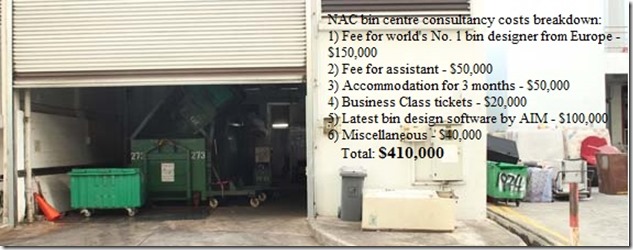
    Secondly, there are plenty of precedents of cases that were given much publicity in the press that led to jail terms to several individuals for lesser amount of money involved, such as the recent case of Hari Raya lighting involving Majlis Pusat. This case involved some inflations of invoices for payments while not going into the pockets of the management team involved, were deemed as CBT worthy cases. And now the expose by the AGO are plenty of worst cases of possibly CBT worthy ones such as the gross inflation of consultation fees of $410,000 for a Bin construction that only cost $60,000. Clearly someone pocketed much public money here.

    For these and many more reasons of consistency and transparency that the public demands accountability by all the Ministers whose Ministries were flagged by the AGO, for the clear failure of oversight.

    What is more fundamental here is the need to call these Ministers to task as they were only a while ago demanding such serious consequences to WP and its leadership for alleged financial lapses involving the AHPETC. Ministers were so bold as to even call for severe action even for hara-kiri as a benchmark for lapses of management of public money. Now these same Ministers have been very silent when they are now caught for much bigger quantum of losses of public money that they are responsible for.

    Singaporeans must not allow the AGO report to go quietly away but must insist that Ministers come clean and explain the serious failures of their own governance of public money and must take the full responsibility for it. Singaporeans remember clearly that these Ministers are paid premium justified precisely on terms that now dictate consequences upon their failures of duty.

    The government must now walk their own talk.


    Source: Damanhuri Abas

  • MCCY And NAC Must Come Clean On Exorbitant Consultation Fees For Bin Centre

    MCCY And NAC Must Come Clean On Exorbitant Consultation Fees For Bin Centre

    The AGO report has revealed lots of lapses, including an eye-popping $410,000 consultancy fee for a $470,000 bin centre.

    Whoever authorised the payment at the National Arts Centre has to be held accountable and the MCCY owes the public an explanation.

    Instead, MCCY Minister Grace Fu defended her subordinate and claimed that it was a “complex” project requiring “significantly more design expertise”. Fu is wrong to assume the public could be taken for a ride easily.

    Should Fu decide to conduct an internal investigation and if it uncovers “more than meets the eye”, the CPIB may need to put in some OT. I am not alleging any wrongdoing but this should not be ruled out as the amount of tax dollars involved is more than 7 times the amount paid by NParks for 26 Brompton bicycles.

    In 2012, former MND Minister Khaw had defended NParks’ purchase without any inside information. Khaw’s knee-jerk defence made him look foolish when CPIB investigations subsequently revealed a NParks’ director had purchased $57,200 worth of bicycles from a friend.

    Fu has got to be kidding by refusing to even conduct an internal investigation. Worse, she insisted on behaving like her SMOS and has started to chut pattern (warning: do not watch video if you feel like puking).

    The $410,000 consultancy fee could have bought 186 Brompton bikes for NParks or 100,000 plates of mee siam without cockles for her boss.

    The following information should be disclosed to public:

    1 The name of NAC director.

    2 The name of the consultant.

    3 The relationship between the consultant and the director

    4 The amount overcharged by the consultant

    5 Action to be taken against director’s overspending of tax dollars.

    So how complex is the construction of NAC’s bin centre? Does it require 56 man-years?


    Source: https://likedatosocanmeh.wordpress.com

  • Osman Sulaiman: Train Defects Saga Shows Limits Of Local Mainstream Media, Lack Of Government Accountability & Transparency

    Osman Sulaiman: Train Defects Saga Shows Limits Of Local Mainstream Media, Lack Of Government Accountability & Transparency

    Most of us would have heard the news about our SMRT trains being exported back to China because of ‘superficial’ hairline cracks.

    Apparently, LTA says that it is of no concern. It tried to downplay the defect. It also mentioned that repair of the trains will take about 7 years and later on clarified that it will take between 3-7 years.

    Interestingly, the news was first reported by foreign media and not by our mainstream media who is supposed to be the citizens first point ofinformation.

    Either they (journalists) are incompetent to sniff out such infos or someone in charge is holding back information to cover up this mess.

    Instead of taking those responsible over these purchases and do a full inquiry, it has decided to keep the matter unknown to the public and hush up these activities (train defects) in an attempt to cover up.

    As these issues involves the life of millions of commuters, it is important that the public is informed of such matters. Afterall, Singaporeans have a stake in the transport system and billions of public funds were used to purchase these trains.

    Our government is never known for its transparency. Where the late LKY would have taken out to dry those responsible over major mishaps, the current leadership has developed a system of shielding those who are responsible.

    Without transparency and a functioning media, we are at the mercy of those who are in position to manipulate the people for its own benefit.


    Source: Khan Osman Sulaiman