Tag: unemployment

  • Unemployment In Singapore Rises, More Workers Made Redundant In Q2

    Unemployment In Singapore Rises, More Workers Made Redundant In Q2

    Amid weaker economic conditions, Singapore’s unemployment rate rose in the second quarter, according to the Ministry of Manpower (MOM).

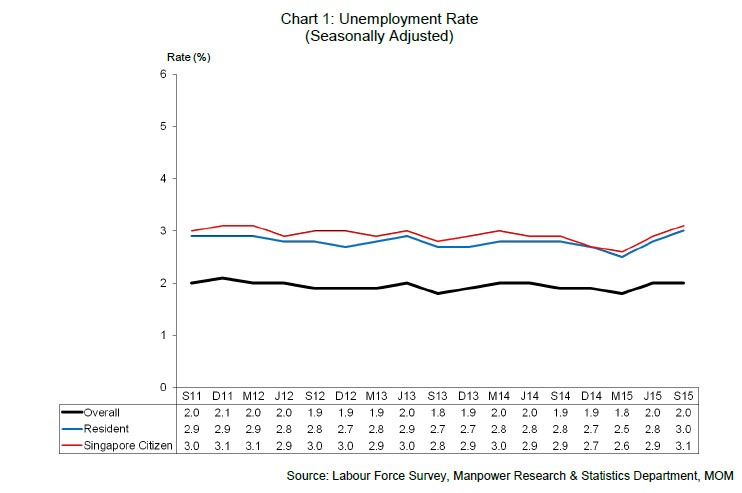
    The overall unemployment rate rose from 1.9 per cent in March to 2.1 per cent in June, figures released in the ministry’s half-quarterly Labour Market report showed. Among citizens, unemployment rose from 2.6 per cent to 3.1 per cent and rose from 2.7 per cent to 3 per cent among residents.

    Unemployment rose further among residents aged 30 and above, and in particular, for those aged 50 and above, which saw unemployment rise for the fifth consecutive quarter. Those with higher qualifications were not spared, with unemployment rates among degree holders rising to their highest level since 2009.

    Total employment grew by 4,200, down from 13,000 in the previous quarter and 9,700 in the same quarter a year ago.

    MORE JOBSEEKERS THAN OPENINGS

    For the first time since June 2012, there were more jobseekers than job openings during the second quarter, according to the report.

    The number of seasonally adjusted vacancies fell from 50,000 in March to 49,400 in June, continuing a downward trend since March 2015. Coupled with the increase in unemployed people, the ratio of job vacancies to unemployed people fell to 93 openings per 100 seekers, compared to 103 in March.

    MORE WORKERS LAID OFF

    A total of 4,800 workers were made redundant during the second quarter, up from 4,710 the previous quarter and 3,250 in the same period a year ago. This was the highest second-quarter redundancy since 2009, which saw 5,980 jobs shed, according to MOM.

    Altogether, 9,510 workers were laid off in the first half of the year, also the highest since 2009.

    Based on Central Provident Fund (CPF) records, 45 per cent of residents laid off during the first quarter re-entered employment by June, the lowest rate since June 2009, the ministry said.

    Responding to the Manpower Ministry’s half-quarterly Labour Market report, NTUC Assistant Secretary-General Cham Hui Fong, said: “While we continue to see slower growth in employment and anticipate that more workers may be made redundant in the coming months, we noted that total employment continued to grow with improvement in productivity. Hence, to ensure sustainable employment growth, we need to push for higher productivity via jobs redesign or re-skilling.”

    Ms Cham added that according to the latest JobsBank statistics, there are more than 60,000 job vacancies across different sectors. “NTUC will work with the tripartite partners to encourage working people to attend relevant training programmes so that they are equipped with the right skills to take on the available jobs as the economy restructures,” she added.


    Source: ChannelNewsAsia

  • Employment Growth In First 3 Quarters Of 2015 Lowest In 6 Years

    Employment Growth In First 3 Quarters Of 2015 Lowest In 6 Years

    Jobs growth in Singapore remained low in the third quarter of 2015, with unemployment rising slightly for residents and citizens, according to figures released in the Ministry of Manpower’s (MOM) latest Labour Market Report.

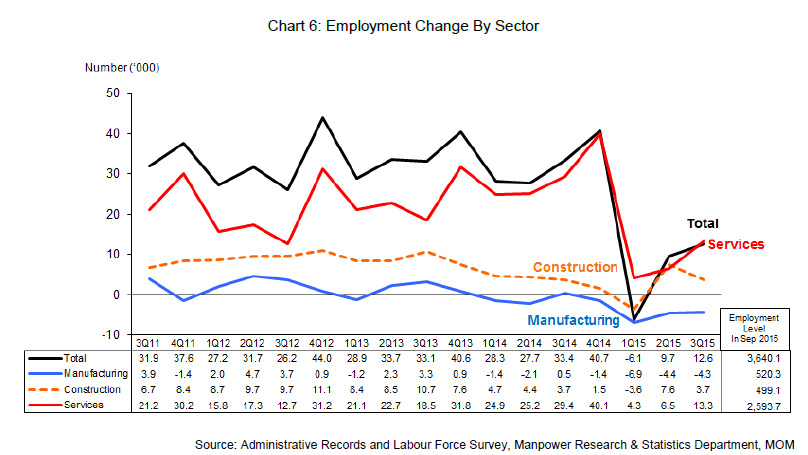
    From July to September this year, total employment grew by 12,600, which is higher than the preceding quarter’s growth of 9,700 but significantly lower than the increase of 33,400 from the corresponding period last year.

    According to MOM, the cumulative employment growth for the first three quarters of this year was 16,200, which is the lowest growth since 2009.

    The employment gains were driven by increases in the services sector, with the wholesale and retail trade, real estate services, construction and manufacturing sectors all cutting back on employment.

    Overall unemployment remained low at 2.0 per cent, but rose slightly for the second consecutive quarter to 3.0 per cent for residents and 3.1 per cent for citizens.

    More workers were laid off in the third quarter, with 3,460 losing their jobs. This is higher than the 3,250 laid off in the second quarter of 2015.

    A significant majority, or seven out of ten, residents laid off in the quarter were from the professionals, managers, executives and technicians (PMET) group, according to MOM.

    Even though there were still more vacancies than people looking for work, the ratio has moderated with the number of seasonally-adjusted vacancies declining over the quarter by 11 per cent.

    This has brought down the job openings to job seekers ratio to 116 openings per 100 seekers, which is comparable to the level in Jun 2013.

    An estimated 56,700 residents, comprising 51,100 Singaporeans, were unemployed in Sep 2015, up from 52,700 residents unemployment in Sep 2014, MOM said.

    Responding to the figures, Ms Jaya Dass, country director for HR services provider Randstad Singapore, said that the government’s focus on increasing productivity and transitioning to a more service and quality-based economy is making Singapore less manpower-reliant. “These initiatives, coupled with the slowdown in core sectors like manufacturing and construction, have contributed to slower employment growth,” she said.

    However, she added that initiatives to deepen the skills of Singaporean workers, such as SkillsFuture, will provide better career opportunities in the coming year.


    Source: http://business.asiaone.com

  • Hard Truth: More Graduates But Not All Degrees Are Equal

    Hard Truth: More Graduates But Not All Degrees Are Equal

    After graduating with a second-class upper degree in human resource management, Mr Tan, 30, took some time to land a full-time job and he is currently doing administrative work — buying office supplies and processing claims. “I wished that we were taught more skills in university instead,” he said.

    Another graduate, Mr Tang, 27, who has a chemistry degree, has been working in an admin support temporary position for the past 18 months. “Unlike our parents’ time, it seems like there are many people holding a degree now but the fact is there are many jobs out there that do not require a degree holder to do the work.”

    On the other hand, there are graduates who have, by their own volition, ventured into careers that have little to do with what they had studied for in university. A PhD holder in biomedical sciences, Dr Christopher Yang, was a research fellow at the National University of Singapore’s Yong Loo Lin School of Medicine when he made the switch into the financial sector four years ago.

    The 41-year-old said his biomedical career was going well, having received a grant to advance immunology research. But a series of circumstances — including the outlook of the industry, and the birth of his fourth child — led to him making the career switch. “I had to seriously think about my career path and prospects,” said Dr Yang, who is now an accredited financial adviser.

    In Asia, Taiwan and South Korea, have been experiencing an oversupply of graduates, with double-digit youth unemployment rates. In contrast, Singa­pore enjoys close to full employment, and more than 80 per cent of graduates from publicly-funded universities and the more-established private institutions are able to find jobs within six months of graduation.

    Nevertheless, policymakers are keeping a close eye on the situation. Anecdotal evidence from interviews with graduates and human resource experts shows that even though large numbers of graduates are able to land jobs, some are underemployed, be it by choice or circumstance.

    Underemployment occurs when highly-skilled people work in low-paying or low-skilled jobs, as well as when part-time workers prefer to be employed full-time.

    Internationally, underemployment is hard to define because of the subjectivity involved — such as a worker’s preference and whether qualifications equate to skills and performance.

    In October 1998, following an international conference among labour statisticians, the Organisation for Economic Co-operation and Development decided to adopt “time-related underemployment” as the universal indicator for objective comparison across countries.

    Singapore’s Ministry of Manpower (MOM) uses the same indicator, which measures the proportion of part-time workers who desire to work more. Over the years, the overall proportion of underemployed graduates has stayed low, hovering around 2 per cent and reaching a three-year low last year. However, the underemployment rates for the arts as well as social services sectors stood at 9.3 and 6.4 per cent, respectively.

    Still, the overall underemployment rate here is significantly lower than in other developed countries. In the United Kingdom, for instance, one in 10 people are considered underemployed as of last year. In the United States, the proportion is 15 per cent as of March.

    Last year, then-Manpower Minister Tan Chuan-Jin flagged the issue as one to watch: “While we are not facing the unemployment and underemployment problems in other countries, we will not be immune to these trends … The proportion of degree holders in our workforce has been increasing.”

    He added: “The market has begun to differentiate between degrees that carry their full worth in knowledge and skills, and those that are essentially paper qualifications. We should, therefore, encourage our young to pursue their interests and go for substance when considering their education and career paths”.

    Agreeing, Mizuho Bank senior economist Vishnu Varathan said that, over time, the situation could be exacerbated by the exit from the workforce of baby boomers holding high-value-added jobs. With economic restructuring and as part of the evolution of the labour market, Mr Varathan said: “Not all of these jobs will be recycled back to the younger generation.”

    He noted that while attractive salaries — as a result of the tight labour market — could keep part-time workers content for now, the current level of wages for part-timers might not be sustainable in the long-term.

    Difficulties in measuring underemployment

    In order to ensure Singapore keeps a lid on the situation, Nee Soon GRC Member of Parliament Patrick Tay, who is part of the labour movement, has repeatedly raised the issue of underemployment in Parliament.

    Speaking to TODAY, he said the Government should re-examine the conceptual definition of underemployment and how it is measured. He suggested conducting a comprehensive survey for the various industry sectors to understand the required worker competencies or skills for specific jobs and whether the people holding these jobs are over-qualified.

    “There is currently a lack of data and a survey will help us assess the real extent of the underemployment problem,” he said.

    Human resource expert Linda Teo, who is country manager of ManpowerGroup Singapore, also stressed the need to analyse data on the pool of underemployed workers. She said: “Could it be a case where their qualifications are no longer relevant? Or that the affected workers have not upgraded themselves and kept up with the challenges in the industry?”

    Nanyang Technological University (NTU) economist Walter Theseira pointed out that underemployment is a growing area of research in many countries, given that the number of people around the world with advanced qualifications is higher than ever before.

    But he noted that it would require extensive efforts to conduct a study on what is essentially a grey area. It would involve, for example, looking at each job and its role and getting experts to determine the type of qualifications required. “What do you call the right level of education for a job? Workers can make up for a lack of formal qualifications with experience and other skills, so the right level of education may differ from person to person,” he said.

    Mr Varathan agreed that such an endeavour would be fraught with difficulties. Assumptions have to be made, including assuming that qualifications equate to job capabilities, he said. Also, “there is always the possibility that people think they are underpaid for a job”, he quipped.

    To better understand the underemployment situation, he proposed using productivity figures alongside unemployment data to determine if the labour force is being tapped to its full potential.

    In response to TODAY’s queries, MOM said that due to the subjectivity involved, there was no internationally established method for measuring non-time-related underemployment. Its spokesperson pointed out that MOM also tracks labour utilisation and employment outcomes, and that information on employment by occupation and education qualifications is collated and made available publicly.

    Nevertheless, the ministry acknowledged the spike in the number of degree holders here as well as the “increasing access to private educational institutions or alternative routes that offer degrees of varying quality”.
    Its spokesperson said: “We need to help individuals equip themselves with the skills needed to take on the quality jobs of today and tomorrow.”

    To this end, the SkillsFuture Council, chaired by Deputy Prime Minister Tharman Shanmugaratnam, was launched in September last year to spearhead efforts to develop an integrated system of education, training and career progression for Singaporeans. “Overall, we have to create a culture where workers are motivated and able to continually acquire relevant skills and experience that will help them advance in their careers,” the MOM spokesperson said. “This includes degree holders, who must also take ownership of their individual career and training development throughout their lives.”

    Singapore labour force statistics by the Ministry of Manpower
    Employees must be skilled in multiple disciplines

    The MOM’s labour force report last year showed that the proportion of degree holders grew by more 10 per cent over a decade to 32 per cent last year. In particular, degree holders made up more than half of local workers aged 25 to 39 last year.

    The report also showed that degree holders with qualifications in education (0.7 per cent), health sciences (1.7 per cent) and engineering sciences (2.8 per cent) had the lowest unemployment rates as of June last year, and were well below the average for all residents (3.7 per cent).

    At the other end, graduates of the fine and applied arts (6.2 per cent), mass communication and information science (6 per cent), and humanities and social sciences (5.3 per cent) had higher unemployment rates than the norm.

    Over the past year, Will (not his real name), 29, had sent out more 100 applications, but the sociology undergraduate — who will be graduating this year — has yet to secure a full-time job. He enrolled in a part-time degree course offered by a private university three years ago, spending S$23,000 on fees in a bid to boost his employability. “I thought getting a degree would help me move up the career ladder, but it did not,” he said.

    But he is in the minority, though there are concerns among policymakers about students spending much time and effort in getting private degrees, only to realise later that their degrees are irrelevant to the job market.

    Graduate unemployment here remains low. As of June last year, the graduate unemployment rate was 3.9 per cent, marginally up from 3.6 per cent in 2013.

    Human resource experts advised Singaporeans to be more selective in the type of degrees that they pursue. Increasingly, employees have to diversify their skills sets to stay relevant to the labour market, they said.

    NTU’s Assistant Professor Theseira noted that while everyone might aim to attain a degree, “not all degrees are created equally”. Mr Varathan pointed to the increasing number of degree holders in regional countries who could provide stiff competition in the job market here. Having working experience alongside qualifications will also start to gain traction among employers, he said.

    ManpowerGroup’s Ms Teo urged industries and universities to put in more effort to address misconceptions about unpopular jobs.

    “Getting students to explore a wide spectrum of careers and piquing their interest in lesser-known but very viable career alternatives can go a long way in nipping underemployment in the bud,” she said.

    Mr Adrian Tan, director of Career Ladder, a career consulting firm, recounted meeting mid-career professionals such as engineers who had to take on entry-level roles after their expertise became obsolete. He said that in the future, employees have to be skilled in multiple disciplines and should find opportunities to apply these new skills even outside of work. “The old career expectation is no longer relevant. You can’t depend on your qualifications and expect your career journey (to be) catered to until your retirement,” he added.

    Paradoxically, it is partly this desire to develop himself and pick up new skills that saw Dr Yang take the leap into a second career that has little to do with his degree in biomedical sciences.

    He recalled how he had taken a 50 per cent pay cut when he first became a financial adviser and had to pound the streets, approaching strangers as he looked for potential clients. He has few regrets leaving the biomedical sciences industry. Now, he is able to provide for his family and his flexible work schedule allows him to spend more time with his children.

    Experts noted that, increasingly, workers — especially younger ones — may opt for jobs for which they are over-qualified, in the name of pursuing their passion, greater work-life balance or other intangibles. For instance, Gen Y employees tend to prefer to work in well-known companies and have “low reliance on monetary benefits”, observed Mr Mark Hall, vice-president of staffing agency Kelly Services.


    Source: www.todayonline.com

  • Positive Outlook For Singapore Economy In Immediate Future

    Positive Outlook For Singapore Economy In Immediate Future

    With a strong pipeline of investments, the overall outlook for Singapore looks positive in the immediate future, said Minister for Trade and Industry Lim Hng Kiang.

    However, he also cautioned that Singapore faces some challenges in the immediate one to two years – these include an ageing population and the task of matching Singaporeans’ aspirations.

    Mr Lim was speaking during a visit to the Braddell Heights ward on Sunday (Feb 1) – his first visit in 20 years. During a dialogue with residents of the ward, he was asked for his take on Singapore’s future economy and population.

    Citing a 2011 World Bank study of 101 middle-income countries, Mr Lim noted that Singapore was one of just 13 countries that managed to move from middle- to high-income, over a period of 50 years.

    But he stressed that Singapore still has to be cautious: “What it means for us as we celebrate 50 years is – number one, it is not very easy to become a high income country; and number two, it is also not very easy to stay there.

    “There is a lot of competition and if you mismanage like some countries – for example Greece – you can drop very quickly and the drop need not be gradual, it can be a very severe drop over a period of five years. As we look after Singapore and we look to our future, let us be careful and reinforce those things which make us successful. Let us also be careful not to fall down the slippery slope and end up with such problems.”

    With investments coming into Singapore and local companies investing overseas, Mr Lim said he is confident that the country will be able to maintain steady growth of between two and four per cent. This is because of Singapore’s strong pipeline of investments, the Economic Development Board still being able to attract investments to Singapore, and Singapore companies investing overseas – which allow them to generate good jobs with their headquarters in Singapore to look after their overseas subsidiaries.

    However, he cautioned that there may be some ups and downs. One challenge is the slowdown in Europe, China and Japan’s economic engines.

    “We have to find new opportunities for our companies. But overall, we are still optimistic that we can generate the jobs and the big challenge now is how to match Singaporeans with these jobs,” said Mr Lim.

    “HUMAN RESOURCE IS THE BEST AND ONLY RESOURCE WE HAVE”

    Thus the need for Singapore’s focus on education and training. “Human resource is the best and only resource that we have. Other resources, like land and energy, will face greater constraints. If you look at what we’ve achieved in the last 50 years and look ahead to the next 50 years, there’s optimism we can do more,” said Mr Lim.

    He cited how in 1966, only half of Singaporeans continued education past the primary six level. This is reflected in a high percentage of the current workforce having primary and secondary level qualifications.

    But Mr Lim noted that this demographic has changed – more than 50 per cent of those who are under 30 and entering the workforce are now graduates. Another 30 per cent are polytechnic graduates, with less than 15 to 20 per cent having primary or secondary school qualifications.

    He said that while an increasingly educated workforce is welcomed, this poses challenges as well and the economy has to adapt: “If your restaurants depend currently on the older workers with less education to be serving them – 10 to 15 years from now, these people will not be in the workforce. Your new workforce are polytechnic diploma holders and graduates. Therefore, you have to restructure your service industry to cater for this new profile of workers.

    “In MTI and MOM, we are very concerned and we study all these statistics very carefully… The objective given to us is to make sure we are able to restructure the economy, make sure we can generate good jobs that satisfy and meet the aspirations of our new workers.”

    About 280 people attended the dialogue, which lasted for over an hour. Questions ranged from Singapore’s education system, to changing consumer habits and the Central Provident Fund. One participant also asked what the role of SMEs looks like in Singapore’s future. Mr Lim said that moving forward, it will be key to have a strong pipeline of startups and SMEs, and to facilitate local SME tie-ups with big companies and foreign SMEs.


    Source: www.channelnewsasia.com

  • Foreign-Born Singapore Citizen Thinks More Singaporeans Now Think They Are Owed A Living

    Foreign-Born Singapore Citizen Thinks More Singaporeans Now Think They Are Owed A Living

    From “overfussiness” and complacency to an inability to accept criticism, many things about Singaporeans’ attitudes to work irk Mr Victor Mills. The Northern Ireland-born Singapore citizen, 55, who took over as chief executive of the Singapore International Chamber of Commerce (SICC) last June, speaks his mind to Walter Sim.

    What was your first impression of Singapore when you arrived 30 years ago?

    When I graduated (with a master’s in East European Political Science from the University of London), it was during a major recession and there were no jobs.

    So I joined an international bank and was first posted to Hong Kong, and then Singapore in 1985.

    What really impressed me about Singapore was that it preached good race relations – and actually had them.

    This was different when compared to Northern Ireland (which had a lot of political violence at the time due to the Protestant and Catholic conflict) and it was the first thing that struck me about Singapore.

    What also struck me, which we have since lost, is that Singapore was much more egalitarian and relaxed back then.

    People didn’t wear suits. They certainly didn’t wear ties – even the Government or businessmen. Anybody could talk to anybody.

    How have things changed?

    We’re now going through a period I saw in Hong Kong in the 1980s.

    The level of materialism – what you wear, where you live, what you drive, what you wear on your wrist – has become a key determinant of the value of human life. This is absolute nonsense.

    But it’s the unintended consequence of the fantastic economic success which we have enjoyed. In our headlong rush for more money, a lot of values seem to have been lost.

    The ability to communicate with anybody else is less evident, and people now, generally, want to interact only with people of their own perceived social group.

    So we’re now a more stratified and polarised society, which is why you hear people longing for the return of the kampung spirit.

    What impact does Singapore’s success have on workplace attitudes?

    There are lots and lots of people – more than before – who feel that life, their employer and the Government owe them a living.

    This has manifest itself in an overfussiness or a sense of entitlement which businesses, whether large or small, foreign or local, have been telling me about.

    They all say the same thing. The problem may vary in degrees in different sectors, but it exists across all sectors.

    But please don’t get me wrong. There are hundreds of thousands of my fellow citizens who do a fabulous job, day in and day out.

    One issue that has become a challenge for many businesses is excessive job-hopping. This has come about only because of our economic success and a very tight labour market.

    I have seen one extreme example in the SICC. We had employed an assistant finance manager who had a lovely personality with all the right experience and skills.

    We thought we hit gold. But she turned up for work for just one day and then disappeared.

    When we tracked her down a few days later – she was not answering her phone – she said: “It just wasn’t for me.”

    But my response was: “How could you possibly know after just one day? You are not giving yourself or the organisation a chance.”

    It’s an extreme case, but there are just too many stories of people leaving their jobs after a couple of months. I’ve not seen so many morose people in the workforce.

    All this job-hopping is stressful, and it doesn’t produce a lot of happiness. Yes, it may give $50 to $100 more in the pay packet but it doesn’t produce satisfaction.

    It is fine to say: “Look, I’ve given this 18 months, two years and it’s not for me. I’ve tried everything and raised issues. But it’s time to move on.”

    That’s healthy. What is unhealthy is not turning up for work because you don’t like it.

    It’s bad for businesses because it increases costs unnecessarily. The churn is just constant, and they have less time to focus on executing their business strategies.

    What other issues have you observed?

    Another problem is the unwillingness to accept feedback, even when given constructively.

    The attitude now is that if you don’t like me, I’ll go. People think they are great and are unwilling to believe that they can learn something as an employee.

    Distance is also another issue.

    I know of an industrial fragrance company which invested $25 million in Singapore. But they could not get a Singaporean to do the job. No matter what they paid, there were no takers because there was no direct bus or train. Also, nobody could tahan (Malay for tolerate) the smell at the plant.

    I think all this is very disappointing. This was not the case 30 years ago. People then were very hungry for a job, and so they were willing to work. And worked hard.

    So all this suggests that people have a misplaced sense of entitlement, but not necessarily retained a sense of responsibility.

    Instead of a two-way street, the employer has to do all the walking. Some employees are not prepared to even meet their employers halfway.

    It’s only because we are so successful that we have a prevalence of these attitudes. People are no longer hungry enough.

    But now, if we have – God forbid – a dreadful recession or some cataclysmic event that curtails employment opportunities, I have every confidence in the pragmatism of my fellow Singaporeans that they will change tack and attitudes.

    How is Singapore unique in the workplace issues that you have observed? Don’t most, if not all, mature cities face such problems?

    There are those who say we have to accept this as a way of life and that we cannot do anything, that a tight labour market produces this sort of behaviour.

    I do not agree with that.

    We are a city-state and cannot behave like another developed country, which can rely on something else happening in a different sector or a different part of the country.

    There is a school of thought that the days of Singapore’s vulnerability are over. But my contention is that Singapore will always be vulnerable. This is because of our size and the geopolitical space where we are located. It will not take much to upset the very delicate balance we have spent 50 years building.

    So we have to be careful in order to sustain our society and way of life. Singapore is an incredibly special place, and not enough of my fellow Singaporeans realise that. We cannot afford complacency because, without a vibrant economy, we can’t exist as a society.

    What repercussions will Singapore face if the negative workplace attitudes persist?

    Our neighbours have not only caught up with us, but are now much more nimble than before.

    They’re capable of producing good-quality talent who can produce good output consistently. They also have a more realistic assessment of remuneration.

    I met a 29-year-old US Silicon Valley technopreneur last year who first came to Singapore in 2012 to launch a start-up.

    But when he arrived, he discovered many problems – among them was a shortage of good IT developers, unrealistic remuneration expectations. He was also disappointed with the quality and quantity of output.

    He cut his losses within one year and moved to Jakarta after having tried everything, including counselling his staff.

    So how can the Economic Development Board say “Come to Singapore, we’ve got the right workers” when companies will very quickly find out that, in large numbers, we do not?

    We need to watch our attitudes because it is indicative of our attractiveness as an investment opportunity on a sustainable basis.

    On salary expectations, Singapore has much higher standards of living than its immediate neighbours. Is it really unfair to expect more?

    That is a fair point. Of course, we have a more expensive lifestyle and the cost of living is higher, but we must make sure it does not get to the point where it undermines our competitiveness.

    This is why the Government has been putting in so much energy to communicate, and facilitate an increase in productivity.

    We need to sit down and talk about how to help people make that mindset change.

    It’s not meant to be some kind of highfalutin, ivory-tower academic debate. These are real rice-bowl issues!

    You have also been a passionate champion against workplace ageism. How big of a problem is it?

    Many talented people above 40, especially PMETs (professionals, managers, executives and technicians) who lose their jobs due to economic restructuring, cannot find jobs due to an extraordinary degree of ageism here.

    HR managers would look at their CVs and think they are too senior and probably stuck in their ways. But age is not the issue here. Rather, it is their skills, experience, capabilities and, above all, their potential.

    Admittedly among this group are people who do not want to take a pay cut because they think they are going to lose face. Or they do not believe in continual learning because they think that’s for young folk. That is wrong. Those attitudes must change too.

    How do you think Singapore could do better in the way it crafts its manpower or workplace policies?

    I don’t think we are lacking in policies, though I sometimes think we are lacking in their execution.

    Our manpower policy is a classic example, because it is a one-size-fits-all blunt instrument. What we need is a much more focused sectoral approach, and an honest assessment of which sectors Singaporeans want to work in and which sectors they do not want to work in.

    The policy itself is clever because it tries to wean businesses off a 30-year addiction to foreign labour, and a real effort to force companies to think about how to improve their processes.

    We cannot just hire an extra body anymore. But we must realise we are in danger of wage inflation if we keep the mistaken belief that if you pay more, Singaporeans will do these jobs.

    That may be so for some jobs, but for the vast majority that Singaporeans are not doing today, it’s because people have taken the conscious decision not to do those jobs.

    So it becomes a double whammy for businesses.


    Source: http://news.asiaone.com