Tag: US

  • American Professor At LKYSPP, Huan Jing, Identified As ‘Agent Of Influence Of A Foreign Country’

    American Professor At LKYSPP, Huan Jing, Identified As ‘Agent Of Influence Of A Foreign Country’

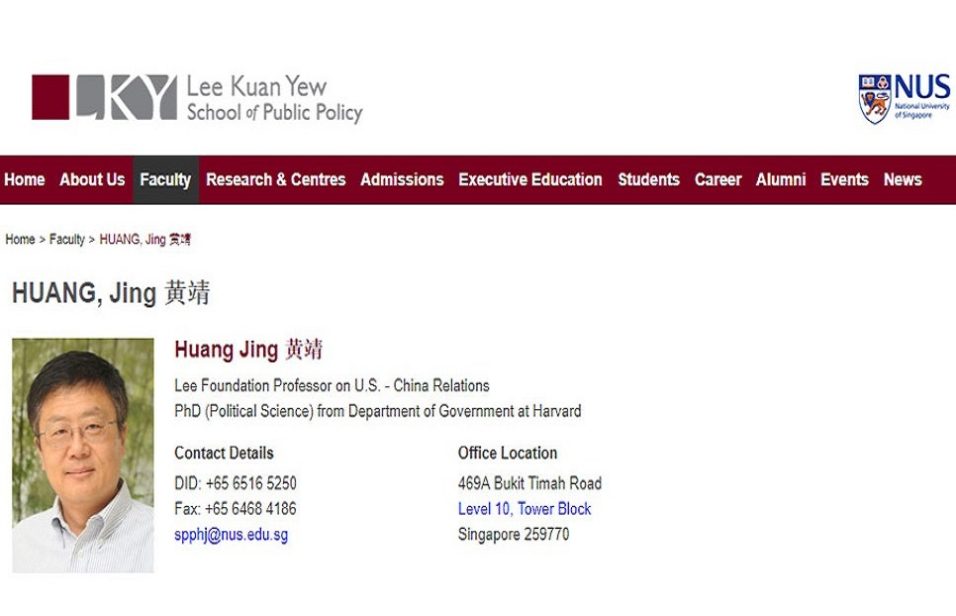
    A senior academic from the Lee Kuan Yew School of Public Policy (LKYSPP), Professor Huang Jing, has been identified as “an agent of influence of a foreign country,” announced the Ministry of Home Affairs (MHA) on Friday (Aug 4).

    “He knowingly interacted with intelligence organisations and agents of the foreign country, and cooperated with them to influence the Singapore Government’s foreign policy and public opinion in Singapore,” said MHA in a news release, without naming the foreign country.

    It added that Prof Huang, who is LKYSPP’s Lee Foundation Professor on US-China relations, gave what he claimed was “privileged information” about the foreign country to prominent and influential Singaporeans, with the aim of influencing their opinions in favour of that country.

    Among those who Prof Huang gave the “privileged information” to was a senior member of LKYSPP, said MHA, without naming the person. LKYSPP is a postgraduate school of the National University of Singapore.

    “The information was duly conveyed by that senior member of the LKYSPP to very senior public officials who were in a position to direct Singapore’s foreign policy. The clear intention was to use the information to cause the Singapore Government to change its foreign policy,” said MHA.

    “However, the Singapore Government declined to act on the ‘privileged information.”

    According to his profile on the school’s website, Prof Huang, who is an American citizen, has published extensively on subjects such as US-China relations, Chinese elite politics, China’s development strategy and foreign policy, Sino-Japanese relations and security issues in the Asia Pacific.

    Apart from the numerous journal articles he has written, Prof Huang, who was director of the Centre on Asia and Globalisation, also edited books on subjects like China’s Taiwan policy, the South China Sea dispute and China-India relations.

    His opinion pieces and columns have appeared in newspapers including Global Times, The Straits Times and Lianhe Zaobao. He has also appeared on Channel NewsAsia.

    “Huang used his senior position in the LKYSPP to deliberately and covertly advance the agenda of a foreign country at Singapore’s expense. He did this in collaboration with foreign intelligence agents,” said MHA. “This amounts to subversion and foreign interference in Singapore’s domestic politics.”

    According to MHA, Prof Huang recruited others to aid his operations. It added that his wife, Shirley Yang Xiuping, was aware of what he was doing.

    The Singapore Permanent Residency of Prof Huang and his wife – both US citizens – have been cancelled by Singapore authorities.

    “Huang’s continued presence in Singapore, and that of his wife, are therefore undesirable. Both will be permanently banned from re-entering Singapore,” said MHA.


    “MATTER OF SERIOUS CONCERN”: NUS

    The National University of Singapore (NUS) said Prof Huang has been suspended without pay with immediate effect.

    “This is a matter of serious concern,” said an NUS spokesperson. “NUS does not tolerate such acts of foreign interference, even as we continue to value and uphold the diverse and international character of our university.”

    The spokesperson also said that Prof Huang’s employment at NUS is conditional on the necessary permits for working in Singapore. “As these permits have been cancelled, we would not be able to continue with his employment.”

    The statement added that LKYSPP is cooperating fully with MHA. “As this matter relates to national security, the university is unable to comment on the details of the case,” said the spokesperson.

    Prof Huang also sits on the board of many organisations, including Singapore’s Keppel Land. When contacted for comment, a Keppel Land spokesperson said: “We have just been alerted to this development and will be looking into the matter.”


    Source: www.channelnewsasia.com

  • Man Wears American-Flag Polo While Taking National Day Photo With PAP MP?

    Man Wears American-Flag Polo While Taking National Day Photo With PAP MP?

    Dear All Singapore Stuff,

    Please see the attached photo. PAP is celebrating Singapore’s national day and US Independence Day in August.

    The guy on the National Day banner next to the PAP MP is wearing a shirt with the USA flag.

    Grassroots leader forgot which flag is Singapore’s?


    Source: www.allsingaporestuff.com

  • Trump Described Islam As “One Of The World’s Great Faiths” And Called For Tolerance And Respect For Each Other

    Trump Described Islam As “One Of The World’s Great Faiths” And Called For Tolerance And Respect For Each Other

    US President Donald Trump on Sunday (May 21) pivoted away from his strident assessment of Islam as a religion of hatred as he sought to redefine US leadership in the Middle East and rally the Muslim world to join him in a renewed campaign against extremism.

    Addressing dozens of leaders from across the Muslim world who had gathered in Saudi Arabia, Mr Trump rejected the idea that the fight against terrorism was a struggle between religions, and he promised not to scold them about human rights in their countries. But he challenged Muslim leaders to step up their efforts to counter a “wicked ideology” and purge the “foot soldiers of evil” from their societies.

    “This is not a battle between different faiths, different sects or different civilisations,” Mr Trump said in a cavernous hall filled with heads of state eager to find favour with the new president. “This is a battle between barbaric criminals who seek to obliterate human life and decent people, all in the name of religion, people that want to protect life and want to protect their religion. This is a battle between good and evil.”

    The president’s measured tone here in Saudi Arabia was a far cry from his incendiary language on the campaign trail last year, when he said that “Islam hates us” and called for a “total and complete shutdown” of Muslims entering the United States.

    Throughout his visit here, a less volatile president emerged, disciplined and relentlessly on message in a way he is often not at home. He did not brag about his electoral victory and avoided tangents. With few exceptions, he stuck carefully to his teleprompter. His mood has been sober and careful.

    By refusing to hold news conferences or answer questions during brief photo opportunities, Mr Trump orchestrated a sense of diplomatic calm that contrasted sharply with the chaos that usually surrounds him in Washington. He has not used Twitter as a cudgel against adversaries since his overseas trip began.

    In his speech on Sunday, he made no mention of the executive orders he signed after taking office barring visitors from several predominantly Muslim countries. Instead, he described Islam as “one of the world’s great faiths” and called for “tolerance and respect for each other”.

    While in the past, Mr Trump repeatedly criticised President Barack Obama and others for not using the phrase “radical Islamic terrorism”, his staff sought to ensure that he would not use it before this Muslim audience. The final draft of the speech had him instead embracing a subtle but significant switch, using the term “Islamist extremism”. Islamist is often defined to mean someone who advocates Islamic fundamentalism, and some experts prefer its use to avoid tarring the entire religion.

    When that moment in the speech came, however, Mr Trump went off script and used both words, Islamic and Islamist. “That means honestly confronting the crisis of Islamic extremism and the Islamists and Islamic terror of all kinds”, he said. An aide said afterward that the president was “just an exhausted guy” and had tripped over the term, rather than rejected the language suggested by his aides.

    But if the speech during the second day of a nine-day overseas trip was intended as a sort of reset from his campaign and early presidency, it was also meant to turn away from Mr Obama’s approach. Rather than preach about human rights or democracy, Mr Trump said he wanted “partners, not perfection”. And he said it was up to Muslim leaders to expunge extremists from their midst.

    “Drive them out,” he said. “Drive them out of your places of worship. Drive them out of your communities. Drive them out of your holy land. And drive them out of this earth.”

    Mr Trump received a warm welcome in the room as Muslim leaders put behind them the messages of the campaign and the attempted travel ban, and he has gotten along well with fellow leaders, who have turned to flattery.

    “You are a unique personality that is capable of doing the impossible,” President Abdel-Fattah el-Sissi of Egypt told him.

    “I agree!” Mr Trump responded cheerily, as laughter rolled through the room.

    A few moments later, Mr Trump returned the compliment, in a fashion. “Love your shoes,” he told Mr el-Sissi. “Boy, those shoes. Man!”

    But some activists back in the United States gave the president mixed reviews at the start of his trip.

    “While President Trump’s address today in Saudi Arabia appears to be an attempt to set a new and more productive tone in relations with the Muslim world, one speech cannot outweigh years of anti-Muslim rhetoric and policy proposals,” Mr Nihad Awad, the executive director of the Council on American-Islamic Relations, said in a statement.

    The speech was meant as a centrepiece of Mr Trump’s two-day stay here before he heads to Jerusalem early Monday, and it was part of a larger drive to plant the United States firmly in the camp of Sunni Arab nations and Israel in their confrontation with Shiite-led Iran. To firm up such a coalition, he spent hours meeting individually with leaders from Egypt, Bahrain, Qatar and Kuwait, then with more Muslim leaders in larger groups.

    “This administration is committed to a 180-degree reversal of the Obama policy on Iran,” said Mr Mark Dubowitz, the chief executive of the Foundation for Defence of Democracies, a nonprofit research organisation in Washington. “They see the Iranian threat as fundamentally linked to the nature and behaviour of the regime and its revolutionary and expansionist ideology.”

    Mr Trump toured the new Global Centre for Combating Extremist Ideology in Riyadh, which employs 350 technicians tracking online radicalism and monitoring 100 television channels in 11 languages. The Trump administration and Saudi Arabia also announced the creation of a joint Terrorist Financing Targeting Centre to formalise long-standing cooperation and search for new ways to cut off sources of money for extremists.

    Mr Trump made little mention of human rights in any of the meetings, and he promised in his speech not to do so publicly. “We are not here to lecture,” he said. “We are not here to tell other people how to live, what to do, who to be, or how to worship. Instead, we are here to offer partnership — based on shared interests and values — to pursue a better future for us all.”

    That approach drew bipartisan criticism back in Washington. “It’s in our national security interest to advocate for democracy and freedom and human rights,” Senator Marco Rubio, R-Fla, said on CNN’s State of the Union. On the same program, Representative Adam B Schiff, D-Calif., called it “a terrible abdication of our global leadership”.

    Ms Michele Dunne, the director of the Middle East programme at the Carnegie Endowment for International Peace, said the president had laid blame for terrorism on Muslim leaders who he says have not done enough. “There are elements of truth to Trump’s narrative,” she said, “but it ignores the deeper grievances, the political and economic injustices, that make young people in the region especially susceptible to extremist ideologies at this particular time.”

    And yet the change in the president’s tone about the relationship between Islam and terrorism was striking. As he assailed Mr Obama last year for not using the phrase “radical Islamic terrorism”, Mr Trump asserted that “anyone who cannot name our enemy is not fit to lead this country.” He used the phrase again in his inaugural address in January.

    Even after Lt General H R McMaster, the national security adviser, told his staff that the phrase was problematic and should not be used, the president defiantly repeated it days later in an address to a joint session of Congress.

    Still, Lt Gen McMaster said in an interview broadcast on ABC’s This Week on Sunday that Mr Trump had been listening to the Muslim leaders he has met since becoming president and understood their views better. “This is learning,” Lt Gen McMaster said.

    Secretary of State Rex W Tillerson told reporters, “The president clearly was extending a hand, and understanding that only together can we address this threat of terrorism.”

    While Mr Trump’s administration is still appealing court rulings that blocked his temporary travel ban, the president has not publicly raised the issue as much lately, and the page on his campaign site calling for the “total and complete shutdown” of Muslim immigration has been taken down.

    Some advisers who advocated stronger action and language about what they call the Islamic threat have either left the administration or faded in influence. Mr Michael T Flynn, McMaster’s predecessor as national security adviser, was fired for other reasons. Mr Stephen K Bannon, the president’s chief strategist, has lost sway. And Mr Sebastian Gorka, a deputy assistant to the president, has been reported to possibly be leaving the White House at some point.

    Even so, the hard-liners found enough to be happy with in the speech. After the president was finished on Sunday, Mr Gorka wrote on Twitter: “After 8yrs disastrous terror-enabling policies we now have @POTUS: ‘We r going 2 defeat terrorism & send its wicked ideology in2 OBLIVION.’” NEW YORK TIMES


    Source: http://www.todayonline.com/world

  • Shanmugam Calls On US And World To Pay Attention To Radicalism In SEA

    Shanmugam Calls On US And World To Pay Attention To Radicalism In SEA

    Singapore’s Minister for Home Affairs, K Shanmugam, has called on the United States (and the world) to pay attention to the rise of “political Islam” and radicalism in Southeast Asia. Mr Shanmugam, who was delivering a keynote speech in Washington DC on Wednesday at the Johns Hopkins University School of Advanced International Studies, said the international community must come together and go beyond focusing on “downstream consequences” of the issue and address “the underlying philosophy and the underlying causes.”

    Mr Shanmugam has been sounding the alarm on the problem in Southeast Asia especially in recent years, pointing out terrorists’ activities in Malaysia, Indonesia and the southern Philippines for particular concern.

    Below is his speech in full:

    The Conflict in Syria and Radicalisation in Southeast Asia

    The underlying point I want to make is this. To deal with Islamic State (IS) in the Middle East, Syria and Iraq, assuming there is a kinetic solution, it will be a continuum and there is going to be much more because the ideology is not dead, and it is going to get on to other places.

    It has seeped into the rest of the world, and they are just going to look for more opportunities to convert other areas, going there and look for new converts, new areas to radicalise.

    Why do I say that? Because I come from a region, South-east Asia, (that) has arguably the largest Muslim concentration in the world, and it has been an area of particular focus for IS. Al-Qaeda probably is also building up its strength. They are not making many aggressive steps, but the sense is they are building up. But certainly IS has targeted, and has said that it is targeting, South-east Asia.

    What is IS’ strategy? You know they want to establish caliphates in many places, although they are a little bit under pressure right now. They have to go to the second ring of conflict, and this second ring of conflict will be South-east Asia.

    They have said publicly the places they want to establish a caliphate, which is Indonesia, Malaysia, parts of southern Philippines. There are about a thousand fighters from the region who have travelled to Syria and Iraq to fight, forming their own combat unit.

    I think IS has become much more effective in reaching out to this region.

    One of the things I want to say to the American audience is, what has all this got to do with America?

    If the Middle East is giving you a lot of problems already, and you take South-east Asia, what you are seeing is a replay of what is happening in other parts of the world.

    At first it is not urgent, it is not immediate, there is no kinetic activity.

    You had Afghanistan and during Soviet times, fighters and people who were trained, they go there, they fight and then they go back, and you have radicalisation coming up.

    You see what has happened as a result of that in Pakistan and other places. Today in Syria and Iraq, history is repeating itself.

    People are going there, they are learning, they are trained in the latest techniques, and then they are going to go back to various parts of the world, including South-east Asia.

    Meanwhile, the way in which political Islam is rising in South-east Asia makes the ground much more fertile for radicalisation.

    Political Islam rises for a variety of reasons — such as the availability of online material; money from the Middle East that goes to fund kindergartens, schools and so on; preachers who are schooled in a very different school of thought, contrary to the very moderate way in which Islam is practised, or has been practised, in South-east Asia.

    That is really a mirror of what has happened in other parts of the world. So you can see and predict what is likely to happen.

    And when that happens, what the implications would be, not just for countries in the region but for American assets in the region, and America itself.

    There are over 60 organisations which have declared their allegiance to IS, which is a huge number. In the past year or so, the number of terrorist attacks that have taken place has not received the level of attention that I think it should in the rest of the world, but it is quite important.

    IS’ strategy in South-east Asia is very simple. They now have very slick videos in Malay appealing to most of the population. They have got newsletters in Malay, all targeted at the Malay-Muslim population. And since September 2014, when their chief spokesperson set out the strategy on what they should do — lone-wolf attacks; use low-tech like knives, stones, cars, vehicles and so on.

    That was the call, and since then, you have had a whole series of attacks using vehicles, in Nice, Berlin, Westminster. We have had attempts in the region, also using low-tech “weapons”.

    They are quite bold in the way they position themselves. This is what they said in Malaysia in response to arrests. Malaysia has arrested commandos, civil servants, people in the transport sector, airports, about 200 people have been arrested.

    They said: “If you catch us, we will only increase in numbers. But if you let us be, we will be closer to our goal of bringing back the rule of the caliph. We will never bow down to the democratic system of governance and we will only follow Allah’s rules.”

    Essentially, the constitutional system of government elections and so on are not acceptable (to IS) — they want to be ruled in accordance with what they consider (to be) the only rule that applies, to overthrow systems of government and establish the caliphate.

    One area that is becoming a danger zone is the southern Philippines, because it is a very large territory, not fully under the control of the government or the military.

    It is an area that seems to be attracting militants back from the Middle East, those who have not been killed as well as those who have been radicalised within the region, to travel to southern Philippines, get trained and then come back to attack other places.

    And within the Philippines, recently an attack was foiled where the terrorists had moved from the southern Philippines all the way to Bohol. So their ability to move around, their logistics ability and their planning seem to be increasing.

    This year or next year, there will be 200 people being released from prisons in Indonesia. In Indonesia, they do not have the laws that allow them to detain people who are serious threats, and even if they have not been fully radicalised when they are in prisons, they are going to be a risk.

    And that is going to happen in significant ways in the next 18 months. It has started happening.

    And (with) these guys, a lot of the radicalisation takes place in Indonesian prisons, and even attacks outside have been planned from within the Indonesian prisons.

    So you have that, apart from the returning fighters, and prison releasees, that are serious threats.

    I talked about this briefly just now, about how values are changing. Based on some respectable surveys, in Indonesia, a good majority of the population think — this was a survey of high school students, but I think it is reflective of broader attitudes as well — that Syariah law should be imposed.

    About 10 to 11 per cent think that Indonesia should adopt the caliphate system. So if you just project that across a population of more than 200 million, that is a lot of people. Some of them are prepared to go further and take kinetic activity.

    In Malaysia, about 70 per cent of its Malay population are now saying that they should have Syariah law. Under the current Malaysian system, which is a constitutional system, it is not clear how Syariah law will work.

    Maybe they might be able to make it work. But the point I make to many people is that people do not overnight decide to take this up. There is going to be a period when the socio-economic and political environment makes it more likely that people want to take up this course.

    If the population becomes more and more “extremist thinking”, or adopts a version of religion that encourages or creates a climate where a number of people within the population might then be prepared to take further action, that is the main risk that I see happening.

    And the whole climate then changes, and it looks like it is changing. When the changes reach a certain point, after that it is not going to be possible to reverse it.

    On the influence of foreign preachers, Zakir Naik is wanted or banned in some countries but travels freely in the neighbouring countries in South-east Asia.

    He was recently in Indonesia, just before the Jakarta Governor elections. He talked about the nature of Muslims, which was not to vote for someone who was not a Muslim, even if that person was a good person.

    That is the sort of preaching and philosophy that was put forward. And there are political leaders who say he is the model of religious authority. The way he speaks is quite radical.

    Mufti Menk is another such preacher who has been banned from preaching in Singapore. He said: “If a Muslim came and greeted you Merry Christmas, it is the biggest sin and crime, the heavens will open up.”

    If you get this preaching day in day out, what do you think will be the tone of the population? When you get preaching like this, people start saying, “Oh, maybe this is true…” And it has real-world consequences.

    Last year, a Muslim shopkeeper in Glasgow put out a Facebook posting wishing his customers a Happy Easter. The next day a fellow Muslim stabbed him to death. And this is in the United Kingdom, a stable country. This kind of preaching has real-world consequences.

    A lot of countries have focused on downstream consequences. They are very good at taking out terrorist leaders, they dismantle organisations, they deal with their finances.

    But if we do not deal with the underlying philosophy and the underlying causes, in the end, as long as you do not deal with that, as long as you do not deal with people’s views which lead them to be radicalised in the first place, all you will be doing is cutting off their heads and new heads will come up.

    So there has to be a more concerted international strategy to deal with the underlying causes and reasons why these things happen. Why people get into these, how populations are becoming more radicalised.

    I have mentioned people who are returning from the Middle East, and the Afghanistan and Pakistan scenarios replaying in South-east Asia.

    I have mentioned people who were released from prisons, radical preachers, the population as a whole becoming more radicalised.

    The spread of radical ideology is also financed a fair bit by money that comes from the Middle East, goes into kindergarten schools, into schools and mosques, and tied to an exclusivist form of Islam which is alien to the kind of moderate Islam that we have in South-east Asia.

    What we intend to do in South-east Asia (is) we are trying to get together a group of like-minded countries to come together, such as Australia, New Zealand, Singapore, Malaysia, and Indonesia, to try to deal with these issues.

    We may not be able to deal with all of them but at least we have a platform, to start trying and talk about these issues and possible solutions. But America has to get involved, other countries have to get involved.

    At this stage, there is relatively low cost, but it will be a much higher cost later on. At the same time, I want to add a note of caution that as we focus on this, the more you talk about it, the greater the risk of Islamophobia as well. And that, you have got to try and avoid.

    If you get into Islamophobia, it will make your populations feel anti-Muslim, anti-Islam, (and) that just feeds the terrorists. It is a big risk. We need to guard against that, and fight it.

    The vast majority of Muslim populations in most places is moderate and peaceful. So what I wanted to share with you is, there is an area of the world where things are happening but people are not paying enough attention.

    By the time it demands attention, it will be too late. So it is best to try and deal with the problem before it gets to that stage.

     

    Rilek1Corner

    Source: https://publichouse.sg

  • Singapore Man Sentenced In US For Plot To Export Bomb Parts To Iran

    Singapore Man Sentenced In US For Plot To Export Bomb Parts To Iran

    A Singaporean man was sentenced to 40 months in prison Thursday for helping ship US-made radio frequency modules to Iran that were eventually found in IED bombs in Iraq.

    Lim Yong Nam, 43, also known as Steven Lim, pleaded guilty last December in Washington to fraud charges related to US sanctions violations by helping route 6,000 of the modules through Singapore to Iran.

    Lim and others he worked with had declared Singapore as the final destination for the electronics, but instead they were forwarded from the south-east Asian city-state in five lots to Iran, the US Justice Department said.

    “Lim and his co-conspirators were directly aware of the restrictions on sending US-origin goods to Iran,” the department said.

    The modules can be used in networking home and office computer equipment. But in 2008-2009, coalition forces in Iraq discovered modules from the same shipments being used in the detonation systems of unexploded IEDs, or improvised explosive devices.


    Rilek1Corner

    Source: http://www.businesstimes.com.sg