Category: Agama

  • Muslim States Discuss Rohingya Crisis

    Muslim States Discuss Rohingya Crisis

    The Organisation of Islamic Cooperation (OIC) is holding a special meeting in Kuala Lumpur on Thursday (Jan 19) called by Malaysia to discuss measures to deal with the conflict affecting the Muslim Rohingya minority in Myanmar.

    The OIC represents 57 states and acts as the collective voice of the Muslim world.

  • Saudi Arabia Quietly Spreads Its Brand Of Puritanical Islam In Indonesia

    Saudi Arabia Quietly Spreads Its Brand Of Puritanical Islam In Indonesia

    When Ulil Abshar-Abdalla was a teenager in Pati, Central Java, he placed first in an Arabic class held at his local madrasa. The prize was six months of tuition at the Institute for the Study of Islam and Arabic (LIPIA), a Jakarta university founded and funded by the Saudi Arabian government. At the end of six months, LIPIA offered him another six. He stayed on.

    After that, it offered him four more years of free tuition to obtain a bachelor’s degree in Islamic law, or shariah. He accepted that too. In 1993, after five years at LIPIA, he was offered a scholarship to continue his studies in Riyadh. He finally said no.
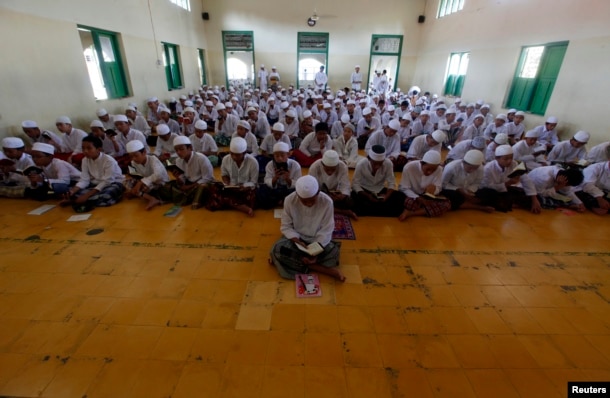
    FILE - Students pray during the first day of the holy month of Ramadan at Al-Mukmin Islamic boarding school in Solo, in Indonesia's Central Java province, August 1, 2011.

    FILE – Students pray during the first day of the holy month of Ramadan at Al-Mukmin Islamic boarding school in Solo, in Indonesia’s Central Java province, August 1, 2011.

    “Once you accept that, you’re on their payroll for life,” Abshar-Abdalla told VOA. “But they made it awfully easy to stick around. I’m from a poor family, and it was quite tempting… I think they managed to pull a few good minds from my generation that way.”

    Since 1980, Saudi Arabia has been using education to quietly spread Salafism, its brand of puritanical Islam, in Indonesia, the world’s most populous Muslim nation. The two main arms of this effort are LIPIA and scholarships for higher education in Saudi Arabia.

    Salafism is an ultra-conservative reform movement that advocates a return to Koranic times. LIPIA teaches Wahhabi Madhab, a strain of Salafi Islam expounded by the medieval Sunni theologian Ibn Taimiyah.

    “Saudi alumni” are now visible in many arenas of Indonesian public life, holding positions in Muhammadiyah, the Prosperous Justice Party, and the Cabinet. Some have also become preachers and religious teachers, spreading Salafism across the archipelago.

    The effects of Saudi Arabia’s massive soft power exercise on the Indonesian citizenry are just starting to become clear.

    ‘The most important post in Jakarta’

    The nexus of Saudi educational diplomacy is the religious attaché, a special office affiliated with its embassy in Jakarta. The office grants scholarships for students to study in Saudi Arabia, although the current attaché, Saad Namase, refused to confirm how many students were involved.

    “We don’t really work with the Indonesian government,” said Namase. “We just try to strengthen cultural ties between our two countries by, for example, holding Quranic recitation competitions.” On the topic of scholarships, he said many countries, including the Netherlands and the U.S. offer scholarships to Indonesian students and the Saudi program was just one among many.

    FILE - A teacher gestures during an Islam personality class during the holy month of Ramadan at the Al-Mukmin Islamic boarding school in Solo, Indonesia Central Java province, Aug. 2, 2011.

    FILE – A teacher gestures during an Islam personality class during the holy month of Ramadan at the Al-Mukmin Islamic boarding school in Solo, Indonesia Central Java province, Aug. 2, 2011.

    “The Saudi religious attaché is the most important post in Jakarta,” said Abshar-Abdalla, who now runs the Liberal Islam Network. “It is the portal for all Saudi efforts to influence Indonesian culture.”

    The attaché’s office also pays the salary of prominent Salafi preachers and supplies Arabic teachers to boarding schools across Indonesia, according to Din Wahid, an expert on Indonesia Salafism at the Syarif Hidayatullah State Islamic University in Jakarta.

    Beyond the attaché’s office, several Saudi Arabian universities directly offer scholarships to Indonesian students.

    One reason the Indonesian government is unlikely to present roadblocks to Saudi cultural expansion is its precarious annual Hajj quota, according to Dadi Darmadi, a UIN researcher who focuses on the annual pilgrimage to Mecca.
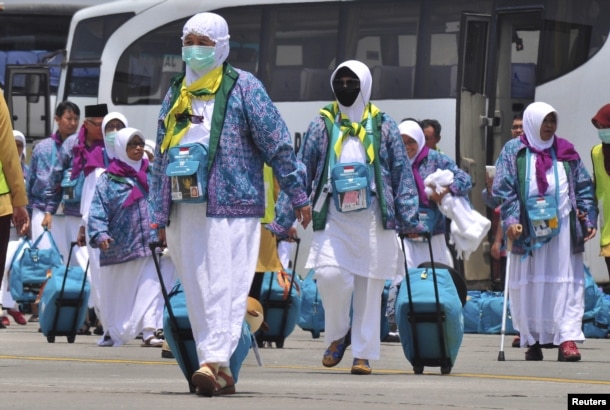
    FILE - Indonesian Haj pilgrims walk towards their flight at the airport in Solo, Central Java province, Indonesia, Sept. 17, 2015, in this photo taken by Antara Foto.

    FILE – Indonesian Haj pilgrims walk towards their flight at the airport in Solo, Central Java province, Indonesia, Sept. 17, 2015, in this photo taken by Antara Foto.

    “We were just granted 10,000 extra Hajj permits this year, which is still a drop in the bucket considering Indonesia’s population of 203 million Muslims,” said Darmadi, “I think Indonesia would hesitate to antagonize Saudi Arabia and prompt cuts to that hard-won quota.”

    Divergent paths

    Hidayat Nur Wahid, a member of Indonesia’s House of Representatives and a leader of the right-wing Prosperous Justice Party (PKS), is one of the most prominent national politicians who have passed through Saudi universities. He studied, through a series of scholarships, for an undergraduate, master’s and doctorate degree in theology and history of Islamic thought at the Islamic University of Medina.
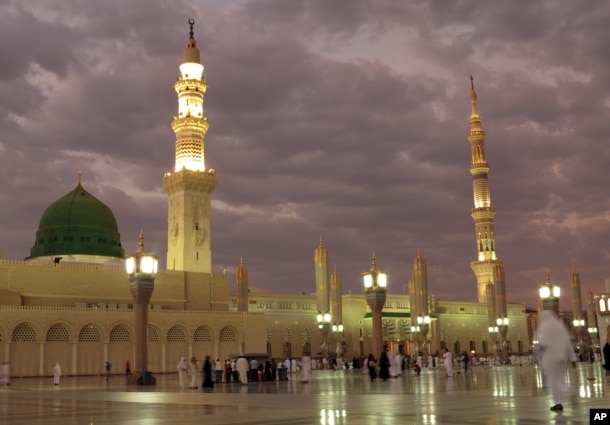
    FILE -- In this July 5, 2013 file photo, worshipers visit the Prophet's Mosque in Medina, Saudi Arabia.

    FILE — In this July 5, 2013 file photo, worshipers visit the Prophet’s Mosque in Medina, Saudi Arabia.

    “The majority of Islamic texts are in Arabic, which is why I wanted to study in Saudi Arabia,” Nur Wahid told VOA. “Plus, the spirit of the Prophet Muhammad animates Medina. I enjoyed my years there.”

    Nur Wahid said he was not exposed to radicalism or “anti-social” teachings in Medina. “We just learned how to be good Muslims. And it’s a misconception that everyone who studies in Saudi Arabia becomes a preacher or religious teacher. Many graduates become officials or politicians like me.”

    “Since it is the place where Islam originated, many students think that Saudi Arabia represents authentic Islam,” researcher Din Wahid.

    Saudi theology had the opposite effect on Abshar-Abdalla, who gradually grew disenchanted with the Salafi movement during his five years at LIPIA.

    “Although I had some short-lived enthusiasm for that simplistic theology, I found it to be puritanical at its core,” said Abshar-Abdalla. Instead, he started to read various other Islamic texts on his own, including Sufi and Shia ones, and eventually founded the Liberal Islam Network (JIL) in 2001.

    Ironically, he himself was once recruited for the student movement that would develop into PKS. “I was invited for a rafting trip in Bogor one weekend at university, and I realized they were trying to get me to join Tarbiyah, the embryo of the current PKS party,” said Abshar-Abdalla. “I sort of ran in the opposite direction.”

    Extremist connection

    Although Saudi-educated preachers in Indonesia might be causing a subtle rightward shift in national ideology, a more immediate concern is whether Salafi teachings encourage terrorism or extremism.

    “By and large, I think not, because official Salafism is quietist, or apolitical, in order to preserve the authority of Saudi royalty in its homeland,” said Wahid. “That being said, when this ideology migrates back to Southeast Asia, all bets are off.”

    One prominent example of non-quietist, or jihadist, ideology is the Salafi-influenced Ngruki pesantren in Solo, Central Java, which has incubated a number of known Indonesian terrorists.

    And Zaitun Rasmin, a graduate of Medina Islamic University, was one of the chief organizers of the hardline demonstrations against the governor of Jakarta in late 2016. “He’s an example of an Indonesian Salafist who is unconcerned with being ‘apolitical,’” said Wahid.

    Wahid’s point is that, for all the resources Saudi Arabia is directing towards Indonesian students, it remains to be seen how exactly Salafi ideology evolves in its new Southeast Asian context. “There are three ‘flavors’ of Salafi ideology: quietist, political, and jihadist. We don’t know what exactly it looks like in Indonesia. All we know is that it’s here, and it’s growing.”


    Source: VOA
  • Me Against The Muslim community: A Convert’s View Of Islam

    Me Against The Muslim community: A Convert’s View Of Islam

    After almost 20 years as a Muslim, I have arrived at some conclusions that put me at odds with the community.

    1. I do not believe the hijab is necessary. It is a cultural affection of the Arabs that evolved into a political statement. It is not mentioned in the Qur’an. And the same with the niqab.

    2. I think halal certification is either a scam or an unfortunate cost. Unless there are obvious reasons to suspect otherwise, everything is automatically halal.

    3. I do not believe damnation permanent. Neither do I believe Salvation is exclusive to Muslims. That limits God’s Mercy.

    4. I think many “authentic” narrations, even in Swahih al-Bukhari, are fabricated. We should exercise more skepticism of problematic ahadits.

    5. I do not believe dog saliva is najis al-mughalazhah, or any restrictions on dogs as pets. That contradicts the Qur’an.

    6. I do not believe that non-Muslims are restricted from inheriting from Muslims. There is no such stipulation in the ayat. There were historical reasons for the hadits.

    7. I do not believe all forms of interest is necessarily usury, riba’. That is a fundamental ignorance of economics.

    8. I certainly do not believe in gender segregation in public places. Strict gender segregation is unnatural.

    9. The concept of an Islamic state is an oxymoron.

    10. Drawings and artistic representations of the Prophet (s.a.w.) are not automatically blasphemous.

    11. Stoning is not a valid means of capital punishment.

    12. Most hudud punishments are outdated, and specific to certain conditions that do not exist for most of us.

    I admit I never cared what Muslims think of me, orthodoxy or otherwise. I did not come to Islam to follow ingrained cultural practices and social beliefs masquerading as religion.


    Source: Terence Helikaon Nunis


  • 52 Ditahan Jabatan Agama, Naik Motor Dengan Bukan Mahram

    52 Ditahan Jabatan Agama, Naik Motor Dengan Bukan Mahram

    Rata-rata daripada 26 pasangan tidak mengetahui menunggang motosikal dengan seseorang yang halal nikah menyalahi undang-undang syariah Terengganu.

    “Saya tidak tahu menunggang dan membonceng motosikal dengan bukan mahram satu kesalahan,” kata mereka selepas ditahan Jabatan Hal Ehwal Agama Terengganu (JHEAT), lapor Sinar Harian.

    Lima puluh dua individu itu, berusia antara 16 hingga 42 tahun, ditahan dalam Op Bonceng di Batu Buruk di sini malam Khamis lalu dengan alasan “berkelakuan tidak sopan di tempat awam”.

    Ketua penolong pesuruhjaya penguatkuasa syariah JHEAT Nik Zulhaiza Ismail berkata mereka ditahan kerana didapati menunggang dan membonceng motosikal dengan bukan muhrim.

    Tambahnya, mereka akan dipanggil menghadiri sesi kaunseling di pejabat JHEAT sebelum diberi amaran dan ditahan selepas ini jika terus mengulangi kesalahan sama.

    Jika ingkar atau masih mengulangi perbuatan sama, mereka akan dikenakan tindakan menurut Seksyen 34 Enakmen Kesalahan Jenayah Syariah (Takzir) (Terengganu) 2001, katanya kepada akhbar itu.


    Source: TheMalayMailOnline

  • Where Malay Royalty Once Lived And Worshipped

    Where Malay Royalty Once Lived And Worshipped

    You can say this was a “glam” kampung, given that it used to be where Malay royalty lived, but Kampong Glam, also called Kampong Gelam, is probably named after a tree.

    Still, Kampong Glam stands as a glamorous attraction today, with its Middle Eastern eateries and trendy fashion shops.

    Beyond these modern additions, sitting grandly in the heart of the enclave are two historic monuments – the Istana Kampong Gelam and the Masjid Sultan.

    The Istana Kampong Gelam was the palace of Sultan Hussein Shah, the 19th-century ruler of the Johor Sultanate which Singapore was part of, while the Masjid Sultan next door had been constructed shortly after upon his request.

    The two grand buildings serve as a reminder of the Malay royalty who once ruled the area.

    The Sultan’s original residence was a timber structure built on stilts in the traditional Malay style.

    According to the National Heritage Board’s (NHB) Preservation of Sites and Monuments division, the present two-storey brick-and-mortar structure was completed in 1843 and commissioned by his son and heir Tengku Mohammed Ali.

    The building’s design reflects both classical European and traditional Malay architecture.

    The round arches at the entrance porch showcase the European design influence, while its layout corresponds to Malay Limas house typology, where the main entrance leading to the main house is connected to an annexe where the kitchen would traditionally be located.

    Meanwhile, the Masjid Sultan, or the Sultan’s Mosque, was originally a single-storey brick structure built in the 1820s.

    Almost a century later, it was in need of repairs and a new mosque was planned. Irish architect Denis Santry from local architectural firm Swan and Maclaren was commissioned for the rebuilding project spanning 1924 to 1928.

    He designed it in an Indo-Saracenic style, which offers a mix of traditional Indian and Islamic elements.

    The mosque features two gold onion domes, and the base of each dome is adorned with glass bottle ends collected from poor Muslims as donations.

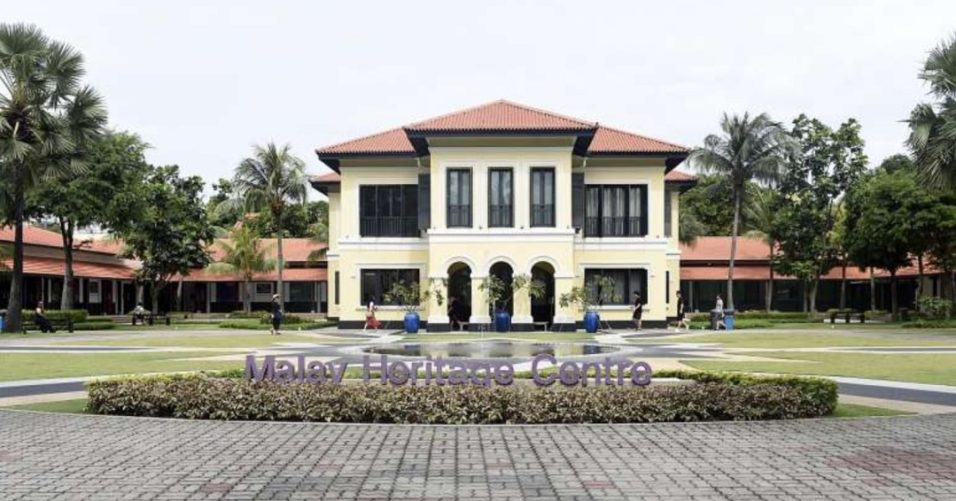
    These monuments are key in telling the larger story of early Singapore, said Ms Suhaili Osman, assistant curator of the Malay Heritage Centre, which now occupies Sultan Hussein’s former palace.

    For instance, porcelain plates dug up from the compound of the Istana Kampong Gelam bear the insignia of ceramic producers from Asia and Europe such as J. & G. Meakin of England. This reflects how the area near the Kallang Basin had thrived as an emporium, with goods from across the globe, in the 19th and 20th centuries.

    Chinese, Jawi and Dutch East India Company coins, also unearthed during two archaeological surveys in the early 2000s, further underscore the cosmopolitan nature of Kampong Glam as well as its economic importance.

    Ms Suhaili said the artefacts “prove that there are more layers to Singapore’s story beyond the traditional narrative of its early beginnings as a sleepy fishing village”.

    According to heritage conservation expert Johannes Widodo, an associate professor at the National University of Singapore, the Kampong Glam compound was laid out based on Hindu and Buddhist mandala symbol principles.

    The mosque and royal graveyard in Jalan Kubor functioned as its crown and the palace was its body, while a market town and old settlement stood as its feet.

    The Istana Kampong Gelam palace compound itself was allotted to Sultan Hussein, after he and Temenggong Abdul Rahman signed a treaty with Sir Stamford Raffles for the British East India Company to set up a trading post here on Feb 6, 1819.

    But to diminish the power of the royals, the British sliced up the area, with Victoria Street and North and South Bridge roads cutting through the place.

    In 1999, the Government announced that the Istana Kampong Gelam would be conserved.

    Some 79 beneficiaries and tenants, including Mr Tengku Shawal, the seventh-generation descendant of Sultan Hussein, were awarded a total of $350,000 a year for 30 years.

    The former palace was restored after its residents moved out and it was turned into the Malay Heritage Centre in 2005.

    The centre, which is managed by NHB in partnership with the Malay Heritage Foundation, houses six permanent galleries.

    Mr Harneis Hadir, general manager at the Malay Heritage Centre, said it aims to provide all communities that go through its doors “a holistic and well-rounded cultural experience”.

    He said visitors can look forward to the annual Malay CultureFest and a special exhibition on the Bugis community this year.

    The Masjid Sultan, meanwhile, took home the Urban Redevelopment Authority’s Architectural Heritage Award last year for its $4.6 million restoration, which included a fresh coat of paint for its golden domes and the addition of elderly- friendly facilities such as a glass lift.

    The mosque won in the restoration category which honours work done to sensitively repair and restore heritage buildings.

    The chairman of its board of trustees, Mr Mohamed Patail, 65, said the restored monument has attracted both worshippers and tourists far and wide.

    On the congregants, he said: “They feel a sense of belonging to the mosque, which is one of the oldest in Singapore. They also come here for a nice family outing – pray at a historically significant mosque, walk around the enclave and then eat at one of the nasi padang stalls.”


    Source: ST

deneme bonusu