Category: Agama

  • In The Aftermath Of Pinkdot And Wear White

    In The Aftermath Of Pinkdot And Wear White

    To many, Pink Dot SG is probably the figurehead of the Lesbian, Gay, Bisexual and Transgender (LGBT) rights agenda in Singapore. It is, to some extent, the local equivalent of Gay Pride.
    Pink Dot has been held at the Speakers Corner at Hong Lim Park since 2009. But only this year has Pink Dot faced significant opposition, particularly from a campaign known as Wear White.
    Why is this so?
    Why Pink Dot 2014 has faced greater opposition
    The reasons why Pink Dot 2014 has faced greater opposition have been concisely summed up in the following statement on the Wear White website:
    The movement’s genesis was from our observations of the growing normalization of LGBT in Singapore. However, we recognize the conduct and it’s support among Muslims is due to the lack of understanding and connection with Islam and our fitrah. We thus came together initially with the expressed purpose of reminding Muslims not to participate in the LGBT event on 28th June.
    The first reason lies in the growing efforts to normalise LGBT lifestyles in Singapore, together with efforts to sanction certain forms of disapproval. Although controversies have arisen over the years, such as the debate in Parliament over section 377A of the Penal Code in 2007, and the AWARE (Association of Women for Action and Research) saga in 2009, several events have intensified the debate in 2014. Early this year, the Health Promotion Board (HPB) stirred controversy in its FAQs on Sexuality by claiming that “[a] same-sex relationship is not too [different] from a heterosexual relationship”. In the debate that ensued, complaints were lodged against National University of Singapore (NUS) Professor Dr Syed Muhd Khairudin Aljunied for describing “alternative modes of sexual orientation” as “wayward”, and as “cancers” and “social diseases” to be “cleansed”. According to NUS, he acknowledged “poor judgment in the tone and choice of words” after he was counselled by the university.
    The second reason is the preservation of religious identity. While the debate has often been portrayed as one between religious conservatives and secular liberals, the video promoting Pink Dot 2014 explicitly threw religion in the mix by featuring a hijab-wearing Malay-Muslim woman and an individual wearing a crucifix. A number of Muslims took offence at this. Among the responses included an open letter titled, “A letter to Muslimah Sister Regarding her Support for PinkDotSG2014“. The Singapore Islamic Scholars and Religious Teachers Association (PERGAS), Fellowship of Muslim Students Association (FMSA), and Masjid Ugama Islam Singapura (MUIS) have since drawn a line in the sand, whether directly or indirectly. Likewise, the Catholic Church and the National Council of Churches in Singapore have made statements calling upon Christians not to support Pink Dot.
    What is at stake here
    At stake in the LGBT debate are competing notions of human dignity, sexuality and the family. Although both sides of the debate hold unequivocally that human beings are rights-bearing individuals, there are marked differences in their appreciation of human nature.
    On one view, marriage – the comprehensive, exclusive and permanent union based on the sexual complementarity of a man and a woman, which is intrinsically ordered to produce new life – is a personal and social good. It fulfils and enriches human personality, and provides the foundation for procreation, family and society. Human dignity is attained by taming desire and directing it according to reason. Therefore, there are both substantive and procedural norms governing sexual expression.
    On the other view, an essential aspect of human dignity is that of self-actualisation or self-realisation, part of which is sexual expression. Reason is instrumental to desire, and the only norm governing sexual expression is consent. Marriage and family, then, are emotional unions based on commitment.
    These two competing conceptions strike at the heart of society and cannot simply be relegated to one of mere opinion or preference. At the moment, the former view is the dominant one in society. Prime Minister Lee Hsien Loong said in 2007:
    Singapore is basically a conservative society.  The family is the basic building block of our society.  It has been so and, by policy, we have reinforced this and we want to keep it so.  And by “family” in Singapore, we mean one man one woman, marrying, having children and bringing up children within that framework of a stable family unit.
    Recent surveys conducted by the Institute of Policy Studies have shown that Singapore continues to remain conservative.
    Given that “[the] family is the natural and fundamental group unit of society”, as affirmed by the Universal Declaration of Human Rights, there will be significant impact on society, whether society adopts one view or the other.
    In fact, the Singapore Government has recognised the social benefits and costs when family is affected. The Shared Values White Paper (Cmd. 1 of 1991) writes:
    12. The sanctity of the family unit is not a value unique to Singapore. All major faiths consider this a cardinal virtue. The family is the fundamental building block out of which larger social structures can be stably constructed. It is the group within which human beings most naturally express their love for parents, spouse and children, and find happiness and fulfilment. It is the best way human societies have found to provide children a secure and nurturing environment in which to grow up, to pass on the society’s store of wisdom and experience from generation to generation, and to look after the needs of the elderly.
    13. In recent decades many developed countries have witnessed a trend towards heavier reliance on the state to take care of the aged, and more permissive social mores, such as increasing acceptance of “alternative lifestyles”, casual sexual relationships and single parenthood. The result has been to weaken the family unit. Singapore should not follow these untested fashions uncritically.

    How the Government has contributed to the culture war

    The Government has repeatedly cautioned against “culture wars”. For example, then-Minister for Home Affairs Wong Kan Seng cautioned in 2009, “We must not import into Singa­pore the culture wars between the extreme liberals and conservatives that are going on in the US.”
    However, in 2014, the Government has itself fanned the flames of the culture war in Singapore by its own doing.
    The first was the controversy over the HPB FAQs on Sexuality, which both conservatives and liberals recognised as a significant shift in the Government’s stance. Gay Star News praised it as a “groundbreaking move”, while PERGAS and Faith Community Baptist Church (FCBC) senior pastor Lawrence Khong made similar observations, to great consternation. The Government’s defence of the FAQs that followed can only be described as weak and self-contradictory (see “Welcome to the Animal Farm: MOH’s response to HPB FAQs on Sexuality“).
    The second was the Government’s statements in response to the Wear White campaign. Minister-in-charge of Muslim Affairs Yaacob Ibrahim said that those who “express support for a cause or a choice of lifestyle should express it in a way that does not divide the community”. These statements were perceived as Government bias against conservatives, sentiments which were perhaps best expressed by Lam Jer-Gen in a letter to TODAY, “Expressions of pro-family support are not divisive” (25 June 2014):
    I disagree with Minister-in-charge of Muslim Affairs Yaacob Ibrahim’s views…
    Why should the Government allow groups, such as the one that organised the Pink Dot event, to promote alternative lifestyles, yet criticise pro-family groups and consider their expressions of support for a cause or a choice of lifestyle divisive?
    Once again, the Government’s response has been little more than a bare denial (see “Impressions of Government Bias in Culture Wars“).


    Conclusion: Where do we go from here?
    During the debates on section 377A of the Penal Code, Prime Minister Lee Hsien Loong said:
    … I do not think it is wise to try to force the issue.  If you try and force the issue and settle the matter definitively, one way or the other, we are never going to reach an agreement within Singapore society.  People on both sides hold strong views.  People who are presently willing to live and let live will get polarised and no views will change, because many of the people who oppose it do so on very deeply held religious convictions, particularly the Christians and the Muslims and those who propose it on the other side, they also want this as a matter of deeply felt fundamental principles.  So, discussion and debate is not going to bring them closer together.  And instead of forging a consensus, we will divide and polarise our society.
    I should therefore say that as a matter of reality, the more the gay activists push this agenda, the stronger will be the push back from conservative forces in our society, as we are beginning to see already in this debate and over the last few weeks and months.  And the result will be counter productive because it is going to lead to less space for the gay community in Singapore.  So it is better to let the situation evolve gradually. [Emphasis added]
    As noted in a previous post, the least the Government can do is to level the playing field in a democratic society by guaranteeing equal rights of freedom of speech and freedom of conscience.

    There are two possible approaches to realise this:

    1. Ban all forms of lobbying. While this is a possible approach, this would raise serious questions about the state of democracy, freedom of speech and freedom of conscience in Singapore. It is not a preferable option.
    2. Permit lobbying by both sides. This is an approach which best comports with democratic principles though, in the Singapore context, the Government will most likely have to mark out the boundaries in such debates with clear and bright lines.
    Any effort perceived as being biased towards one side or the other is likely to provoke a backlash against the Government.
    At the rate things are going, it is foreseeable that both Pink Dot and Wear White will remain a part of the Singapore landscape for a long time.
    Source: http://ionsg.blogspot.sg
  • Habib Hassan Al-Attas Terima Anugerah Pertubuhan Antara Agama (IRO)

    Habib Hassan Al-Attas Terima Anugerah Pertubuhan Antara Agama (IRO)

    Pertubuhan Antara Agama (IRO) semalam menyanjung jasa Imam Masjid Ba’alwie, Habib Hassan Al-Attas, dalam memperjuangkan keharmonian agama dan kaum di Singapura.

    Habib Hassan, 64 tahun, diberi Anugerah IRO bagi khidmatnya kepada pertubuhan itu sebagai anggota veterannya.

    Anugerah itu disampaikan dalam majlis sambutan ulang tahun IRO ke-66 dan sempena ulang tahun Singapura ke-50 (SG50) tahun ini.

    Semasa ditemui dalam acara itu, Habib Hassan berkata beliau terperanjat menerima anugerah tersebut kerana IRO merahsiakan pemberian anugerah itu kepadanya.

    “Saya fikir ramai lagi yang juga berjasa untuk membina keharmonian kaum dan agama di Singapura.

    “Kita perlu terus ambil berat terhadap usaha memelihara keharmonian kaum kerana keamanan dan kebaikan tidak akan terjamin tanpa usaha tersebut,” ujar Habib Hassan.

    Majlis itu dihadiri Presiden Tony Tan Keng Yam selaku tetamu terhormat. Ia dihos Perdana Menteri Lee Hsien Loong.

    Turut hadir ialah Timbalan Perdana Menteri Teo Chee Hean, yang juga Menteri Penyelaras Keselamatan Negara dan Menteri Ehwal Dalam Negeri.

    Di bawah pimpinan Habib Hassan, Masjid Ba’alwie antara masjid yang cergas dalam kegiatan persefahaman antara agama.

    Dari masa ke masa, masjid itu menerima kunjungan pemimpin agama lain di dalam dan luar negara.

    Habib Hassan juga sering diundang menjelaskan kedudukan Islam dalam pelbagai isu semasa.

    Malah, banyak ceramah dan tulisan Habib Hassan dalam bahasa Inggeris atau yang diterjemahkan kepada bahasa Inggeris dimanfaatkan oleh masyarakat bukan Muslim.

    Habib Hassan menjadi imam Masjid Ba’alwie dari 1976, selepas pemergian ayahnya, Allahyarham Habib Muhammad Salim Al-Attas, pengasas dan imam pertama masjid tersebut.

    Masjid Ba’alwie di Lewis Road, dekat Bukit Timah Road, diasaskan Allahyarham Habib Muhammad Salim pada 1952.

    Sementara itu, presiden IRO, Encik Gurmit Singh, berkata Habib Hassan wajar dan layak menerima anugerah itu.

    “Beliau bersikap terbuka menerima sesiapa sahaja ke masjidnya. Beliau juga terbuka dari segi idea dan sedia membincangkan pelbagai isu,” ujarnya.

    Pengerusi Persekutuan Tao Singapura, Encik Tan Thian Lye, pula berkata Habib Hassan telah memberi sumbangan besar kepada IRO dan memupuk keharmonian antara kaum di Singapura.

    “Sikap ramahnya membantu memupuk jalinan mesra antara pemimpin pelbagai agama dan beliau sering berusaha mengekalkan jalinan itu,” ujarnya.

    Antara penerima Anugerah IRO sebelum ini ialah mantan presiden Persekutuan Seruan Islam Singapura (Jamiyah), Allahyarham Haji Abu Bakar Maidin, dan mantan mufti, Shaikh Syed Isa Mohd Semait.


    Source: http://beritaharian.sg

  • Pelajar Remaja Hubungan Sejenis Di Malaysia Pampangkan Gambar Meraka Di Media Sosial

    Pelajar Remaja Hubungan Sejenis Di Malaysia Pampangkan Gambar Meraka Di Media Sosial

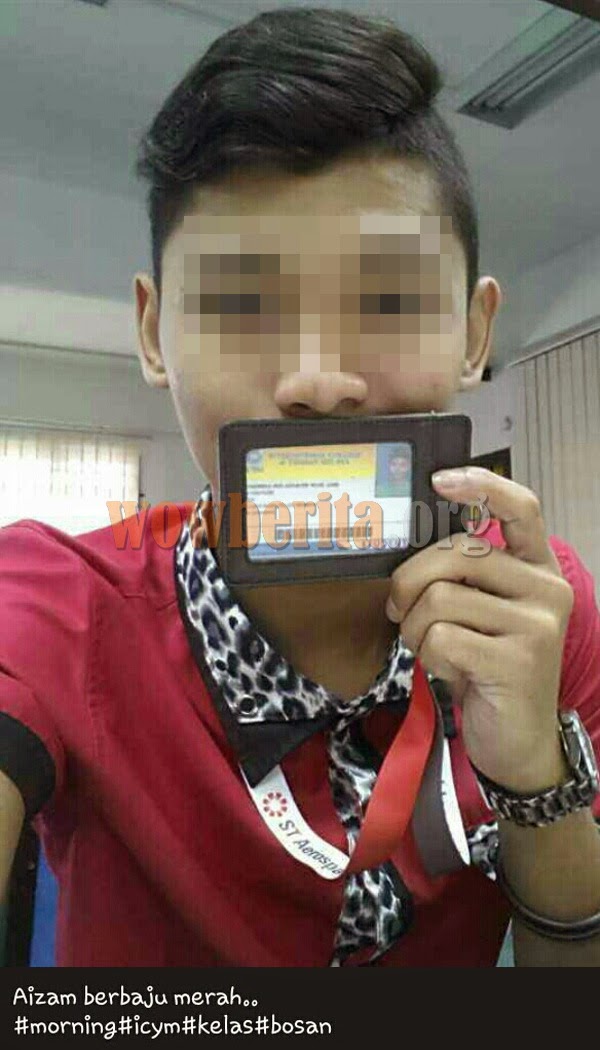
    Tergamam seketika tatkala melihat beberapa gambar yang agak meloyakan ini. Mana tidaknya, sudahlah sejenis, dibuatnya pula sign ‘Love’ ala-ala K-Pop. Mau terbeliak biji mata dibuatnya.

    Gambar pasangan remaja songsang ini mula tersebar di laman sosial menunjukkan betapa intimnya mereka berdua.

    Remaja ini didakwa pelajar sebuah kolej swasta di Melaka ini juga tanpa segan silu ber’papa’ ‘mama’ dengan pasangannya itu serta memuat naik gambar mereka secara terbuka di laman sosial.

    Menurut sumber, gambar-gambar ini diperolehi dari aplikasi pesanan ringkas, WeChat.

    Penularan LGBT di kalangan belia semakin menjadi-jadi. Justeru, ibu bapa digesa memantau aktiviti anak-anak terutamanya telefon pintar mereka.

    Golongan belia amat mudah terpengaruh dengan benda/budaya baru. Yang mana, pada mulanya mereka hanya memberikan alasan mahu mencuba. Tetapi apabila sudah menikmati ‘kesedapan’ yang tidak terhingga, mereka akan terus menerus terjerumus lebih jauh sehingga sukar untuk kembali ke pangkal jalan.

    Mohon siapa yang mengenali pasangan songsang ini, nasihatkanlah mereka agar kembali ke pangkal jalan.

    Source: http://wowberita.org

  • Meet The Gay Muslims Living In Straight Marriages

    Meet The Gay Muslims Living In Straight Marriages

    Khalil realised he was gay at 17.

    It was 1984, and he was living on a council estate in West London with his parents and two sisters, who originally came from Pakistan. “We had some family guests over,” he recalls, “and they brought along their daughter, who was around my age. My father kept making all these jokes about us getting married… and I knew he was joking, but I was trying not to cringe. I wasn’t attracted to her at all, and I realised at that moment that I hadn’t been attracted to any of the girls that had come over before.”

    Seven years later, Khalil got married to the same woman, and they currently live in a well-to-do suburb of London along with their two children. However, he admits at despite having “the ideal life of a Muslim man” on the surface, he does not feel attracted to his wife.

    It’s a position that an increasing number of devout gay Muslims find themselves in, as they attempt to reconcile their faith with their sexual orientation.

    When we meet near his office, Khalil (who has, along with the other interviewees in this article, asked for BuzzFeed News to use a pseudonym) is dressed in a pristine pinstriped business suit, and sports a medium-sized, perfectly trimmed beard. He greets me with a firm handshake – “Salaamwualaikum” – and apologises for being late, telling me that he needed to pray first.

    We’re later joined by two other men, Adnan and Mohammed, both of whom are in similar situations. Adnan, is tall, skinny and dressed in a plain suit. He’s been married for just under two years, having had a ceremony arranged by his parents. Mohammed, who is short but well built, is dressed in the traditional Islamic thoba – a garment he says he usually wears in public. He’s a university student who hopes to be married soon.

    The men head to an Italian restaurant in central London. Khalil booked a corner table weeks in advance: he highly recommends the food, and says that these types of venues are much better for such meetings, because of the nature of their discussions. “You don’t really want to be talking about these things in a Muslim restaurant,” he jokes. Adnan, relaxed in his chair, laughs with him, while Mohammed, who shows some nervousness, hunches over his phone.

    After a small amount of short talk over olives, in which they talk about their jobs – and, more importantly, last week’s football matches – Khalil asks how Adnan and Mohammed have been “managing” since the last dinner.

    Although the men acknowledge they have same-sex inclinations, they are reluctant to identify themselves as “gay”. However, they say that as Muslims who are “devout”, they have dedicated themselves to strengthening their imaan [religious belief] in an attempt to overcome them.

    The men are part of a small support group which began on a web forum. Some of the members now meet every few months to discuss how they are managing their sexual feelings.

    In some British Muslim communities, homosexuality can be a controversial issue: some believe the act counts as a form of “zina” – an Arabic term referring to “unlawful” sexual activity.

    Many imams were uncomfortable talking to BuzzFeed News about the issue on record, although one scholar, who wished not to be named, said that homosexuality was a “cardinal sin” in most strands of Islamic thought. He emphasised that the same view was held in most world religions, including Christianity and Judaism.

    Others imams, such as Ghulam Rasool of Leicester central mosque, said that Islam did not make a direct reference to homosexuality, but instead prohibited areas of sexual activity deemed impermissible, such as anal sex. He adds that the regulations apply to everyone, including those in heterosexual relationships.

    “To have the inclination has never been condemned,” he said. “It’s acting upon it.”

    He added: “Whatever thoughts prevail for your mind, if you don’t act on the bad impulses you have to learn how to deal with them as a Muslim. And if you can’t, it’s about where that sin fits in the Islamic spectrum.”

    Rasool adds that similar rulings on sexual activity are evident in all branches of the Abrahamic faiths – but points out that in Islam, sexual habits have always been a “private issue”.

    There is still little information on how many gay Muslims are living in Britain – not least because many (especially regular worshippers such as the members of the support group) remain closeted, out of fear of reprisal from conservative elements of their communities.

    As a result, some Muslim activist organisations, such as the LGBT support group Imaan (which is not affiliated with the men interviewed in this article), have articulated the need for British Islamic communities to be more open to such Muslims.

    The organisation also said it does not support or encourage LGBT Muslims to enter “marriages of convenience,” or pursue treatments that require one’s sexual identity to be repressed.

    Although Imaan usually works with LGBT Muslims who are “being pressured into heterosexual marriages”, its spokesperson, Naeem (who preferred not to give his surname), told BuzzFeed News that it had heard of some cases where religious individuals were willing to repress their sexuality.

    “The LGBT Muslim community in Britain is as diverse as the wider Muslim community here,” he said.

    “We come from various ethnic and sectarian backgrounds and each would have inherited their community’s attitudes towards Muslims of other ethnic or sectarian communities.”

    Naeem emphasised that the experiences of LGBT Muslims are unique and that they shouldn’t be treated as a single group. However, he added that many are reluctant to talk about sexuality out of fear they “might dishonour their families, be forced into marriage as a form of rehabilitation, or become unwelcome in their communities”.

    In some cases, he says that people have suffered “intense emotional, psychological, and spiritual trauma” as a result of familial pressure to marry the opposite sex.

    However, the men believe that common assumptions about homosexuality in Islam have been misinterpreted.

    “It’s not homosexuality itself that’s a sin,” Adnan says. “It’s more about acting on your sexual urges – I think that’s been really misunderstood by the media, so they make out that Islam is homophobic, or anti-gay or whatever. It’s not, it’s just about controlling things that are haram [forbidden].”

    Mohammed agrees. Although he realised he was gay in secondary school, and says he’s had “quite a few flings” with men in his early years at university, it was only a couple of years ago that he decided to devote himself to his faith.

    “There was always a part of me that said what I was doing – going to clubs, having boyfriends – was wrong, but I tried to block it out,” he says. “It was only when my mum passed away that I began really taking Islam seriously, when I realised we will all eventually return to Allah to be questioned about our evils.”

    “The imam said that this was just a challenge in my life – so the only way to overcome it would be by devoting myself more to God. I was recommended to fast at least once a week, to be more devout in my prayers – and to get married. The imam had told me he knew many men who had felt these ‘natural emotions’, and were able to overcome them by living a good, Islamic way of life.”

    Mohammed describes the group as the first “safe space” where he was comfortable talking about his past activities. “No one judged me for my past,” he says. “They were very open about their experiences, and how they returned to Islam. Usually, people would post a motivational image with verses of the Qu’ran on them, mainly about Allah forgiving you for your sins. And it was nice to be in a place where there were brothers to support you – it’s not often you find [something] like that in a masjid [mosque].”

    Mohammed adds that the most common advice to Muslims in the forum – especially young people – is to get married. “Most of the brothers in the group recommend nikah [marriage] to overcome sexual urges,” he says.

    “It’s not just for gay or lesbian people – Islamically we’re taught to regulate our sinful desires, like having sex out of marriage. Nikah isn’t just sexual, it’s also a way to come closer to Allah and please him.”

    He cites a number of men he knows through the forum who claim to have “overcome their sexual feelings’ toward men” by marrying “practising sisters”, although he admits that they don’t really talk about the more intimate parts of their relationships.

    “It’s not just religion – it’s more to do with culture,” he insists. “Islam doesn’t shy away from talking about dealing with homosexual feelings and transgressions. It offers the best solution for overcoming these feelings. But if you bring it up outside the mosque it is dangerous, and I think that keeps many gay and lesbian Muslims from coming out.”

    When asked how his family would react if he came out, he says: “They’d definitely be very shocked to say the least – I’d be quite worried to find out. I’ve heard about gay Muslims who have come out and have lost contact with all their family, kids and friends.”

    Adnan also keeps his sexual past a secret from his wife, although he says that it “isn’t much different” from the experiences of other Asian Britons.

    “I don’t really know many Asians generally who are open about their sexual history, gay or not. It’s not something we really talk about in our culture, so in some ways it’s actually much easier,” he says. “It helps that I was always quite religious. I wasn’t very outward about my sexual preferences, and was only in one, very short relationship when I was younger.”

    Adnan says he’s “working hard to build a strong relationship” with his wife, and believes that “if Allah wills, our relationship will blossom when we are graced with children”. However, he’s reluctant to answer questions on whether he has felt sexual attraction to other men since he’s been married. “I’m just trying to live my life as Islamically as possible,” he says.

    While Khalil, Adnan and Mohammed have not resorted to drastic measures in their attempts to overcome their sexual inclinations, they do say that others in the group have done. They recall one man in America who went to a spiritual healer, believing that his sexual inclinations were the result of an evil spirit known as a “djinn”. Others have allegedly embraced full abstinence or sought help through gay conversion therapy (which has been condemned by the medical and mental health sectors in both the UK and US as damaging and ineffective).

    “A lot of the time Muslims with these feelings want to follow the “sirat al Mustaqeem” [the right path] but they don’t know how,” he says. “They’re lost. So they go to people who say they can cure them, and a lot of the time they don’t! I’ve heard stories where con artists have ripped people off pretending they can cure them of illness, diseases, and it’s just a con.”

    He adds: “It’s much better to seek proper solution. I’d recommend any Muslim brother or sister feeling these emotions to go to their Imam or a respected scholar first… then seek devout brothers and sisters online for guidance.”

    While this view might be controversial, the men say it is becoming the “normal opinion” of most devout British Muslims trying to understand their faith in the context of a sexually liberal society.

    “It is quite sad to see some Muslims being abused by their families and communities just because they are gay,” Adnan says, recalling a former friend who was kicked out of his family home after coming out to his family.

    Khalil says that while he would ideally want gay Muslims to “return to the right form of Islam”, it was “unacceptable” for anyone to be abused because of their personal qualities: “Doesn’t matter if you’re gay, straight, black, white or whatever, abuse is abuse, whatever the circumstance.”

    And although none of the men have ever heard an imam publicly condemn gays or gay activity, Mohammed says that he still feels uncomfortable whenever his friends make “crude jokes” about gay people.

    As we finish, the men exchange salaams outside the restaurant, and reaffirm the need to “get in touch any time” if they need to.

    “Oh no, I better head back before it gets too late,” Khalil jokes. “My wife will think I’m having an affair!”

    To contact Imaan, visit its website or email [email protected]

    CORRECTION: This story has been edited to clarify that the none of the interviewees are affiliated with Imaan. Additionally, Imaan neither supports or endorses the decisions made by the interviewees. (20/04/15)


    Source: www.buzzfeed.com

  • The Gender Challenged Are Blessed With Opportunity To Prove Love For Allah SWT

    The Gender Challenged Are Blessed With Opportunity To Prove Love For Allah SWT

    “I am born like this and like that, therefore I have the right to behave in such and such manner.”

    We are all born with the carnal self, so what do we do with that? Yes, we have the right, and that right is to direct that carnal self to goodness.

    We all are born as God’s servant, therefore we have the responsibility to make sure that the rights that we think we posses are not wrongs to Him. All of us are tested with different feelings and inclinations, it is a challenge, but it is also an opportunity for us to prove our Love for Him. We should be free to Love Him by unshackling ourselves from the control of our carnal selves.

    If we take care of our responsibilities (Waajibaat), rights will be fulfilled. If we focus only on rights (Huquq), is there guarentee that responsibilities will be fulfilled? Rights are demands while responsibilities are services. A community of service (Khidmah) is what we want. Service to God, One’ self, Fellow Human Beings & The rest of the Creations.

    Let us all Return to Fitrah.

    ‪#‎wearwhite‬


    Source: Wearwhite

deneme bonusu