Prime Minister Datuk Seri Najib Razak assured the Chinese Malaysians today that he recognised them as “sons of Malaysia” and not “pendatang” or immigrants.
He said that they were Malaysians above all, and they should not “worry too much about one or two individuals” who may insist otherwise.
“As far as I’m concerned, the Malaysian Chinese have contributed a lot to the development of Malaysia, to the growth of Malaysia.
“The spectacular growth of Malaysia. You’ve played your part,” Najib said in his speech at the Gerakan annual national delegates’ conference in Shah Alam today.
“And that is why you are not ‘pendatang’. You are the sons of Malaysia. you were born here, you grew up here and when the time comes, you will be buried here, or your ashes will be scattered somewhere in Malaysia.”
Najib said the government would continue to protect the interests of the Chinese, including ensuring vernacular schools continued operating.
He said that while having a single stream of schools was “ideal”, such a system was not included in the social contract signed by Malaysia’s founding fathers.
“Our social contract allows for different streams, and we live with it. We have to live with it. There’s no use going back.”
He added that Malaysians must look beyond race and judge others by their character, rather than their colour.
“There are good Malays, there are good Chinese, there good Indians. There are also bad Malays, bad Chinese, bad Indians. There are also Malay gangsters, Chinese gangsters, Indian gangsters.
“In fact, there are even more Indian gangsters than others,” Najib quipped, prompting laughter from the hall of Gerakan delegates.
THANDWE, Myanmar – Muslim supporters of Myanmar opposition leader Aung San Suu Kyi said on Saturday they hoped a government lead by her National League for Democracy (NLD) would improve their lives in Rakhine State, where many still face discrimination after violence in 2012 and 2013.
The Muslims have put their hopes in the NLD even though the party did not field a Muslim candidate on its lists of over 1,100 hopefuls standing in the Nov. 8 election and has been criticized for not speaking out against their marginalization.
The campaign ahead of what is billed as Myanmar’s first free and fair election in 25 years, which started a month ago, has seen a spike in tensions stoked by anti-Muslim hardline Buddhist group Ma Ba Tha, which has sharply criticized the NLD.
On Saturday, Suu Kyi spoke in Thandwe, where in October 2013 five Kaman Muslims were murdered during a flare-up in religious violence.
Many Muslim residents of Thandwe and surrounding villages who came to see Suu Kyi said they still supported her and hoped the NLD would help to end their discrimination and foster reconciliation between Buddhists and Muslims.
“We have a little hope,” said Win Naing, 41. “We don’t have equal rights. I hope that if Mother Suu wins the election, we will get equal rights,” Win Naing said.
Another supporter, Tun Win, 48, from a village outside Thandwe, said Muslims faced bullying from Buddhists and that many Muslims had been denied national identity cards by the government, curbing their freedom of movement. He hoped the NLD would make obtaining them easier.
“They say, ‘go to Yangon,’ but we can’t because we don’t have any identity cards,” he said. “We come and go around here and it is like a prison.”
Suu Kyi made no mention of the violence in Thandwe during her speech on Saturday. During a speech in the nearby town of Tongup on Friday she also did not mention the 2012 killing of 10 Muslims, who were pulled from a bus by a mob in the town.
While avoiding references to specific incidents, Suu Kyi made broader points about religious tensions and violence.
“It is very important that all people regardless of race and religion living in our country must be safe,” she said. “We can have peace in our country only if the people feel safe both mentally and physically,” she said.
Unlike the marginalized Rohingya Muslims, who also live in Rakhine, the Kaman from Tandwe are one of Myanmar’s 135 recognised ethnic groups. The Rohingya live predominantly in Sittwe and northern Rakhine, where 140,000 were displaced by violence in 2012.
Suu Kyi will not visit Sittwe or northern parts of Rakhine during her three-day trip through the western state. The Nobel peace laureate has been criticized for saying little about the Rohingya’s plight.
Thousands of people, mostly Christians, have left Aceh Singkil regency, Aceh, for neighboring regencies in North Sumatra after an Islamic group attacked a village and set fire to a church.
The attackers, grouped under the Aceh Singkil Islamic Care Youth Students Association (PPI), arrived in Suka Makmur village, Gunung Meriah district, Aceh Singkil, in several trucks on Tuesday afternoon and set alight the Huria Kristen Indonesia (HKI) Church, which they considered to be unlicensed.
Hundreds of police and military officers who had earlier been deployed to the village failed to prevent the attack as they were outnumbered. One of the attackers, identified as Samsul, was shot dead when Christians, the majority in the village, tried to defend their church.
Samsul, 21, a resident of Bulu Sema village, Suro Makmur, died from an air rifle wound, while three other attackers were injured and were taken to the regency’s general hospital for treatment.
The church was one of 10 in the regency that was protested by the Islamic group. At a recent meeting at the regency office between the protesters, the churches’ board members and local officials, it was reportedly agreed that the churches would be demolished on Oct. 19.
After the attack, about 75 percent of the villagers moved to other areas, with many houses in Suka Makmur left empty and locked up.
“We are still afraid that an incident could occur again if [the situation is] not handled properly,” congregation member Silaban said on Wednesday.
The police recorded that 3,433 people had moved to Central Tapanuli regency and 976 to Pakpak Bharat regency, both in North Sumatra.
Many parties have denounced the attack in Aceh, the only province in the country to implement sharia.
“Stop violence in Aceh Singkil. Any act of violence, whatever the reasons behind it, not to mention if it is related to religion and faith, will kill diversity —Jkw,” President Joko “Jokowi” Widodo said on Wednesday on his Twitter account @jokowi.
Jokowi has ordered Coordinating Political, Legal and Security Affairs Minister Luhut Binsar Pandjaitan and National Police chief Gen. Badrodin Haiti to take immediate action to stop violence and promote peace in the regency.
Badrodin acknowledged that the National Police had foreseen such an attack but had not readied enough security personnel on Tuesday to protect the church from the attackers, estimated to have numbered 500 to 700 people.
“We knew [about conflict involving the church] from four months ago. This is why I truly regret the fact that the arson happened,” Badrodin said on Wednesday.
The police have questioned 45 people connected to the incident.
The Indonesian Ulema Council (MUI) also denounced the attack and discouraged Muslims in Aceh from taking part in any activities that could incite a larger conflict between Islamic and Christian communities in the region.
“First of all, the burning will never be justified. Even if the church committed a violation, let the local authorities solve the problem according to the existing rules,” MUI chairman Ma’ruf Amin told The Jakarta Post on Wednesday.
The Wahid Institute recorded 158 incidents of religious rights violations throughout 2014, with 78 percent enacted by non-state actors.
Meanwhile, Setara Institute research director Ismail Hasani condemned the incident as a violation of human rights which was facilitated by the local administration.
Ismail argued that similar incidents in Aceh, namely in 1979, 2001 and 2012, were caused by a discriminatory 1979 agreement between Muslim and Christian communities that stipulated there would be only one church and four small Christian houses of worship in Aceh Singkil.
Kenneth Chee and Gary Lim have been together for almost two decades, but in the eyes of the law they’re criminals.
The couple met by chance at a shopping mall in Singapore in 1997. “I guess my ‘gaydar’ went off,” Chee recalls. “I just went up to him and asked him for his number.” They’ve been inseparable ever since.
“If gay marriage was legal here, we would get married in a heartbeat,” Lim says. Chee, by his side, nods in agreement.
But gay marriage is not legal in Singapore. Same-sex civil partnerships are also not recognized, and there are no laws that protect against discrimination on the grounds of gender expression or sexual orientation.
In 2007, Singapore, which is a former British colony, made headlines when it struck colonial-era penal code Section 377 from its books. The statute had criminalized “carnal intercourse … against the order of nature,” which included anal and oral sex. The law, which dates back to 1860 and was exported to many British colonies, is still in place in several countries, including India, Malaysia and Myanmar. The statute has been called “England’s least lovely law export.”
Though 377 was removed, a related provision — called Section 377A — was kept intact. 377A specifically targets sexual acts between two men. Under this law, homosexuality is criminalized and punishable by imprisonment of up to two years.
The LGBT community in Singapore was incensed. Lim and Chee, who are both graphic designers, say they were shocked.
“Why are we being singled out to be punished? It’s legal for straight people to have anal sex and oral sex, so why are we seen as criminals?” Lim says. “This law is now always hanging over our heads.”
Outraged by the “blatant discrimination,” the couple decided to challenge the state in court — a decidedly unusual move.
“I just refused to accept this nonsensical label,” Chee says. “We didn’t want to be seen as ‘illegal.’”
In 2010, a Singaporean man named Tan Eng Hong was charged under 377A for having oral sex with another man in a public restroom. At the time, Tan challenged the constitutionality of the law. Two years later, Lim and Chee raised a second challenge.
This was the first time in Singapore’s modern history that the constitutionality of a law was being challenged, according to the couple’s attorney, Peter Low.
Last October, the final ruling for the case was delivered after several years of bouncing through the courts. Singapore’s Court of Appeal, the nation’s highest court, determined that 377A is constitutional.
Homosexuality remains illegal in Singapore.
“We were very disappointed,” Lim says, his lips pursing grimly. “The message was loud and clear: We’re not ready for change.”
Singapore’s government has repeatedly said that it will not “proactively enforce” Section 377A. (In the case of Tan Eng Hong, the charge against him was later changed to “committing an obscene act in a public place.”) But Jean Chong, co-founder of LGBT rights group Sayoni, says the law — whether enforced or not — has had a profound effect on the country’s LGBT community, and on human rights in general.
“377A may be targeted at men, but it has a cascading effect. It shapes public opinion, and informs policy. It impacts the entire LGBT community,” she says.
Scott Teng, a 30-year-old gay man, points out that the government’s stance on the law is akin to “holding a gun to a person’s head, but saying, ‘oh, we’ll never pull the trigger.’ That’s the case here. You always wonder — at what point will the trigger be pulled?”
Such a law, he adds, can encourage marginalization.
“It gives people the justification to treat you as a lesser Singaporean, as a lesser human being,” Teng, who is an associate director at a brand consultancy, says. “It filters down to individual experiences, to the hurtful words people choose to use.”
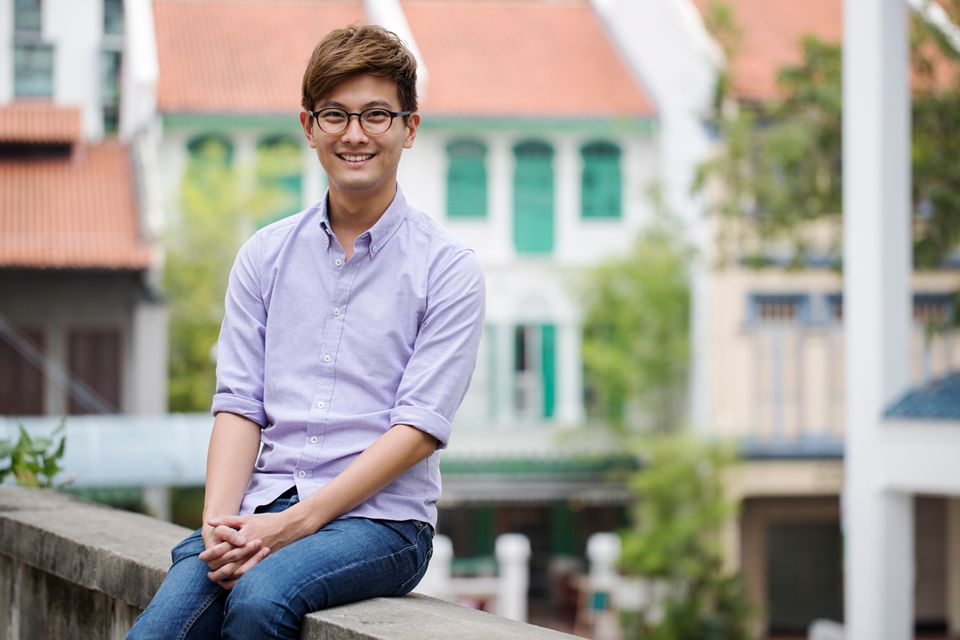
SEAN LEE“When I first came out to my mother, it went horribly,” said Scott Teng. “My family’s very traditional, and the first reaction I got was ‘Get out of my house, you devil spawn!’ She took it very hard. But though it took her a few months, she’s accepted it and now she’s honestly the best mom ever. She told me, ‘Even if the sky falls down, mom will be here for you.”
Sayoni has been documenting cases of violence and discrimination against Singapore’s LGBT community for several years.
Most abuse is underreported Chong says, and she’s been “shocked” by many of the stories she’s heard.
“Transgender women and gay women spoke about being assaulted, sometimes sexually, because of their appearance,” she says. “One trans woman said she was gang-raped at a hotel room, but she didn’t report it to the police. She’s trans and she used to do sex work, so she didn’t feel comfortable.”
Chong says that the poor and the under-educated are particularly vulnerable to abuse. “They have less vocabulary to articulate what’s happening to them and they have fewer resources,” she says. These are individuals who don’t have access to the growing, though still small, LGBT community here.
Avin Tan, 30, is a gay man living with HIV. According to Tan, there have only been two gay people with HIV who have come out publicly in Singapore about their condition. Paddy Chew, who died in 1999 from HIV-related complications, was the first. Tan is the second. “More people need to come out. It takes guts and yes, it’s a risk, but we need people from every walk of life to speak up,” he said. “Only then will we see change.”
The first gay protagonist in a local TV series featured in a 2003 docu-drama called “Crunchtime,” which was aired on Singapore’s Channel U. It was a landmark moment, but the series, supposedly based on a true story, was criticized for promoting homophobia.
A subsequent exhibition about the history of Singaporean television, suggested that homosexuality was depicted as a mental illness in the show. The protagonist, named Shaohua, is seen visiting a counseling service in an effort to find the “correct and normal” path. By the end of the series, Shaohua is happily married to a woman, with whom he has a son.
Storylines like this aren’t unique in Singapore.
“A happy LGBT character, who has a good job or family support, isn’t allowed on Singaporean television,” LGBT activist and corporate attorney Paerin Choa says. “They have to be sad, troubled, or suicidal. In Chinese dramas, the gay character is often a serial killer or a comical sidekick.”
The “promotion or glamorization of the homosexual lifestyle” is not allowed on television or in radio broadcasts, according to guidelines established by Singapore’s Media Development Authority.
“Information, themes or subplots on lifestyles such as homosexuality, lesbianism, bisexualism, transsexualism, transvestism, pedophilia and incest should be treated with utmost caution,” the guidelines state. “Their treatment should not in any way promote, justify or glamorize such lifestyles.”
Activists say that media restrictions like these have impacted their ability to organize and advocate.
More than 50 percent of the 6,000 people who have been diagnosed with HIV in Singapore are gay men, yet, “because of the media law, we cannot run LGBT-specific campaigns,” Avin Tan, the head of advocacy and partnerships at Action for AIDS Singapore, the only organization in the country dedicated solely to HIV/AIDS awareness, treatment and prevention, tells HuffPost.
“We can’t even run condom ads” on mainstream media, he adds. “We have to rely on putting posters up in clubs or using social media. We end up only reaching 10 percent of the community.”
Tan, who lives with HIV, says that these restrictions aren’t just frustrating for advocates, but are potentially fatal for vulnerable individuals who are not being reached.
“For every person who is diagnosed, one is not,” Tan says, quoting an as-yet unpublished AFA study. “One of the greatest challenges right now when it comes to HIV/AIDS is a serious lack of access to information.”
Later this year, 32-year-old Ching S. Sia, a PhD student in architecture at the National University of Singapore, will be going to Australia to freeze her eggs. “Since young, I’ve always thought that I want to have a family one day,” she said. “As a gay woman, I want the option of having a kid when I want to.”
But for all the obstacles facing the country’s LGBT community, “there has been positive change,” according to Lynette Chua, an assistant law professor at the National University of Singapore and the author of Mobilizing Gay Singapore.
“As a scholar, if you solely study outcomes and if your main concern is what laws on the books have been changed, then you’d say activism in Singapore has not been successful,” Chua says. “But if you look at other outcomes, at what’s happening on the ground, there definitely has been progress.”
LGBT activism has a 25-year history in the country. The movement emerged in the early 1990s with small community groups, according to Chua. It was only a few years ago, however, that local activism gained real momentum. In 2009, Singapore’s first public gay pride event — the annual Pink Dot — was launched, and Sayoni was founded in 2012.
The size of the LGBT movement has ballooned in the last decade, Chua says, “and young people are coming out earlier.” There are more activists than ever before and the government has shown “an increased willingness to acknowledge the existence of gay activism.”
“Even as recently as 2009, the word ‘gay’ was very taboo. It wasn’t used in the media, it wasn’t often used in public. LGBT event were held behind closed doors. People were scared of being outed, of losing their jobs, that their families would find out. But that’s slowly changing,” said Pink Dot spokesperson Paerin Choa.
Indeed, when speaking to some members of the community, there is a tangible uniting sentiment: hope.
“When I was younger, ‘gay’ was such a disgusting word to me,” Teng says. “I had trouble even saying it. There wasn’t a sense of pride associated with the term at all. Instead the negative power of the word made me question if I even wanted to be called that.”
But the situation, he says, has “changed significantly.”
“Now being gay is associated with a lot of positive attributes. There’s a better narrative attached. There were no gay role models when I was a kid, but that’s changed too,” Teng says.
In recent years, a handful of local celebrities have come out. Kumar, a prominent comedian, revealed that he was gay in 2011 after years of being in denial. Last year, local actor and theater director Ivan Heng announced in a moving Facebook post that he had married his longtime partner in a ceremony in the U.K.
Paerin Choa, the spokesperson for Pink Dot, says that the LGBT community has grown “more fearless.” The younger generation is “not so frightened or constrained by societal norms.”
“Just look at Pink Dot’s numbers,” Choa says. “In 2009, the first year it was held, 2,500 people showed up. The following year, we had 4,000. In 2015, we had 28,000 people.”
(Pink Dot has had its share of challenges, however, as conservative Christian and Muslim groups have called for believers to oppose the event.)
Progress has been visible in other ways too.
Christopher Khor, a 24-year-old transgender filmmaker, is releasing next year what promises to be a groundbreaking documentary about Singapore’s trans community.
“When we started making this film, there was absolutely nothing, no exposure for the community. I was the first trans person that I knew,” Khor says, his face breaking into a smile. “We hope this film will start to challenge the idea of trans as ‘other.’”
As for the future of Section 377A, both legal experts and activists tell HuffPost that it’s unlikely the statute will be removed anytime soon. “Not in my lifetime anyway,” attorney Peter Low says.
Activists say that there’s plenty of work to be done before that goal can be reached.
“It’s going to be a long fight,” Chong says. “Activists must work the ground and it’s going to take a long, long time. Look at the U.S. How did they win gay marriage? Activists worked the ground for years, they knocked on doors, they educated people, they worked so hard. You need resources, you need tenacity and you need the commitment to slog it out for 10 to 20 years. You need to not give up, and yes, it’s going to be hard.”
Lim and Chee say they’re crossing their fingers that they’ll be around to see the needle shift.
“It took the U.S. 40 to 50 years to get where they are. We’re heading in the right direction, it’s just a matter of when,” Lim says. “I wouldn’t mind being 80 and getting married. I’d do it.”
Singapore-based photographer Sean Lee captured many of the portraits featured in this article. See more of his work here.
JAKARTA — Indonesian Cabinet Secretary Pramono Anung said that Jakarta had earlier rejected Singapore’s offers of assistance to combat the transboundary haze crisis in the region because it was concerned that the city state would claim credit for solving the problem, even while the officials were worried about the rapidly deteriorating situation.
“The (Indonesian) government is not closing ourselves off to assistance. But if we are assisted, the government does not want them (Singapore) to claim the credit. It is the government that is working hard to resolve (this smog disaster) … So we do not want it to reach the point of them claiming credit for it,” Mr Anung told CNN Indonesia yesterday (Oct 7).
According to Indonesian media reports, President Joko Widodo held an unscheduled closed-door meeting yesterday to discuss the haze problem, which has worsened this week.
Jakarta today asked for help from Singapore, Russia, Malaysia and Japan to put out forest fires that have caused choking smoke to drift across South-east Asia, after having turned down several offers of foreign assistance from other countries, particularly Singapore and Malaysia, which have also been affected by haze since the crisis began last month.
Minister of Forestry and Environment Siti Nurbaya Bakar said yesterday that the government had opened up to the possibility of accepting international assistance as the situation was getting worse.
Dr Siti Nurbaya explained that as the fires spread and difficulty of putting them out increased, Indonesia would need support from abroad to provide equipment that is capable of providing water capacity and stronger volume pressure. “It seems that there is a need to receive support whether from Singapore, Russia, Austria, and others,” said the minister at the Presidential Palace Complex yesterday. She added that water bombing and artificial rain would be the most effective and in this regard, Indonesia required more aircraft at its disposal
This was despite Dr Siti Nurbaya stating earlier that Indonesia did not require any assistance from Singapore as it has more than enough aircraft.
Mr Anung stressed yesterday that while the government had not yet decided to declare the smog that is blanketing Sumatra and Kalimantan as a national disaster, it was very concerned about the problem. He said Mr Widodo was actively monitoring the situation, especially through social media, including direct view content uploaded by the community.
“Earlier we showed this (information from social media) to the President. The President knows everything, because we want the President to get information that is as complete as possible to the events that happened,” the Cabinet Secretary highlighted.
Mr Widodo planned to go to a number of areas affected by the haze but he has not been able to do so as the air quality and visibility worsened.