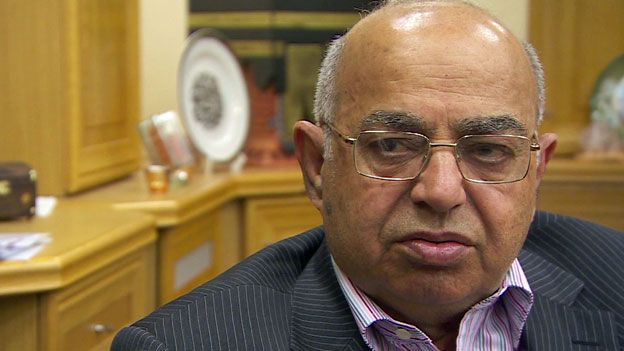
MALACCA: An elderly man died after choking on local delicacy dodol at his house in Taman Merbok, Bukit Baru here last Friday.
K. Sanmugam, 67, experienced breathing difficulties after a piece of dodol got stuck in his throat while he and his wife, S. Santhaletchmy, 66, were enjoying the delicacy around 10am.
Santhaletchmy said upon seeing him choking, she patted his back several times and tried to take the dodol out of his mouth with her fingers.
“I bought that dodol more than a week ago and I cut it into little pieces.
“I advised him to not eat it but he refused to listen to me,” she told reporters here Wednesday.
She added her husband later fainted and was rushed to the Pantai Hospital here for treatment.
However, the doctor said that her husband was in serious condition and died a few minutes later.
Santhaletchmy said her husband was a former employee of SMW Environment and Malacca Historic City Council and had suffered a stroke 15 years ago.
PETALING JAYA: The trend of adopting Arab attire and words is harmless as long as it does not drown out the Malay Nusantara heritage, says Datuk Noor Farida Ariffin (pic).
Adding to the debate on whether the alleged “Arabisation” of Malay Muslims is a cause for concern, the G25 coordinator said that only small parts of Arab culture were being absorbed.
“You have the overt symbols in the sense that you see a lot more people are wearing the abaya (black robe for women), and there are a lot of Arab words being used now,” she said.
Noor Farida also noted that while Malay Muslims today tend to prefer words like “solat” to “sembahyang” and “iftar” instead of “buka puasa”, the changes in vocabulary are minimal.
She, however, refuted the claims of an online news portal columnist that baju kurungs are now difficult to come by in shops as they have been replaced by abayas.
Noor Farida said that while traditionally, baju kurungs are tailored, one can easily still purchase them in shops.
“We Muslims pray five times a day. Many Muslim women feel that by wearing the abaya and the tudung (headscarf), they don’t even need to wear the telekung (white prayer garb) so in that way it is more convenient for them,” said the former Malaysian Ambassador to the Netherlands.
Noor Farida added that she too wears the abaya to the mosque as its more convenient.
“I hope that it is just for convenience rather than the fact that they think they should discard the Malay baju kurung or kebaya because it is unIslamic. So long as it is confined to harmless manifestations, it is fine, but if it’s going to go beyond that and we are going to adopt their (Arab) conservative values then that would be a cause for concern. Especially if we totally lose pride in our own culture,” she said.
“I hope it will not be widespread as to threaten our own Malay Nusantara culture, Islam Nusantara, which is a centuries-old culture which we ought to be proud of,” she said.
Noor Farida does not believe, however, that the Malay community are adopting Arab culture wholesale.
“I don’t think the word ‘culture’ is very apt in the circumstance. If you talk about culture, it’s also about adopting their music and their values,” she said.
Noor Farida, who is also the former director-general of the Foreign Ministry’s Research, Treaties and International Law Department, explained that certain Arab values, such as with regard to the treatment of women, had not seeped into Malay culture as Malay women were still very independent and are given a greater amount of respect.
“I really would not like to see Arab values, especially Saudi Arab values, being adopted by us as they are not very respectful of women. Women occupy very low standing in the eyes of many Arabs. In that sense, I think we are still very different from them because women’s rights groups here are still very active and there is no legal impediment to women’s upward mobility in professions,” she said, adding that in the Malaysian working sector, women could “aim for the sky”.
That being said, Noor Faida stressed that Arab culture was also very diverse. For example, Saudi culture, which is influenced by the strictly conservative Wahhabi interpretation of Islam, is far more rigid than the North African Arab culture.
Noor Farida said that the Saudi culture’s view towards woman was not necessarily Islamic.
She explained that during Prophet Muhammad’s time, women in Arabia were given a vast amount of rights. For example, women then had rights to property and the right to retain their own names after marriage.
“Don’t forget that the Prophet’s first wife, Siti Khadijah, was a very successful businesswoman. In those days, women were still confined to their homes in medieval Europe. Unfortunately, we seem to be regressing. We seem to be going back to the age of ignorance, the age of jahiliyyah. In that sense it would be a pity if we were to regress and adopt conservative Arab values, especially with regard to women’s rights,” she said.
“Many Malay Muslims equate Arab culture with Islam. They don’t realise that not all Arabs are Muslims. There are many Christian Arabs in Palestine and Syria. In Egypt, you’ve got the Coptic Christians so Islam should not equate Arab and vice versa,” she said.
“(It is fine) for the moment so long as it is confined to attire and the absorption of a few Arab words,” she said.
However, some elementes of “Arabisation” have also got Noor Farida peeved like the time someone gave her a “lexicon of Arabic words” to replace existent Malay greetings.
“Honestly, I was quite irritated by that. Please let us respect our values and our culture so long as it is not against Islamic teachings,” she said.
On Dec 8, 2014, The Star published G25’s open letter calling for a review of syariah and civil law in line with the supremacy of the Federal Constitution.
Originally consisting of 25 prominent Malays, most of whom are former high-ranking civil servants, the group now has 53 members and many supporters among other prominent figures.
But what often gets lost in these conversations is that the most common shared trait among entrepreneurs is access to financial capital—family money, an inheritance, or a pedigree and connections that allow for access to financial stability. While it seems that entrepreneurs tend to have an admirable penchant for risk, it’s usually that access to money which allows them to take risks.
And this is a key advantage: When basic needs are met, it’s easier to be creative; when you know you have a safety net, you are more willing to take risks. “Many other researchers have replicated the finding that entrepreneurship is more about cash than dash,” University of Warwick professor Andrew Oswald tells Quartz. “Genes probably matter, as in most things in life, but not much.”
University of California, Berkeley economists Ross Levine and Rona Rubenstein analyzed the shared traits of entrepreneurs in a 2013 paper, and found that most were white, male, and highly educated. “If one does not have money in the form of a family with money, the chances of becoming an entrepreneur drop quite a bit,” Levine tells Quartz.
New research out this week from the National Bureau of Economic Research (paywall) looked at risk-taking in the stock market and found that environmental factors (not genetic) most influenced behavior, pointing to the fact that risk tolerance is conditioned over time (dispelling the myth of an elusive “entrepreneurship gene“).
Resilience is undoubtably a necessary trait for success; many notable entrepreneurs experienced success only after leading failed ventures. But the barrier to entry is very high.
For creative professions, starting a new venture is the ultimate privilege. Many startup founders do not take a salary for some time. The average cost to launch a startup is around $30,000, according to the Kauffman Foundation. Data from the Global Entrepreneurship Monitor show that more than 80% of funding for new businesses comes from personal savings and friends and family.
“Following your dreams is dangerous,” a 31-year-old woman who runs in social entrepreneurship circles in New York, and asked not to be named, told Quartz. “This whole bulk of the population is being seduced into thinking that they can just go out and pursue their dream anytime, but it’s not true.”
So while yes, there’s certainly a lot of hard work that goes into building something, there’s also a lot of privilege involved—a factor that is often underestimated.
Betong: Kubur kata mari rumah kata nanti, namun jiwa muda segelintir lelaki tua rakyat Malaysia yang purata umur menjangkau 70-an menyebabkan ‘kelab tarian bogel’ di pekan Betong, Thailand di sini, tidak pernah sunyi daripada dikunjungi golongan ini.
Lebih memalukan, kewujudan Masjid Jamek Al Mahadi yang terletak kurang 200 meter dari pusat maksiat ini tidak sedikitpun mencetuskan rasa malu dalam kalangan pengunjung beragama Islam ini.
Kumpulan lelaki warga emas yang datang berlibur ini didapati kerap memenuhi pusat hiburan sekitar Jalan Chayachawalit, Jalan Mongkolprachak dan Jalan Grandvilla 2 di sini, yang menawarkan tarian bogel serta joget tiang kepada pengunjung.
Pusat hiburan mendapat jolokan ‘kelab atuk nakal’ ini berbeza dari pusat tarian bogel di Hatyai atau Bangkok, Thailand, berikutan ia membenarkan pelanggan menyaksikan tarian bogel pada jarak dekat dengan pentas atau tiang persembahan.
Suasana ini, sekali gus dianggap istimewa berikutan pengunjung lelaki boleh menyentuh penari atau melihat persembahan maksiat daripada dekat.
Ini menyebabkan lokasi pusat hiburan pernah dijadikan sasaran bom jangka puak pemisah Islam di Selatan Thailand pada 25 Julai lalu terus dikunjungi lelaki warga Malaysia tanpa rasa gusar.
Tinjauan wartawan Metro Ahad selama tiga hari mendapati rata-rata pusat hiburan maksiat ini dipenuhi lelaki Malaysia seawal jam 3 petang saban hari.
Antara pusat maksiat popular dalam kalangan pengunjung warga Malaysia di sini adalah Jockey Club, Gala, Sexy Dance dan Disko 008.
Kebanyakan kelab tarian berahi ini didapati menyediakan sehingga 30 penari bogel pada satu-satu masa.
Wanita terbabit akan menari secara bergilir-gilir di atas pentas sambil diiringi muzik rancak manakala sebahagian lagi rakan mereka melayan pelanggan yang mengerumuni pusat hiburan itu.
Seorang lelaki warga emas yang ditemui wartawan berkata, dia sering datang ke Betong bersama tiga rakan sekurang-kurangnya dua kali sebulan.
“Kami bukan buat dosa teguk arak macam orang lain. Datang cuci mata tengok perempuan seksi di sini…cuma dosa ringan.
“Tak mahal pun, tiada caj masuk kelab, cuma bayar air Coke segelas dengan harga Baht 100 (RM10) kemudian boleh duduk tengok show sampai puas,” katanya yang hanya mahu dikenali sebagai Mat, 71.
Peraih getah berasal dari Gerik, Perak itu berkata, pertunjukan tarian tiang atau ‘tiger show’ itu bermula seawal jam 3 petang hingga 11 malam.
“Jadi kami tak perlu tidur di Betong. Masuk sekejap untuk tengok show dan balik ke Malaysia sebelum pintu Kompleks Imigresen Bukit Berapit di Pengkalan Hulu ditutup,” katanya.
Seorang lagi warga emas yang hanya mahu dikenali sebagai Halim, 65, berkata, lokasi pusat hiburan di Betong kini kian meriah berbanding lima tahun lalu.
“Dulu (pusat hiburan) di Betong lengang dan terkawal, namun sekarang terlalu ramai pengunjung dari Kedah dan Kuala Lumpur terutama ketika hujung minggu.
“Terasa rimas sebab semua pusat hiburan dan tarian bogel berasak-asak dengan pelanggan lain,” katanya yang bekerja sebagai pemandu teksi.
What may be the world’s oldest fragments of the Koran have been found by the University of Birmingham.
Radiocarbon dating found the manuscript to be at least 1,370 years old, making it among the earliest in existence.
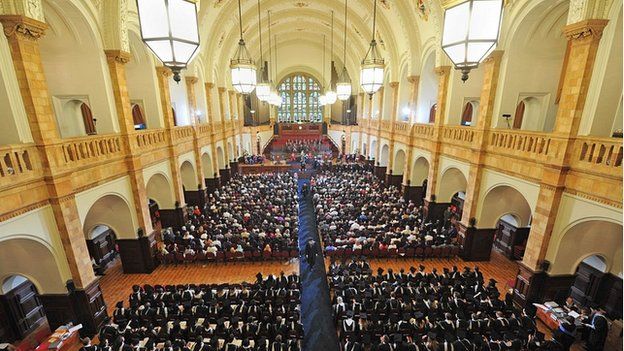
The pages of the Muslim holy text had remained unrecognised in the university library for almost a century.
The British Library’s expert on such manuscripts, Dr Muhammad Isa Waley, said this “exciting discovery” would make Muslims “rejoice”.
The manuscript had been kept with a collection of other Middle Eastern books and documents, without being identified as one of the oldest fragments of the Koran in the world.
Oldest texts
When a PhD researcher looked more closely at these pages it was decided to carry out a radiocarbon dating test and the results were “startling”.
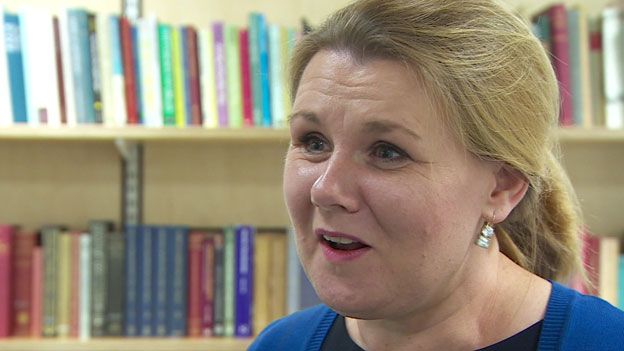
The university’s director of special collections, Susan Worrall, said researchers had not expected “in our wildest dreams” that it would be so old.
“Finding out we had one of the oldest fragments of the Koran in the whole world has been fantastically exciting.”
The University of Birmingham’s manuscript was in a collection brought back from the Middle East
The tests, carried out by the Oxford University Radiocarbon Accelerator Unit, showed that the fragments, written on sheep or goat skin, were among the very oldest surviving texts of the Koran.
These tests provide a range of dates, showing that, with a probability of more than 95%, the parchment was from between 568 and 645.
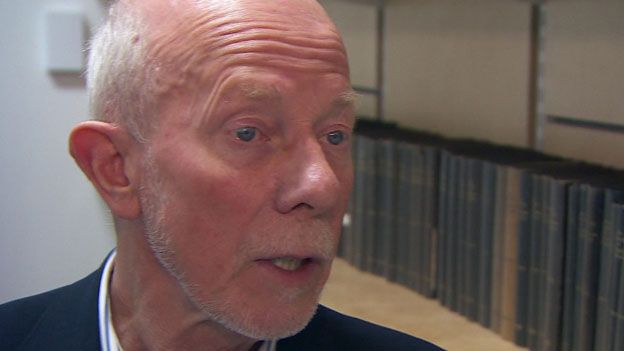
“They could well take us back to within a few years of the actual founding of Islam,” said David Thomas, the university’s professor of Christianity and Islam.
“According to Muslim tradition, the Prophet Muhammad received the revelations that form the Koran, the scripture of Islam, between the years 610 and 632, the year of his death.”
Prof Thomas says the dating of the Birmingham folios would mean it was quite possible that the person who had written them would have been alive at the time of the Prophet Muhammad.
“The person who actually wrote it could well have known the Prophet Muhammad. He would have seen him probably, he would maybe have heard him preach. He may have known him personally – and that really is quite a thought to conjure with,” he says.
First-hand witness
Prof Thomas says that some of the passages of the Koran were written down on parchment, stone, palm leaves and the shoulder blades of camels – and a final version, collected in book form, was completed in about 650.
Prof Thomas says the writer of this manuscript could have heard the Prophet Muhammad preach
He says that “the parts of the Koran that are written on this parchment can, with a degree of confidence, be dated to less than two decades after Muhammad’s death”.
“These portions must have been in a form that is very close to the form of the Koran read today, supporting the view that the text has undergone little or no alteration and that it can be dated to a point very close to the time it was believed to be revealed.”
Susan Worrall says the university wants to put this internationally significant discovery on public display
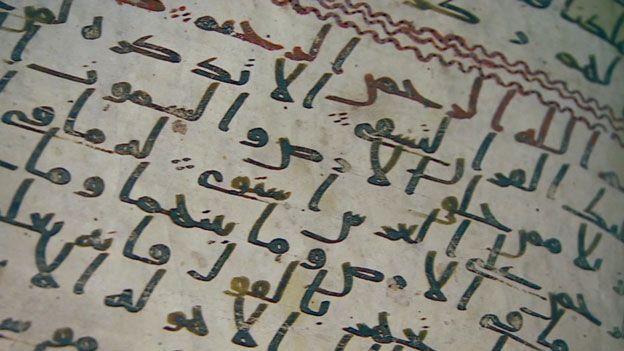
The manuscript, written in “Hijazi script”, an early form of written Arabic, becomes one of the oldest known fragments of the Koran.
Because radiocarbon dating creates a range of possible ages, there is a handful of other manuscripts in public and private collections which overlap. So this makes it impossible to say that any is definitively the oldest.
But the latest possible date of the Birmingham discovery – 645 – would put it among the very oldest.
‘Precious survivor’
Dr Waley, curator for such manuscripts at the British Library, said “these two folios, in a beautiful and surprisingly legible Hijazi hand, almost certainly date from the time of the first three caliphs”.
The first three caliphs were leaders in the Muslim community between about 632 and 656.
The fragments of the Koran are still clearly legible
Dr Waley says that under the third caliph, Uthman ibn Affan, copies of the “definitive edition” were distributed.
“The Muslim community was not wealthy enough to stockpile animal skins for decades, and to produce a complete Mushaf, or copy, of the Holy Koran required a great many of them.”
Dr Waley suggests that the manuscript found by Birmingham is a “precious survivor” of a copy from that era or could be even earlier.
“In any case, this – along with the sheer beauty of the content and the surprisingly clear Hijazi script – is news to rejoice Muslim hearts.”
Muhammad Afzal of Birmingham Central Mosque said he was very moved to see the manuscript
The manuscript is part of the Mingana Collection of more than 3,000 Middle Eastern documents gathered in the 1920s by Alphonse Mingana, a Chaldean priest born near Mosul in modern-day Iraq.
He was sponsored to take collecting trips to the Middle East by Edward Cadbury, who was part of the chocolate-making dynasty.
The local Muslim community has already expressed its delight at the discovery in their city and the university says the manuscript will be put on public display.
“When I saw these pages I was very moved. There were tears of joy and emotion in my eyes. And I’m sure people from all over the UK will come to Birmingham to have a glimpse of these pages,” said Muhammad Afzal, chairman of Birmingham Central Mosque.
Prof Thomas says it will show people in Birmingham that they have a “treasure that is second to none”.