Category: Komentar

Send in your opinion to [email protected].
Kirimkan pandangan anda kepada [email protected].

  • Ex-SCDF Regular: The Boys Need To Learn Their Lesson, We Need To Help Them Move On

    Ex-SCDF Regular: The Boys Need To Learn Their Lesson, We Need To Help Them Move On

    Tak surprising video budak-budak SCDF huru-harakan bunk mereka mendapat perhatian awam.

    Apa kan tidak? Bunk dah bukan macam bunk lagi. Tilam ke mana katil ke mana. Yang satu lagi kelihatan meroko di dalam bunk. Ni semua perkara yang bukan diajar SCDF.

    Tidak pernah saya dalam lebih 25 tahun saya dalam SCDF tengok loss of discipline macam ni.

    We face the facts. Senang cakap,rata-ratanya budak-budak SCDF ni memang nakal-nakal. Their background, most of them, they do not have good qualifications some of them from broken homes, some of them parents keluar masuk jail. You have to look very hard to find a boy from a good school like RI or what not….Scholars and officers you don’t count.

    But even though they come from unfortunate background, I can wholeheartedly say,for those people I trained and trained/worked with, I can trust my life in their hands.

    They brave and courageous. Very good firefighters.  You give them an order, they tak gentar tak terfikir berkal-kali. Dia pergi dia complete the task or the rescue.

    Now the section commanders may not necessarily be the bravest or the fittest, but they are leaders and we epect them to lead.  Some are reluctant. Most come from poly. A few sign-on after poly. They are very dedicated the regulars because this is their rice bowl. Cari makan orang Melayu kata. They don’t spit in that rice bowl.

    So i don’t know how come his bunch so teruk gini.

    I’m sure, you put men together,put them through thick and thin, in the end they forge a deep bond and camaraderie.  They do naughty things. Blanket party. Play pranks. Like me. People put kiwi on my toothbrush. We laugh and we move on.

    But these people destroyed property which was handed to them in good condition. They could have been told to sleep on matresses on the floor as part of the course. But no. Because SCDF care. It’s SCDF core values.  Pride and care.

    But these gentlemen never show that. This is not the kind of section commanders or leaders in the SCDF. What they think there’ll be Banglas or maids to clean after them? Ni kita tak nak fikiran macam gini, orang yang tak responsible dalam SCDF.

    Should they be sent to DB or should they be removed of their ranks and FF badges? That is for SCDF to decide after investigation completed.

    However pada pendapat saya, kita harus ingat yang mereka ni semua masih muda dan ada masa depan mereka. Some also may have to to take care of their familiy and may have young children or sick parents and grandparents that depend on them.

    Whatever the punishment is, they have to understand that what they do is wrong and that future batches don’t follow the same way. But hopefully, we don’t destoy their future with the punishment. Build them up. Help them to reintegrate, especially the regulars. It’s not corruption or it’s not refusing to carry out their duties. If convicts can be rehabilitated, I am confident ini budak-budak boleh change their life.


    Concerned Ex-Regular


  • Indian Helicopters, Israeli Hospitals And Malaysian Medics: How The World Is Coming To Nepal’s Aid

    Indian Helicopters, Israeli Hospitals And Malaysian Medics: How The World Is Coming To Nepal’s Aid

    Nepal’s utter inability to effectively respond to the catastrophic earthquake that rattled the small Himalayan nation on April 25 can be perhaps best explained by the fact that its army has only one big helicopter to its name.

    The massive earthquake—followed by waves of aftershocks—has already killed over 3,000 people and injured thousands across this mountainous nation of 28 million. The exact extent of the damage in large swathes of rural Nepal is still unknown, although entire villages may have been wiped out.

    In the midst of this terrible disaster, there is a slender silver lining for Nepal: The international community—from economic giants like India, China and the US, to tiny Bhutan and faraway Israel—has responded swiftly and generously to help search and rescue efforts in one of theworld’s poorest nations.

    India

    Within four hours of the earthquake on April 25, New Delhi dispatched the Indian Air Force’s first C-130J super Hercules aircraft with members of the National Disaster Response Force. So far, 285 members of the team have been sent to Nepal, along with three army field hospitals and civilian doctors.

    Thirteen military aircraft and three civilian aircraft from Air India and Jet Airways have also been pressed into service to help the rescue operations, according to India’s foreign ministry.

    In addition, six Mi-17 helicopters and two Advanced Light Helicopters have been deployed, and two other Mi-17s are on standby. These choppers have been used to survey outlying areas where road networks have been damaged.

    The Indian government has also sent ten tonnes of blankets, 50 tonnes of water, 22 tonnes of food and two tonnes of medicines to Kathmandu. Indian nationals stranded in Nepal are also being evacuated.

    China

    On April 26, Nepal’s northern neighbor sent a 62-member search-and-rescue team, while  promising 20 million yuan ($3.3 million) in aid. China will send emergency shelters, clothing, blankets, and power generators to Nepal, according to the country’s commerce ministry.

    “The Chinese side is willing to offer all necessary disaster assistance to the Nepalese side,” prime minister Xi Jinping said in a statement.

    Pakistan

    Pakistan has so far sent four Air Force aircraft for rescue and relief assistance, including a 30-bed mobile hospital. According to Radio Pakistan, 2,000 meals, bottled water, medicines, 200 tents, and 600 blankets have already been dispatched.

    “Urban search & rescue team of Pakistan Army, equipped with ground-penetrating radars, concrete cutters, sniffing dogs and other equipment sent to help rescue teams,” Major-General Asim Bajwa, director general of Inter-Services Public Relations, said on Twitter.

    Israel

    On April 26, Israel sent a 260-member team to Nepal on two hired Boeing 747 jumbo jets. The mission comprises a medical staff of 122 doctors, nurses and paramedics, who also carried 95 tons of humanitarian and medical supplies.

    Part of the team will immediately engage in search-and-rescue operations, and medics and other support staff are expected to set up a full field hospital in Nepal within 12 hours of landing.

    Bhutan

    A 53-member team from Bhutan is slated to fly into Kathmandu early on April 27.

    “Upon the Royal Command of His Majesty The King, Bhutan will be sending a 37-member medical team assisted by 15 Desuups to Kathmandu to offer medical assistance for the earthquake relief operations,” the Bhutanese monarch’s office posted on Facebook. The team will consist of surgeons, medical specialists, nurses and technicians from the Bhutan’s ministry of health and the Royal Bhutan Army.

    Japan

    The Japanese government sent a 70-member disaster relief team on April 26 to conduct rescue operations. Tokyo has also offered to provide relief supplies including tents and blankets worth 25 million yen ($210,000), through the Japan International Cooperation Agency.

    Singapore

    Singapore has already sent a 75-member search and rescue team to Nepal in two C-130 aircraft, while another team is expected to leave today (April 27). The Singapore government has also offered $100,000 to the Singapore Red Cross, which is raising money for relief operations in Nepal.

    Malaysia

    Thirty members of the Special Malaysia Disaster Assistance and Rescue Team, together with the necessary equipment, are being readied to fly to Nepal, Malaysia’s prime minister Najib Razak said on April 26. Subsequently, another 20 doctors will join the team on a Royal Malaysian Air Force C130 aircraft. The aircraft will remain on standby to evacuate Malaysians from Nepal.

    Sri Lanka

    Colombo has so far sent 44 army personnel and four medical consultants to Nepal to assist in the rescue and relief operations. The Sri Lankan government also plans to send another team with 156 rescuers, including 14 sailors, 11 airmen and four civil medical consultants, which will be followed by a civilian aircraft carrying food supplies.

    UK

    The United Kingdom has sent an eight-member disaster response team, including experts in search and rescue. The government has also announced that it has released £3 million for immediate humanitarian assistance, with another £2m going to the Red Cross. A number of UK-based charity organisations are sending their own disaster management teams into the country, including Oxfam, Christian Aid, Save the Children, the British Red Cross and Plan International UK.

    UAE

    The United Arab Emirates has dispatched staff from its search and rescue agency to Nepal. The 88-member team will be accompanied by UN personnel. Simultaneously, another Emirati team will fly to India to purchase food and medical supplies and then airlift them to Nepal.

    US and Canada

    Canada and the US have offered $5 million and $1 million for humanitarian assistance, respectively. “USAID is preparing to deploy a Disaster Assistance Response Team and is activating an Urban Search and Rescue Team to accompany disaster experts and assist with assessments of the situation,” John Kerry, US secretary of state, said in a statement.

    Australia

    Julie Bishop, Australia’s foreign affairs minister, has offered aid worth AU$5 million (US $3.9 million) to Nepal. This will include AU$2.5 million to assist Australian non-government organisations, $2 million to support United Nations partners and AU$500,000 to support the Australian Red Cross.

    The country has also sent two humanitarian experts and a crisis response team to Nepal.

    Norway

    The Norwegians have promised $3.8 million in humanitarian assistance to Nepal. “It is now important to get an overview of what the needs are so that relief efforts can be brought in as quickly and efficiently as possible,” the country’s foreign minister, Boerge Brende, said in a statement. “The funds will be channelled through the UN system and NGOs.”

    The European Union


    “The European Commission is making available €3 million in its immediate response to the vast devastation caused by the earthquake that hit Nepal on Saturday,” the EU’s executive arm said in a statement. “This comes in addition to the assistance from the member states and the deployment of European Commission’s humanitarian aid and civil protection experts to the crisis area.”

    Countries such as Belgium, Finland, Germany, Greece, Netherlands, Poland and Sweden have offered their search and rescue teams to Nepal. The teams will also work on water purification systems and technical assistance. Italy, meanwhile, has announced that it has kept $326,000 available for emergency aid to Nepal. This will be channeled through the International Federation of the Red Cross.

    Source: http://qz.com

  • When Must We Be Tolerant And When Are We Asking Too Much?

    When Must We Be Tolerant And When Are We Asking Too Much?

    My friend related a story to me over the weekend…

    His company employed a Muslim worker for the first time since the company started. The staff did well and got along well with the rest of the employees. Not long later, my friend employed another 3 more Muslim workers.

    This is when things gets a bit complicated. The Muslim workers started asking for a prayer room and also longer lunch break on Fridays for them to attend Mosque. Not wanting to appear discriminating against them, my friend agreed and informed the team leader to re-distribute the workload on Friday so that the Muslims could go for prayer. The rest of the team members were then asked to double up. This cause a bit of morale problem within the company as others are unhappy because all are paid the same salary. Over time, the productivity of the team was noted to have gone down due to longer absence from duty.

    The office also has a pantry where workers could use during their lunch break. This time, the Muslim workers asked if they could have their own fridge and microwave oven since the old one had been used for non-Halal food. Again, being religion sensitive, my friend agreed and bought new items for the pantry.

    A year later, my friend noticed that there is clearly a separation in the company. There are different utensils and also washing items for Muslims.

    At one point of time, the Muslims workers even asked if they could have a separate pantry which by now, my friend openly rejected the idea.

    The workers explained that they felt their religion was not respected by others as they were using the common table cloth to clean the table after eating pork and the taps were oily (presumably lard) when they were using it. They asked if the management could stop other workers from bringing in pork/lard into the pantry and they are okay with other non-Halal food.

    Now my friend is in a dilemma. While he respect the Muslim’s religious obligation, he does not want to impose other’s religious restriction and deprived other of their rights. He is wondering where should he stop?

    Gordon Tay

    *Article first appeared on https://www.facebook.com/gordon.tay.75/posts/972387889460449


    Editor’s Note: 

    Let’s refrain from making insulting comments on this issue. It is a real issue, which also applies to other religious customs and cultural customs too. Where do we draw the line between tolerance and over-demanding? It is important to be able to have open, logical discussions about such issues.


    Source: www.therealsingapore.com

  • Osman Sulaiman: Apa Dah Jadi Dengan Adat Dan Budaya Perkahwinan Orang Melayu?

    Osman Sulaiman: Apa Dah Jadi Dengan Adat Dan Budaya Perkahwinan Orang Melayu?

    Adat dan budaya perkahwinan orang melayu sudah jauh melencong dari asal. Unsur-unsur barat sudah banyak menyerap. Hilang nya adat dan budaya orang melayu, hilanglah identiti kita sebagai orang Melayu di Singapura.

    Ramai anak2 muda sekarang sudah tidak cenderung kepada adat istiadat perkahwinan orang melayu. Di anggap kuno katanya. Amalan kita hari ini akan menjejas generasi yg akan datang. Kalau bukan kita yg menjaga warisan dan budaya orang melayu, siapa lagi?

    Dapat kita lihat bagaimana budaya barat telah menyerap masuk dipraktikkan oleh anak2 muda kita apabila mereka bersanding.

    1. Joget2 barat ala the wedding planner.
    2. Pengapit ditukarkan kepada pengiring yg memakai kostume2 seperti star wars
    3. Mempelai mesti memakai baju ‘western’
    4. Malam berinai semakin kurang dipraktikkan
    5. Merenjis sudah jarang dibuat
    6. Pembacaan berzanji semakin pupus malahan ditukarkan kepada music2 pop
    7. Makcik2 bertudung berjoget dangdut
    8. Sekarang, lion dance pula.

    Tanggung jawab memelihara warisan dan budaya terletak pada generasi muda. Ibu-bapa pula memainkan peranan penting supaya budaya dan warisan tidak pupus. Hang tuah berkata: “Takkan hilang melayu di dunia.”

    Mungkin tidak di dunia. Tapi di Singapura kot?


    Source: Osman Sulaiman

  • The SCDF Heritage

    The SCDF Heritage

    First Fire Brigade

    The early fires were mostly put out by policemen, sepoys, soldiers and even prisoners. In April 1869, a voluntary firefighting force was formed, but without proper trainings and equipment, the early brigade was proved to be inefficient in dealing with major fire disasters.

    wheel escape ladder 1910sIt was only until mid-1886, and after countless fires, when the proposal to hire firemen was approved. Two years later, the Singapore Fire Brigade was officially formed. With sufficient funding, fire stations were able to be established within the police quarters, equipped with horse-drawn steam fire engines.

    A breakthrough for the Singapore Fire Brigade was the purchase of its first wheel escape ladder in 1908. Measuring 50 feet, the ladder was able to reach the highest window on a double-storey building. By the seventies, the Singapore Fire Brigade had a total of six wheel escape ladders, which were operationally ready until they were decommissioned in 1981.

    The Early Fire Stations

    Posted from England, Captain Montague William Pett was the first professional fireman in Singapore. He was appointed as the superintendent of the Singapore Fire Brigade between 1905 and 1912, and was given the task to modernise the force. One of Montague Pett’s contributions was to commission the building of the Central Fire Station to serve as the headquarters of his firefighting force. The fire station, also known as Hill Street Fire Station, was professionally designed with a training ground, engine house and a watch tower. It was officially opened in August 1909.

    The Central Fire Station, however, was not the first fire station in Singapore. The Cross Street Fire Station had been the main station for the early firefighting force since 1891, and there were also the Beach Road Fire Station, which became operational two years later, and the Kallang Fire Station.

    central fire station

    The Early Fire Engines

    Merryweather Fire King

    The Merryweather Fire King, one of the world’s best fire engines of its era, was introduced in Singapore in the early 20th century. It had been used by both London Fire Brigade and Penang Fire Brigade since 1905 and 1906 respectively. Fully motorised, it was equipped with a boiler that produced steam to drive the fire engine to the disaster site in a short period of time.

    merryweather fire king

    The Merryweather Fire Engine also allowed water to be pumped directly from a water source. The firemen could then use the high water pressure in their hoses to fight fire effectively.

    Major Pump Three

    The Singapore Fire Brigade acquired two Major Pump Three before the Second World War, and added one more in 1947. Produced in the 1930s, the Major Pump Three, also known as Dennis Fire Tender, was capable of efficient firefighting and rescue missions with its 450/500 Dennis turbine and 16m escape ladder. During the operations, the driver and the officer-in-charge would sit in the front seats of the open-concept vehicle, while the rest of the firemen had to stand on the side platforms, clinging tightly onto the ladder.

    major pump three

    The Major Pump Three fire engines were put to test during the Bukit Ho Swee Fire in 1961. They continued to be used by the Singapore Fire Brigade until the seventies. Only one such model remains today, where it is being put on display at the SCDF Heritage Gallery.

    Dennis Pump Escape

    The Dennis Pump Escape was bought by the Singapore Fire Brigade in 1951 as part of an upgrade to their firefighting equipment. Fitted with a better engine, the Dennis Pump Escape also ensured the personal safety of the firemen, who could now sit inside the fire engine instead of clinging onto the side rails.

    dennis pump escape

    The Dennis Pump Escape served for a total of 28 years in the force, before it was retired in 1979.

    Major Fire Disasters

    Kampong Koo Chye Fire (1958)

    Tragedy struck Kampong Koo Chye at Lorong 1 and 3 of Geylang Road on 5 April 1958, when a raging fire swept across the kampong made up of wooden and attap houses. Six lives were lost, before the firemen were able to keep the fire under control.

    The disaster led to the formation of kampong firefighting parties made up of volunteers. Each party was made up of 20 young men who were given proper trainings by the fire brigade. The fire brigade would visit various kampongs in their fire engines to educate the residents on fire safety. The exercise proved to be successful. Instead of grabbing their possessions and running away, more kampong residents and the firefighting parties were able to quickly deal with small fire outbreaks before they got out of control.

    Tiong Bahru Fire (1959)

    Tiong Bahru had been plagued by fires between the 1930s and 1950s. A major one hit thekampongs at Tiong Bahru in February 1959, causing 12,000 residents to lose their home. The total loss was estimated to be $2 million.

    Bukit Ho Swee Fire (1961 & 1968)

    The notorious Bukit Ho Swee Fire, the worst fire disaster in the history of Singapore, broke out in the afternoon of Hari Raya Haji on 25 May 1961. Believed to have started near the King’s Cinema at Tiong Bahru, the fire, fanned by strong winds, spread rapidly through Bukit Ho Swee to Havelock Road and the Delta area. Rows of attap houses, sawmills and workshops were destroyed, and explosions were heard from the oil and petrol containers in the nearby warehouses.
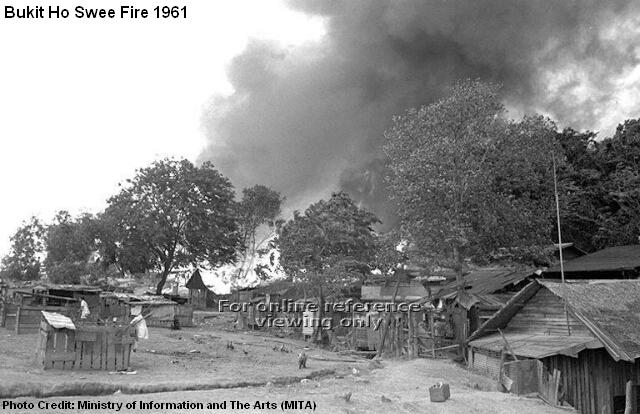
    bukit ho swee fire 1961

    A record 22 fire engines were activated, but by 8pm, the fire was still burning strongly. By the time it was put out, the fire had destroyed more than 100 acres of squatter settlement, claiming four victims and leaving 16,000 homeless. Several years later, on 24 November 1968, Bukit Ho Swee was devastated by another big fire. This time, 3,000 residents’ homes in another squatter settlement at Bukit Ho Swee were burnt down.

    robinsons fire 1972Robinsons Department Store Fire (1972)

    On 21 November 1972, a large fire, caused by an electrical short circuit, engulfed Robinsons Department Store at Raffles Place. A total of nine people perished in the fire, and more than $20 million’s worth of consumer products were destroyed in flames that could be seen as far as Jurong. The disaster also ended Robinsons’ 114-year presence at Singapore’s prime district.

    Sypros Disaster (1978)

    In late 1978, the Liberian-registered vessel named Sypros arrived at the Jurong shipyard for repairs. A spark from the cutting torch caused the ship’s contaminated fuel tank to explode, turning the engine room into an inferno. 76 lives were lost; many of them were burnt to death. The Sypros tragedy later led to the aggressive campaigns for safety in the shipbuilding industry.

    Pulau Bukom Fire (1981)

    Struck by a bolt of lightning in the wee morning of 18 April 1981, the roof of an oil tank at Pulau Bukom was ignited with fires burning more than 15 hours. More than 100 firemen from the Singapore Fire Service were rushed to the scene to battle against the spreading flames.

    pulau bukom fire 1981

    Sentosa Hostel Fire (1982)

    In the island’s first ever major fire, a two-storey youth hostel on Sentosa was partially destroyed on 24 October 1982. Flames quickly fanned through rooms filled with beds and furniture, as 70 rangers battled the fire for almost 90 minutes.

    Pulau Merlimau Refinery Fire (1988)

    A fire had broke out on Pulau Merlimau oil refinery on 16 August 1984. Four years later on 25 October 1988, the storage tanks on the Southern island caught fire again. It went on to become Singapore’s worst offshore fire disaster. Lasting more than six day, the fire sent numerous tanks filled with naphtha into flames and smoke. The Pulau Merlimau fire resulted in 25 injuries and $15 million in losses, and thick clouds of polluted air and soot covered the western part of Singapore for days.

    pulau merlimau fire 1988

    Jurong Shipyard Fire (1994)

    Another flash fire hit a tanker at Jurong shipyard on 8 February 1994, killing eight and injuring three.

    Tuas Chemical Fire (1997)

    One of Singapore’s worst chemical fires occurred on 22 May 1997. Chemical treatment plant Chemsolv Technologies, located at Tuas, was hit by a fire that found it way to the highly flammable waste chemicals stored in drums and containers. The firemen took more than four hours to control the blaze. Two were injured and more than 500 workers were evacuated.

    Eunos Crescent Market Fire (1999)

    On 05 July 1999, some 158 stalls were burnt to ashes in a big fire at Eunos Crescent Market.

    Seletar Market Fire (2000)

    The popular but now-demolished Seletar Market was almost destroyed by a big fire on 28 July 2000. 84 stalls were destroyed, and the hawkers had to be relocated at makeshift stalls nearby. The new Seletar Market was completed in the following year at a cost of $750,000, but was eventually torn down at the end of 2004.

    Pulau Bukom Refinery Fire (2011)

    Burning for 32 hours and resulting in a total loss of $187 million, the fire that struck Shell’s refinery at Pulau Bukom on 28 September 2011 was the worst refinery fire since 1988. More than 100 firefighters were activated to control the situation. It would take three months before Shell’s refinery was able to resume to full production.

    pulau bukom fire 2011

    The Modern-Day Force

    In 1980, the Singapore Fire Brigade became officially known as the Singapore Fire Service (SFS). It was renamed as the Singapore Civil Defence Force (SCDF) in April 1989 after the merger of the Fire Service and the Civil Defence Force. The modern-day force not only dealt with fires but also other disasters such as the collapse of the Hotel New World in March 1986. Since 1988, the Civil Defence Force had also been deployed in overseas humanitarian and disaster relief operations.

    995, the emergency number that most Singaporeans are familiar today, was introduced in 1984, replacing the older versions of 5555, 328111 and 3378111. In 1991, the first Public Warning System (PWS) were tested and installed. Today, the system covers more than 2,000 strategic locations on the island.

    Former Fire Stations

    Alexandra Fire Station (1954-2003)

    Alexandra Fire Station was officially opened by the Governor of Singapore Sir John Nicoll on 25 February 1954. Constructed at a cost of $1.5 million, it was then the largest fire station in Eastern Asia. Located near Rumah Bomba Circus, the former round-about between Alexandra Road and Queensway, the fire station’s main mission was to serve Singapore’s first satellite town in Queenstown, Pasir Panjang and the west coast of the country.

    Alexandra Fire Station boasted a 164-feet high watch tower, 62 feet taller than the iconic tower at the Central Fire Station. One of the station’s most difficult operations was the battle against the Bukit Ho Swee fire in 1961. Serving for almost 50 years, the aging premises of the former Alexandra Fire Station was eventually demolished in 2003.

    Bukit Timah Fire Station (1956-2005)

    The fourth fire station in Singapore, the Bukit Timah Fire Station was built two years after the completion of the Alexandra Fire Station. Standing at the junction of Upper Bukit Timah Road and Old Jurong Road for five decades, it had become an iconic landmark in the vicinity with its distinctive red doors and watch tower. There were also several blocks of staff quarters standing beside the main station.

    former bukit timah fire station

    In 2005, the fire station was closed permanently; its role was taken over by the 4th Civil Defence Division housed in the new Bukit Batok Fire Station at Bukit Batok Road. The premises is currently converted into a restaurant.

    Geylang Fire Station (1929-2002)

    Before the ceasing of its operation, the Geylang Fire Station was the second oldest fire station in Singapore after the Central Fire Station. It was opened in 1929, and served a total of 73 years at the junction of Paya Lebar Road and Sims Avenue.

    former paya lebar fire station

    After 2002, the duties of the Geylang Fire Station were reassigned to the Paya Lebar Fire Station, who also serves as the headquarters of SCDF. The premises of the former fire station was given the conservation status is 2007.

    Sembawang Fire Station (1941-2003)

    Located within the former Sembawang Naval Base, the old Sembawang Fire Station was established by the British in 1941, providing operational coverage for the naval base as well as areas around Sembawang, Mandai and Woodlands. When the British forces started their withdrawal in 1968, Sembawang Naval Base and its facilities were handed over to the Singapore government.

    sembawang fire station 1986

    The Sembawang Fire Station, with its fleet of fire engines, fire boats and firefighting equipment, was taken over by the Singapore Fire Brigade in 1971. It continued to be in service until 2003, when its operations were relocated to Yishun Fire Station. Like the Geylang Fire Station, Sembawang Fire Station was conserved by the Urban Redevelopment Authority (URA) in 2007.

    Serangoon Fire Station (1952-2001)

    Built in 1952, the Serangoon Fire Station was situated along Serangoon Road near the Kallang River. It won the best fire station award in 1996. The responsibilities of the Serangoon Fire Station were transferred to the Bishan Fire Station after it ceased its operation in 2001.

    former serangoon fire station

    The restructuring of the organisation ensured that the SCDF’s operational coverage was extended to the residential, commercial and industrial areas at Bishan and Thomson.

    Published: 22 August 2014


    Source: http://remembersingapore.org

deneme bonusu