Category: Komentar

Send in your opinion to [email protected].
Kirimkan pandangan anda kepada [email protected].

  • Family Of Dominique Sarron Lee: Our Fight Is About Justice, Not Money

    Family Of Dominique Sarron Lee: Our Fight Is About Justice, Not Money

    Following the Facebook post by Dominique’s mum, we have been surprised and touched by the show of support and words of encouragement from members of the public. We, the family, would like to sincerely thank those who have given their support and encouragement.

    The family would like to clarify our position and address some of the misconceptions that have arisen due to lack of accurate information.

    CI AND COI FINDINGS
    MINDEF in its Facebook posting today (Key Findings from the Death of PTE Dominique Sarron Lee, 7 March 2016), stated that Dominique’s death was “unlikely to have been predicted”. If this was the case, why then is there a Training Safety Regulation to limit to 2, the number of smoke grenades to be used in the specific exercise that Dominique was involved in to begin with? How did SAF decide on this limit as being within safety regulation of such an exercise?

    MINDEF has also repeatedly iterated that the coroner had noted that Dominique “had under played and under declared his asthmatic condition.” Yet the coroner had also opined that asthma had a weak correlation to the allergic reaction that Dominique suffered in the exercise. Furthermore, the Minister for Defence himself had said that even those without asthma may be affected by the effects of zinc chloride. So our question is, did Dominique’s alleged under play and under declaration of his condition contribute directly to his untimely demise? Our layman conclusion is that it does not.

    In the Facebook statement, MINDEF stated that “the coroner noted that more smoke grenades than necessary were used during the exercise, but could not ascertain whether the acute allergic reaction was due to concentration and/or the mere exposure of zinc chloride fumes”. We had learnt anecdotally from SAF personnel, immediately after the tragic incident, that Dominique had taken part in a similar exercise before where the TSR had not been breached. This to us, suggests that the fatal allergic reaction occurred due to concentration of rather than mere exposure to zinc chloride fumes, which brings us back to the question of MINDEF’s TSR of 2 smoke grenades as being within safety limits. If the safety hazard has to do with mere exposure to zinc chloride fumes, then the regulation on the number of smoke grenades would be irrelevant as the grenades should not even be in use at all. In that regard, we would like to ask MINDEF about the new N452 smoke grenades that have be introduced since the incident. How are they an improvement to the previous smoke grenades? Has any test been done to ascertain if the concentration and/or mere exposure to the fumes would result in acute allergic reaction? Can MINDEF/SAF share the safety aspect(s) of such an assessment (if any) with the public? What are the chemical compound(s) found in these new smoke grenades?

    It is a fact that Dom died from the effects of the smoke grenades thrown. It is also a fact that the number of smoke grenades thrown exceeded thrice the safety limits. We do not know how more direct a link one can infer from this, about the factors leading to Dominique’s untimely death. The Coroner’s Inquiry is to ascertain the cause of death. The Coroner’s Inquiry does not determine whether or not the 2 officers or MINDEF is/are culpable or not. Can MINDEF kindly make this point clear in its statement? The Minister for Defence, in his Parliamentary Statement in November 2012, stated that the COI concluded that the two officers were negligent. But in the Facebook statement, BG Chan stated that the COI “did not find that the two officers were directly responsible for PTE Lee’s death”. Can MINDEF again, kindly clarify if the Ministerial Statement or the Facebook statement was erroneous?

    ACCOUNTABILITY OF MINDEF/SAF
    MINDEF/SAF has not apologized formally to the family for the incident resulting in Dominique’s death. We had previously requested that the Minister for Defence offer the apology directly to Dominique’s mum as acknowledgement of the negligence on their part, and of the grief she has suffered, but we were rebuffed. We were told by the MINDEF representative, in no uncertain terms, that the Minister will never apologise for the incident, nor will any senior official from MINDEF/SAF.

    Subsequently, we offered an olive branch to MINDEF. Instead of the personal apology, we requested for MINDEF to pay for Dom’s tomb as a symbolic gesture, but this was again rejected. Legal constraints were cited as the reason for the rejection. It is only today (7 March 2016) that we see the first statement of apology from MINDEF in their Facebook statement addressed to the general public.

    We have repeatedly asked for details on how the two officers have been dealt with as the Minister for Defence had said in Parliament in November 2012, that they had been negligent in their duties. The COI had also found that they did not comply with safety regulations.

    We are not out to persecute the two officers, nor asking for them to be crucified. We do not believe in an eye for an eye. We are only asking for MINDEF/SAF to be accountable. Minister K. Shanmugam himself had said in Parliament in May 2012, that “justice must not only be done, it must be seen to be done”. But MINDEF/SAF has thus far, refused to show us how the justice has been done. All we know for sure from recent Facebook postings by netizens, is that one of the officers was promoted in July 2014. To our layman understanding, this seems to be a contradiction of the assurances by MINDEF/SAF that the negligent officers have been duly dealt with, that justice has been done.

    Could MINDEF kindly clarify their statement in the Facebook posting, that ‘‘administrative and disciplinary action against the two officers” have been taken? Please inform the public how the two officers have been “punished according to military law” so that the public can see for themselves that the justice has been served, and not just know it to have been served.

    IMPROVEMENTS TO SAFETY

    It is of small comfort to the family to know that following Dominique’s death, improvements have been made to ensure the safety of all National Service men, with “the setting up of a Safety and Systems Review Directorate, the convening of a Respiratory Medicine Specialist Advisory Board to review medical classification Asthma, and the deploying of more safety officers on the ground as full-time Unit Safety Officers”, as well as the introduction of “new N452 grenades … to replace the smoke grenades used in that training exercise”. We wish all these safety measures had been in place sooner so that it would not have taken a death, Dominique’s death, for the SAF to realize their lapses in ensuring the safety of all National Service men.

    SUPPORT FOR THE FAMILY
    MINDEF’s statement revealed that we had “previously taken out a pre-action discovery application, which [we] subsequently withdrew” and that the court had “awarded costs to MINDEF”, which they had waived. What the statement does not mention is the fact that the said application was withdrawn because we accepted the AGC’s request to enter a mediation with MINDEF, and the agreement was made on the condition that the legal fees were waived. The mediation did not go as planned as MINDEF was not willing to accede to our request for either the Minister to apologise to the family or MINDEF to pay for Dominique’s tomb. Left with no other recourse, the family made the difficult decision of seeking redress in a civilian court.

    We would like to clarify that this law suit has never been about money. It has always been about getting answers to our questions. We would not have taken the legal route had MINDEF been fully “committed to assisting and providing” us with the answers we seek.

    To concerned members of the public, we would like to clarify that to date, we have not accepted nor received any compensation from MINDEF/SAF for Dominique’s untimely demise. The family has repeatedly rejected offers from MINDEF/SAF to discuss monetary compensation. We have only accepted a funeral grant to defray the cost of the funeral, on the same day Dominique was sent back home in a coffin. This grant, according to the SAF, is not part of the compensation.

    Finally, we would like to appeal to the public be fair to Dr Chee Soon Juan. We had initiated the meeting with Dr Chee as we are at our wit’s end. We do not intend nor wish for this to be a political issue. We had, over the past 3 years, approached no less than 4 PAP MPs, including an anchor Minister and a GPC Chairman for their assistance. We had even written to the Prime Minister several times, pleading for help in getting answers. All they did was to direct our questions to MINDEF for their reply. Such help is as useful to us, as a comb is to Michael Jordan. We are not siding with any political party; we are just seeking answers to get some closure. We only seek accountability from MINDEF and SAF.
    We are not asking Singaporeans to change the government; We are asking Singaporeans to demand that the government change the laws to achieve “justice and equality” for all. How can we continue to trust the government when we now know that they have set lower standards of accountability for themselves in law, when In fact they should set higher standards for themselves?

    Unlike MINDEF, we do not have a team of lawyers or PR personnel to craft out statements. While their spin doctors spin ambiguities to manage the fiasco that they have created for themselves through their high-handed handling of our case, we can only rely on our own heartfelt responses to speak about what we intrinsically know to be an injustice to not just us, but the people of Singapore. We lay all our cards on the table. MINDEF, we ask that you do the same. Please be transparent. We do not think that Dominique’s death is in any way a matter of national security that requires secrecy. While you are at it, kindly, with our permission, reveal to the public the compensation that you had intended to offer the family, so that all Singaporeans will know how much the life of a promising young man is worth to MINDEF.


    Source: In memory of Dominique Sarron Lee

  • ARMY TRADOC General: Officers Responsible For Pte Lee’s Death Disciplined

    ARMY TRADOC General: Officers Responsible For Pte Lee’s Death Disciplined

    The SAF offers our deepest condolences to the family of the late PTE Lee Rui Feng Dominique Sarron. We are deeply sorry for the untimely and tragic loss, and the anguish and distress brought to his family. We respect the wishes of the family to determine the reasons behind PTE Lee’s death. When any of our soldiers are injured or killed, the SAF will do its utmost to determine the cause and improve our safety standards to prevent any recurrence. Those responsible through their rash and negligent acts will be held accountable under our Military Court and Criminal Law Courts.

    On 3 March, the High Court struck out the lawsuit filed by the family of the late PTE Lee against the SAF and the two officers involved in the incident. To clarify issues that have risen in response to this judgement, we set out the key findings as determined by the Committee of Inquiry (COI) in 2012 and the Coroner’s Inquiry (CI) in 2013.

    CORONER’S FINDINGS

    The CI was an open hearing that had provided for all interested parties to make their representation, including the family of the late PTE Lee. At the conclusion of hearings, the coroner found that PTE Lee had “died from acute allergic reaction to zinc chloride due to inhalation of zinc chloride fumes”. The coroner also found that this acute allergic reaction was “unlikely to have been predicted”.

    The coroner noted that more smoke grenades than necessary were used during the exercise, but could not ascertain whether the acute allergic reaction was due to concentration and/or the mere exposure of zinc chloride fumes.

    The coroner also noted that PTE Lee “had under played and under declared his asthmatic condition”. None of the other asthmatics in the same platoon reported any adverse outcome from the exercise or exposure to the smoke.

    Smoke grenades which produce zinc chloride fumes have been in use by many militaries, including the SAF since the 1970s. PTE Lee’s death directly attributable to zinc chloride inhalation is the first on the SAF’s records in over thirty years of use.

    COMMITTEE OF INQUIRY’S FINDINGS

    The independent COI, convened by the Armed Forces Council, found that the number of smoke grenades discharged and the distance between the smoke grenades were not in accordance with the limits and minimum distance specified in the Training Safety Regulations. The COI also noted that PTE Lee’s medical classification and vocational assignment were in line with guidelines, and that medical aid rendered was timely, proper and adequate. These full findings of the COI were presented in Parliament through a Ministerial statement in 2012, including the actions taken to address safety lapses.

    LIABILITY FOR ACTIONS

    We would also like to address the misperception that SAF servicemen injured or killed cannot seek legal recourse under military rules. This is incorrect. SAF personnel can be charged and punished in the criminal courts for Penal Code offences of committing rash and negligent acts, even during the course of their military duties. The Attorney-General’s Chambers (AGC), not the SAF, decides if the evidence warrants this course of action. For example, in 2004, four servicemen were charged in court for causing the death of another serviceman during combat survival training. More recently, a senior instructor was charged and convicted of instigating a full-time National Serviceman to commit a rash act, and attempting to pervert the course of justice. The jeep overturn incident resulted in the death of a full-time National Serviceman. In both cases, the servicemen responsible were found guilty, and sentenced to imprisonment.

    In PTE Lee’s case, the Coroner found that PTE Lee had died of an unforeseen acute allergic reaction to the smoke grenade fumes. As PTE Lee’s acute allergic reaction to the smoke grenades thrown by the Platoon Commander was not reasonably foreseeable, no criminal charges were brought against the two officers.

    The SAF has however taken administrative and disciplinary action against the two officers. While the CI and COI did not find that the two officers were directly responsible for PTE Lee’s death, the two officers were summarily tried in 2013 for negligent performance of lawful order or duty, found guilty, and punished according to military law.

    IMPROVEMENTS TO SAFETY

    The SAF had since 2012 taken several measures to strengthen training safety across the whole SAF. This included the setting up of a Safety and Systems Review Directorate, the convening of a Respiratory Medicine Specialist Advisory Board to review medical classification on Asthma, and the deploying of more safety officers on the ground as full-time Unit Safety Officers. New N452 smoke grenades were also introduced to replace the smoke grenades used in that training exercise.

    SUPPORT FOR THE FAMILY OF PTE LEE

    Before the most recent suit, the family of PTE Lee had previously taken out a pre-action discovery application, which they subsequently withdrew. The court had awarded costs to MINDEF, but MINDEF had waived the legal costs.

    MINDEF and the SAF have been extending help to PTE Lee’s family throughout this period, and remain committed to assisting and providing support to the family. Since the incident, welfare grants have been disbursed, and an offer of compensation has been made to the family, based on the full extent allowed by the compensation legislation. To respect privacy and maintain confidentiality, compensation amounts are not disclosed, but are generally two to four times that of amounts provided under the Work Injury Compensation Act for incidents arising from training and operations.

    Once again, the SAF offers our sincere condolences to the family of PTE Lee. The SAF values the life of every soldier and recognises that we are responsible for the sons of Singapore placed under our charge. We will uphold safety standards while ensuring that we build a strong National Service force able to defend Singapore.

    Brigadier General Chan Wing Kai

    Commander Army Training and Doctrine Command (TRADOC)


    Source: www.facebook.com/notes/the-singapore-army

  • Do Singaporeans Really Vote Along Racial Lines?

    Do Singaporeans Really Vote Along Racial Lines?

    Would you simply believe someone’s questionable claims without concrete proof?

    For more than three decades, the People’s Action Party (PAP) government in Singapore has been peddling the notion that many Singaporeans vote along racial lines and that this has the potential to trigger a lack of minority representation in Parliament.

    This argument forms the basis of the Group Representation Constituency (GRC) electoral scheme the PAP devised in the 1980s. But have Singaporeans ever wondered how the island’s ruling party arrive at its conclusion about racial bias at the polls?

    Instead of simply accepting the PAP’s theory as gospel truth, Singaporeans should be asking their government to prove its claims.

    Relying on only anecdotal evidence of a supposed problem to devise policy solutions is hardly sound policymaking, and certainly not the kind that would serve Singapore’s national interest.

    This issue is not about whether one is pro-PAP or not. Neither is this about whether one is pro- or anti-affirmative action for the Republic’s political arena.

    Most importantly, the issue is about whether the PAP’s claims are backed up by facts. If the basis for the GRC scheme is invalid, it raises some uneasy questions.

    Have Singaporeans been believing in a myth? Are GRCs a response to unfounded fears? Should the GRC system be abolished if there is no real basis for keeping it?

    The most effective, and perhaps only, way of testing the PAP’s voting-bias theory is to observe how Singaporeans vote, by examining election statistical data from every general election since 1959, the year Singapore became a self-governing state.

    Voting Along Racial Lines – What It Really Means

    Before examining evidence that either confirms or disproves the PAP’s theory of voting bias, let’s see what this theory really means.

    For instance, it could mean that even a lifelong PAP supporter would switch his vote to the opposition if the racial profiles of candidates in his constituency necessitate his doing so.

    In other words, simply because of a candidate’s ethnicity, voters would actually abandon their loyalty to a political party and switch their votes to another party which they may not trust, without regard to the political views or strengths/weaknesses of competing candidates.

    Racially motivated voting could also mean a person would spoil his vote because he neither wants to vote for a minority nor for any candidate from a political party he does not believe is leading Singapore in the right direction.

    But since spoilt votes have always formed a miniscule portion of all votes cast in Singaporean elections, we can conclude that such invalid votes have no significant impact on minority representation in Parliament.

    Empirical Evidence

    Over the past three decades, many have argued against the GRC scheme, pointing out incidents of gerrymandering. But Singaporeans should first seek the answer to this question: Is it true that most Singaporeans vote along racial lines?

    Using all election statistical data since 1959, this article provides empirical evidence confirming the veracity of these two statements.

    1) The assertion that Singaporeans vote along racial lines is fiction.

    2) The assertion that Singaporeans vote along political lines is fact.

    Unsolved Mysteries

    The path towards the GRC electoral system began in July 1982 when the then Singaporean prime minister, the late Lee Kuan Yew, initially discussed with his right-hand man, Goh Chok Tong, the possibility of ensuring a minimum level of minority representation in Parliament.

    At that time, Lee was worried about more Singaporeans choosing their member of parliament (MP) based on race. Lee felt this would lead to a lack of diversity in Parliament.

    But GE1980, the last general election before Singapore’s ruling politicians began the journey towards introducing their GRC scheme, produced 18 minority MPs, who filled 24 percent of all seats in parliament.

    Herein lies the mystery: Given 24 percent minority representation and with minorities forming approximately 22 percent of Singapore’s population in 1982, how did the Lee Kuan Yew administration arrive at its conclusion on Singaporeans’ voting behavior?

    During GE1984, the last general election before the PAP government legalized its GRC scheme in 1988, minority candidates won 31.6 percent of multiracial electoral contests, the highest percentage since Singapore’s independence in 1965.

    Here’s another mystery: Against a backdrop of empirical evidence demonstrating that minority candidates were not racially disadvantaged, why did the PAP implement the GRC system?

    Talk about being kiasu. The PAP has clearly displayed this typical Singaporean trait through its excessive worries about what it perceives as Singaporeans’ racially motivated voting behavior and seizing the opportunity for affirmative action its unfounded fears have created.

    If you think the GRC system is an invalid government policy devised to fight a non-existent problem, you will very likely find many others who think likewise.

    Did PAP Misread Singapore’s Pre-GRC Election Data?

    Table A: Numerical data from pre-GRC elections (1959 – 1984)


    1

    2

    3

    4

    5

    6

    Year of general election Proportion of minority representation in parliament Number of minority MPs Total number of MPs Number of multiracial electoral contests Number of minority victories Proportion of minority victories
    1959 35.29% 18 51 28 16 57.14%
    1963 31.37% 16 51 20 13 68.42%

    Singapore became an independent country in 1965

    1968 29.31% 17 58 4 1 25.00%
    1972 24.62% 16 65 20 3 15.00%
    1976 24.64% 17 69 20 6 30.00%
    1980 24.00% 18 75 15 4 26.67%
    1984 20.25% 16 79 19 6 31.58%

    There was a downward trend in the proportion of minority representation from 1959 to 1984. Could this trend (see Table A, Column 1) have pushed the PAP to hit the panic button? If it had, it would have meant an overly simplistic approach to policymaking – formulating policies based on conclusions drawn from only one election statistic.

    A national election is a highly complex process that requires a careful analysis of statistical data if one is to draw valid conclusions on voter behavior.

    No one should rush into any judgment that an electoral victory by a candidate from Singapore’s ethnic Chinese majority over a minority must be due to voters’ racial bias.

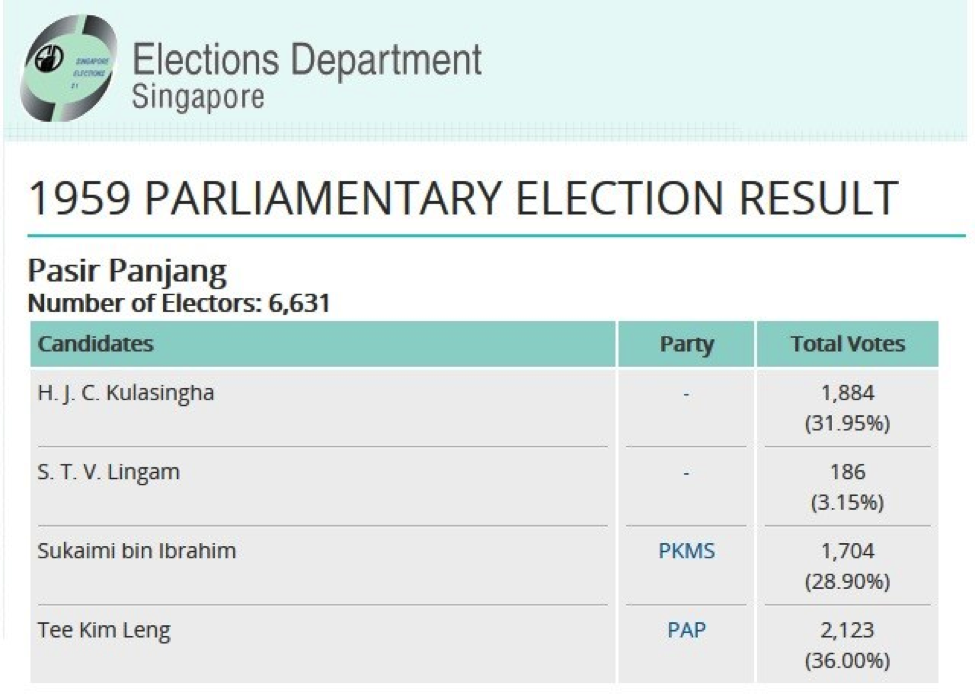
    For instance, during GE1959, 64 percent of valid votes by Pasir Panjang residents were split among three defeated minority candidates, while the PAP’s Tee Kim Leng obtained 36 percent (see image below). Clearly, there was no unfair disadvantage attributable to race.

    Pic1

    From 1959 (when the PAP first assumed power) until 1984, there were 77 victories by Chinese candidates in multiracial electoral contests. Seventy three of those wins went to the PAP. If Singapore’s ruling party insists that racial bias exists among many voters, it should clarify which of its candidates did not win on merit but through voters’ racialism.

    Another important statistic involves minorities defeating Chinese candidates. There were 49 such victories, or 38.9 percent of all 126 pre-GRC multiracial electoral contests, evidence that a candidate’s ethnicity plays little or no part in a voter’s decision at the polls.

    The PAP won 117 of those 126 multiracial tilts, proving that whenever voters were asked to make a choice between candidates of different races, they almost always chose the PAP and did so regardless of ethnicity. This is known as voting along political lines.

    Why the Downward Trend in Minority Representation?

    The preference of most Singaporean voters for the PAP, whatever its candidate’s race, has resulted in this phenomenon – a near-perfect correlation between the proportion of minority representation in parliament and the proportion of minority candidates on the PAP slate. This phenomenon is the reason for the drop in minority representation from 1959 to 1984.

    TABLE B

    Year of general election Proportion of minority candidates in PAP slate Proportion of minority representation in Parliament Number of minority PAP candidates Number of minority MPs in Parliament Total number of MPs in Parliament
    1959 33.33% 35.29% 17 18 51
    1963 33.33% 31.37% 17 16 51
    1968 29.31% 29.31% 17 17 58
    1972 24.62% 24.62% 16 16 65
    1976 24.64% 24.64% 17 17 69
    1980 24.00% 24.00% 18 18 75
    1984 18.99% 20.25% 15 16 79

    Table B shows that the lower the proportion of minorities in the PAP slate of candidates, the smaller the proportion of minority representation in parliament.

    Back in the 1980s, the PAP government should have noticed this trend before jumping to a vastly different conclusion about voter behavior and changing the law to accommodate its GRC scheme.

    The almost 100 percent correlation is not surprising. This is exactly what one would expect when voters choose their parliamentary representative based on political affiliation, not race, in a situation where one party enjoys overwhelming dominance.

    Elections Under the GRC System

    The pre-GRC trend of Singaporeans voting along political lines continued after GRCs became a fixture on Singapore’s political landscape. Almost every elected seat since 1988 has been filled by a PAP parliamentarian – 562 out of a total of 585.

    Just like during the pre-GRC era, the proportion of minority representation under the GRC system is almost wholly dependent on the proportion of minority candidates on the PAP slate.

    This period saw 28 GRC battles involving an unequal number of minority candidates between the two competing parties. If voters were racially biased, they would choose the party with fewer minority candidates, but there were as many as eight victories (28.57 percent) for the party fielding more minorities.

    One of those eight wins is a good example of why race is not an issue in Singaporean politics requiring affirmative action such as the GRC scheme.

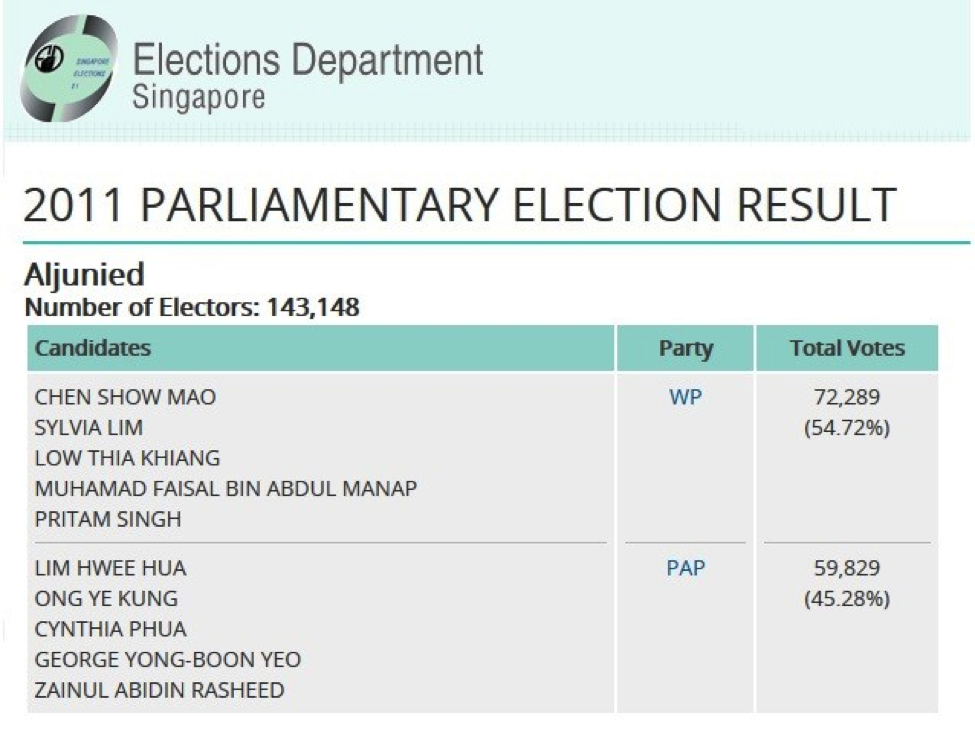
    If the PAP theory of racial bias among voters was valid, why did Aljunied residents vote for a party fielding more minority candidates (see image below), especially since they (Pritam Singh and Muhamad Faisal) had no previous parliamentary experience, unlike their opponent Zainul Abidin Rasheed?

    Pic2

    One may argue that the 2011 Workers’ Party victory in Aljunied does not necessarily mean racial bias didn’t exist. Rather, this argument might go, there was just too much voter dissatisfaction with the ruling party at that time, causing the tide to turn against the PAP.

    But if so, then it means that Aljunied residents’ political concerns trumped any racial bias they might have had, meaning that any racialism among voters was not able to sway the outcome of an election contest.

    Multiracial Single-Seat Contests During the GRC Era

    Not every minority MP entered parliament through a GRC.

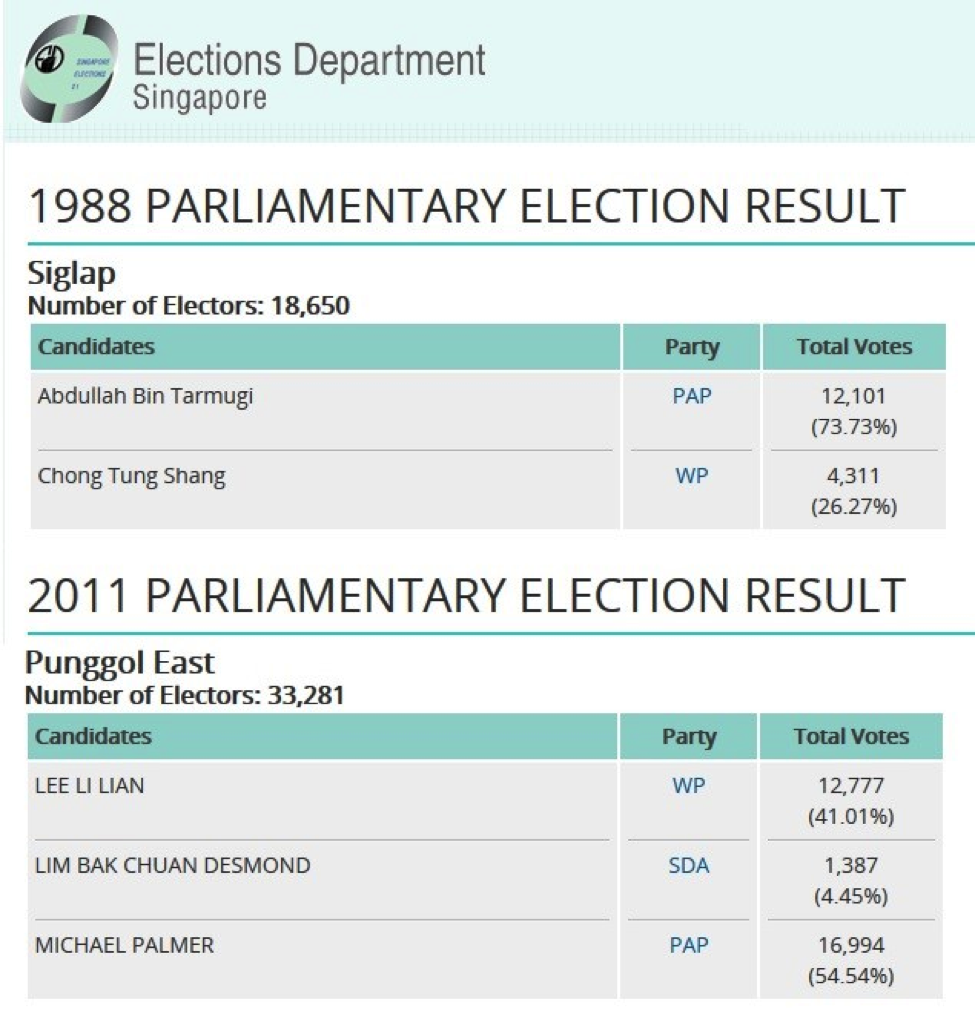
    Even when the PAP decided to have one of its minority candidates contest in a single-seat constituency, voters still sent that candidate into parliament instead of picking the opposing candidate from the ethnic Chinese majority (see image below). This clearly demonstrates that race plays no significant part in voters’ decisions.

    Pic3

    Of course, there were 28 single-seat victories by Chinese candidates against their minority opponents. But one can easily argue that those results simply reflect the clout that the PAP enjoys in Singapore’s political arena. If the PAP disagrees with that argument, it should reveal to Singaporeans which of its 28 victories had nothing to do with merit.

    From whichever angle you look at the Republic’s election data, it’s impossible to arrive at any convincing conclusion that Singaporeans vote along racial lines.

    So Many Questions, But No Satisfactory Answers

    The PAP says it fears inadequate minority representation in parliament, but what is adequate? If “adequate” means proportional parliamentary representation based on Singapore’s demographics, should there also be affirmative action to bring about “adequate” minority presence in the country’s employment, educational and sporting sectors?

    If it is deemed impractical or unnecessary to expect every Singaporean corporation, school or sports team to adhere to a racial quota, why should the GRC scheme be allowed to continue, especially when the very problem the scheme was created to overcome does not even exist?

    Michael Y.P. Ang is an independent Singaporean journalist. In 1999, he was among the core group of journalists who helped launch Channel NewsAsia, where he covered sport, entertainment, crime, and the 2001 Singapore General Election. He comments on Singapore’s sporting issues, often through a sociopolitical angle, on his Facebook page Michael Ang Sports.


    Source: http://thediplomat.com

  • Bukit Candu  – Satu Penghormatan Bagi Leftenan Adnan Saidi

    Bukit Candu – Satu Penghormatan Bagi Leftenan Adnan Saidi

    februari ini
    kuingat kembali
    bukit candu
    yang menjadi medan terakhir
    desingan peluru tembakan
    bertukar ganti merobek kedamaian
    dan tusukan-tusukan bayonet
    yang menghiris pedih
    cucuran merah darah
    masih terasa hangatnya
    mengalir di relung masa
    basah di hati bangsanya
    kanvas ceritera duka
    mengungkap makna
    di bingkai sejarah
    ini bumi yang dipijak
    sebati dengan jasadnya
    amanah setia di pundak
    mempertaruh seluruh jiwa
    kau tanamkan sumpah
    membentengi raga pertiwi
    biar tewas bergalang tanah
    bertahan terus
    dan pantang berputih mata
    biar takdir menentukan akhirnya
    demi sebuah perjuangan

    di bulan februari ini
    tidak lagi kuhadiahkan
    sekuntum mawar merah
    buat kekasih
    biar kuhidupi kenangan
    mengirim sepotong doaku
    buat seorang perwira
    dan sekawan perajurit
    wira nusa berjasa.

    ROHMAN MUNASIP

    14 Februari 2016


    Source: http://beritaharian.sg

  • How ISIS Supporters Passing Through Singapore Were Nabbed

    How ISIS Supporters Passing Through Singapore Were Nabbed

    On a Thursday evening three weeks ago, three men and a teenage boy from a boarding school in Bogor, West Java, got off a budget airline at Changi Airport.

    They were dressed in T-shirts, jeans and casual jackets, and carried backpacks – not unlike many young Indonesian travellers.

    But something about the group seemed odd to the undercover officer monitoring the passengers coming through the arrival gate at 9pm on Feb 18. His hunch proved right when they took the escalators a floor down to the immigration counters.

    Mukhlis Khoirur Rofiq, 22, had a passport expiring the same day as that of his brother Muhammad Mufid Murtadho, who was just nine days away from his 15th birthday.

    The brothers approached different counters. One followed Risno, 27, and the other, Untung Sugema Mardjuk, 48. The brothers could speak English, but their travel companions could not.

    Once they cleared customs, they took public transport to Woodlands Checkpoint. By midnight, they were on a bus that crossed the Causeway and was heading to Johor Baru. When it stopped at Larkin bus terminal in Johor, the four travellers went to a nearby prayer room to sleep.

    The next morning, Friday, Feb 19, they boarded a bus and returned to Singapore.

    Their unusual travel pattern prompted immigration officers to stop them at the passport counter and they were subsequently questioned by the Internal Security Department.

    They were put on three separate ferries to Batam two days later on Feb 21, and handed over to Indonesia’s counter-terrorism police.

    BUILDING A TRAVEL FOOTPRINT

    Mukhlis had booked a one-night stay for that Friday at a budget hotel in central Singapore on a popular Indonesian travel site. The group also had plane tickets to fly back to Jakarta on Saturday, Feb 20.

    Unlike the two Indonesians who were detained on Nov 5 at the HarbourFront Ferry Terminal and were on their way to join Islamic State in Iraq and Syria (ISIS), this group was not bound for Syria immediately. They did not have enough money to head there yet.

    Rather, in the first case of its kind detected here, the four wanted to build a travel footprint so that the authorities would regard them as legitimate travellers when they eventually had enough funds to head to the conflict zone.

    “Singapore was not a launch pad for their travel – they came here just to get their passports stamped,” said Professor Rohan Gunaratna, who heads the International Centre for Political Violence and Terrorism Research at Nanyang Technological University’s S. Rajaratnam School of International Studies. “They have also admitted to the authorities in Indonesia that their intention was to travel to Syria and be part of ISIS.”

    DEEPLY RADICALISED

    Videos and material related to ISIS were found on the men’s mobile phones, sources from intelligence agencies in the region familiar with the case said.

    All four were from a school, the Pondok Pesantren Ibnu Mas’ud in Bogor, West Java.

    Mukhlis taught religion and mathematics, while his younger brother was a student. Risno and Untung were cooks at the school, which had some 180 students.

    Investigations by the Indonesian authorities found the school is associated with radical ideologue Aman Abdurrahman, who is in Nusakambangan prison in Central Java. Even from his cell, Aman has been influential in reaching out to ISIS supporters across the country.

    He has also been in touch with Indonesian ISIS fighters in Syria and Iraq, many of whom are members of the South-east Asian unit Katibah Nusantara.

    And Mukhlis, Mufid and their family were loyal supporters of that cause. Their father Armeidi was in a chat group with ISIS fighters and planned to sell his house and migrate to Syria with his family.

    He and several of his family members took the bai’ah (oath of allegiance) to ISIS leader Abu Bakr al-Baghdadi in a ceremony in south Jakarta in 2014.

    They believed that suicide bombing was justified, and were also prepared to kill other Muslims – because those who did not follow their ideology could be deemed disbelievers. The school also propagated these hardline ideas.

    Mr Muh Taufiqurrohman, a senior researcher at Indonesia-based non-governmental organisation Centre for Radicalism and Deradicalisation Studies, told The Sunday Times that the school is one of at least three boarding schools to have emerged in recent years where ISIS supporters study or find work, and enrolled their children.

    At least a dozen people from the school have travelled to Syria.

    They include Mukhlis’ elder brother Ghozian, a former treasurer at the school who left for Syria early this year with three others.

    Ghozian had travelled through Singapore and Malaysia on transit to Thailand and then Turkey.

    A senior Indonesian police source said Singapore’s Changi Airport is a favoured stop for Indonesians travelling to fight in Syria given its proximity to home and flight connections. Yet, many also go undetected as transit passengers are not subject to immigration checks.

    A former principal of the school, Abu Umar, also left for Syria with his wife and four children, and was last known to be in Mosul, Iraq.

    The current principal – Mashadi, who is in his 30s – is said to be an ISIS supporter from Riau Islands.

    PERSISTENT DANGER

    Around 700 Indonesians are estimated to have travelled to Syria to fight, and the authorities in the region are concerned that when they return home, they will sow hatred.

    More worrying, however, are those who never left but stayed in touch with Katibah fighters in Syria online. There are also those who are indoctrinated through schools like Ibnu Mas’ud.

    The four who travelled to Singapore held hardline views – that suicide bombing was permissible, and killing other Muslims was all right if they did not subscribe to their beliefs. They also wanted to kill Shi’ites in Syria.

    They did not meet people in Singapore, and Prof Rohan noted that the fact that they were detected shows the authorities are vigilant. There is also strong counter-terrorism cooperation between Indonesia, Malaysia and Singapore, he said.

    When the four were sent back in three ferries – for security reasons – they were detained by Indonesian counter-terror police for questioning. The police recorded their statements, but had to let them go as there were no provisions under Indonesian law to detain them longer.

    Mr Taufiqurrohman noted that other radicalised Indonesians, who were stopped before they could reach Syria, would still want to carry out attacks on Indonesian police as well as Shi’ite and other minority communities in Indonesia.

    “The Indonesian security apparatus needs to monitor their activities closely, especially to find out with whom these four associate themselves,” he said. “If they communicate with Indonesian ISIS fighters in Syria, they will pose a threat because they will continue to receive online bomb-making instructions, funding and orders to carry out terrorist attacks.”

    Even as the four were found out, it remains unclear just how many others have travelled to Singapore without being detected. Who else might have transited here on their way to Syria?

    Observers like Prof Rohan say governments can be alert only up to a point. Much more remains to be done to step up vigilance and harden laws to tackle the terror threat.


    Source: www.straitstimes.com

deneme bonusu