Category: Politik

  • Jakarta Anti-Governor Protest: Cars Burnt, 1 Dead And Many Injured

    Jakarta Anti-Governor Protest: Cars Burnt, 1 Dead And Many Injured

    Indonesian police have used tear gas and water cannon to subdue protesters as thousands of hard-line Muslims marched against Jakarta’s governor.

    Basuki Tjahaja Purnama, a Christian, is the first ethnic Chinese to hold the governor’s post in the capital of majority Muslim Indonesia.

    The demonstrators accuse him of having insulted Islam’s holy book, the Koran, and want him to be prosecuted.

    Clashes broke out between police and protesters who refused to disperse.

    One elderly man died, the Associated Press reports, citing police. Several other people, including police officers, have been injured.

    Protesters had earlier marched upon the presidential palace.

    Police had been braced for the possibility of religious and racial tensions erupting at the rally, which an estimated 50,000 people attended.

    It had mostly been peaceful but groups of angry demonstrators clashed with police after nightfall and set vehicles alight.

    In 1998, a wave of anti-Chinese sentiment led to mobs looting and burning Chinese-owned shops and houses. Ethnic Chinese make up about 1% of Indonesia’s population of 250 million people.

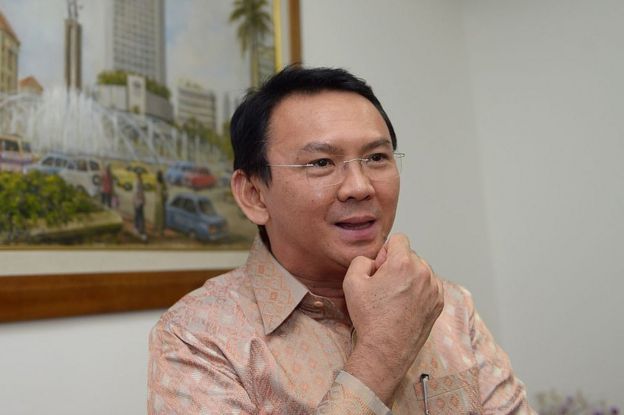
    Basuki Tjahaja Purnama, known by his nickname Ahok, speaks to journalists at his office in Jakarta in 2014
    Protesters are sprayed with water from a police water cannon truck during a clash outside the presidential palace in Jakarta, Indonesia, Friday, Nov. 4, 2016

    The protest was held to demand that Mr Purnama be prosecuted for blasphemy over comments he made in September that were seen as criticising a Koranic verse.

    He said that Islamic groups using a passage of the Koran to urge people not to support him were deceiving voters, who will go to the polls in February.

    The verse is interpreted by some as prohibiting Muslims from living under the leadership of a non-Muslim.

    Mr Purnama has since apologised but formal complaints were lodged against him by Islamic groups for defamation. He is now being investigated by police.

    Who is Governor Ahok?

    Some protesters at Friday’s rally carried signs calling for the governor’s death, the BBC’s Rebecca Henschke in Jakarta says.

    Representatives met with Vice-President Yusuf Kalla, who promised that the investigation into Mr Purnama would be completed within two weeks.

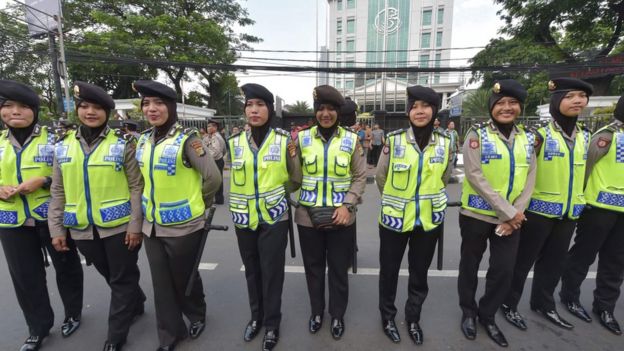
    Indonesian policewomen stand guard as Muslims march towards the presidential palace during a protest against Jakarta governor Basuki Tjahaja Purnama also known as Ahok over an alleged blasphemy in Jakarta on November 4, 2016

    There have long been tensions around Mr Purnama political role.

    In 2014, he was the deputy governor under Joko Widodo. When Mr Widodo was elected president the main group behind the current protest – Islamic Defenders Front (FPI) – did not want Mr Purnama to succeed him.

    They argued that a Christian should not govern a Muslim-majority city. The campaign against him has since taken on anti-Chinese overtones, though the FPI said the rally was not about the governor being from a minority group.

    Jakarta police said there were “provocative statements and images” on social media urging people to take violent action against Mr Purnama, including calls to kill him.

    Despite being seen as brash and outspoken, the governor is popular among many in the capital and has been praised for his effectiveness.

    Muslims in Indonesia are largely moderate and the country’s largest Islamic organisation, Nahdlatul Ulama, had advised its 40 million members not to take part in the protest.


    Source: www.bbc.com

  • Children With Moderate To Severe Special Needs To Be Part Of Compulsory Education Act

    Children With Moderate To Severe Special Needs To Be Part Of Compulsory Education Act

    Starting from 2019, children with moderate to severe special needs will need to attend publicly-funded schools, just like all other children in Singapore.

    The move to extend the Compulsory Education Act to this group of children will take effect from the Primary 1 cohort three years from now.

    With the change, they will be required to attend any of the 20 government-funded special education (Sped) schools here, unless they apply for exemption.

    Minister for Education (Schools) Ng Chee Meng announced the new policy on Friday morning (Nov 4) at the annual Sped conference, saying: “This is indeed an important milestone in Singapore’s continuing drive towards national inclusiveness.

    “I am heartened to hear that nearly all children with special needs are receiving formal primary education in government-funded schools, either mainstream or Sped.”

    He noted the progress made in the Sped sector in the areas of curriculum, teaching and learning, professional development for teachers and infrastructure.

    “It is therefore timely to include our children with special educational needs within the framework established by the Compulsory Education Act. This is a reaffirmation that every child matters, regardless of his or her learning challenges,” he said.

    The policy change comes nearly five years after it was recommended by a a 32-member, government-appointed expert panel. Experts have said that including special needs children in the Compulsory Education Act would compel parents who do not send their children to school – due to lack of awareness of opportunities, or fear of their children being seen in public – to do so.

    It also guarantees to provide enough places for special needs children. Currently, some Sped schools have long waiting lists.

    The Ministry of Education (MOE) has pledged that there will be enough school places for all Singaporean children.

    A quarter – or about 440 – of the 1,770 children with special needs per cohort are currently exempt from the Compulsory Education Act, according to MOE figures. They have moderate to severe special needs, such as autism, intellectual disabilities and cerebral palsy.

    Of this, about 40 children do not go to school.

    The remaining three-quarters of the cohort – whose disabilities are mild, including conditions like dyslexia – are in mainstream primary schools.

    The Compulsory Education Act passed in 2000 requires all Singaporean children to complete six years of primary education in national schools before they turn 15. Parents can be fined up to $5,000 and/or jailed for up to a year otherwise. Besides those with moderate to severe special needs, children attending designated religious schools or being homeschooled can be exempted.

    Dr Janil Puthucheary, who is Minister of State for Education, will chair an advisory panel appointed by MOE to look into implementing the new policy.

    “Over the years, MOE and various voluntary welfare organisations have worked closely to enhance the quality, accessibility and affordability of Sped. We have also implemented measures to strengthen support for children with special educational needs in mainstream schools,” said Dr Puthucheary.

    “The advisory panel will have some work ahead, to make sure that we implement compulsory education in a way that serves the needs of all children, but with the community and the professionals coming together I’m sure we’ll be able to.”

    Mr Ng said that his ministry is mindful of the challenges involved in implementing compulsory education for children with special needs, noting that there will be a small group of children with serious conditions who cannot attend school or whose parents may still prefer to teach their children at home.

    “We will need to work out exemption processes for this group to ensure their interests and welfare are safeguarded. But the overall policy intent is clear, as is our determination to facilitate what will be in the best interests of our children.”

    The welfare community lauded the move.

    Dr Victor Tay, president of the Association for Persons with Special Needs, said that Singapore had signed the United Nations Convention on the Rights of the Child in 1995, which states that every child has the right to education.

    “Somehow we did not put it into effect fully, because perhaps the Sped sector was not prepared and was still building up its resources and curricula,” he said.

    “But there has been more discussion about moving towards a more inclusive society in the last few years, and schools are more ready now for such a mandate.”

    Today, there are a total of 18,000 students with mild special educational needs in mainstream schools, while another 5,500 with moderate and severe needs are supported by Sped schools.

    These schools are provided substantial funding by MOE – significantly more than the mainstream schools – which goes towards paying specialised staff and providing tailored support for students.

    In a Facebook post on Friday, Minister for Social and Family Development Tan Chuan-Jin said that MOE’s plan to include children with Special educational needs in the Compulsory Education Act “is a huge step in making Singapore a more inclusive society”.

    “The changes to the Compulsory Education Act support the recommendation in the Second Enabling Masterplan for more support in enabling children with special needs to access education in both mainstream and Sped schools. This will help children with special needs to realise their potential, and open up opportunities for continual learning, and employment,” he wrote.

    He noted that MOE has been working closely with Sped schools over the past few years to improve the quality of education, affordability and accessibility for students. Support for children with special needs in mainstream schools has also been improved, so that they can learn and develop in a natural setting.

    Mr Tan said the Ministry of Social and Family Development will be working with MOE and the new advisory panel to further build on efforts to enhance the learning opportunities for children with special needs, “so that they are better able to develop and build competencies”.


    Source: The Straits Times

  • Pelarian Mahu Jual Bayi Berusia 1 Bulan Di eBay Dengan Harga S$7,600

    Pelarian Mahu Jual Bayi Berusia 1 Bulan Di eBay Dengan Harga S$7,600

    Seorang pendatang asing ke Jerman yang memuat naik gambar bayinya ke laman eBay untuk dijual, dilarang berjumpa dengan anaknya yang baru berusia enam minggu tanpa penyeliaan.

    Bayi yang bernama Maria itu dijual di laman bidaan online tersebut oleh bapanya. Bayi itu kini sudahpun berada di bawah unit jagaan khas di Duisburg di North Rhine-Westphalia, Jerman Barat, lapor Daily Mail.

    Mahkamah kelurga di bandar itu mengarahkan ibu bayi berkenaan supaya berpindah ke unit yang sama namun bapanya hanya dibenarkan berjumpa dengan mereka di bawah penyeliaan yang ketat.

    Maria ditawarkan dengan harga €5,000 (S$7,600) dengan kapsyen: “Bayi berusia 40 hari ini bernama Maria…untuk dijual”.

    Daily Mail melaporkan, bapa bayi itu yang berusia 28 tahun dan berpindah ke Jerman sebagai pelarian baru-baru ini, menyerahkan dirinya kepada polis dan bayi tersebut diambil dan diletakkan di bawah jagaan unit khas sementara keputusan dibuat, sama ada keluarga bayi itu akan dikenakan hukuman jenayah.

    Iklan, yang memaparkan gambar-gambar Maria di laman eBay itu dipadam dalam masa 30 minit kemudian sebelum lelaki tersebut menyerah diri.

    Pihak pendakwa raya kini sedang menyiasat sama ada lelaki itu perlu dihukum atau tidak setelah dia mendakwa tidak serius dengan iklan tersebut.

    Pengarah Kesatuan Demokratik-Kristian di daerah Rheinhausen, Duisburg di mana keluarga mereka tinggal berkata: “Saya berpendapat perbuatan lelaki itu mesti dikenakan tindakan undang-undang”.

    “Jika ibu bapa bayi itu tidak mampu menanggung anak mereka dan menjaganya, kami ada menyediakan kemungkinan di Jerman supaya bayi itu diberikan sebagai anak angkat kepada keluarga lain.”

    Menurut seorang jurucakap khidmat belia di Duisburg: “Bayi itu sekarang diletakkan di bawah keluarga jagaan, di mana dia akan menetap sehingga keadaan lebih jelas.”

    Kedua ibu bapa bayi berkenaan pula kini berada di bawah pemantauan khidmat sosial, lapor Daily Mail.

    “Pihak berkuasa perubatan juga menyatakan masih ada kemungkinan Maria dikembalikan kepada ibu bapanya – jika dapat dibuktikan mereka tidak melakukan sebarang jenayah.”

    Source: Berita MediaCorp

  • Ustaz Abd’ Al-Halim: Layak Mengajar Agama Kerana Ilmu Atau Sijil ARS?

    Ustaz Abd’ Al-Halim: Layak Mengajar Agama Kerana Ilmu Atau Sijil ARS?

    AsSalaam’alaikum!

    Saya rasa ramai di Singapura perlu fikirkan – jika seseorang guru agama yang sekian lama mengajar tentang Islam tetapi tiada sijil ARS (Asatizah Recognition Scheme) maka tidak dibenarkan mengajar dimana-mana institusi keagamaan di Singapura, adakah ini bermakna ilmunya itu sudah hilang? Adakah bermakna dia sebenar-benarnya tidak layak lagi untuk mengajar? Dan jika pensijilan ARS bergantung kepada menghadirkan diri di program-program MUIS atau mana-mana program yang diluluskannya, adakah ini bermakna seseorang guru agama itu yang tidak sering menghadirkan diri tiba-tiba kehilangan ilmu agamanya?

    Tidakkah kelayakkan utama seseorang guru agama yang berhak mengajar ialah berdasarkan keilmuannya?

    Ya, mungkin juga yang bersijil itu juga berilmu TETAPI jika benar yang berilmu boleh dinafikan pensijillan maka timbul persoalan; adakah kamu mahu belajar daripada yang bersijil ataupun yang sebenarnya berilmu?


    Source: Abd’ Al-Halim

  • Syakir Hashim: Singaporean Elders Deserve Rest, Not More Work

    Syakir Hashim: Singaporean Elders Deserve Rest, Not More Work

    As I walk into Changi Airport today at about 7 a.m, I saw many workers of old age either cleaning or moving the trolleys around.

    I was reminded of an incident back when I was in year one in NUS. I went for lunch with my project groupmates in Utown. Three of them to be exact. All of them are foreign students.

    We all went to get our meals separately. I was the first to be back at the table followed by two others. We asked each other where the 4th person went. We waited for a few minutes and she was still nowhere in sight.

    Soon I walked around and I saw her helping an old lady clearing up tables. She was trying to help the lady pick up cups and rubbish from some of the tables, making the old cleaner lady discomforted.

    I asked my friend what she was doing and she said that she felt bad seeing the old lady working so hard. Where she came from, no elderly has to work that hard.

    That moment hit me hard. The fact that elderly workers are so common in foodcourts, malls and our airport, we sometimes forget to ask if its right to keep them working till that ripe old age.

    Can’t we as a developed country think of ways to give our elderly the peace of mind and rest they deserve after serving the country and its economy over four or five decades? I’m sure if our leaders put their mind to it, innovative policies can be formulated to help our elderly, here in singapore.

    Can you imagine your parents at the age of 70 having to work 8 hours a day clearing and cleaning at a foodcourt?

    Just food for thought.


    Source: Syakir Hashim

deneme bonusu