Category: Politik

  • ‘Reasonable’ To Expect Six-Month Wait For New Passport: Malaysia Authorities

    ‘Reasonable’ To Expect Six-Month Wait For New Passport: Malaysia Authorities

    Those intending to renew or apply for passports would have to endure long lines and wait hours…for another six months.

    The Immigration Department, in acknowledging a shortage of passports, said they expected the matter to be ironed out by January next year.

    Its director-general Sakib Kusmi said the department was introducing new passports which would include more security features. However, the passports required extensive testing to ensure they meet international safety standards and are not damaged easily when used.

    “The transition to this new version (of passports) cannot be done overnight. We need to ensure the new passports are near-perfect.

    “The reasonable time for the transition is six months. The department and the vendor will ensure there is enough supply of passports.”

    Mr Sakib said there would be disruptions to Immigration services during this period that would “slow down the application process and production of passports”.

    “We hope the public will understand and continue to support the efforts of the government to give the best services and providing world-class full-proof passports,’’ he said.

    Deputy Prime Minister Ahmad Zahid Hamidi said he had instructed the Immigration Department to increase the number of passports to 20,000 daily and for them to be delivered to its offices nationwide following the passport shortage.

    Mr Zahid’s comments came following a series of reports on the passport shortage by Malay Mail since June 16.

    Mr Sakib said 20,000 passports were being supplied daily since Mr Zahid made the announcement.

    He added the National Printing Department (NPD) had increase its daily printing quota as ordered by the Home Ministry following an increase in the number of applications.

    “Previously, the vendor could only provide between 5,000 and 10,000 passports per day but the printing has increased to 20,000 daily since Wednesday (July 27),” he added.

    Sources had previously revealed the department struggled to cope with demand as they had insufficient stock of passports as a large number of the microchips embedded in the data page had defects.

    Mr Zahid, who is also home minister, said Datasonic Group Berhad — appointed to supply the biodata polycarbonate data page — would work closely with NPD to resolve the problem.

    In a statement to the media on June 14, Mr Sakib said the closing of immigration offices was not due to the shortage of passports and that the department has issued 206,716 passports since May.

    The statement added Malaysian passports met requirements of the International Civil of Aviation Organisation.

    Pending assemblyman Violet Yong said the Immigration branch at the Urban Transformation Centre in Kuching was supplied with passports on Wednesday but were all issued in a day.

    However, she said she was unsure how many passports had been issued.

    “I’ve been told the centre is out of stock again,” she said on Thursday.

    Ms Yong added the Immigration office continued to process applications despite running out of passports, assuring applicants they would obtain their travel booklets within five days.


    Source: TODAY Online

  • MCCY And NAC Must Come Clean On Exorbitant Consultation Fees For Bin Centre

    MCCY And NAC Must Come Clean On Exorbitant Consultation Fees For Bin Centre

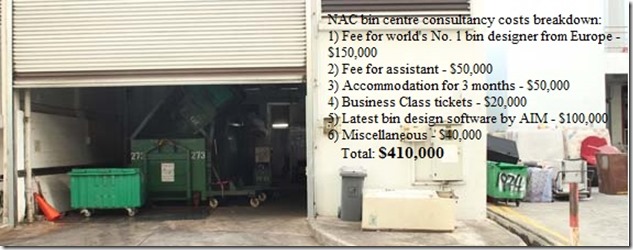
    The AGO report has revealed lots of lapses, including an eye-popping $410,000 consultancy fee for a $470,000 bin centre.

    Whoever authorised the payment at the National Arts Centre has to be held accountable and the MCCY owes the public an explanation.

    Instead, MCCY Minister Grace Fu defended her subordinate and claimed that it was a “complex” project requiring “significantly more design expertise”. Fu is wrong to assume the public could be taken for a ride easily.

    Should Fu decide to conduct an internal investigation and if it uncovers “more than meets the eye”, the CPIB may need to put in some OT. I am not alleging any wrongdoing but this should not be ruled out as the amount of tax dollars involved is more than 7 times the amount paid by NParks for 26 Brompton bicycles.

    In 2012, former MND Minister Khaw had defended NParks’ purchase without any inside information. Khaw’s knee-jerk defence made him look foolish when CPIB investigations subsequently revealed a NParks’ director had purchased $57,200 worth of bicycles from a friend.

    Fu has got to be kidding by refusing to even conduct an internal investigation. Worse, she insisted on behaving like her SMOS and has started to chut pattern (warning: do not watch video if you feel like puking).

    The $410,000 consultancy fee could have bought 186 Brompton bikes for NParks or 100,000 plates of mee siam without cockles for her boss.

    The following information should be disclosed to public:

    1 The name of NAC director.

    2 The name of the consultant.

    3 The relationship between the consultant and the director

    4 The amount overcharged by the consultant

    5 Action to be taken against director’s overspending of tax dollars.

    So how complex is the construction of NAC’s bin centre? Does it require 56 man-years?


    Source: https://likedatosocanmeh.wordpress.com

  • Malaysia’s Najib Gets New Powers Amid Planned Protests Over Fund Scandal

    Malaysia’s Najib Gets New Powers Amid Planned Protests Over Fund Scandal

    Malaysia’s Prime Minister Najib Razak will get sweeping security powers on Monday amid planned protests calling for his resignation over U.S. allegations that millions of dollars from a state fund wound up in his personal bank account.

    The new National Security Council (NSC) Act, which comes into force on Aug. 1, allows Najib to designate any area as a “security area”, where he can deploy forces to search any individual, vehicle or premise without a warrant. It also allows investigators to dispense with formal inquests into killings by the police or armed forces in those areas.

    Najib’s ruling coalition promoted the law as a means to counter threats to security in predominantly Muslim Malaysia, which has long dealt with a fringe element of radical Islamists.

    But critics say the law’s expansive powers threaten human rights and democracy in the middle-income emerging nation, and could now be used to silence critics of the One Malaysia Development Berhad (1MDB) fund scandal.

    “The concern among the civil society and others is because the NSC can be used against anything that the government is unhappy with,” said Wan Saiful Wan Jan, chief executive of the Institute for Democracy and Economic Affairs, adding that it could extend to public rallies.

    “It does give the PM a huge amount of power to declare emergency zones…,” he said.

    NO ROYAL ASSENT

    The law was passed on the last day of the legislation session in December, surprising the opposition, as Najib came under mounting criticism over the multi-billion dollar scandal surrounding the 1MDB fund, which he founded and whose advisory council he chaired until recently.

    The law was enacted without the customary royal assent from Malaysia’s king, who had asked for some changes.

    Pressure on Najib to step down mounted last week after the U.S. Justice Department filed civil lawsuits alleging that over $3.5 billion was misappropriated from 1MDB. The lawsuits seek to seize more than $1 billion of assets allegedly siphoned from the fund, saying they were part of “an international conspiracy to launder money”.

    The civil lawsuits do not name Najib, but refer to a high-ranking government official who received over $700 million of the misappropriated funds. A source familiar with the investigations told Reuters the official, named as Malaysian Official 1 in the lawsuits, was Najib.

    Najib, who has denied any wrongdoing, has said Malaysia will cooperate in international investigations of the 1MDB case.

    The ruling party suffered unprecedented losses in the 2008 general elections and then lost the popular vote in 2013 under Najib’s leadership. The next general election must be called by 2018.

    ANTI-NAJIB RALLIES

    The NSC is coming into force amid growing complaints about assaults on civil liberties in Malaysia.

    Najib has in recent months used the colonial era Sedition Act and other draconian laws to arrest government critics, jail opposition leaders and stifle free speech by suspending media groups and blogs.

    “The likelihood of the NSC being utilized in order to crack down against any act of civil movement is likely to steadily increase as maneuvering space for the PM decreases,” said Sevan Doraisamy, executive director at Suaram, a human rights NGO.

    Malaysia’s opposition coalition is planning an anti-Najib rally on July 30. Pro-democracy group Bersih, whose street protests last year drew a 200,000-strong crowd, is also planning a separate rally, but has not set a date.

    While rallies can still be organized under the Peaceful Assembly Act, the NSC can declare any area — a building, a street or a city — a “security area”, where protests would be disallowed.

    Inspector-General of Police Khalid Abu Bakar said on Monday he will not allow rallies that demand Najib step down from power.

    “Red Shirt” supporters from Najib’s ruling United Malays National Organisation have vowed to hold a counter-rally. They did so last September and it turned rowdy when participants breached security barricades and clashed with riot police.

    “I think they (the government) are getting nervous about 1MDB and the reaction of the people,” said civil rights activist and lawyer Ambiga Sreenevasan, adding that the public was also “very nervous” about the new security law.


    Source: TODAY Online

  • Audited Financial Statements For 2013 And 2014 Should Be Disregarded: 1MDB

    Audited Financial Statements For 2013 And 2014 Should Be Disregarded: 1MDB

    Embattled 1Malaysia Development Berhad (1MDB) has decided that its 2013 and 2014 audited financial statements should be disregarded, pending a court decision on the civil lawsuit filed by the United States last week to recover more than US$1 billion (S$1.36 billion) in American assets bought with money allegedly misappropriated from the state investment firm.

    “Whilst the Board remains confident that no wrongdoing has been committed by 1MDB and that the past audited financial statements continue to show a true and fair view of the company’s affairs at the relevant points in time, the Board has decided that, as a precautionary measure, the 2013 and 2014 audited financial statements of 1MDB should no longer be relied on by any party,” 1MDB said in a statement on Tuesday (July 26).

    1MDB’s 2013 and 2014 financial statements were signed off by its auditor, international audit firm Deloitte.

    Last Wednesday, the US Justice Department (DOJ) filed a civil lawsuit to seize the assets it said were tied to money stolen from 1MDB, overseen by Malaysian Prime Minister Najib Razak.

    Hidden in the US in real estate, art and other luxury goods, the DOJ said the money was embezzled from the fund and moved around the world using secretive shell companies that masked its trail.

    The Singapore authorities have also said they seized bank accounts and properties worth S$240 million in a probe on possible money laundering linked to the state investment fund.

    Mr Najib had said Malaysia takes good governance seriously and will fully cooperate with investigators. He had also maintained that it would be unfair to pass judgment on the individuals identified in the lawsuit — including his stepson Riza Aziz, a Hollywood producer of films, including The Wolf Of Wall Street as well as financier Mr Jho Low, who is a longtime friend of Mr Aziz and his family— simply for being named in the filing.

    1MDB, which was founded by Mr Najib in 2009 shortly after he came to office, has accumulated debts of RM50 billion (S$16.7 billion) as of January this year, as opposed to its assets of RM53 billion. It is being investigated in at least six countries, including Switzerland and Singapore, over allegations it was used to funnel money to politically connected individuals. Both Mr Najib and 1MDB have denied any wrongdoing.

    Mr Najib has been under intense political pressure over RM2.6 billion deposited into his private accounts, as well as irregularities in 1MDB.

    Malaysia’s attorney-general has cleared Mr Najib of wrongdoing, saying that the money in his bank accounts was a political donation from the Saudi royal family. Despite the controversy, Mr Najib has consolidated his political power, removing officials from the governing party who have criticised him.

    Some outspoken activists who used social media to question his conduct also face criminal charges.

    1MDB also said on Tuesday that it is committed to finding a new auditor to replace Deloitte, after the latter had notified the firm of its intention to resign on Feb 26 this year.

    “Until a new auditor is appointed, Deloitte will remain as auditor on record,” it said.

    Expressing its appreciation of the professionalism displayed by Deloitte to date, 1MDB said the auditor will continue to audit the company’s key subsidiaries, including its real estate and energy arms such as TRX City, Bandar Malaysia and Edra.


    Source: TODAY Online

  • AGO Report Flags Several Ministries For Lapses

    AGO Report Flags Several Ministries For Lapses

    When two universities failed to recover tuition-fee and study loans given to their students within a specified period,the Ministry of Education (MOE) did not take the necessary follow-up actions promptly.

    Called out for its lack of oversight in administering schemes and programmes such as scholarship bonds and study loans, the MOE was one of 12 government bodies whose lapses were flagged by the Auditor-General’s Office’s (AGO) annual audit of the public sector.

    Others cited for lapses in the AGO’s 61-page report, made public on Tuesday (July 26), included the Defence Ministry (Mindef) and the Housing and Development Board (HDB).

    The AGO report highlighted four areas that public sector entities should improve on: Inadequate financial controls; weak governance of public funds; lack of oversight of external entities; and lapses in management of contracts.

    As of June 30 last year, the two universities — National University of Singapore (NUS) and Nanyang Technological University (NTU) — saw an outstanding balance of loans totalling S$228.04 million. For 23.3 per cent — 27 out of 116 — of the outstanding loans audited by the AGO, recovery action was delayed by one to 3.5 years.

    The report found that the MOE was not prompt in following up on long outstanding loans to ensure that the banks had taken adequate recovery actions. It also noted discrepancies among records of loans in default kept by the MOE, the universities and the banks. The MOE was also rapped for lapses in monitoring and enforcing bonds related to scholarships disbursed by the two universities.

    The universities lagged in sending out letters of demand to half of the scholars — 16 out of 30 test-checked — who were not serving the required bonds, with delays of up to 26 months.

    The MOE over-contributed S$4.14 million over nine years to NTU’s sinking fund for replacement of MOE-funded buildings and facilities, a sum that the ministry said on Tuesday had been recovered.

    In a statement, issued following the release of the AGO’s report, the MOE said it is working with the universities and banks to ensure prompt follow-up of loans in arrears. It may allow borrowers facing financial hardship to defer repayment of monthly instalments or temporarily reduce the amount payable in some cases. It added that measures are also in place to reduce default on scholarship bonds — such as working with government agencies to track bond service records — noting that many of the lapses flagged were from “earlier graduation batches”.

    Default rates have come down significantly over the last three years, said the MOE, adding that 1 per cent of international scholarship recipients had intentionally defaulted.

    As for the HDB, the AGO noted that final payments to contractors totalling S$37.62 million were delayed for up to 3.3 years — a move it described as an “unfair business practice” since it could have hurt the contractors’ cashflow. The HDB said it will implement new processes, such as a tracking system, to ensure that delayed accounts are brought to the management’s attention so that final payments can be made promptly.

    The AGO also found inadequate monitoring of car parks at industrial and residential estates, which allowed motorists to use the facilities without being charged. Of five industrial car parks audited, the AGO found 243 instances where the motorists, on multiple occasions, had manipulated the electronic parking systems to allow another vehicle to exit the car parks for free, such as through tailgating.

    Mindef was cited for investing S$50.26 million in a United States real estate investment trust exchange-traded fund without approval from its board of trustees. It also failed to provide Central Provident Fund (CPF) contributions on bonuses paid to members on the Savings and Employee Retirement Plan.

    According to the AGO report, Mindef said that it had since obtained approval from the board of trustees for the investment, and will make the required CPF contributions — amounting to about S$324,000 for 215 members — by next month.

    Other government bodies chided for lapses included the Land Transport Authority, whose weak controls over toll collection at checkpoints resulted in under-collection of S$13.9 million; and the Law Ministry for lapses in its handling of deceased persons’ assets received from nursing homes. The Ministry of Foreign Affairs was taken to task for continuing to subscribe to phone lines that were no longer needed, resulting in wastage amounting to S$80,744.


    Source: TODAY Online

deneme bonusu