Category: Politik

  • Zaid Ibrahim: Singapore’s Exit Allowed Malay Ultras To Take Over Malaysia

    Zaid Ibrahim: Singapore’s Exit Allowed Malay Ultras To Take Over Malaysia

    KUALA LUMPUR, March 30 — Singapore’s expulsion in 1965 prevented Lee Kuan Yew from continuing to press for a “Malaysian Malaysia” and allowed Malay ultras headed by Tun Dr Mahathir Mohamad to depose Tunku Abdul Rahman, Datuk Zaid Ibrahim asserted today.

    In a blog post eulogising the late Singapore founding father, the former de facto law minister lamented the lost opportunity for both Tunku and Lee to co-operate on transforming Malaysia into a flourishing democracy with strong rule of law.

    “Without Singapore in the wings and without LKY articulating his mantra of ‘Malaysian Malaysia’, the ultra Malays, led by Dr Mahathir, gained huge momentum.

    “They filled the vacuum with the help of a young Islamist named Anwar Ibrahim.

    “They were able to push Tunku out after May 1969 and the country’s history was rewritten by the introduction of the New Economic Policy (NEP), followed by the Malay-first and Islamisation policies,” Zaid wrote on his blog today.

    Tun Dr Mahathir Mohamad, a vocal critic of Tunku, eventually became the country’s fourth and longest-serving prime minister, while Anwar later became his deputy.

    The NEP is the technically-defunct race-based affirmative action that created a system of preferential treatment for the Bumiputera in jobs, housing and access to government funding.

    The policy and others taking after it are blamed for Malaysia’s declining competitiveness as well as increasing discontent among non-Bumiputera communities over what is perceived to be “second-class” treatment.

    Zaid said that keeping Singapore in Malaysia and Lee in the administration would have allowed Tunku to resist the push for Malay-first policies in order to make the community competitive, progressive and reasonable.

    According to the former Kota Baru MP, the country’s first prime minister would also have been able to keep Islam’s focus on charity, good and ethical conduct and compassion instead of permeating into the governance of the country.

    “Malaysia has come full circle: Malays have become Arabs, Malay words have changed to Arabic, and their Western education has changed to the Islamic variety.

    “Malaysia’s identity no longer follows Tunku’s vision. Singapore remained true to the dreams of its founder, and very successfully as well. That’s the tale of the two leaders, in short,” he said.

    Singapore founding father Lee died on March 23 after over a month on life support following complications arising from severe pneumonia.

    Singapore joined Malaya, Sabah and Sarawak to form the Federation of Malaysia in 1963, but was expelled two years later by an Act of Parliament following racial tensions over the republic’s insistence on equal treatment for all citizens.


    Source: www.themalaymailonline.com

  • Focus On Lee Kuan Yew’s Achievements May Give Boost To PAP

    Focus On Lee Kuan Yew’s Achievements May Give Boost To PAP

    Over the past week, Hasanji Dhilawala has shed tears for a man he never met.

    “I am grateful to Lee Kuan Yew for the life he gave me,” said the 86-year-old, who wept in his wheelchair when he finally had a chance to be in the same room as Lee to thank him.

    “He was a leader who kept his promises. I am the envy of my relatives back in India,” said the grandfather of five, one of more than 400,000 Singaporeans who waited for hours this week to view Lee’s body as it lay in state.

    The bond that the older Singaporeans like Dhilawala had with the country’s first prime minister was a special one. They experienced political tumult but saw their standard of living rise dramatically in a generation, and through it all Lee Kuan Yew was their assured leader.

    Indeed, Lee has been such a constant that when he fell seriously ill last month and died last Monday at age 91, the most common question was whether the People’s Action Party (PAP) would decline without the man who had been its centre of gravity for 60 years. Even PAP leaders have readily admitted that nobody is likely to fill Lee’s shoes.

    Opposition watershed

    Speculation has swirled for years – receding into the background as he faded from public eye but resurfacing last week – that the PAP owed its longevity to Lee, and that it could fall apart without him. After a week of nationwide mourning, however, an intriguing new possibility has emerged: that the intense focus on his achievements and qualities could actually solidify support for his PAP.

    “If the election is next week, the PAP ‘sure win’,” said Mr Jason Ling, a 45-year-old sub-contractor, using the colloquial slang for “guaranteed victory”.

    General elections are only due in January 2017 but were widely expected to be called later this year or early next year in the afterglow of the republic’s 50th anniversary bash in August.

    Although the PAP has won every election decisively since independence, its share of the vote dipped significantly in the 1980s. After the September 11, 2001 terror attacks on the United States, it bounced up to 75 per cent. But in the last election, in May 2011, it fell to a historic low of 60 per cent.

    That election also proved a watershed as the opposition crossed a psychological threshold – a group representation constituency (GRC) made up of multiple rather than single seats and long viewed as impregnable fell to the Workers’ Party. In one fell swoop, five seats were lost, including those of two ministers, one junior minister and one potential office holder.

    The PAP also lost two subsequent by-elections, with the result that seven out of 87 elected seats in parliament are now held by the opposition. In the guessing game for the next polls, pundits had predicted that one or two more GRCs and a few more single seats were well within the opposition’s reach.

    The Singapore Dream

    Over the past five years, politics in Singapore has become much more contentious as voters pressure the government over a fistful of issues, from the public housing shortfall, to fixing gaps in public transport and slowing the influx of foreign talent.

    The PAP has been assiduously adjusting policies. In the latest Budget, there were more handouts. Such moves and the feel-good SG50 celebrations, including generous anniversary giveaways, are seen as potentially paying dividends at the polls for the PAP.

    However, Lee’s sorrowful send-off may have an even greater impact on voters than the multimillion-dollar SG50 bash. The eulogies, including superlative tributes from abroad, appear to have focused people’s minds on some of the strong fundamentals of PAP governance.

    “Before he passed away, I was a little bit upset with the government, everything so expensive; my car payment every month makes me a little bit depressed,” said an insurance agent who would only give his name as Low.

    “But now after Mr Lee’s left us, maybe I give the PAP a chance. They are trying to be more generous and honestly speaking, this is a good government. His son [Prime Minister Lee Hsien Loong] is working very hard.”

    Low, a father of one in his 30s, is the typical younger middle- income Singaporean who is believed to hold the crucial swing vote.

    Older Singaporeans are said to form the PAP’s loyal base. Dhilawala, for example, sees Singapore’s legendary progress reflected in his own life story. He immigrated from Mumbai, India, in 1952 with just two sets of clothes in his suitcase and 100 rupees in his pocket to work as a clerk with an uncle who paid for his passage.

    He lived in the office with six other men and rose to become a gunmetal supervisor, brought his wife from India, bought a three-room Housing Board flat and raised three children. One daughter is a lawyer, another runs an online business, and his son is an oil trader. He and his children now live in private housing and spend holidays abroad.

    Dhilawala’s life encapsulates the Singapore Dream, Act 1, when poor young migrants could land on its shores and build a life from scratch, own a home and place their children and grandchildren on a firm footing.

    Act 2 and 3 may not be as sweet a story. “After first-world status, what else can we achieve?” asked Chung Miao Ling, an IT worker in her 50s, one of the thousands of mourners for whom Lee’s passing provided a moment for introspection.

    But she is sold on Lee’s brand of governance. “His passing has reminded me all the more why we need good, capable leaders to get things done, not just those who can talk,” she said.

    A parting gift

    Before the last election, social media was dominated by government critics. The PAP has been encouraging its base to speak up. Last week, finally, the silent majority showed up in force and made plain their loyalties, say many commentators.

    They emerged in the long, 24-hour queues to file past Lee’s coffin, in the thousands of notes and mementoes at community halls all over the island, and in the hundreds of thousands who lined the streets bid their final farewell to Lee’s cortege yesterday.

    “These past few days, the silent majority showed where they stand, what type of government they like,” said a banker in his 50s.

    Lim May Yee, 43, a businesswoman who runs a financial consultancy said: “We need strong government now, more than ever, this is what this week has reminded us.”

    Lee’s passing appeared to help crystallise in Singaporeans’ minds the benefits of strong leadership and good governance. Lee was a pragmatist obsessed with improving Singaporeans’ security and quality of life.

    Over the past few days, they had a refresher course on the values that Lee extolled as they pored over his life story, listened to his speeches, and saw him in action when he got things done. In death, the ultimate persuader of the people appeared to have convinced them all over again.

    The bigger question is whether swing voters – mainly those who want the PAP to continue in power but with a much stronger opposition – have been similarly moved. Supporters like Chung believe this to be the case. “I believe Singaporeans will say thanks to Mr Lee by giving the party he founded the vote,” she said. “This is how we will say thank you.”

    But even if goodwill towards the old PAP is now at an all-time high, there is no guarantee that today’s PAP will be rewarded with a dividend or bounce at the polls. Supporters like Chung say that even the PAP base worries whether future party leaders will have what it takes, partly because the succession planning on who can take over from Lee’s son has not been clearly mapped out.

    Besides, many say that while the elder Lee’s style suited his times, it may not fit new realities. One new ineluctable reality is that in the internet age, people have shorter time horizons in their expectations of their leaders and the PAP needs to find that sweet spot of being able to deliver both the long- and immediate- term promises.

    What is clear is that the mourning crossed party lines. Singaporeans’ own personal stories of struggle and success, ambition and achievement came together as “nationally shared emotions”, said Professor David Chan, a Lee Kuan Yew fellow and professor of psychology at the Singapore Management University.

    Sociologist Tan Ern Ser said: “In death, he has become larger than life. To many, Lee Kuan Yew was Singapore and the PAP; hence, I believe the good things associated with Lee Kuan Yew and, in turn, the PAP will help to boost the ruling party’s electoral support.”

    Observers like Tan also note that the unusual nature of the events of the past week became rallies for the ruling party to reinforce its record. There were memorial services by various groups, from unions to big corporations, from grass-roots groups to the civil service. The events “have had the effect of a large, continuous political rally that are not accessible to opposition parties”, says Tan.

    “Perhaps, the events, recollections and emotions of the past week could be understood as LKY’s farewell gift to the PAP and Singapore.”

    If nothing else, he says, the Lee dividend could translate into this: “The memory and the messages and images will have a tremendous impact of how Singaporeans think about the past and the future of the nation.”

    The past week was about a re-dedication to the mission.


    This article, writtenby Zuraidah Ibrahim, appeared in the South China Morning Post print edition as The Lee Kuan Yew dividend.


    Source: www.scmp.com

  • The Rainbow After The Rain

    The Rainbow After The Rain

    A eulogy has strange powers. It brings the dead back to life as we listen, enthralled by captivating stories about what he did, who he was, and what he aspired towards. For as long as we listened, Mr Lee Kuan Yew lived; time was suspended and we re-lived his life as the founder of a nation, as a statesman, and as a father and husband. But just as surely as all eulogies must end, so must our moment of fantasy.

    At the end of each eulogy, there is a farewell and an expression of hope for the future. We say our last goodbyes, for the last time, and dedicate ourselves to honouring the memory of the deceased. And with a finality we cannot express, we acknowledge that it is indeed the end. It is the end.

    Mr Lee passed away on Monday, at 3.18am. But yesterday was the day we put him to rest. This time it is final. This time, he really is no more. The rain ceases and the rainbow shines.

    Mr Lee is truly gone now, but his legacy lives on, and oh what a legacy it is. For seven days, we were serenaded with stories of his determination, his integrity, his kindness, his steadfastness. We heard the Singapore Story retold, again and again—the story of how one man took a tiny, vulnerable, island-state from the precipice of economic ruin to the heights of prosperity; how he quelled the unruly unions with a firm hand, bringing peace and stability; how he turned ethnic strife into racial harmony; how he gave everyone the opportunity to achieve their ambitions; and how he established an incorruptible government and imbued it with his personal values of frugality and integrity.

    Mr Lee was a remarkable visionary, an extraordinary leader, a charming statesman, a wise mentor, a loving husband, and a strict father. And he was also a gardener, a great boss and a fun person to interview. But he was not an icon of modern Singapore and he did not belong in the history books. However, as we close this chapter, a new one is opened. Mr Lee becomes Singapore; now he is a legend.

    And so, as with all legends, and like the stuff of history books, Mr Lee’s life will be subjected to scrutiny. The academics will poke and prod, ask who he really was, what he really believed in, and whether he really was who he said he was; and undoubtedly, the ivory-tower priests will carry with them their own intellectual prejudices. The hagiographers will retell his story, replete with the best anecdotes, and without the inconvenient details; and undoubtedly, many a reader will welcome the fascinating story. The revisionists will tinkle with the narratives, question established wisdoms, and keep us all on our toes.

    And the politicians will not be left behind. They will fight to reclaim Mr Lee’s story as their own and make him the champion of what they stand for.

    The PAP will have a field day using Mr Lee’s story to merge the three narratives: of the nation, of the man and of the party he left behind. The nation will be Mr Lee, and Mr Lee will be the PAP. Just as no nation votes against itself, no nation will vote against the PAP. Thus, the PAP will extol the virtues of Mr Lee’s ideals and point to his accomplishments as evidence; then they will emphasise how much they too stand for those virtues; and then they will make every vote for the PAP, a vote for Mr Lee Kuan Yew. Now, Mr Lee will not be bound to Tanjong Pagar, he will stand for election on the national stage, and he will win a victory for his son.

    The opposition will struggle as they contest the truth of Mr Lee’s story. They will have to battle the relentless mainstream media juggernaut as they question the dominant narrative that focuses on Mr Lee’s success and ignores the sacrifices. Ask whether the Barisan Socialis was really going to turn Singapore upside down in 1963, and the headlines will splash back with cries of dirty, sneaky, historical revisionism. Ask whether the PAP should hold fast to Mr Lee’s myth of meritocracy and face charges of foolish, idealistic socialism.

    But the opposition will contest the story nonetheless, and they will pit Mr Lee’s own virtues against the new PAP’s leadership. They will say: Mr Lee was a man of the people, but his son has lost touch with the ground. Mr Lee was a true socialist, but his son has left us at the mercy of the rich. Mr Lee picked capable successors on the basis of merit, but his son has filled his Cabinet with his army buddies.

    As a result of all this, the pessimist will throw his hands up in the air and call everyone a liar and a revisionist. There is only one Mr Lee, he says. He is either the benevolent founding father or he is the ruthless tyrant; there is no two ways about it. But what if Mr Lee was both? What if it was his ruthlessness and his authoritarian tactics that allowed him to make Singapore what it is today? What if it was precisely because he wanted the best for Singapore that he mistakenly repressed those he saw as enemies of Singapore’s good?

    I submit that we cannot fully understand Mr Lee if we do not acknowledge that he was a benevolent dictator, whose benevolence made him a dictator, and who used authoritarian policies to benefit Singapore.

    Inherent in this legend, then, is a story of compromise and of sacrifice—sacrifices which Mr Lee himself acknowledged, and said were necessary. And more than that, this is also a story of an imperfect man—a man who was not above making mistakes. Mr Lee said much the same of himself; we would be foolish to deny it.

    So we may now start to ask the questions that we have withheld for the past week: Did Mr Lee, in his benevolence make a mistake by being unnecessarily authoritarian? And did Mr Lee, in his authoritarianism make a mistake by not being truly benevolent? Was the benevolent dictator at times merely a dictator? And was he at times capable of being benevolent without being a dictator?

    The rain has ceased and we may now look at the rainbow—the man of many colours.


    Source: http://asiancorrespondent.com

  • Cherian George: Lee Kuan Yew Was Bulwark For Singapore Minorities

    Cherian George: Lee Kuan Yew Was Bulwark For Singapore Minorities

    Unlike-Lee admirers around the world may be missing significant details.

    In an amusing case of mistaken identity, a banner honouring Lee Kuan Yew has appeared in India, bearing a photo of another Singaporean elder statesman, President Tony Tan. Both are white-haired ethnic Chinese males, but Tan, as you have may noted from Channel NewsAsia’s coverage of Lee’s funeral today, is rather more alive.

    The picture has been making the rounds on social media in Singapore, bringing smiles to an otherwise sombre day. It serves as a useful reality check for Singaporeans, that although Lee has been lauded by world leaders as a 20th century giant, not everyone can recognise him from Tom, Dick or Tony.

    Some other cases of mistaken identity are less trivial. It’s nothing new. For at least a couple of decades, he has been all things to all men who aspire to a certain kind of leadership. They see in him a model, a kind of proof-of-concept that they can point to when defending their own missions and methods. Leader X is Country A’s Lee Kuan Yew. How often have you heard that line.

    As a Singaporean born in the year of the republic’s independence, I’ve benefited from Lee’s global brand, most tangibly in the fact that my red passport travels extremely well. But the way that brand is sometimes used is cringeworthy.

    Most of the parallels that foreign politicians and their acolytes draw with Lee Kuan Yew are selective and self-serving. His name is evoked by anyone who wants to apply less-than-democratic means in the name of strong, decisive leadership in order to achieve high economic growth. But there was a lot more to the man and his formula for success.

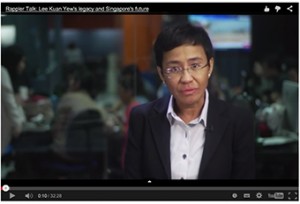
    My interview with Maria Ressa of Rappler.com.

    The most obvious was the zero tolerance of corruption that he embodied and instituted in the Singapore system. That is probably a chapter in his bestselling memoirs that admirers like former Thai prime minister Thaksin Shinawatra skipped. Similarly, fans of Indonesia’s late president Suharto who cite his friendship with Lee conveniently ignore the fact that Suharto topped the world league table of corrupt leaders, according to the same organisation that routinely names Singapore as the cleanest in Asia.

    Less noticed is the fact that Lee, while loudly dismissive of the liberal brand of democracy, never deviated from electoral authoritarianism – the belief that regular multi-party elections are ultimately the only way for a government to win legitimacy, and are not bad at keeping a dominant party on its toes. Of course, he did his best to insulate his government from distractions like short-term public opinion, an adversarial press and protest movements; he also treated the opposition unfairly, to put it mildly.

    But, to this day, elections in Singapore remain competitive enough and credible enough to make democracy “the only game in town”, as political scientists would put it. As a result, opponents of the regime plot election strategy, not extra-parliamentary struggle; and Singaporeans accept the government’s authority as legitimate, even if they disagree with its policies. The thousands of Chinese officials who pass through Singapore to learn the Lee model may think this lesson can’t apply to the People’s Republic, but shouldn’t overlook how important it has been to Singapore’s success.

    Back to India. When its government decided to fly the tricolour at half-mast today, I wonder which Lee they were honouring. I hope – but I doubt – that it was the leader who stood resolutely against sectarian politics and majority domination. Among all his core principles, this is the one least talked about abroad. Yet, to minorities like me – and, thankfully, most members of the majority race as well – this may be the single most precious aspect of the legacy.

    Not that he got everything right. Older Indian Singaporeans still bristle at the way he labelled us as “fractious and contentious”. The stereotype might not have been off the mark (note Amartya Sen’s Argumentative Indian thesis), but if only he had seen it as a positive contribution to Singapore’s national culture rather than a weakness. Similarly, his open suspicion of Muslim Singaporeans’ growing religiosity was hurtful. Some of such straight-talking about race and religion could come back to haunt Singapore, should future bigots exploit his words to justify their prejudices.

    But minorities never needed to doubt this: Lee was an unshakeable bulwark against majoritarian tendencies that could have easily overwhelmed Singapore. Malay/Muslims make up only 15% and Indians 7% of the population. For decades, the risk of a Chinese chauvinist party playing the race/language card posed the single biggest threat to PAP dominance. This fact is lost on most of the Western press, who self-aggrandisingly like to believe that they were Lee’s bête noire. They were more like sparring partners, compared with champions of the Chinese-speaking ground, who were the main victims of both detentions without trial as well as flagrant censorship.

    Lee went to the extent of amending the republic’s Constitution to stop any party from sweeping into power without minority support. For most Parliamentary seats, candidates are forced to contest as small teams that must include minorities. Thus, no Chinese party could do in Singapore what the BJP did in India last year – come to power without a single MP from the country’s largest minority group.

    Thankfully, Lee and his comrades were influenced by an older Indian tradition, the Nehruvian secular ideal that accommodated minorities – the same tradition that the BJP and the larger Hindutva movement is bent on dismantling.

    Singapore should not presume that it can serve as a model for any other country, least of all India. The world’s largest democracy is 200 times larger than the city state that Lee ran, and its challenges are profoundly more complex.

    But if foreigners do choose to honour Lee Kuan Yew, they shouldn’t fall into the mistaken-identity trap. Yes, he was a firm leader who stretched the limits of democratic government to breaking point in order to get things done.

    But a leader who makes minorities feel unwanted, insecure and fearful?

    That’s not a face that Singaporeans recognise.


    Source: www.airconditionednation.com

  • Dr Tan Cheng Bok’s Tribute To Lee Kuan Yew

    Dr Tan Cheng Bok’s Tribute To Lee Kuan Yew

    Tribute to Lee Kuan Yew

    I just returned from paying my respects to Lee Kuan Yew. My friends and I were advised to go to his Tanjong Pager CC after being told not to join the queue to Parliament.

    I first met face to face with Lee Kuan Yew when he interviewed me to be a candidate for the 1980 GE. It was very intimidating. Greats like Toh Chin Chye, Goh Keng Swee , and S Rajaratnam were present. They asked many questions. I fumbled some of the answers. I left the interview suspecting he was not impressed with me. Moreover, my academic records and CV were colourless. I was only a village doctor with a rebellious streak. But one striking thing he said was “We are not looking for yes men.”

    I served under his leadership for a decade till 1990 when he passed the baton to Goh Chok Tong. He was without doubt the greatest leader I have encountered in my life. In my early years as an MP, he used to call me and other MPs for lunch. Lunch was a tutorial session. LKY would quiz me occasionally on my parliamentary speeches and offer tips for improvement. Some of his corrections were unpleasant to hear. But they were always valuable and meant to help us grow. I was surprised he followed what I said in Parliament. “Don’t be fooled to think you can speak off the cuff without preparation” he said. “You must always prepare.”
    His personal interest in our development as parliamentarians impressed me. He generously shared his deep experience with us as a master politician. He brought into focus political issues of the day, be it local or world affairs. We were at a master class.
    .
    Lunch was also sometimes a fact finding session for him especially when he wanted to confirm the ground’s feedback on controversial issues. Two issues stood out for me
    .
    One was his family’s purchase of a flat at a discounted price. The first question he shot at me was “Cheng Bock, am l a crook?” I told him if he was a crook l would not have served him in the first place. LKY embodied the virtues of integrity and incorruptibility, without which Singapore could never have succeeded. I was then moved to speak up for him in parliament and was pleasantly surprised when he took the time to pen a note of thanks
    .
    The other issue was the elected Presidency. He wasn’t happy with the ground misunderstanding his intentions for creating the new elected office. At that time, many thought that he was doing this for himself. He was visibly disturbed. “I am doing this for Singapore , I don’t want to be President”. Indeed, he was truly a man who lived for our nation. Every political step taken by him, however difficult to understand then, he meant it for the good of Singapore. LKY loved his country, and it is only right for him to receive the highest honour and genuine affection shown by Singaporeans this week.[see photos]

    LKY is also often perceived as one intolerant of challenges to his core beliefs. Many a time, I saw the fire of his formidable personality when debating dissenting views. His MPs always felt safer being on his side.

    But on one occasion I was at the receiving end of his fury. This was the debate on the Foreign Talent policy where he felt I offended him. He reprimanded me publicly and our relationship grew cold after that. No more lunch with him
    .
    But not many know that in 2006, I met him at my final post- budget dinner. I was retiring that year as MP and chose to close my tenure with my favourite song “My Way”. I changed the lyrics of the song with reference to MP’s role. After I sang, LKY looked at me and broke into a smile. We then shook hands. To me, it was a good feeling to end my stint as MP for Ayer Rajah.

    I will always remember him as the greatest person I have ever met and worked with. A true son of the soil, his love for Singapore was his drive. Despite his outward hardness, he always took the trouble to sign his replies personally to letters l sent him, and not left it to his subordinates.

    Lee Kuan Yew left a legacy we must never compromise. People will continue to support a good government that has integrity, honesty, incorruptibility, and transparency
    .
    Thank you Mr Lee Kuan Yew for your sacrifices and what you did for us. Rest in peace.


    Source: Dr Tan Cheng Bok