The People’s Action Party’s (PAP) Teo Ho Pin will defend his Bukit Panjang seat in the coming General Election (GE).
Dr Teo, 55, was first elected as a Member of Parliament (MP) for Sembawang Group Representation Constituency (GRC) in 1997. He then served as MP for the former Holland-Bukit Panjang GRC from 2001 to 2006, before taking charge of the Bukit Panjang Single Member Constituency (SMC) from 2006.
Dr Teo is also the Mayor of the North West District and a Deputy Government Whip. Prior to entering politics, he was a lecturer at the National University of Singapore from 1985 to 1999.
(Photo: Lam Shushan)
At the last GE in 2011, Dr Teo defeated Singapore Democratic Party (SDP) candidate Alec Tok with 66.27 per cent of the vote. This time, the SDP has declared it will contest the Bukit Panjang seat once again.
The recent news of National Solidarity Party’s (NSP) secretary general Hazel Poa resignation, together with her downcast facial expression, came to my sight as I flipped through my newspapers. It was a smart move by the mainstream media to use the situation to the People’s Action Party’s advantage.
Moving the focus past that, I was more curious about what initially made NSP gave up both areas when they could have fought for at least one, even if it meant a three-cornered fight.
And if NSP had taken up the initial offer by Workers’ Party (WP), it would not have even led to the sudden resignation by Ms Poa. However, I can empathize that it was most likely because NSP did not want to give up Marine Parade GRC which they had fought for in 2011 (with a close margin of 43%). WP could also have chosen to not contest in Marine Parade since they know it was NSP’s “territory”.
The outcome of this entangled mess was 1) Ms Poa’s resignation as she “strongly disagreed” with NSP’s decision to contest in MacPherson SMC and 2) NSP’s return to MacPherson SMC due to what they claim was support and appeal by the residents from the constituency. This would mean a three-party fight, which could result in the increase of PAP’s chance of winning.
To give a fair picture, WP did contest in Joo Chiat SMC in 2011 which they nearly won (49%), and the area has now been absorbed into Marine Parade. This was their stated reason for wanting to contest in Marine Parade GRC this year. Still, since NSP contested in Marine Parade in 2011 and WP is already contesting in so many other wards, why not give way to other parties who gave way to you before?
If WP had not stepped into Marine Parade, might NSP even do better this year than the 43% they received in Marine Parade GRC during GE2011?
What does all this show? WP may feel they can easily win Marine Parade GRC this year since NSP was on the verge of winning in 2011. “Since we are the most established opposition party and have prominent supporters, the smaller parties will most likely give way to us.” To give some insight, NSP had also similarly given up Moulmein-Kallang GRC to WP in 2011.
In a sense, WP was very smart when it stuck to their plans and played the waiting game, letting the action and drama play out in NSP, which affects only NSP’s image. Lesson 1: The one who strategise in the long-term, instead of making quick decisions rashly, only stands to win. Lesson 2: More power = more control over the playing field = less prominent parties will give way to us. Does this mean more parties will have to give way to WP in the future?
Another reason for the three-cornered fight in MacPherson SMC could also be the opposition parties thinking they can win MacPherson because of Ms Tin Pei Ling’s presence. Yes, Ms Tin Pei Ling may have faced negative backlash 4 years back, but it seems her image has matured, and she has become more level-headed.
Furthermore, she had just given birth during the pre-election period – which could be an X-factor to draw in more voters, since she is a new mother; and is active even during this post-partum period, usually set aside as a resting period for a mother’s recovery.
Tin Pei Ling, husband and ESM Goh Chok Tong (image – ESM’s Facebook page)
“We have five years. If after five years, Tin Pei Ling remains what she is, then of course, she would still be a factor at the next election. But at this stage, looking at her action, in three years time, she would be a different Tin Pei Ling.” It seems like what Mr Goh Chok Tong said in 2011 did come true, and Ms Tin Pei Ling did persevere to stay on in the political scene. Let’s see if her effort will pay off and if she can prove her worth in September.
And lastly, the burning question: Is thereopposition unity in Singapore? No doubt, we saw separate parties contesting when they could have a higher chance of winning by combining forces. However, the opposition parties’ meeting and the fact that most parties gave way to each other to prevent three-cornered fights do show the mutual respect and amity they have for each other.
Here is a new series where Yahoo Singapore speaks to potential candidates for the upcoming General Election. Members of Singapore’s various political paties have been invited to participate. First up: Dennis Tan of the Workers Party, who was interviewed Friday, 14 August.
Shipping lawyer Dennis Tan, 44, cuts a somewhat nervous figure when we meet at the Yahoo Singapore office. Vice-chair of the media team for the Workers’ Party, Tan, who is married without children, also sits on the party’s central executive committee.
Tan has come to 60 Anson Road to be profiled as one of the many new faces in the upcoming General Election, though he stresses that Workers Party’s candidates will only be officially unveiled on Nomination Day.
Perhaps he seems ill at ease because he will be on camera in a one-on-one interview, and also because party members have strict guidelines on speaking to the media. “Discipline is very important for us. It’s important that party members are seen to be behaving in a responsible and disciplined way, and I think people respect that a lot,” says Tan.
But the diffident and mild-mannered Tan begins to loosen up when asked about the issues close to his heart, in particular multi-party democracy, and the adequacy of retirement schemes.
Asked what he thinks of the nine Workers Party MPs’ contributions to Parliament so far, Tan replies emphatically with a somewhat dated Carpenters reference, “As the song goes, we’ve only just begun. This is only the beginning of what we see as a First World parliament, and it will take time, given the political circumstances in Singapore.
What we look forward to, and certainly I look forward to, is a more diverse parliament with representation from different political parties. It is important that people from different ends of the political divide come together, share their ideas in parliament, debate bills and policies openly, and may policies be made as a result of such vigorous debate in parliament.”
He is also concerned about bread-and-butter issues like the Central Provident Fund (CPF), and whether Singaporeans will have enough to retire on. Tan says, “I think we have seen…in the last year, that there has been a lot of discussions, online as well as generally in the coffeeshops, about the adequacy of CPF savings for retirees in Singapore.
Clearly, with the relatively low interest rate, which is not linked to inflation, this is an issue that has really not been resolved by the ruling party.”
Tan’s education and background seem to echo that of many middle-class Singaporeans. The younger of two children spent much of his childhood in a housing estate in Telok Blangah and studied at Raffles Institution and Raffles Junior College. Tan also studied in the United Kingdom in his university days. Tan’s father used to work at the Japanese embassy, while his mother was a housewife.
He remembers being fired up on Nomination Day in 2011, when he was present as the candidate for Joo Chiat SMC was unveiled. Shortly after, he was invited by a friend to join the WP, and he gladly accepted.
“I could identify with the Workers Party leadership, with the way that they looked at politics in Singapore, the way they conducted themselves as a party,” recalls Tan. It has been a fairly rapid ascent within the party for Tan – by 2013, he was speaking at the WP rally during the Punggol East by-election.
Tan has been doing grassroots work in the Paya Lebar and Kaki Bukit divisions of Aljunied GRC for the past four years, a experience he calls “enriching and humbling”.
And while Tan declined to comment directly on the ongoing Aljunied-Hougang-Punggol East Town Council (AHPETC) saga, his words seem to reflect the party’s wariness of mainstream media outlets.
Asked how ground sentiment in Aljunied GRC have changed since 2011, he says, “I think the residents of Aljunied have been very supportive of our MPs and our WP members and volunteers who are on the ground, and they have encouraged us, including at times when there were not so happy news in the mainstream media about the Workers Party, and what the PAP is trying to do.”
But perhaps the issue that gets the strongest reaction from Tan is that of elitism, and his alma mater. A recent letter by teenager and RI alumnus Russell Tan Wah Jian to The Straits Forum, had suggested that elitism can be good for society, “There is no point aiming for equality for the sake of equality, and giving up equity.”
Tan says quietly but firmly, “I am from Raffles Institution, and I’m proud of being an RI boy…and I am proud of the fact that I’m a member of the Workers Party.”
Alluding to a newspaper article from the 1980s which noted that most of the RI students at the time came from working class backgrounds, he adds, “Elitism is something that all societies recognize exist, but it is always frowned upon, especially in a school like RI where we always prided ourselves…as a school that provides equal opportunity for Singaporean children of different backgrounds.”
Perhaps Tan’s sentiments on elitism have something to do with the fact that a fair number of his peers and schoolmates are currently Members of Parliament.
He clearly has strong feelings on fairness and having a voice in the democratic process, “It is important that Singaporeans have an active say in the way that they would like to see how their country moves forward, in which direction, rather than to have any party dictating to Singaporeans, telling us what is good for us.”
Asked if he has a message for voters, Tan takes a minute to compose himself, “Your vote is secret, always remember that. There’s nothing to fear. And if you cast away your fear, you can do anything that you would like to do.”
Earlier this month, there was a media article on how a toy-plane lover and former television child star was now a high-flying colonel in the Republic of Singapore Air Force (RSAF).
The article began by saying that Col Zakir Hamid, 46, had become the RSAF’s first Malay pilot in 1992 and was now the highest-ranked Malay officer there.
I wondered why there was an emphasis on Colonel Zakir’s race, alongside his achievements. This emphasis seems to occur in instances when Malays rise to high positions in society.
In April, when Minister in the Prime Minister’s Office Masagos Zulkifli was promoted to a full minister, all news reports said this was the first time that Singapore had two Malay full ministers. Prime Minister Lee Hsien Loong, in his Facebook post announcing the appointment, said this reflected the progress of the Malay community.
I agree that stories of success serve to motivate and inspire younger Singaporeans. In the case of Malays who have done well, the Malay community celebrates their achievements, and younger Malays see these figures as good role models.
Their success stories exemplify the meritocratic system in Singapore. They also help to convince the Malays that, even though we are a minority — the community forms 13.4 per cent of the citizen population — we can, like anyone else, and with effort and determination, succeed.
However, in mentioning race when highlighting the achievements of Malays, might it not create a sense of inferiority, that we are not as capable and so any success attained by a Malay needs to be tied back to their race?
It does not reflect Singapore’s meritocratic value of seeing ourselves as a united people regardless of race, language or religion.
Academic Hussin Mutalib, in his book Singapore Malays — Being Ethnic Minority And Muslim In A Global City-State, wrote about the Malay “marginality” that some Malays felt as Singapore progressed. Could such mentions of race-based achievements be an attempt to remove those perceptions?
It is a fact that the Malay community falls behind the Chinese and Indian communities in terms of educational qualifications and other socioeconomic attributes. But the gap is narrowing.
The Malay community is moving forward and we want to continue doing so. According to the Education Statistics Digest published by the Ministry of Education, close to eight in 10 of Malay students in the 2003 cohort received admission to post-secondary education institutions.
In 2012, almost nine in 10 achieved this — the biggest improvement seen among the races.
Another positive trend by the Ministry of Social and Family Development data also showed that the home ownership rate among Malay residents is highest among the other races at 93.2 per cent.
DO NOT LET RACE GET IN THE WAY
I believe that members of the Malay community want to be seen as being as capable as other Singaporeans, and able to achieve similar success to their friends in school and at work.
It will be even more encouraging if Malays who have benefited from the system in Singapore are willing to guide and mentor young Malays. Self-help groups such as Mendaki have programmes that require volunteers and mentors to lead them, and this will be a great opportunity to engage and empower future generations of the community.
This will go a long way in dispelling perceptions of inferiority or discrimination that these young Malays may have internalised.
The media can also play a part. They are instrumental in telling the stories of Singaporeans and also in moulding perceptions of the different communities and groups.
While it is perfectly fine to showcase celebrations of racial cultures or cultural events, I believe there is no need to emphasise race, especially when articles are accompanied by photos of the people mentioned.
This special mention for Malays in stories of success may unintentionally cause Singaporeans of other races to see Malays as less capable. This can affect how they relate to and communicate with their Malay friends.
As we progress, I hope to see less emphasis put on a person’s race when highlighting his or her achievements.
In my opinion, Singapore will never be a race-blind country because race, for good reasons, will continue to be a huge part of a person’s identity.
Based on a survey by the Institute of Policy Studies on race, religion and language, 70.7 per cent of the respondents indicated that race is important to their overall sense of identity.
Race should be less of a social marker and more of a cultural marker. We can be proud of our individual ethnicities and share our unique cultures, while still having a strong national identity. But we should not let race shape our interactions or perceptions of others.
Stories of success should be read as they are — the achievements of fellow Singaporeans. I, for one, am sure that members of the Malay community can find any successful Singaporean, regardless of race, a worthy role model.
ABOUT THE AUTHOR:
Muhammad Syakir Bin Kamal is a second-year student at Imperial College London, where he is reading aeronautical engineering. He is currently interning at the Institute of Policy Studies, National University of Singapore.
Singapore’s first 10-storey flats, colloquially known as “chap lau chu” in Hokkien, are seven blocks of brown and beige-coloured flats in Commonwealth Drive.
Built in the early 1960s, this pioneering “mini estate” introduced Singaporeans to the concept of a self-contained “public housing precinct” with several tall housing blocks next to a food centre.
Decades later, the once-bustling neighbourhood lies vacant.
After the area was earmarked for redevelopment in 2008, residents of blocks 74 to 80 and businesses cleared out by early last year.
The abandoned estate has sat in limbo since, awaiting the wrecking ball which is expected to strike later this year.
Entrances to the stairways of flats are gated and padlocked to keep away loiterers.
An eerie silence hangs in the aisles of shuttered provision stores and the odd childcare centre or barber shop below the blocks.
In the courtyard lies a worn-out playground and pavilion that were once a distraction to children and their elderly caregivers on many an afternoon.
“It has an eerie vibe, especially when night falls and you see the leaves scattered all over the desolate streets,” said Mr Jason Seow, 45, a former Tanglin Halt resident who returned to photograph the place before it is torn down.
As the nation relentlessly renews itself, more housing estates have been left deserted.
These are curious places, caught in between yesterday and tomorrow, with everything intact but its inhabitants gone.
Over the last decade, 19 projects have been completed under the Housing Board’s Selective En bloc Redevelopment Scheme. This means that residents in all these 19 areas have vacated their flats.
However, the old blocks of flats in seven of these sites are either still in various stages of demolition or set aside for interim use or conservation today.
The ghost town in Commonwealth Drive has become a spot for some to linger.
On a warm weekday evening, two Chinese construction workers cut through the blocks to get groceries from the supermarket across the road.
On the way back, they went to sit on the concrete floor at the fringe of Block 76, shelling peanuts and drinking rice wine.
They later used a small sandy track that winds through the dense vegetation to get back to their nearby worksite.
Security supervisor Tong, who declined to give his full name, found himself early for his night shift that same evening and sat down at a stone table for a rest.
“This is a special place because there’s no one here and the quiet clears my mind,” said the 65-year-old.
After 20 minutes, he left via another shortcut that office workers use to pass through the empty estate to get to Biopolis and Commonwealth MRT station.
Hollowed-out neighbourhoods like these can also become hot spots for crime. In April, a researcher was slashed in the dim and derelict shortcut at night.
Her employer, the Agency for Science, Technology and Research (A*Star), has advised staff against using the public footpath.
Surveillance cameras have since been installed there by JTC Corporation. The Housing Board said it conducts inspections every day to “deter unauthorised entry into the vacated site”.
The seven blocks are part of the authorities’ biggest housing redevelopment project to date, with 3,480 flats in 31 blocks in Tanglin Halt Road and Commonwealth Drive slated for demolition.
Affected residents have the option of moving to new flats in the nearby Dawson estate.
Residents said the abandoned estate’s destruction seems inevitable, given that its once-distinctive “10-storey” look is now overshadowed, literally, by modern skyscrapers with futuristic names such as Galaxis, Sandcrawler and Fusionopolis.
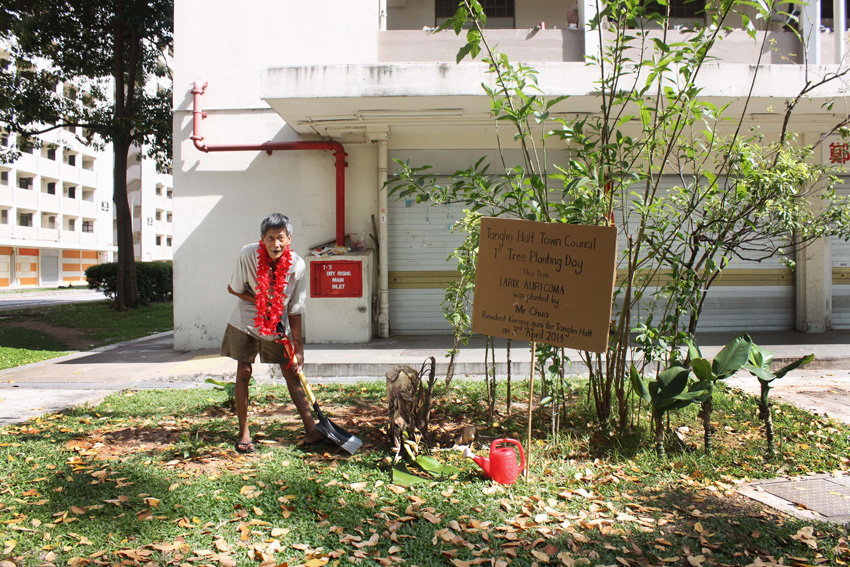
Yet one stubborn presence continues to haunt the forlorn corridors – karung guni man Chua Thiam Seng, 62.
The long passageways below the flats are strewn with cardboard boxes and cans that he collects from occupied flats and coffee shops across the road.
“This is my office,” he said with a toothless grin. Mr Chua has been a rag-and-bone man in the neighbourhood for the past 20 years.
He claims to have taken up HDB’s offer of a new flat nearby after the relocation exercise, but he still sleeps in a little corner on cardboard beneath his former block on most nights.
He added that it was for convenience, but reporters have spotted him cleaning up at a nearby market many mornings.
The bachelor reminisced about the old days when the close-knit community would gather in coffee shops or outside the lottery shop to exchange gossip.
He lamented: “They don’t construct flats like these any more and though my neighbours have moved nearby, they are not as close as before.”