Most Singaporean know of Mr Teh Tarik and it is one of the usual go-to place for families and friends to come together and bersembang. But what happens when we hear of someone who frequent the place, treated with a distasteful experience? Quite disappointing..
From a FB post:
I dont usually waste my time to post any complains online but the incident which happened earlier was over the limit and I just feel the need to do this. On 30/01/2017 at about 9pm, I went to Mr Teh Tarik@ Khatib as my sick wife was craving for the ban mian there. So while she was queueing to order her food, i went over to the drink stall and join in the queue to a drink for my wife. When it was my turn, conversation with the BLACK SHIRT STAFF went like this:
Me: bang, teh o ais satu.
(He then started making my drink)
When the drink was ready, he placed the cup on the counter and then he turn to his cashier system to key my order. Noticing that there was no cover for the drink, i politely requested in malay:
Me: Bang, die nye cover ade bang ?
Staff: Cover? Ni nak minum sini ke nak take away?
Me: take away bang.
Staff: Ohhhhh take away ehhh. Cakap la lain kali (with a smirk on his face and in a very very sarcastic tone)
Me: aah bang take away.
Staff: (while taking the cover and covering my cup) Ohhhh take away. Lain kali cakap la take away ke, minum sini ke, DRIVE THROUGH KE. (He raised his voice)
Me: knape bang? Saya mintak cover jek bang, lagi pon abg pon tak tanye pe nak minum sini ke take away. (Both started to raise voices)
The next minute, he took my cup which was on the counter, turn to his right and tossed my drink into the sink and told me to get lost and immediately asked for the next customer’s order!!!!!! WHAT IN THE WORLD IS THIS ?!?!?!?!
Look at the picture and you can see that the bin is nearer to him but he managed to toss it into the sink instead !!!! I strongly feel that such behaviour is very inappropriate !!!!! If its just verbal argument i would have probably just forget about it but he threw away my drink while i was handing over to him my money !!!!
From the picture also, i can see that there are cameras overlooking the counter. I hope the management will view the footage and look into this matter seriously !! I believe the customers queueing behind me and his partner wearing the grey tshirt witnessed the incident as well !!!
I LOVE THE FOOD THERE AND I ALWAYS GO TO MR TEH TARIK KHATIB BRANCH BUT WITH SUCH POOR ATTITUDE STAFF AROUND, I WILL NEVER PATRONISE THIS BRANCH AGAIN.
Thaipusam and the Right to Religious & Cultural Practice in Singapore
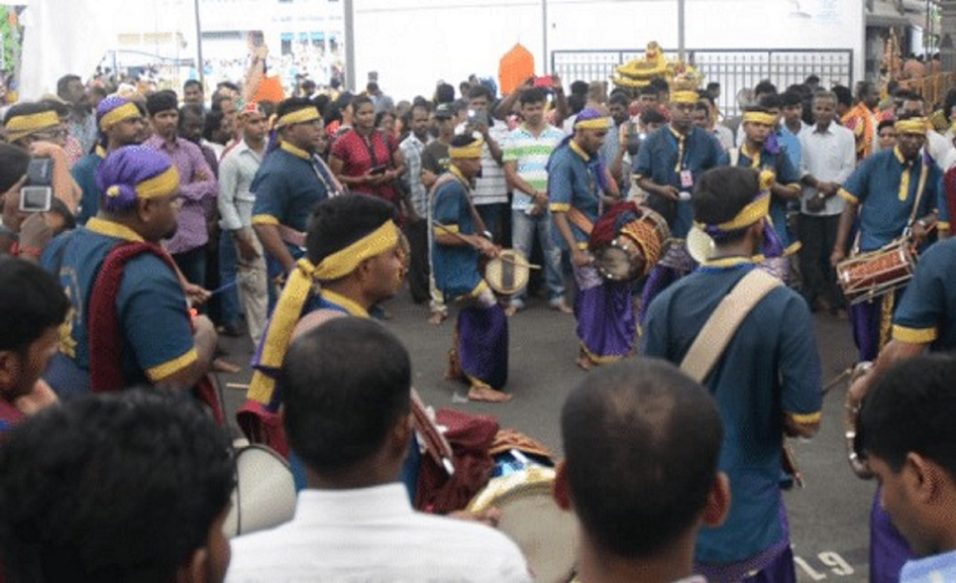
Thaipusam has been an integral part of my religious and cultural upbringing. As a child, I attended, supported and even participated in the festival. Singapore’s Tourism Board lists Thaipusam as an event in its rich diverse cultural heritage calendar. Each year, the streets are lined with supporters, devotees and curious tourists alike. The festival, however, has been shrouded in controversy in Singapore – the consequence being that thousands of Singaporeans would rather chose to flock to Batu Caves in Malaysia to celebrate the festival.
The reason for the controversy was a 42-year-old ban on the playing of live music during the festival. First imposed in 1973, the government argued that the blanket ban on loud live music was necessary to quell disorder as several fights often disrupted between competing groups, thus disrupting the procession and risking the lives of spectators and accompanying supporters.
I have written previously about this “Silenced Festival” in my book Kampong Boy and how in 2011, I myself stepped up as a plaintiff with the Attorney-General’s Office and the Hindu Endowments Board (HEB) that is responsible for running and organising the festival, as the defendants. This was the first time someone challenged the live music ban in court. Unfortunately, my legal action before then Justice Steven Chong, did not succeed due to the points I listed in the book.
The Legalities
Article 15(4) of the Constitution gives the executive branch of the government the broad authority to restrict the practice of religion in accordance with the law – the caveat being that the decision-maker’s power to do so may be challenged in Court. Additionally, the Public Order Act and its related regulation empower the Commissioner of Police to impose such conditions as he deems fit for the purposes of making an application for a licence to hold a public assembly or a public procession.
Of particular relevance to Thaipusam are regulations 8(1)c and 8(2)c which do not permit singing or music, gongs, drums or the playing of music-producing equipment. Also public processions require permits and applications which also have conditions attached.
2015 Case
In 2015, three men were arrested during a scuffle which took place during a Thaipusam festival. In the ensuing case, Vijaya Kumar s/o Rajendran v Attorney-General, the three Applicants cited their constitutional rights to freedom of religious practise and equality before the law to challenge the conditions which prohibited the use of musical instruments (other than at certain fixed points) during the procession.
The Applicants argued that music from an urumi is a fundamental aspect of the religious practice of marching in the Thaipusam procession and that the music conditions imposed constituted a breach of their rights to practice their faith without interference.
The case raised important questions including firstly, the proper meaning of the term “public order” under Article 15(4) of the Constitution, secondly, the type of state interests which can justify restricting a religious liberty, thirdly, the degree of harm that must be posed by a religious liberty before it can be restricted, and fourthly, whether the possible hostility of third parties to a person’s peaceful exercise of faith can be deemed as constitutionally relevant under the “public order” consideration.
I got involved in the case through my connections with the legal team at Eugene Thuraisingam LLP representing the Applicants. Everything balanced on being able to prove that the relevance of musical instruments was an integral part of Thaipusam and therefore to the practice and religion of Hinduism. We tried to find experts in Singapore who were able to affirm the position in our favour. We were confronted with the reality that as most temples in Singapore are affiliated to the government’s HEB, no one was willing assist the Applicants. I recall the day, I travelled with Eugene Thuraisingam who led the legal team to seek Hindu experts from across the border who were willing to share the history and origins of the procession and to explain the relevance of music and devotional songs played during the festival. We were thrilled to find Tan Sri Datuk R. Nadarajah, Chairman of the Batu Caves temple in Kuala Lumpur.
The expert stated that the “playing of the musical instruments forms an integral and inseparable part to the carrying of the Kavadis” because the music facilitates the Kavadi carriers to “enter into a trance” which then enables them to bear the enormous physical burden and pain of weight of the hoisted Kavadi. The music is an essential part not just to the procession but also to the “nature of worship”. The expert’s affidavit went as far as to state that the taking away of the musical instruments would be “traumatic” for the Kavadi carrier as the trance will be broken and he will feel immense physical burden and unbearable pain from the body piercings. Without the music, the devotee is more likely to be “distracted from focusing on the divine”.
In the end, the High Court dismissed the application on the grounds that the public order proviso to freedom of religion was made out, and the differential treatment was justified. The Applicants appealed, but later decided to withdraw their case in the light of increased dialogue between interested parties and the announcement by the government to relax the live music rule.
Music to the Ears – Latest Developments
In 2016, Hindu devotees in Singapore received their first bout of good news. The 42 year old ban on live music was lifted and live music was allowed to be played from 3 stages at different points during the procession. Broadcasted music was also permitted at 7 other locations. The Chairman of HEB was able to proudly announce that “there won’t be a stretch that is without music”. He also added, “The kavadi bearers pierce their bodies, causing enormous pain, as part of the vows they have taken. The music will be useful in reducing the pain and enhancing their spiritual focus throughout their journey.
The latest bout of good news came last week. This year’s festival which will fall on the 9th of February, will see music broadcasted at 23 points along the 4km stretch. Live music will be continued to be played at 3 stages where musicians will play traditional classical Indian instruments so that the younger generation understands their rich cultural heritage and be interested to learn these instead of the modern western style drums and bongos which have appeared at the festival in recent years.
No doubt tremendous progress has been made to listen to feedback from the Hindu community and from devotees. Participants are still not yet allowed to bring their own musicians or musical instruments and some restrictions remain. I personally hope some faith will be restored in the celebration of this festival in Singapore and that fewer Singaporean Hindus see the need to cross the border to partake in such a monumental and colourful festival.
As I wrote in my book, it is hard to think that over 155 years of tradition and devotion could be “cowed into quietude”.
Amongst the most common statements made when one recounts instances of racism in Singapore, or even discusses ethnicity in the first place is, ‘At least minorities here have it better than anywhere else in the world. Can you name me anywhere in the world where racism is less rampant?’
Aside from the condescension in the statement, and the fact that many who make such statements have actually never lived in other countries – lived, not visited for a week and then speak as though one knows everything about a place -, there are more serious questions to be asked about the statement and question.
Firstly, I do not get a vote in Malaysia, or India, or the USA. Nor do I live in those countries. I do get a vote, however, in Singapore. I do live here, as does my family. So i should be bothered about what happens here.
Secondly, how on earth does pointing out worse situations absolve oneself of blame or self-introspection? These people are essentially saying that ‘others have it worse, so do not complain.’ Why does that even make sense?
‘Oh don’t complain or do anything about your stage 1 cancer. Others have stage 4 cancer.’
And most importantly, when a person makes that statement and/or asks that question, he/she is basically devaluing my citizenship. Why should i compare myself to a Rohingya in Myanmar, or a Palestinian, or an Egyptian Copt? I should be comparing myself to other Singaporeans!!!!
Whether people realize it or not, when they make such statements or ask such questions, they are, in actuality, saying that minorities SHOULD NOT expect equal rights in this country. And that is an assumption we should all reject.
For us minorities, when someone asks ‘where else in the world are minorities treated better?’, we should not even legitimize the question by thinking of countries where minorities have it good. We should just point out how bigoted that question is in the first place.
I wish to share my unfortunate & difficult life story that has made me suffer financially, mentally, emotionally & psychologically, having to raise my 4kids on my own.
14 years ago, I was married to a man from a broken family. Things were fine initially,until my Husband started job jumping. He finds that all the jobs he was working were unsuitable for him. Eventually he started abusing me physically & verbally after I began pressing on him the importance of a stable job as our financial were beginning to tumble. Being temperamental as he was, he would occasionally abused me, and after which he would apologised and promised that he would not repeat his mistakes. Despite being trapped and afraid, I always forgave him, thinking that this time he would change for the better. This patience in me has held on until we had 4 kids. Instead of becoming better, he became worse over time. Eventually he stopped working & just didn’t bother about the family and our needs. There are times where our children barely had anything to eat even but my husband just didn’t care.
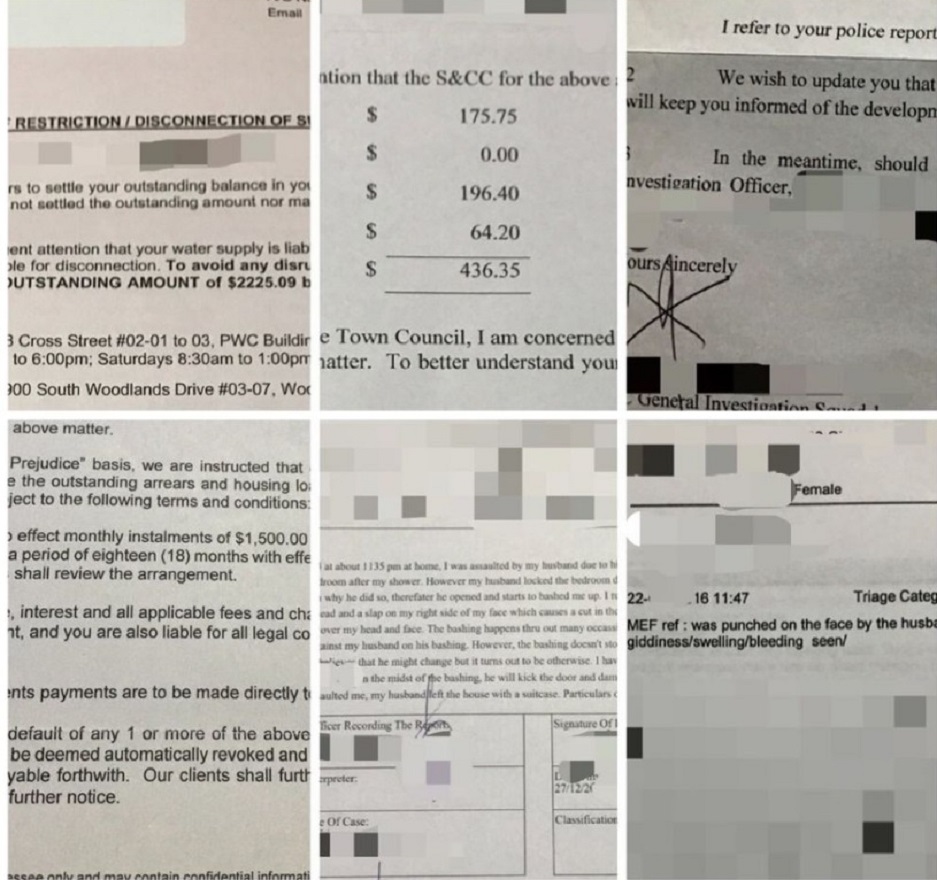
In 2014, I decided to file a Personal Protection Order(PPO) against my Husband after being physically abused until I broke my nose recently.
As a mother, I tried hard looking for jobs to sustain my kids but it is too difficult to manage. It came to a point where I have utilities arrears ,there are days where we stayed in the dark even. I tried applying for financial assistance throughout many organisations, but barely getting enough to support my kids’ education as my Husband is still able & fit to work. His laziness & attitude has cost me my life,struggling around for assistance just to raise my kids.
I am now filing a divorce against him, hoping that without him in our lives, I would be able to pick myself up & continue nurturing my kids in a decent environment.
Currently I am raising this fund to save my house, the only asset & shelter left for my 4 kids & I from being taken away. Beside that I have pile of arrears with town council & power supply.
I sincerely hope that this would raise awareness to all kind souls out there who can financially assist for me to be able to support in upbringing my kids while I desperately find a job to get back on my feet from this big drop in life. Whatever that has happened to me, I never want my kids to suffer the same fate. May God Bless all of you.