SEPANG – Balai Ketibaan Lapangan Terbang Antarabangsa Kuala Lumpur (KLIA) gempar seketika petang semalam selepas muncul seorang lelaki yang mendakwa sebagai Raja Bomoh Sedunia Nujum VIP yang kononnya mampu membuat ramalan berhubung keadaan pesawat MH370 yang dilaporkan hilang sejak Sabtu lalu.Bomoh terbabit, Datuk Mahaguru Ibrahim Mat Zin, 80, yang berpengalaman lebih 50 tahun mendakwa berdasarkan upacara yang dilakukan selama 30 minit itu, beliau mendapat alamat bahawa kesemua penumpang pesawat terbabit dipercayai masih berada dalam keadaan selamat di satu lokasi tertentu terletak antara Laut China Selatan, Filipina dan sebuah negara asing yang tidak dapat dipastikan.
“Saya nampak pesawat itu masih tergantung di ruang udara, di tengah -tengah ketiga-tiga lokasi terbabit.
“Saya tak dapat jelaskan secara terperinci soal keselamatan mereka tetapi percaya pesawat itu mungkin berada dalam dua keadaan sama ada diculik oleh pihak tertentu atau disembunyikan di alam ghaib”, katanya semalam.
Upacara ritual itu menggunakan peralatan khas iaitu teropong buluh serta bubu mata pancing sebagai simbolik untuk memperoleh alamat terkini berhubung keadaan pesawat terbabit.
Ibrahim berkata, bubu mata pancing terbabit sebagai simbolik penjara di mana pesawat itu dipercayai berada dalam cengkaman pihak tertentu atau ditawan di alam bunian.
“Kita gunakan teropong sebagai simbolik meminta anasir-anasir terbabit untuk membebaskan pesawat terbabit secepat mungkin.
“Upacara yang kita buat turut menggunakan ayat-ayat suci al-Quran iaitu surah Nabi Yunus dan surah Yassin,”katanya.
Dalam upacara tersebut, Ibrahim turut mempelawa beberapa individu daripada pelbagai bangsa termasuk seorang wakil media untuk membuat ritual pembebasan dengan meletakkan bubu mata pancing di atas kepala mereka.
Menurut bomoh yang mendakwa pernah menampar buaya tembaga sehingga mati itu, selain upacara terbabit, seramai 100,000 ahli Persatuan Silat Gayung Ghaib dan Selendang Merah turut melakukan solat hajat serta berdoa semoga pesawat yang hilang ditemui dalam minggu ini.
Katanya, pihaknya sudah melakukan perkara yang sepatutnya dilakukan dan selebihnya terserah kepada Allah SWT.
Beliau berkata, pihaknya mendapat jemputan daripada seseorang yang ‘penting’ untuk melakukan upacara tersebut semalam.
Ibrahim sebelum ini mendakwa pernah terlibat dalam membuat ramalan untuk kes antaranya berkaitan kes tragedi Highland Tower serta membatalkan ilmu hitam Mona Fendy agar hakim dapat menjalankan tugas di Mahkamah Temerloh, Pahang.
Saksikan juga aksi bomoh Datok Mahaguru Ibrahim Mat Zin dalam menangkap pontianak dengan hanya menggunakan handphone.
So last night after my gig in Sentosa while waiting for my band mates to pick me up at the taxi stand, I witnessed an very obnoxious guy and friends (one girl, one guy) hi jack a limo cab and shout in the most demeaning way to the cab driver and limo service personnel. Complaining about the $43 per trip fee of the limo. And telling the limo service staff, ” you are MY bitch!” repeatedly.
So as I was leaving to jump into friend’s car, I told him what he’s doing is not cool and he didn’t have the right to talk to people like that. Angry guy started verbally abusing me with vulgarities and chasing after me as I made my way to the car. His female friend soon got out of the limo they were holding hostage and tried to get violent with me using a beer bottle she had in her hand. Which landed on my best friend, Munir Alsagoff’s nose while he was trying to retrain her. My other band mate and friend jumped out to stop her. While my friends were trying to restrain her, angry guy came up to the car (which I was already in) and punched me in my face and gave me a bloody nose. Which his response to was, ” why did you punch yourself?” After an entire episode of verbally abusing me with names like bitch, cunt, mother fucker, racist, slut, when he saw that he had made me bleed he showed no remorse. Even as I announced I was gonna call 999 right away. I gave my details to the police and went to hospital for x ray etc in an ambulance. The massive bleeding from my nose only stopped late this morning. And half my face is tender and swollen.
So boys and girls, he’s still out there. And to get some justice done, I have since filed a police report hoping the police will take action against him, or I’ll have to engage a lawyer to file a civil suit against him which will take time. Watch out for this angry guy, AARON JEREMIEJCZYK.
Aaron Jeremiejczyk works for The Exchange, managed by Tadcaster Hospitality.
Asia Square Tower One
8 Marina View #01-05
(+65) 6636 1200 [email protected]
The Internet takes on an important function in maturing democracies with an under-developed civil society. Citizens see the cyberspace as an important avenue to perform checks and balances. This have led some to call for a rethinking of the rules of engagement.
A couple of years ago, Singapore’s Minister for Information, Communication and the Arts called for the crafting of an Internet code of conduct. Attempts to regulate the cyberspace through the suggested “netiquette” and the recent passing of the MDA regulations to legislate online news were met with disagreement on the part of the netizens. About 1,500 people registered their discontent against this new implementation and an Internet Blackout Thursday saw more than 130 bloggers trading their web pages with black screens carrying the slogan ‘Free My Internet’.
The complexity of the issue is compounded by the ambiguity as to whether social networking sites such as facebook represent the private or public sphere. Comments posted on personal capacities are often shared among hundreds or thousands of people. With this development, the phenomenon of public lynching on the Internet is becoming more common in Singapore. The cases of Amy Chua’s comments on the Malays, a PRC Chinese student’s remarks on Singaporeans, Anton Casey’s observations on the poor and Dr Aljunied’s views on homosexuality are some examples.
Consequently, the opportunity to engage deeper on contentious issues such as race, nationality, religion and social class are lost due to the manner in which these discussions have placed too much emphasis on the personalities. Surely, the strategy of removing or silencing the protagonist cannot be a better alternative to addressing the root of the concerns in open discussions. More important questions such as who represent these views, how pervasive these views are, and who are discriminated, remain unanswered. If there is one rule of engagement on the internet, it is this – every contentious point should be engaged in a civilized and respectful manner, regardless of age, hierarchy or any other social divisions.
An accompaniment to the culture of public lynching is the culture of online petitions. The petitions against and for Dr Aljunied circulating online over the last week denouncing or championing their professor is neither the first nor will it be the last that we will see. Certainly, for every social group that feels aggrieved, there will be another that feels validated. Such is the complex cosmopolitan society that we live in today.
However, if university students were to start petitioning against every disagreeable point spouted by their professors, the university will lose its critical edge and become an undesirably monotonous place. These points of views should be debated in a mature, open and inclusive manner taking on board views from all sides.
The problem with the culture of public lynching is that living in a state where there are many punitive measures to sanction the citizenry against making contentious comments that may potentially cause public disorder, it will be more convenient to slip back to an era where people are governed by a culture of fear and not speak on critical issues, anxious that they will tread on the wrong side of vague OB markers. This will surely retard Singapore’s progress and quest for a more consultative society.
Written by Kamaludeen Mohamed Nasir
Kamaludeen Mohamed Nasir is an Assistant Professor of Sociology at the Nanyang Technological University. He is the author of The Future of Singapore: Population, Society and the Nature of the State (Routledge, 2014).
Alex Au, a blogger at Yawningbread and founder of a Singapore gay rights group, People Like Us.
When the story first broke, what struck me most was the focus on lesbians. It is far more common in anti-LGBT speech for the reference to be either directed at gay males or framed with reference to gay male sex, at least in Singapore and the West. But coming from a lecturer in Malay Studies, I wasn’t surprised.
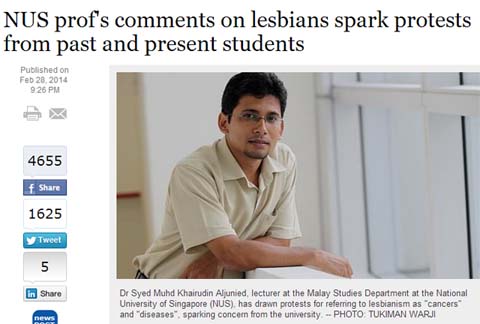
On 20 February, Syed Muhd Khairudin Aljunied made a post on Facebook in which he lambasted “liberal Islam” and its support for lesbianism, describing them not only as “wrongful ideologies” — a matter of opinion, perhaps — but also as “diseases” and “cancers”. The latter may have stepped into hate speech.
As the story in the Straits Times (headline shown above) shows, it generated protests and several petitions.
Now, before I go further, it is important to look at what Khairudin actually said. An anonymous comment led me to the Rilek1Corner site which had a screengrab (see thumbnail at left). His Facebook post seems to have been an answer to a question by an unnamed person, concerning a “new development” in which liberal Islam may be affirming unorthodox sexual identities. In his answer, Khairudin suggested giving advice, going to “proper religious classes”, and seeking help from counsellors. He urged using the “power of technology” to alert groups and movements about spreading these “wrongful ideologies”.
The recommendation may sound reasonable, even if we disagree with his view. Nevertheless, the dehumanising tone he used to describe lesbians — and for that matter, adherents of “liberal Islam” too — is what made the post stand out.
I have on several occasions argued that homophobia is deeply linked to insecurity stemming from a loss of male privilege. You get clues to this when you read some of the things Pope Benedict XVI used to say, speaking of both “radical feminism” and “homosexual lifestyles” in virtually the same breath, and how both have undermined “family life”. Traditionalists’ conception of a happily ordered family is one where the husband is the dominant member, and where the sexes had clearly demarcated roles. Feminism, which argued for equality and autonomy for women, was a serious threat. The gay rights movement sprang from this, making the point that true autonomy includes autonomy in sexual orientation and gender identity.
It is not easy to see this linkage between feminism and gay rights when one looks at the speech of the US-based Christian Right, and that may be why we forget that there is a link. This, in my view, is because in the US, it has become socially impossible to speak openly against equality for women. Thus, even as the Christian Right goes ballistic over gays and lesbians, they know it won’t be politick to attack heterosexual women as well.
However, this does not mean they don’t engage in side actions that try to limit women’s autonomy. The same people also tend to support tighter restrictions on abortion. But they have cleverly packaged it as a “right to life” issue, not as an “attack women’s right to control their bodies” issue, which in reality it is.
Islam is much less reticent about speaking out against equality and autonomy for women. I used to joke that Muslim clerics aren’t as prominent in attacking the LGBT movement as the Christian Right because they were too busy trying to control women. Things may be changing now, not because they are any more accepting of equality for women, but because the LGBT issue has made enough progress that we can’t be ignored any longer.
But it is probably no coincidence that the religions that feel most threatened by this “deadly mix” of feminism and gay rights, and are more explicit about linking the two, are the ones that still segregate men and women, either in prayer halls or in clerical roles. Gender distinctions are not just important in Islam and Roman Catholicism, they are part of the teaching. It is much easier for them to speak out against both feminism and gay rights simultaneously than it is for conservative Protestants, who have already conceded the point on women’s equality (even if they have not internalised it).
This dual threat perception comes together to explain why the question that Khairudin had to answer focussed on lesbians. Lesbians represent both a refusal to be subordinate to men and a challenge to heteronormativity. They are the “worst of the worst”.
* * * * *
In the wake of the news reports, I asked around if anyone knew Khairudin or had heard him speak on previous occasions. One friend gave me a particularly interesting answer, painting a negative picture of the man. She had attended one (or maybe more than one — I didn’t clarify with her) lecture by him and came away with the impression that he was insufferably sexist. She remembered how the notion of male privilege and dominance held up many of the ideas he propounded.
The other strong impression she came away with was his condescension towards Malays. She said, “His opening remarks was something along the lines of ‘I want to stress that while my field is Malay Studies, I myself am not Malay, but Arab’. Why was it necessary to stress that? He then added, ‘However, I married a Malay wife,’ and saying how much he ‘loved’ Malays.”
My friend got quite agitated just retelling this to me. I don’t blame her. It sounds awfully like people who say, “I have nothing against gays, in fact some of my best friends are gay, but . . . “
It’s a bit ironic then that a group called Fellowship of Muslim Students Association (FMSA), responding to petitions being circulated, described in a statement it issued,
Dr Syed Khairudin is an icon of the Malay/Muslim community in the field of academic achievement. He continues to play a contributing role to the Malay/Muslim community and the mainstream society.
Another thing you’d note from the FMSA statement is its reference to a “Neo-Sodom-Gomorrah community”, presumably newly coined by them. However, as playwright Alfian Sa’at pointed out,
They do use the term LGBT as well, which clearly shows that the coinage is a silly and childish attempt at testing the limits of provocative and inflammatory speech.
Which brings me back to the question of hate speech.
* * * * *
There is at least one petition calling on the university authorities to sanction Khairudin for committing hate speech. Khairudin’s defenders argue that if the university did so, it would be a violation of academic freedom.
Where is the line between academic freedom and hate speech? It may be hard to draw, for indeed there is value in allowing space for counter-mainstream, even offensive ideas. But a necessary test may be whether the idea being espoused is intellectually grounded: What is the basis for the idea? How sound is it?
This test may be easier to apply in some disciplines than others. It is, for example, quite clear that advocating the “truth” of creationism can seek no protection from academic freedom, but arguing the moral value of large-scale genetic engineering of humans — well, that may not be so clear-cut.
But lost in the debate about whether Khairudin was exercising his academic freedom is this: Was his Facebook posting on a matter that was within his area of expertise? It is doubtful. From what little I know, his area is that of Malay Studies, which I would think is quite distinct from Islamic Studies. He was pronouncing on religion, particularly on liberal Islam. I am sure there are scholars out there with much deeper knowledge about Islamic perspectives.
This is important. A professor of monetary theory can have no special claim to be an expert on transgender identities.
If on balance his passing judgement on liberal Islam and lesbians wasn’t within Khairudin’s area of expertise, then the greater laxity that one might give for academic freedom will not apply. He was in fact just exercising his right to free speech, the same right that you and I have. That speech will need to be tested on the same basis as anyone else’s speech for hate content. So the question comes back to this: Is labelling a class of people a “disease” and “cancer” something that would cross the line? Suppose one said that the migration of dark-complexioned people from such and such a place to Singapore was a “cancer” — would that be OK? Suppose one said that a new religion making inroads and gaining adherents was a “disease” infecting Singapore society, would that be acceptable?
POST-SCRIPT
In Straits Times’ Breaking News,
The National University of Singapore (NUS) professor who drew criticism last week for referring to lesbianism as “cancers” has been counselled by the university.
In an e-mail to all faculty members, staff and students on Wednesday, NUS provost Tan Eng Chye said he had counselled Associate Professor Syed Muhd Khairudin Aljunied, who acknowledged that his original post “reflected poor judgment in the tone and choice of words”.
Prof Tan, who is also NUS deputy president of academic affairs, said Dr Khairudin’s comments “contained provocative, inappropriate and offensive language”.
– Straits Times, 5 March 2014, NUS professor “counselled” by university for Facebook posting on lesbianism, by Pearl Lee
In a Clarification Statement which I found on Rilek1Corner (the source was Khairudin’s Facebook page) he wrote that he has not removed the original post, except the words “cancer” and “social diseases”. He also wrote that “My position as a Muslim about LGBT remains clear and is in line with the view of Muslims scholars”, and that “There is no disagreement in Islam on the prohibition of homosexuality.” Although Khairudin stressed that this was his personal view, the sense one gets from the foregoing is an attempt to invoke his religion for justification and defence.
Nine men were charged with cheating yesterday over an alleged staged road accident, which saw them claim more than $83,000 in insurance.
The group is said to have conspired to fraudulently tell insurers that a Rentokil van had been involved in a crash with three cars along Sembawang Drive in July 2009, before claiming for injuries and damage to their vehicles.
The day after the accident, the van’s driver, Rudyanto Sarmani, 32, reported it to his employer, Rentokil Initial Singapore, which paid out $1,563 to cover repairs to the Toyota van in January 2010. He faces one charge of cheating.
The Straits Times understands that the three cars involved were a Proton Gen 2, a Hyundai Matrix and a Honda Fit.