Blog

  • Martyn See: Did K Shanmugam Make An Illegal Party Political Film?

    Martyn See: Did K Shanmugam Make An Illegal Party Political Film?

    Did Law Minister K. Shanmugam make an illegal party political film?

    Dear K. Shanmugam,

    On the 10th of May 2015, you uploaded a video entitled “A Day in the Life of a Minister”, which features a camera crew tracking your activity of the day. It was an unscripted video shot and edited in the style of a reality-TV programme.

    You stated that the 12-minute long video was made by “volunteers”. By that, one would assume that this is not a government-sponsored production. As such, may I inform you that this video is not exempted under section 40 of the Films Act and therefore in possible violation of section 33 which criminalises “party political films”, the penalties of which are a fine not exceeding $100,000 or to imprisonment for a term not exceeding 2 years.

    I cite the following clauses of the Films Act relevant to “A Day in the Life of a Minister”.

    “Party political film” means a film —

    (a) which is an advertisement made by or on behalf of any political party in Singapore or any body whose objects relate wholly or mainly to politics in Singapore, or any branch of such party or body; or

    (b) which is made by any person and directed towards any political end in Singapore;

    For the purposes of this Act, a film is directed towards a political end in Singapore if the film —

    (a) contains wholly or partly any matter which, in the opinion of the Board, is intended or likely to affect voting in any election or national referendum in Singapore; or

    (b) contains wholly or partly references to or comments on any political matter which, in the opinion of the Board, are either partisan or biased; and “political matter” includes but is not limited to any of the following:

    (i) an election or a national referendum in Singapore;

    (ii) a candidate or group of candidates in an election;

    (iii) an issue submitted or otherwise before electors in an election or a national referendum in Singapore;

    (iv) the Government or a previous Government or the opposition to the Government or previous Government;

    (v) a Member of Parliament;

    (vi) a current policy of the Government or an issue of public controversy in Singapore; or

    (vii) a political party in Singapore or any body whose objects relate wholly or mainly to politics in Singapore, or any branch of such party or body.

    None of the following films shall be regarded for the purposes of this Act as a party political film:

    (e) a documentary film without any animation and composed wholly of an accurate account depicting actual events, persons (deceased or otherwise) or situations, but not a film —

    (i) wholly or substantially based on unscripted or “reality” type programmes; or

    (ii) that depicts those events, persons or situations in a dramatic way;

    Exemptions

    40. —(1) This Act shall not apply to —

    (a) any film sponsored by the Government;

    (b) any film, not being an obscene film or a party political film or any feature, commercial, documentary or overseas television serial film, which is made by an individual and is not intended for distribution or public exhibition; and

    (c) any film reproduced from local television programmes and is not intended for distribution or public exhibition.

    (2) The Minister may, subject to such conditions as he thinks fit, exempt any person or class of persons or any film or class of films from all or any of the provisions of this Act.

    (3) An exemption granted under this section may be withdrawn at any time.

    I put it to you that the video “A Day in the Life of a Minister” may constitute an illegal ‘party political film’ under section 33 of the Films Act because :

    1. It is an advertisement made by or on behalf of a political party in Singapore whose objects relate wholly or mainly to politics in Singapore.

    2. It is made by a person and directed towards a political end in Singapore – by featuring a Member of Parliament.

    3. It is a film that is substantially based on unscripted and “reality” type programmes, and it also contains dramatic elements.

    4. It is not a government-sponsored film.

    Of course, the Minister may opt to exercise section 40 of the Films Act to exempt your film from the Act.

    In the interest of upholding transparency in the application of the Rule of Law in Singapore, this letter will be made public. I look forward to your reply on this matter.

    Yours sincerely,
    See Tong Ming

    The above was emailed to K. Shanmugam on 11 May.


    Source: Martyn See

  • Lim Swee Say: Degree Mills Are Fine So Long As Individuals Meet Salary And Experience Criteria

    Lim Swee Say: Degree Mills Are Fine So Long As Individuals Meet Salary And Experience Criteria

    New Manpower Minister Lim Swee Say on Monday wrote an entry in his blog to explain how the Ministry of Manpower (MOM) treats forged degrees and those from degree mills in Employment Pass and S Pass applications.
    His explanation included an infographic (see below) and the potential penalty for providing forged degrees.
    Accredited Forged And Degree Mills
    Those who provide fraudulent educational documents will be barred for life from working in Singapore.
    Those with degrees from an unaccredited institution, will be assessed based on their experience and salary criteria.
    His blog post came after Non-Constituency MP Gerald Giam had submitted a Parliamentary Question on Monday about the checks that are done when processing S Pass and Employment Pass applications.
    Mr Lim provided a similar answer, and said that to detect forged qualifications, his ministry conducts internal database checks, as well as external checks through third-party screening agencies, direct verifications with the issuing institutions, and by requiring the employer to show proof that they have verified that the submitted qualifications are genuine.
    He added that employers have a primary responsibility to ensure the authenticity and quality of the academic qualifications of the foreigners they wish to hire.

    Source: www.allsingaporestuff.com

  • Assailant Intolerant And Cowardly But Let’s Forgive

    Assailant Intolerant And Cowardly But Let’s Forgive

    By Andrew Loh

    Neo Gim Huah has been sentenced to three weeks’ jail for voluntarily causing hurt to teenager, 16-year old Amos Yee, on 30 April.

    Neo, 49, had struck Yee in the face outside the State Court while the latter was on his way to a pre-trial conference.

    A posse of media reporters and cameramen were present when the incident happened, and several videos of it later made its way online.

    Neo told the court on Monday that he wanted to teach the teen “a lesson” for disrespecting Singapore’s former prime minister, Lee Kuan Yew.

    Yee had made and posted an eight-minute video ridiculing and castigating Mr Lee, and compared him to the Christian religious icon, Jesus Christ, in an unflattering manner, saying both men were “power-hungry and malicious”.

    Yee is facing charges for the video and for a caricature of Mr Lee and the late British prime minister, Margaret Thatcher.

    “The accused sought to maximise the publicity that would be generated by his intended course of action by deliberately choosing the time and place – while the victim was on his way to the State Courts to attend a pre-trial conference,” District Judge Ronald Gwee said in his judgement.

    Judge Gwee said “a strong message must be sent to the public at large and particularly to like-minded persons as the accused that his brand of vigilante justice must never be allowed to take root.”

    Since the incident almost two weeks ago, members of the public have largely condemned Neo’s actions.

    Indeed, Law Minister K Shanmugam described Neo’s deed as “quite unacceptable”.

    Others have called for Neo to be taught a good lesson himself.

    There are still others who are now, after yesterday’s judgement, calling for Neo’s background to be unearthed, and to further punish him by hounding his business into closure.

    We must refrain from doing such things, and take the higher ground and forgive Neo, now that he has been sentenced and more importantly, he has also apologised to Yee and his family.

    Some of us (and there are not a few) cried foul when Amos Yee himself was hauled up by the police in a most unnecessary manner – arresting him at his home, handcuffing him, requiring him to post bail, having his passport impounded, dressing him in prison clothes with the word “PRISONER” emblazoned on his back, shackling his feet, and basically parading him in front of the media – even though he has not been found guilty of any offence.

    The way the state (and the media, which have sought to demonise the boy) has gone about this is disturbing indeed.

    There are many questions about how Amos Yee is being treated by several quarters, including the silence from our elected members, none of whom has publicly raised concerns about whether throwing the book at a boy is the right thing to do.

    Yet in the middle of all this – including repeated abuse online by pro-establishment, pro-Lee Kuan Yew supporters – Amos Yee has not sought to do as others have done to him.

    Indeed, when Neo assaulted him outside the State Courts, Amos Yee merely put his palm to his cheeks and walked away.

    He didn’t chase after Neo.

    He didn’t shout back at Neo, who had reportedly challenge Amos Yee to “sue me”.

    Amos Yee didn’t ask his parents to file a police report.

    He went about his business in court that day, which subsequently saw him being remanded again, till this day.

    Amos Yee sought no vengeance.

    But this was not the first time that the teenager was dealt such violence or threats of such violence.

    After his video was first published, a purported grassroots leader threatened to “cut off his dick and stuff into his mouth”, while others called for and encouraged the rape of Amos Yee while the boy was in remand.

    Others have made vile and obscene references to his mother as well.

    In short, Amos Yee has been thrown before the courts, misrepresented and smeared in the mainstream media, threatened and assaulted, abused and ridiculed by a pro-establishment lynch mob, a mob which now hails Neo as a “national hero”.

    Yet, throughout all this utterly shameful behaviour directed at him, Amos Yee has not sought to react in the same childish manner.

    Instead, he has even defended the right of the grassroots leader to say as he pleased, even if it were threats the man was making.

    I believe that Amos Yee has forgiven the man, an adult man.

    In fact, it would be more accurate to say that Amos Yee probably found nothing to forgive at all, for that is what he believes in – the freedom which must be accorded to everyone to say and express as he would.

    And so we return to Neo whose actions are the epitome of intolerance and cowardice.

    According to news reports, Neo – in a rather grandiose self-righteous manner – told the court “he hoped everyone would learn from this”.

    Well, he is not wrong.

    But it is Neo, more than anyone else, who needs to learn from this incident – to learn that being intolerant is not how society progresses, and that striking a boy and then cowardly flee is an entirely shameful and disgraceful act.

    Indeed, instead of Neo teaching Amos Yee a lesson, the truth is the other way round – that Neo should learn from a young boy who, despite all the abuse heaped on him this past one and a half month, has chosen to smile at his abusers, stand his ground on what he believes even if meant going to jail, and forgive those adults who claim to know “the way of the world” (as Neo himself claims to) but instead behave like barbarians.

    So, let’s not behave in the same manner as those like Neo would.

    Let us forgive and move on.

    Neo has made a mistake and has apologised. He too has a family who worries for him.

    Leave his business be. Let him make his living.

    And respect his admiration for Lee Kuan Yew, even if we do not agree with it.

    For this is what Amos Yee would want.

    Let us not do violence against others, in any form, in the name of defending or seeking justice for Amos Yee.

    It is forgiveness which will take us forward, not hatred, intolerance and abuse.


    Source: www.theonlinecitizen.com

  • Pelajar Remaja Hubungan Sejenis Di Malaysia Pampangkan Gambar Meraka Di Media Sosial

    Pelajar Remaja Hubungan Sejenis Di Malaysia Pampangkan Gambar Meraka Di Media Sosial

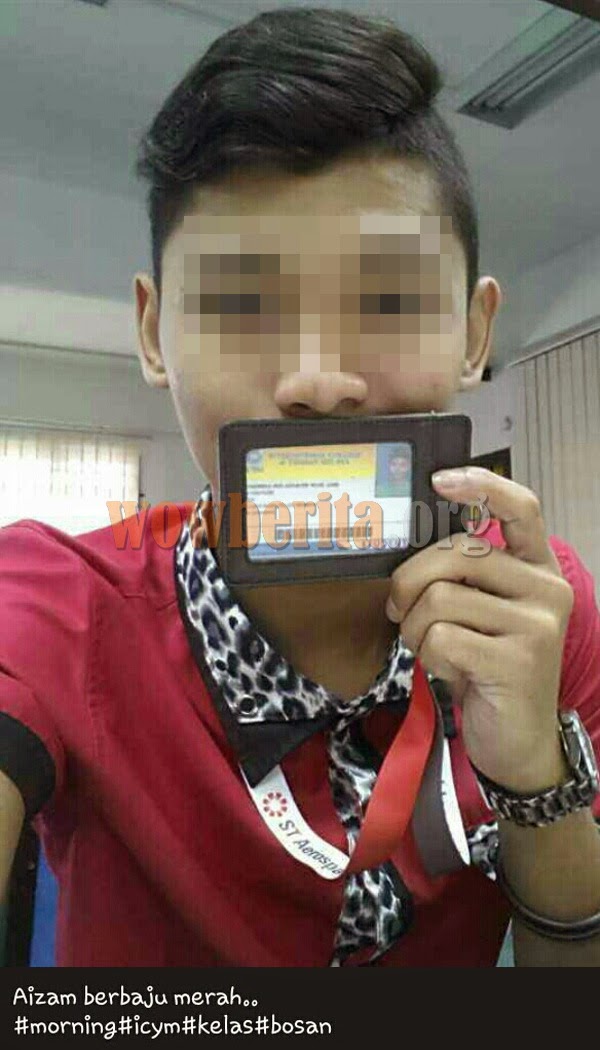
    Tergamam seketika tatkala melihat beberapa gambar yang agak meloyakan ini. Mana tidaknya, sudahlah sejenis, dibuatnya pula sign ‘Love’ ala-ala K-Pop. Mau terbeliak biji mata dibuatnya.

    Gambar pasangan remaja songsang ini mula tersebar di laman sosial menunjukkan betapa intimnya mereka berdua.

    Remaja ini didakwa pelajar sebuah kolej swasta di Melaka ini juga tanpa segan silu ber’papa’ ‘mama’ dengan pasangannya itu serta memuat naik gambar mereka secara terbuka di laman sosial.

    Menurut sumber, gambar-gambar ini diperolehi dari aplikasi pesanan ringkas, WeChat.

    Penularan LGBT di kalangan belia semakin menjadi-jadi. Justeru, ibu bapa digesa memantau aktiviti anak-anak terutamanya telefon pintar mereka.

    Golongan belia amat mudah terpengaruh dengan benda/budaya baru. Yang mana, pada mulanya mereka hanya memberikan alasan mahu mencuba. Tetapi apabila sudah menikmati ‘kesedapan’ yang tidak terhingga, mereka akan terus menerus terjerumus lebih jauh sehingga sukar untuk kembali ke pangkal jalan.

    Mohon siapa yang mengenali pasangan songsang ini, nasihatkanlah mereka agar kembali ke pangkal jalan.

    Source: http://wowberita.org

  • Meet The Gay Muslims Living In Straight Marriages

    Meet The Gay Muslims Living In Straight Marriages

    Khalil realised he was gay at 17.

    It was 1984, and he was living on a council estate in West London with his parents and two sisters, who originally came from Pakistan. “We had some family guests over,” he recalls, “and they brought along their daughter, who was around my age. My father kept making all these jokes about us getting married… and I knew he was joking, but I was trying not to cringe. I wasn’t attracted to her at all, and I realised at that moment that I hadn’t been attracted to any of the girls that had come over before.”

    Seven years later, Khalil got married to the same woman, and they currently live in a well-to-do suburb of London along with their two children. However, he admits at despite having “the ideal life of a Muslim man” on the surface, he does not feel attracted to his wife.

    It’s a position that an increasing number of devout gay Muslims find themselves in, as they attempt to reconcile their faith with their sexual orientation.

    When we meet near his office, Khalil (who has, along with the other interviewees in this article, asked for BuzzFeed News to use a pseudonym) is dressed in a pristine pinstriped business suit, and sports a medium-sized, perfectly trimmed beard. He greets me with a firm handshake – “Salaamwualaikum” – and apologises for being late, telling me that he needed to pray first.

    We’re later joined by two other men, Adnan and Mohammed, both of whom are in similar situations. Adnan, is tall, skinny and dressed in a plain suit. He’s been married for just under two years, having had a ceremony arranged by his parents. Mohammed, who is short but well built, is dressed in the traditional Islamic thoba – a garment he says he usually wears in public. He’s a university student who hopes to be married soon.

    The men head to an Italian restaurant in central London. Khalil booked a corner table weeks in advance: he highly recommends the food, and says that these types of venues are much better for such meetings, because of the nature of their discussions. “You don’t really want to be talking about these things in a Muslim restaurant,” he jokes. Adnan, relaxed in his chair, laughs with him, while Mohammed, who shows some nervousness, hunches over his phone.

    After a small amount of short talk over olives, in which they talk about their jobs – and, more importantly, last week’s football matches – Khalil asks how Adnan and Mohammed have been “managing” since the last dinner.

    Although the men acknowledge they have same-sex inclinations, they are reluctant to identify themselves as “gay”. However, they say that as Muslims who are “devout”, they have dedicated themselves to strengthening their imaan [religious belief] in an attempt to overcome them.

    The men are part of a small support group which began on a web forum. Some of the members now meet every few months to discuss how they are managing their sexual feelings.

    In some British Muslim communities, homosexuality can be a controversial issue: some believe the act counts as a form of “zina” – an Arabic term referring to “unlawful” sexual activity.

    Many imams were uncomfortable talking to BuzzFeed News about the issue on record, although one scholar, who wished not to be named, said that homosexuality was a “cardinal sin” in most strands of Islamic thought. He emphasised that the same view was held in most world religions, including Christianity and Judaism.

    Others imams, such as Ghulam Rasool of Leicester central mosque, said that Islam did not make a direct reference to homosexuality, but instead prohibited areas of sexual activity deemed impermissible, such as anal sex. He adds that the regulations apply to everyone, including those in heterosexual relationships.

    “To have the inclination has never been condemned,” he said. “It’s acting upon it.”

    He added: “Whatever thoughts prevail for your mind, if you don’t act on the bad impulses you have to learn how to deal with them as a Muslim. And if you can’t, it’s about where that sin fits in the Islamic spectrum.”

    Rasool adds that similar rulings on sexual activity are evident in all branches of the Abrahamic faiths – but points out that in Islam, sexual habits have always been a “private issue”.

    There is still little information on how many gay Muslims are living in Britain – not least because many (especially regular worshippers such as the members of the support group) remain closeted, out of fear of reprisal from conservative elements of their communities.

    As a result, some Muslim activist organisations, such as the LGBT support group Imaan (which is not affiliated with the men interviewed in this article), have articulated the need for British Islamic communities to be more open to such Muslims.

    The organisation also said it does not support or encourage LGBT Muslims to enter “marriages of convenience,” or pursue treatments that require one’s sexual identity to be repressed.

    Although Imaan usually works with LGBT Muslims who are “being pressured into heterosexual marriages”, its spokesperson, Naeem (who preferred not to give his surname), told BuzzFeed News that it had heard of some cases where religious individuals were willing to repress their sexuality.

    “The LGBT Muslim community in Britain is as diverse as the wider Muslim community here,” he said.

    “We come from various ethnic and sectarian backgrounds and each would have inherited their community’s attitudes towards Muslims of other ethnic or sectarian communities.”

    Naeem emphasised that the experiences of LGBT Muslims are unique and that they shouldn’t be treated as a single group. However, he added that many are reluctant to talk about sexuality out of fear they “might dishonour their families, be forced into marriage as a form of rehabilitation, or become unwelcome in their communities”.

    In some cases, he says that people have suffered “intense emotional, psychological, and spiritual trauma” as a result of familial pressure to marry the opposite sex.

    However, the men believe that common assumptions about homosexuality in Islam have been misinterpreted.

    “It’s not homosexuality itself that’s a sin,” Adnan says. “It’s more about acting on your sexual urges – I think that’s been really misunderstood by the media, so they make out that Islam is homophobic, or anti-gay or whatever. It’s not, it’s just about controlling things that are haram [forbidden].”

    Mohammed agrees. Although he realised he was gay in secondary school, and says he’s had “quite a few flings” with men in his early years at university, it was only a couple of years ago that he decided to devote himself to his faith.

    “There was always a part of me that said what I was doing – going to clubs, having boyfriends – was wrong, but I tried to block it out,” he says. “It was only when my mum passed away that I began really taking Islam seriously, when I realised we will all eventually return to Allah to be questioned about our evils.”

    “The imam said that this was just a challenge in my life – so the only way to overcome it would be by devoting myself more to God. I was recommended to fast at least once a week, to be more devout in my prayers – and to get married. The imam had told me he knew many men who had felt these ‘natural emotions’, and were able to overcome them by living a good, Islamic way of life.”

    Mohammed describes the group as the first “safe space” where he was comfortable talking about his past activities. “No one judged me for my past,” he says. “They were very open about their experiences, and how they returned to Islam. Usually, people would post a motivational image with verses of the Qu’ran on them, mainly about Allah forgiving you for your sins. And it was nice to be in a place where there were brothers to support you – it’s not often you find [something] like that in a masjid [mosque].”

    Mohammed adds that the most common advice to Muslims in the forum – especially young people – is to get married. “Most of the brothers in the group recommend nikah [marriage] to overcome sexual urges,” he says.

    “It’s not just for gay or lesbian people – Islamically we’re taught to regulate our sinful desires, like having sex out of marriage. Nikah isn’t just sexual, it’s also a way to come closer to Allah and please him.”

    He cites a number of men he knows through the forum who claim to have “overcome their sexual feelings’ toward men” by marrying “practising sisters”, although he admits that they don’t really talk about the more intimate parts of their relationships.

    “It’s not just religion – it’s more to do with culture,” he insists. “Islam doesn’t shy away from talking about dealing with homosexual feelings and transgressions. It offers the best solution for overcoming these feelings. But if you bring it up outside the mosque it is dangerous, and I think that keeps many gay and lesbian Muslims from coming out.”

    When asked how his family would react if he came out, he says: “They’d definitely be very shocked to say the least – I’d be quite worried to find out. I’ve heard about gay Muslims who have come out and have lost contact with all their family, kids and friends.”

    Adnan also keeps his sexual past a secret from his wife, although he says that it “isn’t much different” from the experiences of other Asian Britons.

    “I don’t really know many Asians generally who are open about their sexual history, gay or not. It’s not something we really talk about in our culture, so in some ways it’s actually much easier,” he says. “It helps that I was always quite religious. I wasn’t very outward about my sexual preferences, and was only in one, very short relationship when I was younger.”

    Adnan says he’s “working hard to build a strong relationship” with his wife, and believes that “if Allah wills, our relationship will blossom when we are graced with children”. However, he’s reluctant to answer questions on whether he has felt sexual attraction to other men since he’s been married. “I’m just trying to live my life as Islamically as possible,” he says.

    While Khalil, Adnan and Mohammed have not resorted to drastic measures in their attempts to overcome their sexual inclinations, they do say that others in the group have done. They recall one man in America who went to a spiritual healer, believing that his sexual inclinations were the result of an evil spirit known as a “djinn”. Others have allegedly embraced full abstinence or sought help through gay conversion therapy (which has been condemned by the medical and mental health sectors in both the UK and US as damaging and ineffective).

    “A lot of the time Muslims with these feelings want to follow the “sirat al Mustaqeem” [the right path] but they don’t know how,” he says. “They’re lost. So they go to people who say they can cure them, and a lot of the time they don’t! I’ve heard stories where con artists have ripped people off pretending they can cure them of illness, diseases, and it’s just a con.”

    He adds: “It’s much better to seek proper solution. I’d recommend any Muslim brother or sister feeling these emotions to go to their Imam or a respected scholar first… then seek devout brothers and sisters online for guidance.”

    While this view might be controversial, the men say it is becoming the “normal opinion” of most devout British Muslims trying to understand their faith in the context of a sexually liberal society.

    “It is quite sad to see some Muslims being abused by their families and communities just because they are gay,” Adnan says, recalling a former friend who was kicked out of his family home after coming out to his family.

    Khalil says that while he would ideally want gay Muslims to “return to the right form of Islam”, it was “unacceptable” for anyone to be abused because of their personal qualities: “Doesn’t matter if you’re gay, straight, black, white or whatever, abuse is abuse, whatever the circumstance.”

    And although none of the men have ever heard an imam publicly condemn gays or gay activity, Mohammed says that he still feels uncomfortable whenever his friends make “crude jokes” about gay people.

    As we finish, the men exchange salaams outside the restaurant, and reaffirm the need to “get in touch any time” if they need to.

    “Oh no, I better head back before it gets too late,” Khalil jokes. “My wife will think I’m having an affair!”

    To contact Imaan, visit its website or email [email protected]

    CORRECTION: This story has been edited to clarify that the none of the interviewees are affiliated with Imaan. Additionally, Imaan neither supports or endorses the decisions made by the interviewees. (20/04/15)


    Source: www.buzzfeed.com

deneme bonusu