Blog

  • Malaysia Pre-University Students No Longer Required To Wear School Uniforms

    Malaysia Pre-University Students No Longer Required To Wear School Uniforms

    SEREMBAN (THE STAR/ASIA NEWS NETWORK) – After weeks of speculation, Malaysia’s Education Ministry has confirmed that students enrolling in Form Six or pre-university will be allowed to wear traditional outfits or other apparel as part of their school dress code when they begin the new term in a fortnight.

    Students will also be allowed to wear batik attire to school under a move by the ministry to “re-brand” Form Six.

    Education Ministry director-general Datuk Seri Dr Khair Mohamad Yusof said schools can no longer compel Form Six students to wear a standard uniform.

    Male students will be allowed to wear light-coloured shirts and slacks to school, but these should not have floral or other designs.

    “Although they are free to choose the colour of their shirts, these should not have designs other than stripes or checked designs which are fine,” he said in a directive to all schools.

    The slacks should be ankle-length and not tight.

    They would also be allowed to wear belts but the buckles cannot be more than 5cm in size.

    Malaysia Form 6 Uniform

    Although it was not stated in the directive, students can still wear their uniforms.

    Dr Khair said despite the flexibility under the new rule, students are prohibited from wearing any attire made of denim material.

    He said apart from baju kurung, female students will be allowed to wear long pants and two or three-piece pant suits.

    They can also wear blouses with sleeves, maxi dresses and skirts which were lower than the knee level. Jeans, cargo pants, shorts and leggings are banned.

    “The students will not be allowed to wear t-shirts when they attend classes,” he said, adding that female students would not be allowed to don tight attire.

    Boys will be required to wear shoes and socks while the girls can only wear shoes that cover their feet.

    Slippers, clogs and sandals are out.

    As for outdoor activities, the students are encouraged to wear long pants or track bottoms and short or long-sleeved t-shirts.

    “The t-shirts they wear should not have political, violent, vulgar or any negative images,” he said.

    The move to do away with the uniform for pre-university students has not been welcomed by most of the public.

    In a poll by The Star Online, many believed the decision would not have any relevant impact on the overall standard of education.

    Facebook user Stephanie Ha said that the move was not a good idea as students, especially girls, will waste their time thinking of what to wear.

    “This will also lead to a sense of loss of identity and sense of belonging to their school,” she said.

    Another Facebook user, Cecilia Thomas, questioned how the move would help with the students’ education.

    “There will be extra expenses for families because students would want to impress their friends,” she added.

    Grace Williams said the move would create a divide between the rich and poor students.

    “The rich will try to show off with their expensive dresses and the poor will suffer from an inferiority complex.

    “This will directly affect their studies,” she said.


    Source: www.straitstimes.com

  • Defining The Moderates In The Malay Muslim Community – Are Majority Of Us Extremists?

    Defining The Moderates In The Malay Muslim Community – Are Majority Of Us Extremists?

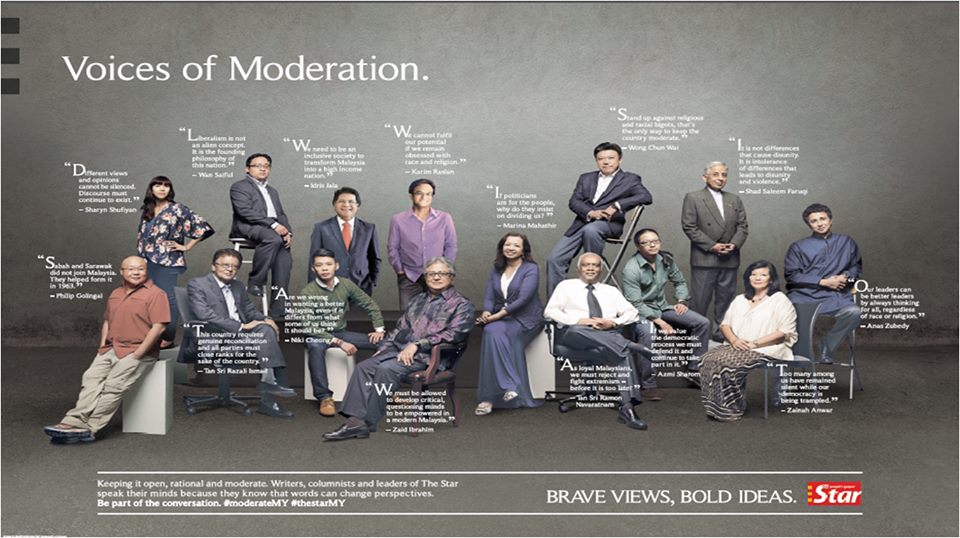
    It is indeed funny to see how the star lined up a band of people whom it called the voices of moderation.

    Well I don’t care about the non-Muslim (not Malay) in the line up because it is none of my business to interfere with how they want to define the term moderation, but it is kind of appalling to see the Malays in the list. They are

    • Marina Mahathir
    • Zaid Ibrahim
    • Razali Ismail (chairman of Global Movement of Moderates)
    • Zainah Anwar (Sisters in Islam co-founder)
    • Karim Raslan
    • Azmi Sharom
    • Anas Zubedy
    • Wan Saiful Wan Jan
    • Sharyn Shufiyan (Tunku Abdul Rahman’s great granddaughter)

    I want to clarify that I have nothing against them personally. What I am against is the people who put them in the list and claimed that they are the voices of moderation that represent the Muslims whereas many Muslims (including me) and Malays are against their thinking and ideology. What more when some of them are well known for carrying ideology that is against the main stream understanding of Islam. Take for example the ladies in the list, whom none is wearing tudung. Zainah Anwar is also known to claimed that covering one’s hair is unnecessary in Islam, whereas the mainstream Muslim understanding all over the world is that it is compulsory. So how can the person ever claimed that Zainah Anwar is the voices of moderation for the Muslim while clearly she is the minority. If Zainah Anwar represents the voices of moderation for the Muslim, does that mean 90% (or probably 99%) of Malaysian Muslim women who believe hair as aurat which needs to be covered in public are the extremist? This is indeed insulting.

    I am not sure if the person who put up the list is a Muslim or not, but for me, as a Muslim, it is a blatant misused (and wrongly used) of the term moderation for the Muslim. Firstly, the term moderation is a very misunderstood terminology. Secondly, for the Muslim, the term moderate is a religious definition where there are hadiths from the prophet S.A.W. that explains about the meaning of moderation. Therefore, to put these Malays (Muslims) as role model of moderation is an insult to the Muslim especially when some of them is known to have ideology and understanding of Islam that is against the understanding and practice of the mainstream Muslim.

    It is Tolerate, not Moderate

    When I dropped the word Moderate into Google, this is what I got

    moderate

    Moderate, by its adjective definition is the average in amount, intensity, quality, or degree. You cannot have an average if you only have one extreme. For example, what is the average of 10? No one can tell you. But if  you ask what is the average between 1 to 10, then the answer is 5. So we can say that 1 is the extreme to the left and 10 is the extreme to the right. So 5 is the moderate value which is in between the two intensities!

    extreams

    The misconception comes in the noun definition. It says that moderate is a person who holds moderate views, especially in politics. Now the problem is that views in politics are subjective. What someone view as moderate may not be viewed as moderate by others. For example, to the non-Muslim, a Muslim who is not wearing tudung is a moderate Muslim. To the many Muslims, she is not a good Muslim. To the non-Muslim, a person who drink only in social occasion is a moderate drinker. To the Muslim, if a Muslim drink at any occasion, he is a sinner. People like Marina, Zainah and Zaid Ibrahim may think that they are the moderate, but to the many they are the liberals and to some they are the deviants.

    The more correct definition that fits them is Tolerate. These people are not moderate, they are just more tolerable, for example, some are more tolerable to western lifestyle where they don’t mind to wear bikini or drinking in a party with alcohol. So does in political view. Some are more tolerable to opposing views.

    There is no point arguing who is indeed the moderate. We can never agree to such a subjective matter. What is unbecoming is for the Star to put up these people and claimed that they are the voices of moderation among the Muslim. it is like the Star trying to shovel the definition Moderation into the throats of Muslim. Who is the Star to tell the world that those people represent the moderate voices of Muslim in Malaysia? That is why I say it is insulting.

    A Religious Definition

    Islam has clear definition moderation. It is in the Quran and there are numerous hadiths from the Prophet s.a.w. about moderation.

    In the Quran, Allah S.W.T. says

    “We made you to be a community of the middle way, so that (with the example of your lives) you might bear witness to the truth before all mankind.” (Qur’an, 2:143) 

    In one of the hadith,

    ‘Abdullah ibn Masood (Allah be pleased with him) reported that once Allah’s Messenger (Peace be upon him) drew a line in the dust with his hand and said, “This is the straight path of Allah.” Then he drew a series of lines to the right of it and to the left and said, “Each of these paths has a devil at its head inviting people to it.” He then recited (Qur’an 6:153), “Verily this is my straight path so follow it and do not follow the (twisted) paths.” (Collected by Ahmad, Nisai and Darimi; see Mishkat ul-Masabih, 1/166)

    If you look back at the adjective definition, you will understand better the concept of moderation in Islam. In every moderation, there is always an extreme left and extreme right. So the moderate is the middle path in between the extremes. Picture speaks a thousand word. By looking at the picture below, you should understand better. This is off course according to Ahlul Sunnah definition.

    moderate2

    What it clearly tells you is that Zainah, Marina, and the other ladies in the list are not the moderate according to the Muslim standard. They are indeed the extremists, the liberals!

    I will list few more examples of moderation in Islam

    EXTREME LEFT MODERATE EXTREME RIGHT
    Marriage
    Priesthood, complete refrain from marriage Marriage up to 4 wives (in this respect, Sister in Islam by Zainah Anwar is against polygamy, so she is not the moderate) More than 4 and unlimited number of concubines
    Relationship with Non-Muslim
    Extreme enimity against non-Muslim irrespective of whether they have peace agreement with the Muslim or not. Treat and deal with those who have peace agreement with Muslim with kindness, honor, respect. Befriend those who are an obvious enemy to Muslim who are known of ploting to destroy Islam and the Muslim
    Ibadah
    Monastery life, i.e. spend whole life doing nothing except in prayer and worship Balance between worldly life and time spend in prayer and worship of God Only focus on world life and ignore worshipping of God
    Charity
    People who give everything and left nothing for themselves Give some part of their wealth for charity and keep the remaining for own use Do not give charity or alms at all

    So it is not difficult to understand moderation in Islam. It is something very clear cut and obvious. There is a law in Islam. Some will take it extremely lightly and some will take it rigidly. The moderate is the one who take the middle path.

    Trying to tell Muslim how to practice Islam

    This is the alter ego and ignorance of many of the non-Muslim today. What exhibits by the Star is the result of this alter ego. They believe these few figures are the “moderates” so they put them as the moderate voices of Malaysia without an iota to think if the mainstream Muslim actually agree with them. Arrogance is one thing, but such ignorance is unacceptable. Even for those non-Muslims, do you think they really represent the voices of moderate among the non-Muslims? Don’t they know that Zainah is one of the most loathe personality among the mainstream Muslim community in Malaysia. How can you ever shovel such person into throats of Muslim forcing them to accept her as role model. This is an utter demonstration of low class journalism.


    Source: https://grandmarquis.wordpress.com


  • Dormitory To Be Constructed In Jurong East

    Dormitory To Be Constructed In Jurong East

    Listed construction firm Lian Beng Group is teaming up with listed dormitory provider Centurion Corp to build a 7,900 bed dormitory for foreign workers in Jurong East, not far from major industrial plants on Jurong Island.

    The two companies said the proposed facility, which will also include a training centre, will provide better quality accommodation for Singapore’s foreign workers.

    They were selected to build the centre, in Jalan Papan, in the vicinity of Jurong East MRT station, by an entity set up by the Association of Process Industry.

    Lian Beng will take a 49 per cent stake in the joint venture, while Centurion will hold the other 51 per cent. In their filings with the Singapore Exchange on Tuesday, the two firms did not disclose the cost of the project.

    The process industry encompasses plants involved in the manufacturing of petroleum, petrochemicals, specialty chemicals and pharmaceutical products, and companies providing process construction and maintenance works to the plants.

    The self-contained community with extensive recreational facilities and amenities will sit on about 1.5 ha, with a lease tenure of 23 years.

    The development is scheduled to be completed by mid-2016 and is will have easy access to Jurong Island where most of its workers are expected to commute to for work.


    Source: www.straitstimes.com

  • Barry Desker: Mindset Shift Needed On MInimum Wage And Dual Citizenship

    Barry Desker: Mindset Shift Needed On MInimum Wage And Dual Citizenship

    Professor Barry Desker believes that Singapore should be prepared to have a minimum wage and allow dual citizenship. He also said that Singaporeans should welcome new citizens.

    “Attitudes need to change,” Prof Barry wrote in his opinion piece in The Straits Times.

    “We should welcome the presence of new Singaporeans and encourage their integration into Singapore society.

    “We should revise our laws to permit dual citizenship, which benefits some who are permanent residents but do not wish to give up the citizenship of their land of birth.

    “It would also allow the growing numbers of Singaporeans working abroad to retain their links with Singapore,” he said.

    “We should be prepared to adopt a minimum wage policy to protect vulnerable groups in our workforce and to ensure that cheap foreign labour does not displace Singaporeans in their twilight years eking out a living.”

    Prof Barry said that a minimum wage should be considered because “The ease with which foreign labour was recruited has resulted in depressed wages for a segment of our population with minimal educational qualifications, unskilled and often in their 50s and 60s.”

    But he admitted that even though there have been “calls for the introduction of a minimum wage”, the government has resisted implementing one over the years.

    Prof Barry also admitted that the “high levels of economic growth over the past two decades resulted from increases in capital and foreign labour deployed, not from significant productivity increases.”

    “However, the unsustainable sharp influx of foreigners granted permanent residence, as well as employment permits, in recent years has resulted in a backlash, making the issue of immigration politically toxic,” he said.

    Prof Barry said that as a result, for younger Singaporeans, they are “concerned about competition for university places or preferred jobs”.

    “Older Singaporeans worry about the changing environment around them, as they have neighbours with alien languages and different lifestyles.”

    However, he felt that “ethnic ghettos in HDB estates have disappeared, as legislation has ensured an ethnic balance”, even as he admitted that “condominiums are beginning to see such ghettos, as new immigrants and expatriates from certain nationalities congregate in preferred locations”.

    “The past year has seen rising anti-immigration sentiment in Singapore,” Prof Barry added.

    He said that these “views” have been “influenced” by “the pressure placed on Singapore’s infrastructure because of the sharp increase in the number of people residing in Singapore.”

    “MRT trains are crowded, hospital beds always full, traffic jams occur frequently, once-quiet parks are filled with foreign workers on weekends.

    “The rapid pace of the foreign influx resulted in growing criticism and an undercurrent of resentment reflected in social media sites.”

    Prof Barry also said that “the tightening of government policy on foreign workers in recent months” has led to Singaporeans being employed in “restaurants, offices and department stores, for example, cannot rely on cheap foreign labour”.

    He asked, “One wonders where these people were employed before the restrictions were imposed.”

    “But the reality is that immigration will continue and there will be more foreign labour employed, if low birth rates continue,” Prof Barry continued to say.

    But Prof Barry acknowledged the need for a minimum wage as “The pace of change over the past 50 years has left us with a pioneer generation lacking the education and skills to benefit from the transformation that has taken place in Singapore.

    He also suggested that the pioneer generation package is not a sustainable solution.

    “Ensuring a basic living wage will do more to retain their pride and sense of purpose than handouts as part of a pioneer generation package.”

    He also asked, “Do we retain Third World attitudes towards manual labour even as we proclaim ourselves a First World society?”

    He felt that “Internet chatter suggests that many in our community are unwilling to recognise that even temporary workers have rights and should be protected.”

    Prod Barry pointed to how “The Little India riots last December highlighted the risk of outbreaks of social unrest” and that “A minor dispute in Geylang or Beach Road on weekend nights involving Singaporeans and foreign workers could easily turn nasty.”

    He also warned of packing migrant workers into constructed ghettos because “As large self-contained dormitories are built, dissatisfaction on trivial issues could spark a destabilising wave of riots and public commotion.”

    Prof Barry also warned the government that “even as we want to focus on big ideas and grand plans for reimagining Singapore, reality will intrude.

    “Dealing with such challenges should not be seen as a distraction, but as part of the core test in remaking Singapore to meet the needs of the next generation.”

    Prof Barry is a Distinguished Fellow and Bakrie Professor of South-east Asia Policy at the S. Rajaratnam School of International Studies, Nanyang Technological University.

    As such, Prof Barry said that “the possibility of paradigm shifts should not be ignored.

    “The emergence of unexpected issues which become the focus of attention by policymakers can be seen in the current debate over the population challenge.”

    But he also resigned himself to the knowledge that, “What is striking is how much our imaginations are prisoners of the present.”

    Prof Barry is not the first to call for a minimum wage in Singapore. As he pointed out, there has been numerous calls in the past which the government has resisted.

    However, Prof Barry’s plea to the government is the latest, as worries about the threat of social rupture has crept in even for the well-heeled who are now finally beginning to worry about how the angry sentiments can impact Singapore’s social landscape.

    However, beneath Prof Barry’s plea is also an acknowledgement that the government might be choosing to overlook the social problems, while continuing to believe that it is able to plan for the future, based on old models of thinking. He cautioned the government about its state of denial, and is aware that his plea might just as well fall on deaf ears, as past warnings have as well.

    The state of the Singapore economy is in danger, as the government has over-extended its use of cheap labour which has not only resulted in depressed wages and livelihoods of Singaporeans which have suffered, but it also means that Singapore’s productivity is now backwards by more than a decade or so. This would mean at least a decade or more lost in Singapore, depending on when the government wakes up to its broken economic model.

    And until then, Singapore and Singaporeans will continue to lose out and by the time a change of mindset in the government, either by a mindset change by the current ruling party, the PAP, or by a change of government, decides to reverse the downward spiral of things, Singaporeans would have to brace themselves for the drastic restructuring to finally take place and one which has been postponed for far too long as the current government lacks the political will to do what is necessary to put Singapore back on track.

    But as Prof Barry tacitly acknowledges, any such change might take decades as the PAP is unlikely to change its mindset and neither is it likely to be willing to cede power to another government.


    Source: www.therealsingapore.com

  • First Deflation In 5 Years But Still No Savings On Food And Healthcare

    First Deflation In 5 Years But Still No Savings On Food And Healthcare

    Despite a strong Singapore dollar and falling oil prices, Singaporeans have said they have not noticed savings in areas such as food and healthcare.

    While the Consumer Price Index showed an overall decrease, food inflation for November stemmed the slide, rising 2.9 per cent year-on-year and up from 2.8 per cent in the previous month.

    This is despite oil prices driving down transport costs, and a strong Singapore dollar compared to regional currencies.

    The Monetary Authority of Singapore (MAS) said food prices rose 0.2 per cent due to more costly non-cooked food items, and higher prices of regional food supplies and hawker meals.

    F&B outlets Channel NewsAsia spoke to agreed, but cited other reasons too.

    Said Mr Dilip Ghosh, owner of Urban Fairways Golf Cafe and Bar: “Essentially, the costs of food and drinks rise because I believe for our supplier, rental and manpower costs go up. So as a whole, all our costs increase.”

    Rookery’s general manager, Mr Joshua Wee, said the two main cost drivers for his establishment were rent and labour. “We needed to invest in automation of some things, so that we do not have to pass back the high costs to the consumers,” he said.

    Senior economist at Mizuho Bank, Mr Vishnu Varathan, said that although a strong Singapore dollar buffers against rising costs in the region, it cannot absorb the increased cost for local services in a tight labour market, among other volatile conditions.

    He said: “If they are looking to see very rapid price drops in terms of food or any items they are consuming, that may not come through as quickly for three reasons. One, your labour costs may not be dropping. It may stabilise, but it may not drop as quickly, and businesses always need to build a buffer.

    “Two, even if you get oil prices dropping, that may not fully offset other things such as your Causeway toll going up and hence food from across the Causeway becoming more expensive.

    “Rentals also take a while to adjust, and in the meantime, hawkers may not be so willing to adjust their prices so quickly in case they get hit by a sudden increase in, say, oil prices, because certain things are volatile.”

    Mr Varathan said that because of this buffering effect, the public may not feel the price drop immediately. Instead, prices are likely to continue rising in the medium term, just at a slower pace.


    Source: www.channelnewsasia.com

deneme bonusu