KUALA LUMPUR, Aug 4 — A local lawyer on the French island of Reunion found two mineral water bottles from Malaysia among debris from the Indian Ocean washed ashore amid an ongoing search for the clues to the Malaysia Airlines flight MH370 that went missing over a year ago.
In an interview with Australian daily Herald Sun, Philippe Creissen said he found three mineral water bottles while walking along the Bois Rouge beach; two of them bore made in Malaysia labels while the third was from Taiwan.
“I walk along this beach all the time and 99 per cent of the debris that is here comes from Reunion,” Creissen was quoted as saying in the Melbourne-based publication.
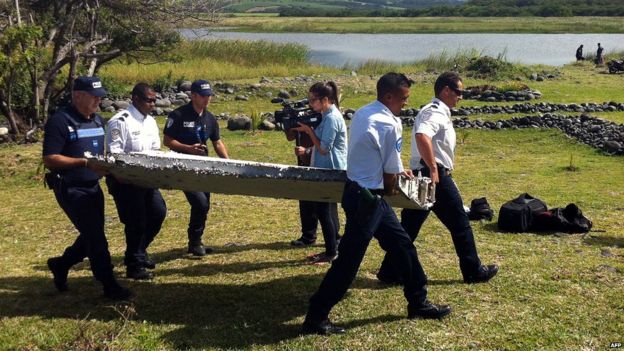
The foreign-made mineral water bottles caught his eye, more so following the discovery of an airline wing part that has been confirmed to be from a Boeing 777, the same model plane as MH370.
The plane carrying 239 people on board from Kuala Lumpur to Beijing disappeared off the radar on March 8, 2013, believed somewhere over the Indian Ocean; over 130 of the passengers were China nationals.
Creissen said he handed the bottles to the police, and was later told they had been passed to a Malaysian investigation team on the island.
The islander had snapped pictures of the bottles which he posted on Twitter account on Sunday which showed two common Malaysian bottled water brands — “Cactus Mineral Water” and “Life Pure Distilled Drinking Water”.
Questions have been raised over whether those debris found came from MH370 that went missing March 8, last year following the discovery of a wing piece of a plane on the French island of Réunion in the Indian Ocean last week.
Despite MH370 being the only Boeing 777 to be lost in the Indian Ocean, authorities have not confirmed the debris’ link to the missing aircraft.
The Republic is watching political developments in Malaysia closely, said Prime Minister Lee Hsien Loong, who expressed his hope that the country remains stable.
“When something happens which could cause either a political upset or social or security worries, I think we have to watch very carefully,” said Mr Lee today (July 31). He was interviewed by Ambassador-at-large Chan Heng Chee for A Conversation with the PM: Our Future, Our People, which is airing on Channel NewsAsia and Channel 5 on Sunday (Aug 2).
Professor Chan, who is also chairman of Lee Kuan Yew Centre For Innovative Cities at the Singapore University of Technology and Design, had asked Mr Lee whether the political developments in Malaysia would affect Singapore, and how.
Mr Lee noted that Malaysia is Singapore’s closest neighbour, not just geographically, but also linked by “very big trading ties and investments”.
“We have a lot of people who live and work in Malaysia, a lot of Malaysians work in Singapore…and so when something happens in Malaysia, we watch very carefully and are very concerned how it affects us,” he said.
Malaysia has been in a state of political turmoil of late, with Prime Minister Najib Razak under fire over some US$700 million allegedly funnelled from companies linked to state-owned firm 1Malaysia Development Bhd (1MDB) into his personal bank accounts. Earlier this week, he sacked his deputy Muhyiddin Yassi — who had called on Mr Najib to explain the scandal engulfing 1MDB — as well as four other ministers, and replaced the Attorney-General.
Mr Lee reiterated that Singapore has very good relations with Malaysia. “I personally have very good relations with Prime Minister Najib, so we hope that Malaysia will remain stable, that we will be able to have a Government there which we can do business with and cooperate with, as we have been doing the last few years,” he said.
Foreign Affairs and Law Minister K Shanmugam, who was separately responding to media queries on Malaysia’s recent developments, said when any two countries are as close as Malaysia and Singapore, they will want stability in each other.
“Malaysia and Singapore are linked by an umbilical cord…The total trade between Singapore and Malaysia is S$111 billion and we are amongst each other’s top trading partners and top investors,” said Mr Shanmugam, who reiterated that Singapore is following developments very closely.
He said: “Any instability in Malaysia will also deeply affect Singapore, both economically and in other ways. We depend on Malaysia for water everyday, protected by a treaty. You really don’t want any instability. We hope that there will be stability that is good for Malaysia and good for us.”
Malaysia has sent a team to the French Indian Ocean island of Reunion to determine whether debris which washed up there is from missing flight MH370.
The Malaysia Airlines Boeing 777 travelling from Kuala Lumpur to Beijing with 239 people on board vanished without trace in March 2014.
Aviation experts have said the debris looks like a wing component from a 777, known as a flaperon.
Malaysia Airlines said it would be “premature” to speculate on its origin.
There were 227 passengers on the flight, including 153 Chinese and 38 Malaysians.
“Whatever wreckage found needs to be further verified before we can further confirm whether it belongs to MH370,” Transport Minister Liow Tiong Lai told reporters in New York where he was attending a UN Security Council debate for a separate Malaysian jet shot down over Ukraine.
“So we have dispatched a team to investigate on this issues and we hope that we can identify it as soon as possible,” he said.
French air transport officials are also investigating the wreckage
The wife of the in-flight supervisor for the missing MH370 plane, Jacquita Gonzales, told the BBC that she is torn by the news.
“A part of me hopes that it is (MH370) so that I could have some closure and bury my husband properly but the other part of me says ‘no, no, no’ because there is still hope,” she told the BBC by phone.
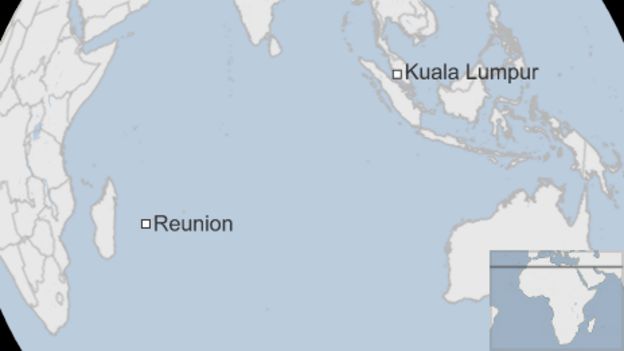
The two-metre-long (6ft) piece of wreckage washed up on the island, about 600km (370 miles) east of Madagascar, late on Wednesday.
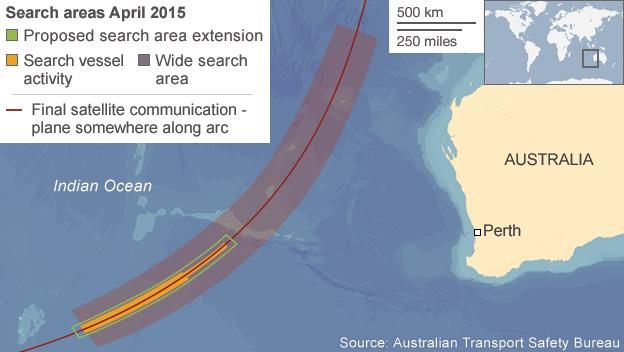
The search efforts for MH370, led by Australia, are focussed on a broad expanse of the southern Indian Ocean – some 6,000km to the east of Reunion, which is a French region.
There have been other plane crashes much closer to Reunion, but flight MH370 is the only Boeing 777 to have disappeared in the area.
Officials said in April that the search area would be doubled if nothing was found
An US official told the Associated Press news agency that, based on the photos, investigators had a “high degree of confidence” that the part was a flaperon unique to a Boeing 777 wing.
A flaperon is a part of the wing used to manage the lift and control the roll of an aircraft.
French authorities in Reunion are also investigating the debris and Australian investigators are reported to be in touch with manufacturers over the find.
In a statement, Australian Infrastructure Minister Warren Truss said that if the wreckage was identified as being from MH370, this “would be consistent with other analysis and modelling that the resting place of the aircraft is in the southern Indian Ocean”.
Any new evidence will be used to refine search efforts, the statement added.
Analysis: BBC’s transport correspondent Richard Westcott
Experts should be able to tell fairly quickly if this is a piece of MH370. Aircraft parts have individual serial numbers on them, and the airlines should have records of all those numbers.
So in theory, investigators could check them and give a positive or negative ID. If it is part of the aircraft, it’s washed up thousands of miles from where search teams continue to look for debris at the bottom of the sea.
And realistically, although it would confirm the aircraft crashed and broke up, a piece of wing is unlikely to reveal much more about what actually happened on board the plane.
But these are all big “ifs” right now. It could still be yet another false alarm.
The Australian-led search teams have been focusing on a 60,000 sq km (23,000 sq mile) area off the coast of Western Australia, where the plane is believed to have crashed.
Australian Transport Safety Bureau Chief Commissioner Martin Dolan, who heads the operation, told AP that even if the part was proven to be from MH370 it would not change the search area, as it was “entirely possible that something could have drifted from our current search area to that island”.
Confirmation the debris came from MH370 would also disprove theories that the airliner went missing somewhere in the northern hemisphere, Mr Dolan said.
Key moments in the search for MH370
8 March, 2014: Malaysia Airlines Flight MH370 departed from Kuala Lumpur International Airport on Saturday 8 March (16:41 GMT, 7 March), and was due to arrive in Beijing at 06:30 (22:30 GMT). Malaysia Airlines says the plane lost contact less than an hour after takeoff. No distress signal or message was sent.
20 March: Australian search teams say they are investigating two objects spotted on satellite images in the southern Indian Ocean and sent long-range surveillance planes to the area. The objects were later revealed not to be from MH370.
24 March: The Malaysian prime minister announces that following further analysis of satellite data it was beyond doubt that the plane had gone down in this part of the ocean.
28 March: The main search area was moved 1,100km (684 miles) to the north-east and closer to Australia, following further analysis of the speed of the plane and its maximum range.
5-8 April, Australian and Chinese vessels using underwater listening equipment detected ultrasonic signals, which officials believed could be from the plane’s “black box” flight recorders. The pings appeared to be the most promising lead so far, and were used to define the area of a sea-floor search.
29 May: Australian officials announced that the search had found nothing and the area where the signals were heard could be ruled out as the final resting place of the plane.
26 June: Officials announced a new 60,000 sq km search area some 1,800 km west of Perth. This phase of the operation started in August with detailed mapping of the sea bed.
16 April, 2015: Officials from Australia, Malaysia and China say the search area would be doubled if nothing is found in the current search zone.
History should judge former Prime Minister Tun Dr Mahathir Mohamad as being himself the author of a long national decline that has culminated in this latest crisis, wrote University of Chicago political science associate professor Dan Slater.
In a piece published in the EastAsiaForum today, Slater wrote that Malaysian Prime Minister Datuk Seri Najib Razak is right about one thing. “The current mess in Malaysian politics is the making of his greatest nemesis, Dr Mahathir, who led the Southeast Asian nation with an iron fist from 1981–2003.”
Slater wrote that Mahathir has not produced this mess by criticising (Najib’s) leadership, but by paving Najib’s path to power in the fashion he did during his decades in office.
“Dr Mahathir may believe that he can end the crisis by bringing Najib down… But this road toward ruin commenced with Dr Mahathir, not Najib.”
In outlining the events that led to the current crisis, Slater wrote: “Dr Mahathir was holding a winning hand when he became prime minister in 1981.
“Then came the debt. Obsessed with following in the footsteps of Asia’s technological leaders, Mahathir began borrowing heavily to fund his ‘Look East’, state-led heavy-industrialisation programme.
“Privatisation was part of his growth package, but the beneficiaries were businessmen of loyalty more than talent.
“When the global economy went into recession in the mid-1980s, patronage started drying up. Umno split, largely in reaction to Dr Mahathir’s strong-armed style of rule.
“Dr Mahathir’s two most talented rivals, Tengku Razaleigh (Hamzah) and Tun Musa Hitam, bolted from Umno despite their deep personal ties to the party, mostly to get away from Dr Mahathir himself.
“Dr Mahathir responded by launching a police operation under the pretext of racial tensions, imprisoning and intimidating political rivals, and cementing his autocratic control.
“Hence by the late 1980s, all of the defining features of Malaysia’s current crisis under Najib’s leadership were already evident under Dr Mahathir.
“Ethnic tensions had been reopened to political manipulation. The economy was worrisomely indebted. Umno was shedding some of its most capable leaders. This was the beginning of Malaysia’s sad national decline, under Dr Mahathir’s watch and at his own hand.”
These seeds were to play out towards the current crisis because of what Dr Mahathir did next, wrote Slater.
“Fast-forward a decade and all of these syndromes would recur in even nastier forms. The Asian financial crisis of 1997–98 punished Malaysia for the unsustainable dollar-denominated debts it had accumulated under Dr Mahathir’s single-minded push for breakneck growth.
“Dr Mahathir blamed everybody but himself for the crash. Dr Mahathir didn’t pull Malaysia out of its crisis with economic reform or adjustment, but with more and more borrowing and spending.
“Hence even before the turn of the millennium, Malaysia was hurtling down the very trajectory of decline we are witnessing in the current crisis.”
Slater also noted that Najib has taken a page out of Dr Mahathir’s playbook, when the latter was publicly criticised by then Deputy Prime Minister Datuk Seri Anwar Ibrahim.
“In consummate Dr Mahathir style, Najib has now even sacked his deputy Tan Sri Muyhiddin Yassin for questioning Najib’s repression of the media in response to the 1MDB scandal.
“In sum, Dr Mahathir has nobody to blame more than himself.”
It is so difficult to find a good cabinet nowadays.
The cabinet I now have is full of termites. Apparently it is made of plywood.. Despite looking stylish and sharp, when knocked, it sounds hollow. It sounds like a tin kosong.
I tried getting them renovated and visited a store called GE13. They offered various custom made compartments and were made of different types of wood. There were many options for the cabinet doors ─ metal, composite, laminate, and thermofoil. All good options, to be honest. I decided to give it a try and placed my order.
But for some reason, the order never came through. Maybe someone offered a better price for it. Sigh.
The truth is, they don’t make cabinets like they used to anymore like the cabinets we had back in my kampong. They were all made by my dad. He singlehandedly picked and chose every part of the cabinet. The workmanship was rough since dad was merely a hobby carpenter but he knew how to pick the woods and make the edges meet.
We’ve had those cabinets for more than 40 years now. The red meranti still stands firmly on my mom’s kitchen walls – slightly worn, but well kept. Even the paint is in good condition. And no matter how hard my crazy rough brother bangs the doors shut, not a single splinter comes off. The only thing that gets broken every now and then are the made in china door hinges.
But then again, the cabinets were made by a mamak – which explains its durability.
The truth is, when it comes to kitchen cabinets, you get what you pay for. There is the cheap plywood kind teeming with insects (like the one I have in my kitchen) of low durability but surprisingly sturdy and good looking.
Then you have laminates which are basically a thin layer of solid wood over an inner core of chipboard. The wood covering is deceiving, misleading and in the end the chipboard doesn’t last that long.
I don’t want that type of cabinets anymore. I need something solid. Something durable. Something with quality.
Seriously, I need to change the cabinets in my home. The IKEA ones look nice – quite pricey though, but nice nevertheless. However, I wonder if it can fulfil the real purpose of a cabinet.
You see, what I do know is that peddlers at furniture malls who want to sell me cabinets, try to distract me so that I forget the real function of a cabinet. Cabinets must serve a purpose and I know getting the wrong one means that the purpose is not achieved. On top of that you are left with a heck of a lot of trouble.
And I also know that a homeowner who keeps changing cabinets just for show should not be trusted completely. I mean, why would a homeowner change his/her cabinet(s) around Syawal? What is he/she trying to accomplish? Is he/she hiding some deep rot by refurbishing it with some good looking chipboard cabinet with an oak overlay?
Like I said, I hate my cabinet. Besides the termites eating away at the wood I paid for, I hate the fact that some of the doors which are made of dark shaded wood keep dark secrets. And I also hate that the old drawers in the cabinets don’t slide in easily. I think drawers should never fight with their master.
To be honest, I don’t think any amount of renovation or refurbishing or reshuffling can cover the unpleasantness of having this cabinet in my kitchen. It just needs to go. All of it.
I would really like to replace it with a nice, new, gleaming cabinet. Maybe one with transparent sides or a transparent glass door. One that will let some sun in so that everyone can see that it is not messy on the inside.
I want a cabinet with doors that don’t creak loudly every time they’re opened or shut.
I want a cabinet that doesn’t store candies and cookies in its’ recesses….hidden away from the kids.
And I want a cabinet with classy, durable, functional containers – not one screaming with red Tupperware and cheap plastic containers in pastel colours.
I guess I should start shopping for a good cabinet before it’s too late. As of now, one side of my cabinet is full of termites and the other side is also corrupted from absorbing too much water and dampness that didn’t belong in the cabinet in the first place.
Hopefully by 2018, I will get my cabinet replaced. Maybe with a meranti, maybe a jati. But definitely never a plywood or a chipboard ever again. I know it won’t be easy – good wood is hard to come by despite living in a tropical climate.
But then again, we must be willing to put in the effort if we want to enjoy having a good quality cabinet in the house.