Tag: authoritarian

  • Malaysia Sparks Anger After Banning Book Published In Singapore About Moderate Islam

    Malaysia Sparks Anger After Banning Book Published In Singapore About Moderate Islam

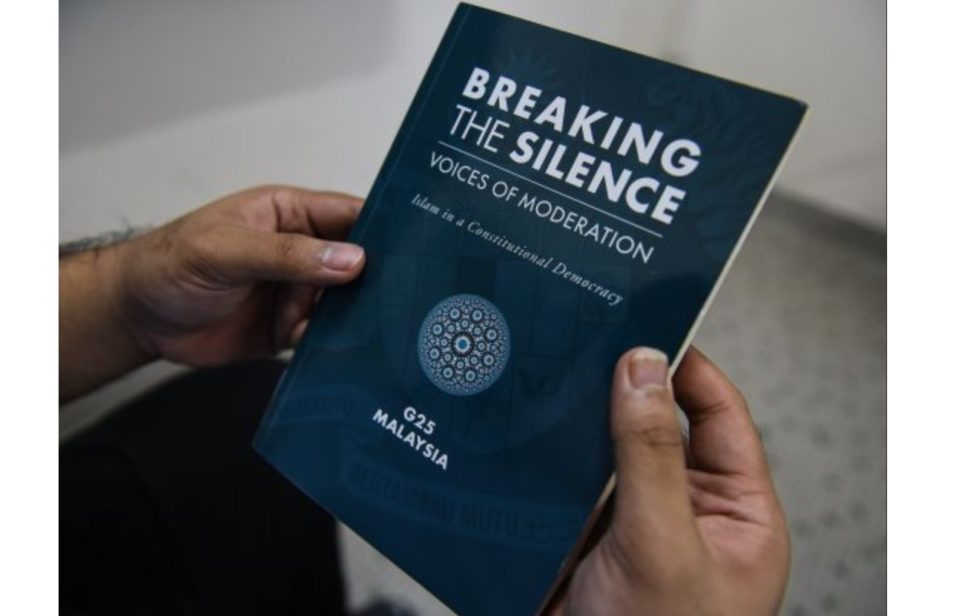
    Activists and authors in Muslim-majority Malaysia reacted with outrage Tuesday (Aug 2) after authorities banned a book aimed at promoting moderate Islam, as concerns mount about growing conservatism.

    The book, Breaking The Silence: Voices Of Moderation — Islam In A Constitutional Democracy, is a collection of essays whose publication was organised by a group of prominent Muslim Malaysians pushing a more tolerant form of Islam.

    The ban, signed by Deputy Prime Minister Ahmad Zahid Hamidi, said that printing or possessing the book was “likely to be prejudicial to public order” and “likely to alarm public opinion”.

    Anyone breaching the ban on the book — which was published in neighbouring Singapore — can be jailed for up to three years.

    Malaysia routinely bans books, movies and songs that may contain sensitive material regarding religion or sex, but critics say the government has been clamping down harder in recent times.

    The book was the brainchild of a group of high-ranking former civil servants and diplomats known as the “G25” — for the number of its founding members — which was formed to push back against intolerance, and some of the essays were written by its members.

    Mr Chandra Muzaffar, one of the authors featured in the collection, said the ban showed the government’s “authoritarian approach to Islam”.

    “It’s a collection of essays which is intended to show that extremists and bigoted thinking on matters pertaining to the practice of Islam in the country should be combated in an intellectual manner,” he told AFP.

    Ms Marina Mahathir, a rights activist and daughter of former long-serving premier Mahathir Mohamad, said the ban — signed last week — was aimed at silencing government critics.

    “It is about silencing anybody who has a different view,” she said.

    Critics say the government clampdown on anything deemed un-Islamic has accelerated in recent times as Prime Minister Najib Razak’s party seeks to appeal to its Muslim Malay base amid speculation elections could be called in the coming months.

    In July the hit song Despacito was banned on state TV and radio due to its racy lyrics after pressure from an Islamic political party.

    More than 60 per cent of Malaysia’s population of over 30 million are Muslim, but the country is also home to significant religious minorities.


    Source: http://www.todayonline.com/

  • Financial Times Claims Singapore Better Than Malaysia Despite Authoritarian Government

    Financial Times Claims Singapore Better Than Malaysia Despite Authoritarian Government

    A hard-hitting opinion piece by international business daily Financial Times (FT) has compared Singapore’s achievements with Malaysia’s, saying that despite the city-state’s tightly controlled society, its ruling party is largely appreciated by Singaporeans due to the success of its socio-economic policies.

    In comments on Singapore’s Golden Jubilee celebrations yesterday, which marked 50 years since it separation from Malaysia, FT said the difficulties faced by Singapore “paled in comparison with those in Malaysia”.

    “Not only is Malaysia going through its worst political crisis in years after hundreds of millions of dollars found their way into the bank accounts of (Datuk Seri) Najib Razak, the prime minister,” said FT, referring to allegations surrounding Najib in the 1Malaysia Development Berhad (1MDB) saga.

    “More critically, Malaysia has been undergoing a long-term meltdown in which the political, religious and ethnic compact that has underpinned the country since independence groans under its own rotten contradictions,” said the paper, noting that Singapore’s per capita gross domestic product is five times that of Malaysia’s.

    FT said Malaysia could learn from Singapore, adding that its fight against corruption should start with Najib coming clean on the 1MDB affair, or stepping down.

    Drawing comparisons between PAP and Umno, the two political parties which have dominated Singapore and Malaysia respectively since independence, FT said Singaporeans still regarded PAP as “honest and competent”, despite recent inroads by opposition parties in the republic.

    On the other hand, it said the Malaysian public “senses” that Umno has long fronted a corrupt system.

    But the paper acknowledged that both countries are vastly different in terms of demography, and that Singapore’s micromanagement style might not work for Malaysia.

    “Still, both countries have potentially combustible ethnic mixes. Singapore has done better at forging a sense of fairness and national unity, through language, meritocracy and incorruptibility.

    “Malaysia, in the name of protecting Malays through positive discrimination, has by contrast created a crony capitalist state,” said FT, calling for the dismantling of religion and race-based policies.


    Source: www.themalaysianinsider.com

  • The Singapore Exception

    The Singapore Exception

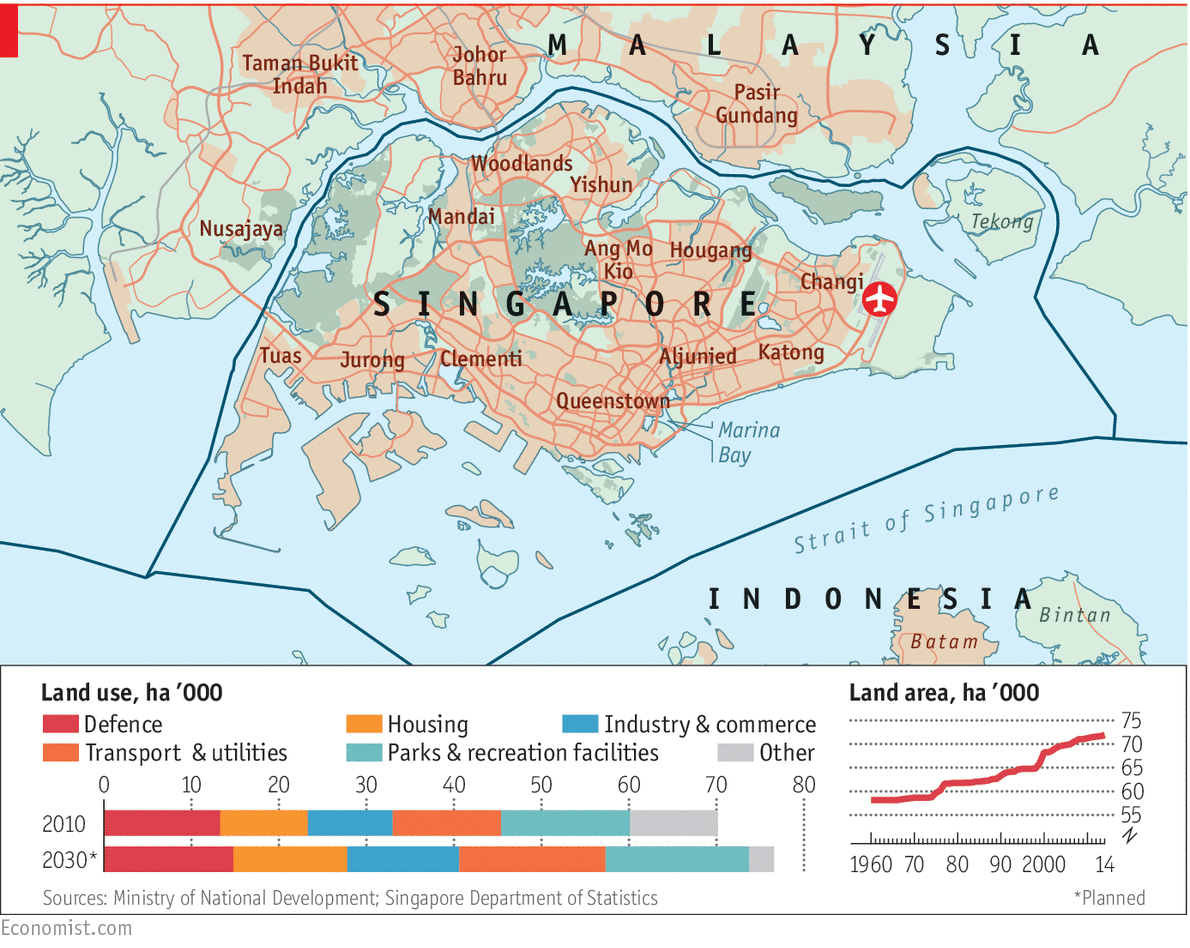
    AT 50, ACCORDING to George Orwell, everyone has the face he deserves. Singapore, which on August 9th marks its 50th anniversary as an independent country, can be proud of its youthful vigour. The view from the infinity pool on the roof of Marina Bay Sands, a three-towered hotel, casino and convention centre, is futuristic. A forest of skyscrapers glints in the sunlight, temples to globalisation bearing the names of some of its prophets—HSBC, UBS, Allianz, Citi. They tower over busy streets where, mostly, traffic flows smoothly. Below is the Marina Barrage, keeping the sea out of a reservoir built at the end of the Singapore River, which winds its way through what is left of the old colonial city centre. Into the distance stretch clusters of high-rise blocks, where most Singaporeans live. The sea teems with tankers, ferries and container ships. To the west is one of Asia’s busiest container ports and a huge refinery and petrochemical complex; on Singapore’s eastern tip, perhaps the world’s most efficient airport. But the vista remains surprisingly green. The government’s boast of making this “a city in a garden” does not seem so fanciful.

    Singapore is, to use a word its leaders favour, an “exceptional” place: the world’s only fully functioning city-state; a truly global hub for commerce, finance, shipping and travel; and the only one among the world’s richest countries never to have changed its ruling party. At a May Day rally this year, its prime minister, Lee Hsien Loong, asserted that “to survive you have to be exceptional.” This special report will examine different aspects of Singaporean exceptionalism and ask whether its survival really is under threat. It will argue that Singapore is well placed to thrive, but that in its second half-century it will face threats very different from those it confronted at its unplanned, accidental birth 50 years ago. They will require very different responses. The biggest danger Singapore faces may be complacency—the belief that policies that have proved so successful for so long can help it negotiate a new world.
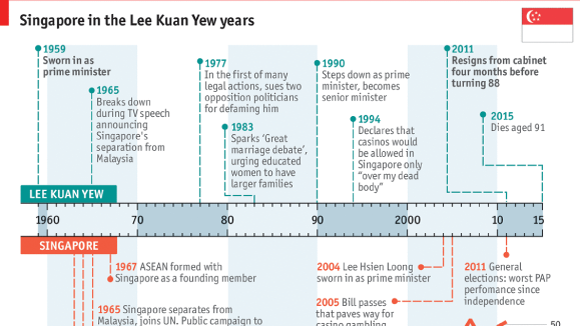
    In 1965 Singapore was forced to leave a short-lived federation with Malaysia, the country to its north, to which it is joined by a causeway and a bridge. Lee Kuan Yew, Lee Hsien Loong’s father, who became Singapore’s prime minister on its winning self-government from Britain in 1959, had always seen its future as part of Malaysia, leading his country into a federation with its neighbour in 1963. He had to lead it out again when Singapore was expelled in 1965. By then he had become convinced that Chinese-majority Singapore would always be at a disadvantage in a Malay-dominated polity.

    Mr Lee’s death in March this year, aged 91, drew tributes from around the world. But Mr Lee would have been prouder of the reaction in Singapore itself. Tens of thousands queued for hours in sultry heat or pouring rain to file past his casket in tribute. The turnout hinted at another miracle: that Singapore, a country that was never meant to be, made up of racially diverse immigrants—a Chinese majority (about 74%) with substantial minorities of Malays (13%) and Indians (9%)—had acquired a national identity. The crowds were not just mourning Mr Lee; they were celebrating an improbable patriotism.

    Lee Kuan Yew himself defined the Singapore exception. As prime minister until 1990, he built a political system in his image. In line with his maxim that “poetry is a luxury we cannot afford,” it was ruthlessly pragmatic, enabling him to rule almost as a (mostly) benevolent dictator. The colonial-era Internal Security Act helped crush opposition from the 1960s on. Parliament has been more of an echo-chamber than a check on executive power. No opposition candidate won a seat until 1981. The domestic press toes the government line; defamation suits have intimidated and sometimes bankrupted opposition politicians and hit the bottom line of the foreign press (including The Economist).
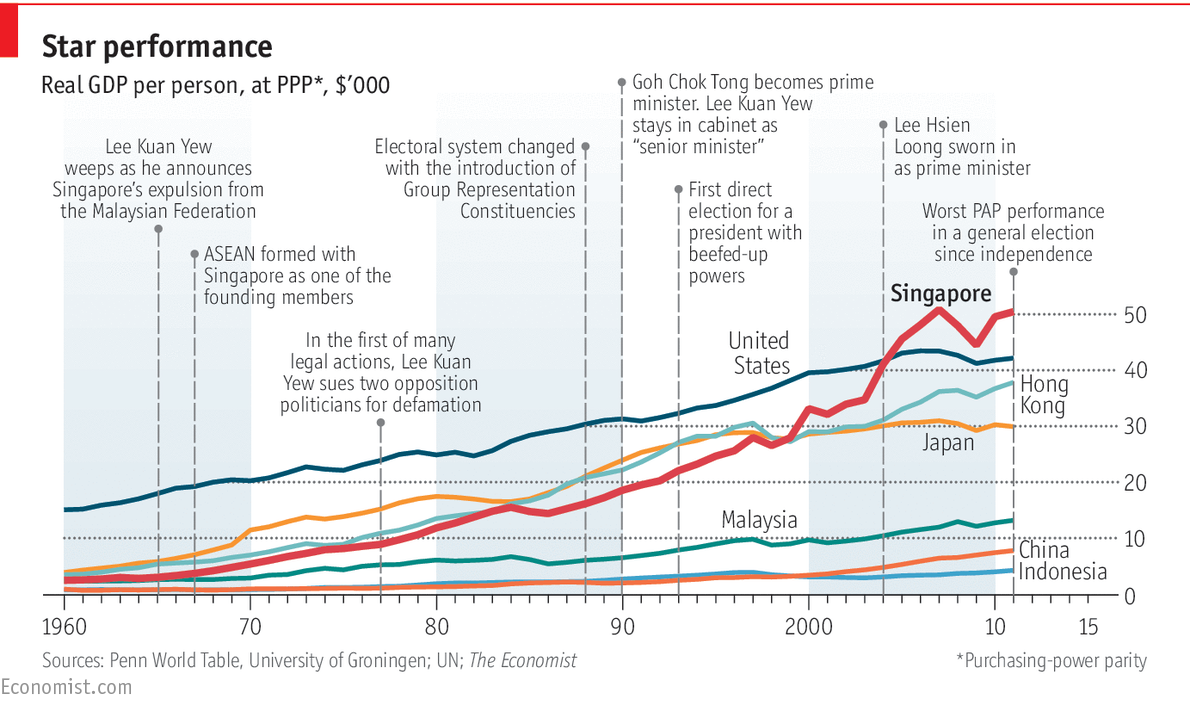
    Singapore, it is sometimes joked, is “Asia-lite”, at the geographical heart of the continent but without the chaos, the dirt, the undrinkable tap water and the gridlocked traffic. It has also been a “democracy-lite”, with all the forms of democratic competition but shorn of the unruly hubbub—and without the substance. Part of the “Singapore exception” is a system of one-party rule legitimised at the polls and, 56 years after Mr Lee’s People’s Action Party (PAP) took power, facing little immediate threat of losing it. The system has many defenders at home and abroad. Singapore has very little crime and virtually no official corruption. It ranks towards the top on most “human-development” indicators such as life expectancy, infant mortality and income per person. Its leaders hold themselves to high standards. But it is debatable whether the system Mr Lee built can survive in its present form.

    It faces two separate challenges. One is the lack of checks and balances in the shape of a strong political opposition. Under the influence of the incorruptible Lees and their colleagues, government remains clean, efficient and imaginative; but to ensure it stays that way, substantive democracy may be the best hope. Second, confidence in the PAP, as the most recent election in 2011 showed, has waned somewhat. The party has been damaged by two of its own successes. One is in education, where its much-admired schools, colleges and universities have produced a generation of highly educated, comfortably off global citizens who do not have much tolerance for the PAP’s mother-knows-best style of governance. In a jubilant annual rally to campaign for lesbian, gay, bisexual and transgender (LGBT) rights on June 13th, a crowd estimated at 28,000 showed its amused contempt for the illiberal social conservatism the PAP has enforced. Younger Singaporeans also chafe at censorship and are no longer so scared of the consequences of opposing the PAP.

    The PAP’s second success that has turned against it is a big rise in life expectancy, now among the world’s longest. This has swelled the numbers of the elderly, some of whom now feel that the PAP has broken a central promise it had made to them: that in return for being obliged to save a large part of their earnings, they would enjoy a carefree retirement. And it is not just old people who have begun to question PAP policies. Many Singaporeans are uncomfortable with a rapid influx of immigrants. These worries point to Singapore’s two biggest, and linked, problems: a shortage of space and a rapidly ageing population.


    Source: www.economist.com
  • Shisha Banned In SG From Today

    Shisha Banned In SG From Today

    Shisha will be banned in the Republic from Friday (Nov 28) via the publication of the Prohibited Tobacco Regulations made under Section 15 of the Tobacco (Control of Advertisements and Sale) Act, announced the Ministry of Health (MOH) on Thursday.

    As a transitional measure, existing licensed tobacco importers and retailers who import or sell shisha tobacco will be allowed to continue importing and retailing shisha tobacco until July 31, 2016, MOH said. This is to allow them ample time to deplete their stock and restructure their businesses away from shisha.

    Those who flout the ban could be fined up to S$10,000 or jailed for up to six months or both. Repeat offenders face a fine of up to S$20,000 and up to 12 months’ jail or both.

    Members of the public who have information on the import, distribution, sale or offer for sale of shisha tobacco by unlicensed operators can tip-off authorities via the reporting lines 66842036 or 66842037.

    Parlimentary Secretary for MOH Associate Professor Muhammad Faishal Ibrahim had earlier said in Parliament that in view of health risks associated with shisha smoking, and to prevent the proliferation and entrenchment of shisha smoking in Singapore, a ban would be effected at end-November.


    Source: www.channelnewasia.com

  • Is The PAP Government Being Selectively Pro-Family?

    Is The PAP Government Being Selectively Pro-Family?

    Kirsten Han is a Singaporean blogger, journalist and filmmaker. She is also involved in the We Believe in Second Chances campaign for the abolishment of the death penalty. A social media junkie, she tweets at @kixes. The views expressed are her own.

    Singapore, we are told, is a pro-family country. The government actively introduces policies that will encourage young Singaporeans to get married and have children, and nuclear families are often given benefits in the form of tax rebates and subsidies. 

    Yet there are sometimes stories that make you doubt that stance.

    The New Paper ran an article on 17 November about a family now torn apart: upon returning to Singapore and applying for a Long-Term Visit Pass, married couple Mr Y. C. Chen and Ms Li Qiaoyan realised that Ms Li had been served an entry ban. Her offence was not seeking permission from the Ministry of Manpower before getting pregnant and married. Ms Li is now back in China, while Mr Chen had to quit his job to care for their 10-month-old son.

    Under Singapore’s current rules, existing and former work permit holders are required to obtain permission from the state before marrying Singaporeans. According to The New Paper, the Ministry of Manpower says:

    “MOM reviews all marriage applications on a case-by-case basis. Factors taken into consideration include the economic contributions of the applicants, the ability of the applicants to look after themselves and their family without becoming a burden to the society or state.” 

    The New Paper also reported MOM’s position that “work-permit holders, as transient workers, ought to come to Singapore only for work”.

    There are 980,8000 work permit holders in Singapore. It’s impossible that these men and women are here “only for work”; they don’t just come here to serve us food, work in our construction sites and clean our homes. They come here with all their likes and dislikes, their hopes, dreams and desires. They’re people. It’s hardly surprising that they might meet someone and fall in love. 

    Yet the state doesn’t seem to see them as the multi-dimensional human beings they are. It expects them to serve, and only to serve. When they fall in love and want to get married or have children, they are expected to apply to Singapore for permission, even though it should be none of the state’s business who anyone chooses to marry. The state will then decide if the work permit holder is a worthy (read: economically viable) spouse for the Singaporean.

    This rule even applies to former work permit holders. Come to Singapore on a work permit and your desire to marry your partner – if he/she is a Singaporean – will always be dependent on special dispensation from the Controller of Work Passes.

    Such rules and requirements show us that the state is, perhaps, only pro-a-certain-type-of-family. If you’re a non-Singaporean, if your “economic contribution” is deemed wanting, then maybe your family is not so important after all.

    Source: https://sg.news.yahoo.com