Tag: bilateral ties

  • The Mighty Red Dot; Once Mocked Now A Source Of Pride For Singaporeans

    The Mighty Red Dot; Once Mocked Now A Source Of Pride For Singaporeans

    How is it that Singapore, once mocked as a mere “red dot” state by then president BJ Habibie, became the largest foreign investor, and sent the largest number of tourists to a much more “gigantic” Indonesia in 2016? The moral of the story is: Size alone does not always matter.

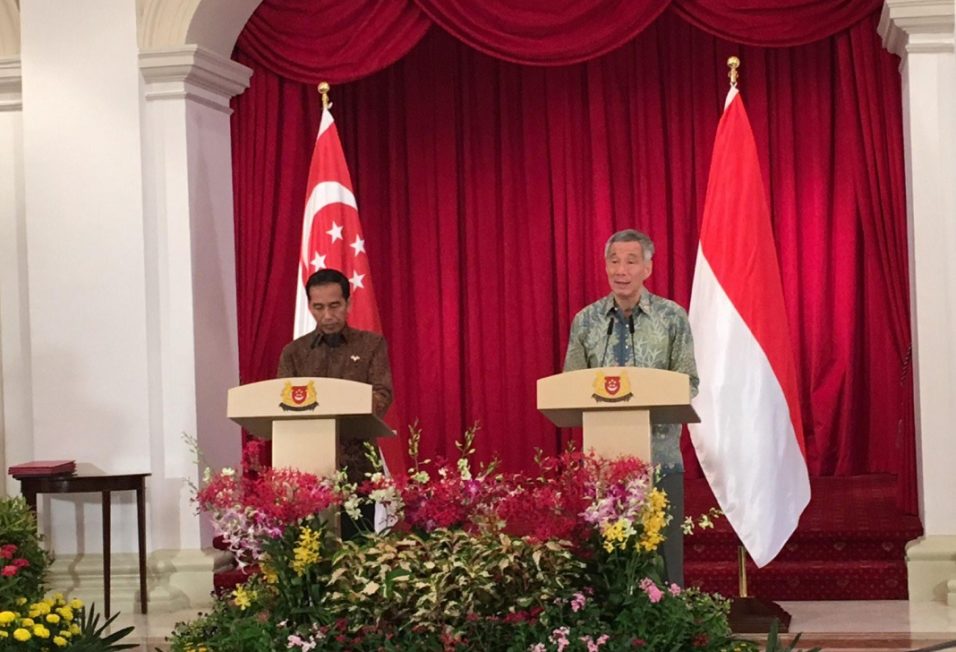
    In Thursday’s joint press conference with his guest President Joko “Jokowi” Widodo, Singaporean Prime Minister Lee Hsien Loong announced that his country invested US$9.2 billion in Indonesia last year. Indonesians, who have often blamed the city-state for harboring corruption suspects, may sneer that the investment value is just a “red dot” compared to the huge amount of money invested by corrupt Indonesians and unscrupulous conglomerates in Singapore.

    For many Singaporeans, the “red dot” mockery later became a source of pride because, despite their extremely small size, they became much more prosperous and advanced in nearly all aspects of life compared to their neighboring “big brother.”

    At the time he made his comment, Habibie was upset because, according to him, then prime minister Goh Chok Tong was very late in sending his congratulatory message on his appointment as Indonesia’s third president in May 1998.

    In an interview with the Asian Wall Street Journal, Habibie, who had just replaced Soeharto following his abrupt decision to end his nearly 32-year dictatorship, pointed to a map, and said, “It’s OK with me, but there are 211 million people [in Indonesia]. All the green [area] is Indonesia. And that red dot is Singapore.”

    Singapore denied Habibie’s allegation of belatedly congratulating Indonesia’s new president; but Singaporeans have since taken the phrase as their own, and it has become both a source of pride and an endless source of jokes to tease Indonesia and themselves.

    President Jokowi arrived in Singapore on Wednesday and attended a bilateral summit to commemorate the 50th anniversary of relations between the two countries. Two years after Singapore’s separation from Malaysia to become an independent republic in 1965, Singapore and Indonesia agreed to end military tensions between them.

    In the same year, the two countries, along with Thailand, the Philippines and Malaysia, established ASEAN. Soeharto is always remembered by Indonesia’s neighbors as a leader who created political security and stability in the region, letting them grow and progress together.

    There have always been ups and downs in relations between Indonesia and Singapore, especially after the fall of Soeharto. From the very beginning, Singapore always stood firm against its larger neighbors, including Indonesia — sometimes unnecessarily — while Indonesia is often tempted to show off its muscles to its smaller neighbor, but to no avail.

    PM Lee’s revelation about the investment is strong evidence that Singapore plays an important role in Indonesia’s economy, while Singapore also needs Indonesia’s market and resources. As a pragmatic leader, Jokowi knows very well how to conduct business with his counterpart, based on mutually beneficial relations. Neither Singapore nor Indonesia will ever tolerate bullying from their neighbor.

    Indonesia and Singapore have learned a lot in the last 50 years.


    Source: http://www.thejakartapost.com

  • New Zealand Defends UN Resolution Critical Of Israeli Settlements

    New Zealand Defends UN Resolution Critical Of Israeli Settlements

    WELLINGTON (AFP) – New Zealand said on Saturday (Dec 24) the United Nations Security Council resolution condemning Israeli settlements should have come as no surprise to the Jewish State, after Israel retaliated by recalling its ambassador to Wellington.

    New Zealand co-sponsored the resolution which described the settlements in the occupied territories as a major stumbling block to Middle East peace efforts, as they are built on land the Palestinians consider part of their future state.

    There was applause in the UN chamber when the first resolution by the United Nations Security Council (UNSC) in more than 38 years to condemn Israel over its settlement policy was passed 14-0, with the country’s key ally the United States abstaining.

    Israel refused to recognise the resolution with Prime Minister Benjamin Netanyahu’s spokesman Ofir Gendelman tweeting that their ambassadors to New Zealand and Senegal, who co-sponsored the resolution, were to return to Israel immediately.

    “These steps are taken against countries that have tabled the draft resolution to the UNSC and have diplomatic relations with Israel,” he said.

    New Zealand Foreign Minister Murray McCully said the decision should have been no surprise to Israel which knew Wellington’s position long before the UN vote.

    “Israel has informed us of their decision to recall their ambassador to New Zealand for consultations,” McCully told AFP in a statement.

    “We have been very open about our view that the (Security Council) should be doing more to support the Middle East peace process and the position we adopted today is totally in line with our long established policy on the Palestinian question.

    “The vote today should not come as a surprise to anyone and we look forward to continuing to engage constructively with all parties on this issue.”

    The resolution demands that “Israel immediately and completely cease all settlement activities in the occupied Palestinian territory, including East Jerusalem.” It states that Israeli settlements have “no legal validity” and are “dangerously imperilling the viability of the two-state solution”.

    Netanyahu’s office described the UN move as a “shameful anti-Israel resolution”.

    Malaysia and Venezuela also sponsored the UN resolution but do not have diplomatic relations with Israel.

    New Zealand is one of 10 non-permanent members of the UNSC, whose two-year term ends this month.


    Source: www.straitstimes.com

  • Singapore Can Re-enter Federation of Malaysia to Dilute Malay Race

    malaysia-and-singapore-flags

    Credit: Reuters
    Credit: Reuters

    KUALA LUMPUR: Bumiputera must unite under Umno to stem the rise of opposition party DAP, an Utusan Malaysia columnist wrote today, warning that Singapore could still possibly re-enter the Federation of Malaysia to dilute the community’s majority among the races.

    Cautioning the Malay youth not to be sold on the notions of liberalism espoused by the opposition, Datuk Ahmad Faris Abdul Halim said the country’s largest ethnic group was not certain to always maintain its numerical superiority over the other races.

    He claimed that Article 2(A) of the Federal Constitution allows the inclusion of new states into the federation with a two-third majority vote in Parliament, which he said could open the door for Singapore to re-join the federation that expelled in 1965.

    “If this happens — bolstered by the recent statement by Singapore’s founding father Lee Kuan Yew who repeatedly said it was not impossible for Singapore to re-unite with Malaysia under certain conditions — then imagine the ‘implications’ of Singapore with its 87 parliamentary seats,” he said.

    “Therefore, Singapore’s 87 seats included into our country’s 222 parliamentary seats. What would happen to the Malays?”

    Ahmad Faris said this would be the easiest way for a combination of DAP and Singapore’s ruling PAP to dominate the opposition bench here, given the former party’s existing 38 federal seats.

    He also alluded to the increasing dissent from the country’s non-Bumiputera community towards Article 153 of the Constitution and contention against Islam’s position as the religion of the federation.

    Article 153 specifies preferential quotas for the Bumiputera community in the areas of scholarship, education, and civil service.

    He also alleged that the non-Malay community were so strong in their racial culture that they have managed to control nearly 68 per cent of the country’s riches, but he did not elaborate what he meant by the “riches” nor did he state how culture facilitate this purported domination.

    The self-described current issues analyst then said the entire Bumiputera community should unite together with Umno — even if they did not all share the same religion — to demand for their rights as prescribed under Article 153, saying this would cow others from making claims on these.

    Umno, in turn, must adopt the tough measures introduced under former Prime Minister Tun Dr Mahathir Mohamad, and take the lead in defending Islam, the monarchy, and the Malays.

    Singapore joined Malaya, Sabah and Sarawak in 1963 to form what is now known as the Federation of Malaysia, but was expelled in 1965 after a tumultuous period that witnessed large scale race riots in the republic the year before.

    In Election 2013, the ruling Barisan Nasional (BN) suffered its worst electoral performance when it managed to win 133 spots in the 222-seat Parliament and lost the popular vote to the opposition Pakatan Rakyat pact.

    Although the rest of BN lost further ground from the previous nadir of Election 2008, Umno grew more dominant as a result of the backing it received from the mostly-Malay rural areas of the country.

    Since then, the party has come under increasing pressure to reward the community and ensure its continued support as the bedrock for the party’s revival or survival in the next general election.

    Source: http://www.themalaymailonline.com/malaysia/article/singapore-could-rejoin-malaysia-to-dilute-malay-rule-utusan-columnist-claim

    letters to R1C banner


    YOUTUBE: youtube.com/user/rilek1corner

    FACEBOOK: facebook.com/rilek1corner

    TWITTER: twitter.com/Rilek1Corner

    WEBSITE: rilek1corner.com

    EMAIL: [email protected]

    FEEDBACK: rilek1corner.com/hubungir1c/

  • Malaysian Commando Intrusion Into Singapore Missile Complex?

    commando_69_malaysia_1

    THE STALLED WATER TALKS BETWEEN Malaysia and Singapore can now restart only with a meeting of the two Prime Ministers. The two negotiating teams cannot overcome the impasse, for one does not understand the other and the other only too well. For the talks to resume, Singapore must ask for it. But she would not without some guarantees from Malaysia. Singapore botched the talks, in the Malay mind, when she revealed confidential documents in an unresolved issue. And proved she would in future in a regional dispute when she published confidential correspondence between Singapore and Indonesia over trade statistics. Singapore insists the letter of the law must be honoured.

    Malaysia has now released a series of advertisements putting her case public for Singapore to rebut when, if, talks resume. The National Economic Action Council (NEAC) placed the advertisements but behind it is the Prime Minister, Dato’ Seri Mahathir Mohamed’s deft hand. It is brilliant. It tells Singapore what she must resolve before an amicable settlement. It is also pointless. Malaysia need not have to make its case public. For Singapore is painted into a corner. It is all but impossible for the talks to resume until the two Prime Ministers, Dr Mahathir and Mr Goh Chok Tong, meet in Putra Jaya. Both Malaysia and Singapore know this. But Dr Mahathir is on his way out, and it would be Dato’ Seri Abdullah Ahmad Badawi, who would in his place. Would Singapore allow it or send in the deputy prime minister instead? More than the water talks, Dr Mahathir has raised the spectre of, to use the current buzz-word, regime change in Singapore.

    Singapore ignores the historical past. Why did Malaya, as she then was, agree to three cents (the sen came later) per 1,000 gallons in the agreements of 1961 and 1962? Johore had wanted a far higher price, but Singapore was making its case to join Malaysia, and the then Prime Minister, Tengku Abdul Rahman Putra, decided that since the two states would be in the newly formed Malaysia, there was no need for the island state to pay too high a price. But Singapore left the Malaysian federation two years later in 1965. The agreement provides for a review after 25 years, and when the purchasing value of the dollar declines. Singapore does not accept this. She did not in 1986 and 1987, and that was unravelled only when the then Singapore prime minister, Mr Lee Kuan Yew, came to pay, in the Malay mind, homage to Dr Mahathir. That is how it is view here. Nothing can erase that.

    Singapore goes for broke in talks when there is political uncertainty in Malaysia. In 1986 and 1987, Dr Mahathir was fighting for his political life. UMNO had been declared an unlawful political organisation by the courts, and few concentrated their attention on the water talks. It is an issue now when there would be a new Prime Minister of Malaysia in three months. And stumbled in both because the Malays close ranks when there is an external threat like this, when an outsider tries to take advantage of internal mayhem. If anything, the new Prime Minister, Dato’ Seri Abdullah, must, indeed would, be unbendable in the water talks.

    Malaysia has over the years created an efficient smokescreen with a number of pointless issues, which Singapore saw as proof of Kuala Lumpur’s perfidy. The second bridge, the needless quarrel over the CIQ, the railway land, and others were brought out for the end game. At first I wondered why but it was a deliberate plan of Dr Mahathir’s to seize the advantage in Malaysia’s favour. He has. It would not be easy for Singapore under his successor, or the successor of his successor, to reach agreement without the two prime ministers meeting.

    In the next stage in the talks, over raising the price Singapore pays for water, a similar deadlock has occurred: the Singaporeans insist on its pound of flesh and it is not agreed presses for a public humiliation of Malaysia. All that matters in Singapore is the present, devoid of the historical past, framed in graphs and pie charts. And she cannot understand a Malaysia, for all its commitment to a technological future, is still mired in a cultural and religious mindset. In Malaysia, there is an acceptance that nations, no matter how powerful, blunder through, and that must be taken into account in every matter. Especially in talks.

    Singapore does not understand or accept this. Which is why a think tank in the republic holds a seminar next month on the Malay mind, with two prominent Malaysians, neither Malay, leading it in an attempt find an instant answer. Could cultural forms be understood and learnt at seminars like this if the national mood is to drag the other side’s nose to the ground? When Singapore positions itself, with Israeli help, as a Chinese island in a hostile Malay sea, as Israel in the Middle East, and believes its military might could flatten its neighbours armed might at the onset of hostilities, and conducts its talks with its neighbours as it does, is it not inevitable that many in Malaysia believe that this issue must result in open hostilities? Especially when it was Singapore that began the military arms race with Malaysia when she bought tanks in the late 1960s. And continue to taunt the Malaysian armed forces by her military aircraft straying deep into Trengganu and Kelantan and back into international waters when the RMAF jets scramble from Kuantan.

    Malaysia has quietly shown Singapore over how weak her security is. She has slapped the Singapore armed forces in ways that caused it to come unstuck. The most dramatic was when its commandos invaded its high security air missiles base in Bukit Batok overlooking the Straits of Johore and pasted Malaysian stamps on the missiles and replaced the Singapore flag on the commanding officer’s table with the Malaysian flag. Several Singapore officers resigned or were reassigned or demoted. The major who carried it out, who is known by his nickname, Sam, is still around and in the business.

    Malaysia believes this tough talk on water is to force the issue to be resolved on the battlefield. A book on Singapore’s armed forces suggest it as a way of reinforcing its own security and ensuring the republic gets all the water she needs. When Jordan said she would divert a river from the Lake Galilee for agricultura, Israel warned Amman that would be a cause for war. Malaysian defence planners say that its armoury is outclassed by Singapore’s. But the Malaysian fighting machine after the war is not. Besides, neither Israel nor the United States would rush to Singapore’s aid should hostilities break out. Not after the quagmire of one in the Middle East and engaging another Muslim nation of the other. As one military planner asked: “Would Singapore cut its nose to spite Malaysia’s face? For should war break out. Singapore would be destroyed no matter what happens. Is that the brinkmanship it displays?” The talks are preferable, but it is Singapore which must ask for it.

    Source: http://militaryofmalaysia.net/2008/12/komando-malaysia-intrusion-into-singapore-missile-complex/


    EDITOR’S NOTE

    Sometimes, we cannot help but wonder why our neighbours are so mean to this tiny island when we have been very helpful and friendly. Just look at what we did for the Malaysians during the MH370 plane disappearance. We were the first few countries to help. That’s what neighbours are for, we look out for each other.

    This sounds like a nice ‘scary story telling’ session by the Malaysians. But Singaporeans should not take this ‘story’ lightly.

    Hope MINDEF can clarify this matter. This is very serious.


    letters to R1C banner