Tag: Buddhist

  • Thailand Chasing Halal Gold With Tourism And Food

    Thailand Chasing Halal Gold With Tourism And Food

    The ceremony is one of dozens of marriages held over the last few months at the Al Meroz – the city’s first entirely halal hotel.

    Thailand has long been a draw for the world’s sun-seekers and hedonists, drawn to its parties, red-light districts, cheap booze and tropical beaches.

    But it has also seen a huge influx of visitors from Muslim countries, part of a quiet but deliberate strategy by the Southeast Asian nation to diversify its visitor profile.

    “Considering there are 1.5 billion Muslims around the world, I think this is a very good market,” explains Sanya Saenboon, the general manager of the hotel, one of a growing number of businesses serving a boom in Islamic tourists.

    The hotel opened its doors last year, setting itself apart with its attention to all things Islamic.

    For a start there is no alcohol on sale, while the top floor swimming pool and gym has specific times for when men and women can use the facilities.

    Everything in the building has been ticked off against a stringent checklist for practising Muslims, from bed linen washed in a particular way, to ensuring toiletries are free of alcohol or animal fat – making everyday goods “permissible” for the faithful.

    Sanya, who is Muslim, says such checks give visitors “peace of mind” so clients never have to ask themselves “can I eat this?”

    Sanya Saenboon, general manager of the Al Meroz hotel. (Photo: AFP/Robert Schmidt)

    “AHEAD OF THE CURVE”

    Despite a decade of political turbulence, Thailand has seen an explosion in tourist arrivals, from 13.8 million annual visitors in 2006 to a record 32.5 million last year.

    Western arrivals have largely remained a constant. The biggest increase in arrivals comes from China, skyrocketing from just 949,000 arrivals 10 years ago to 8.7 million visitors in 2016.

    But Muslim countries are also sending their citizens.

    An AFP analysis of government figures shows visitors from key majority Muslim nations in the Middle East and Asia have risen from 2.63 million in 2006 to 6.03 million last year.

    “Thailand was ahead of the curve,” says Fazal Baharden, founder of the Singapore-based Crescent Rating, which rates which countries are most welcoming to Muslim travellers.

    Thailand routinely places in the top two for non-Muslim majority nations alongside Singapore in Crescent Ratings’ annual survey of halal destinations.

    “They’ve really recognised the Muslim consumer market is worth tapping into,” he explains, adding medical tourism, shopping and high quality hotels are the primary draws.

    Baharden says the Islamic travel market is one of the world’s fastest-growing, thanks to the growth of cheap flights and booming Muslim middle classes.

    He estimates the number of Muslim travellers has surged from around 25 million a year in 2000 to 117 million in 2015.

    But it is not just at home that Thailand has gone halal.

    FOOD GETS HALAL MAKEOVER

    From chicken and seafood to rice and canned fruit, the country has long been one of the world’s great food exporters.

    Now a growing numbers of food companies are switching to halal to widen their customer base.

    Against a backdrop of humming machines churning out butter, Lalana Thiranusornkij, a Buddhist, explains how her family turned their three factories – under the KCG Corp banner – halal to access markets in Indonesia, Malaysia and in the Gulf.

    But going halal sometimes required some clever workarounds, such as how to avoid animal-based gelatin to make jelly.

    “In the past we used gelatin from pork but … we changed our gelatin from the pork source to be from a seaweed source,” she said.

    Thailand’s junta has set the goal of turning the country into one of the world’s top five halal exporting nations by 2020.

    Some outsiders might be surprised to see an overwhelmingly Buddhist nation embrace halal.

    But Dr Winai Dahlan, founder of the Halal Science Centre at Bangkok’s Chulalongkorn University, says Thailand was well-placed to make the change.

    Five per cent of its population is Muslim and – outside of the insurgency plagued southern border region – is well-integrated within the Buddhist majority.

    It was local Thai Muslims who first began asking for the country’s halal testing centre, a business that scours products for any banned substances and has since boomed.

    A Thai lab technician tests halal products at the Halal Science Centre at Chulalongkorn University in Bangkok. (Photo: AFP/Roberto Schmidt)

    “Fifteen years ago there was only 500 food plants that had halal certification. Now it’s 6,000,” Winai told AFP as female lab technicians in headscarves tested food products for traces of pork DNA.

    Over the same period the number of halal certified products made in Thailand has gone from 10,000 to 160,000, he added.

    It’s paid off. The government estimates the halal food industry is already worth $6 billion a year.

    As Thailand has quickly learned, there’s gold at the end of the halal rainbow.


    Source: www.channelnewsasia.com

  • Anti-Rohingya Protests Greet Malaysia Rohingya Aid Ship

    Anti-Rohingya Protests Greet Malaysia Rohingya Aid Ship

    A Malaysian ship carrying aid for thousands of Rohingya Muslims who have fled a bloody army crackdown arrived in Yangon Thursday, where it was met by nationalist protesters.

    Health workers and activists crowded onto the deck of the Nautical Aliya as it docked at Thilawa port near Myanmar’s commercial capital carrying food, medical aid and clothing.

    Myanmar’s social welfare minister was among a delegation meeting the ship, which has been at the centre of a rare diplomatic spat with fellow ASEAN member Malaysia.

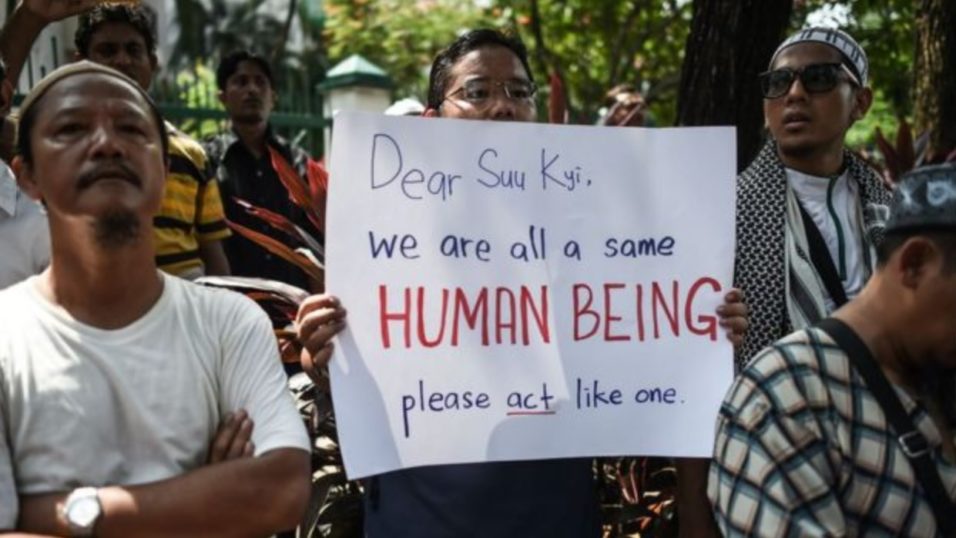
    Outside the docking area, dozens of Buddhist monks and demonstrators waited waving national flags and signs reading: “No Rohingya.”

    “We want to let them know that we have no Rohingya here,” a Buddhist monk named Thuseitta, from the Yangon chapter of the Patriotic Myanmar Monks Union, told AFP at the docks.

    Myanmar denies citizenship to the million-strong Rohingya, despite many of them living on its soil for generations.

    Buddhist nationalist groups are especially strong in their vitriol, rejecting them as illegal immigrants from Bangladesh.

    Hundreds of Rohingya are thought to have been killed in a brutal campaign launched by security forces in October, which the United Nations says may amount to ethnic cleansing.

    Tens of thousands have fled to neighbouring Bangladesh, bringing harrowing tales of murder and rape.

    Myanmar’s treatment of the Rohingya has sparked criticism from Muslim-majority Malaysia, in a rare spat between Southeast Asian neighbours.

    Myanmar initially refused to allow the ship into its waters and has barred it from sailing to Rakhine’s state capital Sittwe.

    Part of the aid will instead be unloaded in Yangon and transported overland to the north of Rakhine state, site of the military crackdown.

    The rest will be taken to Teknaf port in southern Bangladesh, where almost 70,000 Rohingya have fled since October to escape the violence.

    The government has also demanded that the aid be distributed to both Rohingya and Buddhist ethnic Rakhines.

    The delivery comes days after a blistering report from the UN accused Myanmar’s security forces of carrying out a campaign of rape, torture and mass killings against the Rohingya.

    Based on interviews with hundreds of escapees in Bangladesh, investigators said the military’s “calculated policy of terror” very likely amounted to ethnic cleansing.

    For months Myanmar has dismissed similar testimony gathered by foreign media and rights groups as “fake news” and curtailed access to the region.

    The UN’s top official on preventing genocide, Adama Dieng, said this week that a government commission tasked with investigating allegations of abuse was “not a credible option”.

    Critics have rejected the state-appointed body, which is led by retired general and Vice President Myint Swe and includes no Muslims, as toothless and biased.

    In a meeting on Wednesday Myint Swe admitted that “among the facts and accusations included in the (UN) report, there may be something special to be investigated,” state media reported.

    Source: https://sg.news.yahoo.com

  • ‘There Are No Homes Left’: Rohingya Tell Of Rape, Fire And Death in Myanmar

    ‘There Are No Homes Left’: Rohingya Tell Of Rape, Fire And Death in Myanmar

    When the Myanmar military closed in on the village of Pwint Phyu Chaung, everyone had a few seconds to make a choice.

    Noor Ankis, 25, chose to remain in her house, where she was told to kneel to be beaten, she said, until soldiers led her to the place where women were raped. Rashida Begum, 22, chose to plunge with her three children into a deep, swift-running creek, only to watch as her baby daughter slipped from her grasp.

    Sufayat Ullah, 20, also chose the creek. He stayed in the water for two days and finally emerged to find that soldiers had set his family home on fire, leaving his mother, father and two brothers to asphyxiate inside.

    These accounts and others, given over the last few days by refugees who fled Myanmar and are now living in Bangladesh, shed light on the violence that has unfolded in Myanmar in recent months as security forces there carry out a brutal counterinsurgency campaign.

    Their stories, though impossible to confirm independently, generally align with reports by human rights organizations that the military entered villages in northern Rakhine State shooting at random, set houses on fire with rocket launchers, and systematically raped girls and women. At least 1,500 homes were razed, according to an analysis of satellite images by Human Rights Watch.

    The campaign, which has moved south in recent weeks, seems likely to continue until Myanmar’s government is satisfied that it has fully disarmed the militancy that has arisen among the Rohingya, a Muslim ethnic group that has been persecuted for decades in majority-Buddhist Myanmar.

    “There is a risk that we haven’t seen the worst of this yet,” said Matthew Smith of Fortify Rights, a nongovernmental organization focusing on human rights in Southeast Asia. “We’re not sure what the state security forces will do next, but we do know attacks on civilians are continuing.”

    A commission appointed by Myanmar’s government last week denied allegations that its military was committing genocide in the villages, which have been closed to Western journalists and human rights investigators. Officials have said Rohingya forces are setting fire to their own houses and have denied most charges of human rights abuses, with the exception of a beating that was captured on video. Myanmar’s leader, Daw Aung San Suu Kyi, the recipient of a Nobel Peace Prize, has been criticized for failing to respond more forcefully to the violence.

    The military campaign, which the government describes as a “clearing” operation, has largely targeted civilians, human rights groups say. It has sent an estimated 65,000 Rohingya fleeing across the border to Bangladesh, according to the International Organization for Migration.

    “They started coming in like the tide,” said Dudu Miah, a Rohingya refugee who is chairman of the management committee at the Leda refugee camp, near the border with Myanmar. “They were acting crazy. They were a mess. They were saying, ‘They’ve killed my father, they’ve killed my mother, they’ve beaten me up.’ They were in disarray.”

    Soldiers were attacking villages just across the Naf River, which separates Myanmar from Bangladesh, so close that Bangladeshis could see columns of smoke rise from burning villages on the other side, said Nazir Ahmed, the imam of a mosque that caters to Rohingyas.

    He said it was true that some Rohingya, enraged by years of mistreatment by Myanmar forces, had organized themselves into a crude militant force, but that Myanmar had dramatically exaggerated its proportions and seriousness.

    Rohingyas are “frustrated, and they are picking up sticks and making a call to defend themselves,” he said. “Now, if they find a farmer who has a machete at home, they say, ‘You are engaged in terrorism.’”

    An analysis released last month by the International Crisis Group took a serious view of the new militant group, which it says is financed and organized by Rohingya émigrés in Saudi Arabia. Further violence, it warned, could accelerate radicalization among the Rohingya, who could become willing instruments of transnational jihadist groups.

    Muhammad Shafiq, who is in his mid-20s, said he was at home with his family when he heard gunfire. Soldiers in camouflage banged on the door, then shot at it, he said. When he let them in, he said, “they took the women away, and lined up the men.”

    Mr. Shafiq said that when a soldier grabbed his sister’s hand, he lunged at him, fearful the soldier intended to rape her, and was beaten so severely that the soldiers left him for dead. Later, he bolted with one of his children and was grazed by a soldier’s bullet on his elbow. He crawled for an hour on his hands and knees through a rice field, then watched, from a safe vantage point, as troops set fire to what remained of Kyet Yoepin.

    “There are no homes left,” he said. “Everything is burned.”

    Jannatul Mawa, 25, who is from the same village, said she crawled toward the next village overnight, passing the shadowy forms of dead and wounded neighbors.

    “Some were shot, some were killed with a blade,” she said. “Wherever they could find people, they were killing them.”

    Dozens more families are from Pwint Phyu Chaung, which was near the site of a clash between militants and soldiers on Nov. 12.

    According to Amnesty International, the militants scattered into neighboring villages. When army troops followed them, several hundred men from Pwint Phyu Chaung resisted, using crude weapons like farm implements and knives, the report said. A Myanmar army lieutenant colonel was shot dead, and the troops called in air support from two attack helicopters.

    Mumtaz Begum, 40, said she was awakened at dawn when security forces approached the village from both sides and began searching for adult men in each house.

    She said she and her daughter were told to kneel down outside their home with their hands over their heads and were beaten with bamboo clubs.

    She said her 10-year-old son was shot through the leg, her daughter’s husband was arrested, and her own husband was one of dozens of men and boys in the village who were killed by soldiers armed with guns or machetes that night. Villagers, she said, “laid the bodies down in a line in the mosque and counted them.”

    Ms. Begum’s daughter, Noor Ankis, 25, said the next morning soldiers went from house to house looking for young women.

    “They grouped the women together and brought them to one place,” she said. “The ones they liked they raped. It was just the girls and the military, no one else was there.”

    She said the idea of trying to escape flickered through her head, but she was overcome by fatalism. “I felt there was no point in being alive,” she said.

    Ms. Ankis pulled her head scarf low, for a moment, removing a tear. She said she had been thinking about her husband.

    “I think about how he took care of me after we got married,” she said. “How will I see him again?”

    Sufayat Ullah, 20, a madrasa student, said that he was home with his family on the morning of the attack and that the first thing he registered was the sound of gunfire. He realized quickly, he said, that he could only survive by escaping. “When they found people close by, they attacked them with machetes,” he said. “If they were far away, they shot them.”

    Mr. Ullah ran from the house and bolted for the creek at the edge of town, and he dived in, swimming as far as he could. He said he spent much of the next two days underwater, finally scrambling onto the bank near a neighboring village. Only then did he learn that his mother, father and two brothers had burned to death inside the family house.

    “I feel no peace,” he said, covering his face with his hands and weeping. “They killed my father and mother. What is left for me in this world?”

    Source: nytimes

  • Commentary: Inter-Racial Marriages Nothing Special, Until I Met Those Facing Challenges

    Commentary: Inter-Racial Marriages Nothing Special, Until I Met Those Facing Challenges

    My own inter-ethnic relationship has been obstacle-free, writes Kane Cunico, but a documentary on mixed marriages has spurred others to share with me the struggles they face in gaining acceptance.


    SINGAPORE: Sàam gu ma, sei gu ma, baat gu che, sahp suk – Cantonese words I would have never imagined myself learning by heart, had I not married my ethnically Chinese wife whose dad’s side of the family is from Ipoh, Malaysia.

    Respectively, they mean this:

    Sàam gu ma: My father-in-law’s third oldest sister.

    Sei gu ma: My father-in-law’s fourth oldest sister.

    Baat gu je: The eighth sibling in the family and my father-in-law’s younger sister.

    Sahp suk:  The tenth sibling and my father-in-law’s younger brother.

    In my Indian-Eurasian household, which feels neither very Indian nor very Eurasian, we just call them aunty (insert name) and uncle (insert name).

    I have always been indifferent to my cultural roots, flippant to a point. I wouldn’t consider myself religious, but I am constantly open and curious about other people’s heritage.

    The same goes for my wife, who identifies herself as a third-culture kid.

    We both were fortunate to have parents who were willing to break their own cultural and religious traditions for their children, and compromise on a wedding that made everyone happy. Even while dating, race or religion never became an issue. I would call us rather happy-go-lucky.

    But the recent On The Red Dot series, Love Is (Colour) Blind, prompted me to reflect on just how lucky perhaps we were. The documentary profiled three mixed-race couples who spoke about the ups and downs of their relationships, from gaining family acceptance to bringing up their mixed-heritage children.

    In response, hundreds of netizens have commented on Facebook, eager to share their own experiences in inter-ethnic marriages. I was heartened to see all those different races and religions coming together – it was like those United Colors of Benetton ads I wished the world could be more like.

    Watch: The story of Martin and Esther

    But on the flip side, friends and not a few commentators on Facebook have asked: “Why is this even a story? Why talk about this? What’s the big deal? Inter-racial marriages have been around for a long time. Why single it out?”

    And in a way, they were right. I had never before seen it as a problem.

    WE’VE HAD IT EASY

    Yet in talking to some of those who wrote on our Facebook page, and re-watching the episodes, it struck me – my wife and I have had it easy, relationship wise.

    The same can’t be said of Facebook writer Hui Jing Ong. A Singaporean Chinese who is Buddhist, she married an Indian national who is Sikh. They have two children.

    In a telephone interview, she told me: “My parents are divorced, but my father until now cannot accept our marriage or children. He’s kind of a racist. My mum says as long as I’m happy, she’s okay with it.”

    Hui Jong Ong with her husband, Gurdev Singh, have two children. (Photo: Hui Jing Ong) 

    Another Facebook user, Jasmine Jay, had dated her husband-to-be for four years. He is Malaysian, Malay and Muslim, and she is Singaporean, Sikh and Catholic.

    Three and a half years ago, when she became pregnant, they decided to tie the knot. For three months, both deliberated on who should convert. They ultimately decided neither should. His family snubbed their wedding.

    “Even my mum said no to the wedding. But since the birth of our daughter, his family have accepted us,” said Jasmine in a phone interview.

    She added: “Today we have two children. I have a younger son and we both agreed the children will be Catholic.”

    Despite the continuing struggles, both have found happiness where their relationship once floundered in a quagmire of disapproval.

    Last year, 4,142 marriages in Singapore involved couples of different races, making up 21.5 per cent of all marriages for the year. In 2005, inter-ethnic marriages made up just 14.9 per cent.

    So mixed marriages may be becoming normalised; but many couples still face familial and societal obstacles to make it work.

    Watch: The story of Simon and Veronica

    Friends of ours in inter-racial relationships have had to try hard to win over their culturally traditional in-laws-to-be, who were worried about what others in their community might say or think.

    And such cultural conservatism isn’t just confined to our parents’ generation. Some young couples my wife and I meet have no qualms telling us that they wouldn’t want their children dating someone of another race.

    A recent survey by Channel NewsAsia, in partnership with the Institute of Policy Studies, reflects some of these response. The survey found that fewer than one in four Chinese respondents were accepting of a non-Chinese marrying into the family; while fewer than half of Indian respondents indicated acceptance of a non-Indian into their family, according to the survey.

    WHEN CHILDREN COME INTO THE PICTURE

    For newlyweds like my wife and me, who are looking forward to having children, we know we cannot keep taking a laissez-faire approach to our mixed marriage.

    At some point, matters of race and religion will come up, and perhaps these may actually turn out to be issues for both sets of parents, as Jasmine learnt.

    “Managing families – that is still a challenge,” said the 23-year-old stay-at-home mother and trained nurse.

    “So many awkward moments. How you spend your festivities and whose religion you follow. You will argue about what cultural name the child will have. Should it be Indian or Malay in our case? And what religion will the child practice?” she added.

    Jasmine Jay with her husband, Abdul Rahim, daughter Raphaela 3, and son Rayden, 6 months. (Photo: Jasmine Jay)

    “To be honest, it is tough, but my husband and I, only because we are quite neutral with race and religion, we told our parents to leave the decision to us. So we gave the children neutral names. There is no “daughter of” to follow my Indian heritage, and no “bin or binte” to follow his Malay heritage.

    “But the beauty is that they get to be a part of both our cultural and religious practices and festivities,” said Jasmine.

    “So just follow your heart and fight for your right, and hopefully, both sides can still remain a strong family.”

    Watch: The story of Norsham and Anne

    Another Facebook user, Hazre Salim, told me it’s really about planning far ahead.

    A Malay Muslim, he married a Chinese Buddhist about two years ago after they dated for a year. Hazre, a secondary school educator, was upfront about how religion was important to him. With her full understanding, they both pre-empted their parents very early on in their relationship.

    “I knew first and foremost there were going to be challenges: Parents, friends, religion. But we had supportive parents,” the 35-year-old said.

    “There will be instances where we cannot solve the problem straight away. Children will definitely be an issue; we will face it when it comes.

    “But we both believe that when two people get together and have faith and trust in each other, it will work out,” said Hazre, adding that when they cannot resolve matters on their own, “we go to our parents and figure it out”.

    Hazre Salim and Nur Iviana Tham sought the approval of their parents early on. (Photo: Hazre Salim)

    Hazre’s and Jasmine’s advice are timely. My wife and I will soon have to decide which religion our child will be a part of, and what second language they should learn at school.

    What race do we categorise our children under, when their ancestral tapestry has Italian, Indian, Chinese and Peranakan heritage woven into it?

    These are questions we do not have the answers to yet. But we are fortunate and optimistic.

    Fortunate, to be in a place where inter-ethnic marriages are fast becoming normalised, if they aren’t already; and where strangers, who have shared their stories online, are willing to give us the perspective we need.

    Optimistic, that our families, made up of a suks, gu mas, aunties, uncles, mums, dads, mamas and grandmas, are around to hopefully be as open as they have always been with two happy-go-lucky and culturally impartial children.


    Source: CNA

  • UN To Myanmar: Your Reputation Is At Stake Over Rohingya Crisis

    UN To Myanmar: Your Reputation Is At Stake Over Rohingya Crisis

    UNITED NATIONS — The reputation of Aung San Suu Kyi’s government in Myanmar is at stake amid international concerns over how it is dealing with violence in the country’s divided northwest, a senior United Nations official warned on Tuesday (Nov 29).

    The conflict in Myanmar’s Rakhine State has sent hundreds of Rohingya Muslims fleeing across the border to Bangladesh amid allegations of abuses by security forces. The crisis poses a serious challenge to Nobel Peace Prize winner Suu Kyi, who swept to power last year on promises of national reconciliation.

    In a statement, the U.N.’s special adviser on the prevention of genocide Adama Dieng, said the allegations “must be verified as a matter of urgency” and urged the government to allow access to the area.

    “If they are true, the lives of thousands of people are at risk. The reputation of Myanmar, its new Government and its military forces is also at stake in this matter,” he said.

    “Myanmar needs to demonstrate its commitment to the rule of law and to the human rights of all its populations. It cannot expect that such serious allegations are ignored or go unscrutinised,” he said.

    Soldiers have poured into the area along Myanmar’s frontier with Bangladesh, responding to coordinated attacks on three border posts on Oct. 9 that killed nine police officers.

    Myanmar’s military and the government have rejected allegations by residents and rights groups that soldiers have raped Rohingya women, burnt houses and killed civilians during the military operation in Rakhine.

    The violence, the most serious bloodshed in Rakhine since hundreds were killed in communal clashes in 2012, has renewed international criticism that Ms Suu Kyi has done too little to alleviate the plight of the Rohingya minority, who are denied citizenship and access to basic services.

    “The government needs, for once and for all, to find a sustainable solution to the situation of the Rohingya Muslims and other religious and ethnic minorities in Myanmar, a solution that is in full compliance with the international human rights standards that the government has pledged to respect,” Mr Dieng said.


    Source: www.todayonline.com