Tag: Christians

  • Amos Yee: The Boy Who Criticised Lee Kuan Yew

    Amos Yee: The Boy Who Criticised Lee Kuan Yew

    Dressed in a black T-shirt and khaki shorts, Amos Yee cut an unassuming figure when he showed up at the Singapore State Courts on 17 April.

    The 16-year-old was facing serious criminal charges – some of which he would be convicted of on 12 May. They were of wounding religious feelings, harassment and posting obscenities. But the teenager breezed past reporters, munching a banana.

    This is Amos, the enfant terrible who has fascinated and infuriated Singaporeans ever since he was arrested in March over a Youtube video.

    To his mother, he is just “different”, a child born in the wrong place. But to many others he is seen as the boy who dared to insult Lee Kuan Yew.

    Jeers and cheers

    On 23 March Singapore lost Lee Kuan Yew, the deeply respected former prime minister seen as the country’s founding father.
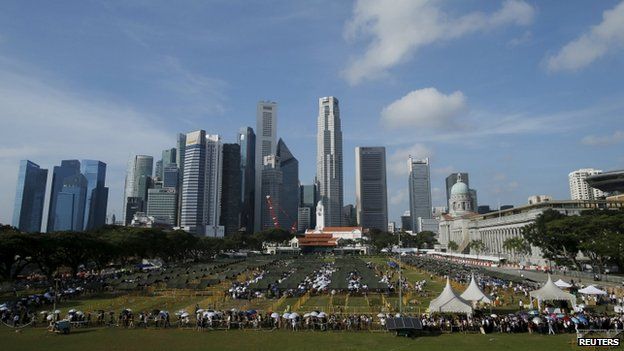
    People queue up to pay their respects to the late first prime minister Lee Kuan Yew, outside the Parliament House in Singapore, 27 March 2015

    Days later, Yee posted his video, titled Lee Kuan Yew is Finally Dead! – becoming one of the few Singaporean voices openly criticising Lee’s legacy.

    He likened Lee to Jesus Christ, and criticised Christians in general, a serious crime in a country which has seen race riots in the past and takes a zero-tolerance approach towards insults of race and religion.

    Later, he posted a crude cartoon depicting Lee having sex with Margaret Thatcher, a personal and political ally of Lee’s.

    At least 30 people lodged police reports; he was swiftly arrested and charged.

    Screenshot of Amos Yee's Youtube video on Lee Kuan Yew

    Since then, Yee has attracted insults and death threats.

    But he has also earned praise and support from those who see him as a free speech advocate.

    Several strangers stepped up to act as his defence lawyers and post bail. A local humorist started a campaign calling for leniency with a blog post titled Je Suis Amos.

    Another blog detailing his quirky outfits went viral, as did jokes about “Famous Amos”, referencing the US cookie brand. Dozens held a vigil on the eve of the verdict.
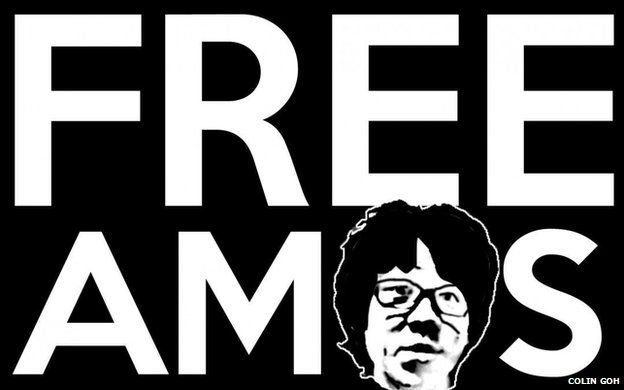
    Image of a campaign poster calling for Amos Yee's release done by Singaporean humorist Colin Goh

    Sociologist Tan Ern Ser said some may have agreed with him but disapproved of his “show of disrespect”, while others marginalised by Lee’s policies were “inclined to see someone who dares to openly speak up against the system as a kind of folk hero, and worthy of praise”.

    ‘So different’

    Yee’s mother, Mary, told the BBC that her son was “a fantastic child, perhaps born in the wrong country”.

    She described him as a precocious boy who loved reading and making videos. He won awards in a short film contest and acted in a local movie.
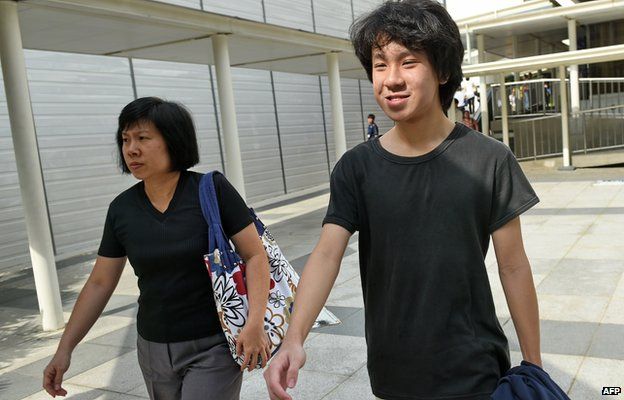
    Amos Yee (R), a 16-year-old student, and his mother leave the State courts in Singapore on 31 March 2015.

    But he cut short his studies, and in a blog described how he struggled to fit in at school, where he had few friends.

    The media has seized upon the fact that Mrs Yee took her son to see a psychiatrist after he posted his video. But his mother insisted that it was just a health check, and that the test results were “fine”.

    Generational anxiety

    Perhaps one reason Yee has become the object of deep fascination is his utter lack of remorse.

    In recent years, Singapore has seen several people torn apart online for offensive posts. Faced with public fury, these people without exception have apologised,gone into hiding, or even left the country.

    In contrast Yee broke bail spectacularly by not only reposting his material but also unleashing a torrent of Facebook and blog posts criticising his bail conditions. He pleaded not guilty to his charges during his trial.

    Such unrepentant insouciance, and the fact that he insulted a founding father, may have tapped into a recurrent anxiety among Singaporeans that a younger generation, having known only prosperity, takes the country’s stability for granted.
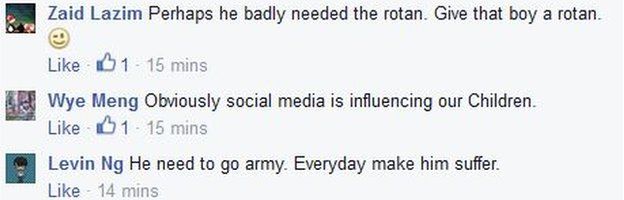
    Screenshot of Facebook comments about Amos Yee on 6 May 2015

    This may be why the slapping of Yee on 30 April by a stranger, as he arrived at court, drew not just shock but also approval in some quarters.

    Many denounced it as vigilantism, and the attacker jailed for three weeks, also being publicly condemned by the law minister.

    But Singapore remains a place where corporal punishment is still seen by some – including the state itself, which sentences people to caning – as an acceptable form of discipline.

    The 49-year-old attacker argued in court that he only slapped Yee because as an elder, he wanted to teach him a lesson.

    There were those who thought “it’s about time the boy got his comeuppance”, while some did not condone the violence “but they’re still gleeful that [the attacker] did what they have an urge to do themselves if they could or had the guts to”, noted one blogger.

    Wave of emotion

    The state made it clear that it was prosecuting Yee for his remarks about Christians, not his criticism of Lee – a harassment charge for his anti-Lee comments was dropped.

    But it was those Lee comments which sparked the most public anger.
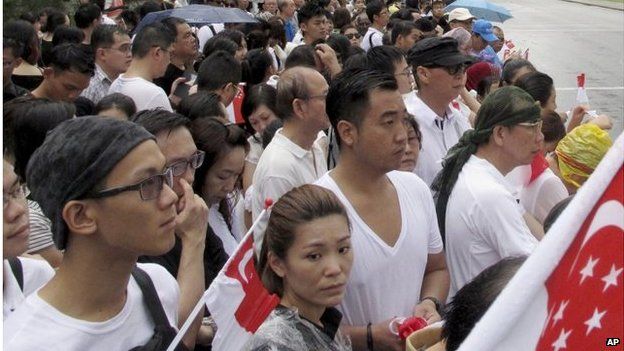
    Singaporeans wait for the coffin of Lee Kuan Yew to pass during the funeral procession, Sunday, 29 March 2015, at the Padang parade grounds and City Hall in Singapore.

    Many Singaporeans accept Lee was a controversial figure, and comments criticising him are not new. At any other time, an anti-Lee rant by a teenager may have at most caused weary eye-rolling or jokes.

    But when Lee died, the city state saw an unprecedented wave of emotion overcome its normally stoic citizens, as they lost the man seen as their anchor.

    “Sensitivities were high after Mr Lee’s passing and also, I don’t think the vast majority of Singaporeans have a nuanced grasp of the discourse of free speech… or about the proportionality of criminal sentencing,” said Colin Goh, the humorist behind the campaign for Yee’s release.

    ‘Lack of boundaries’

    Youth counsellor Vincent Law, who treated Yee and posted bail for him, said he did so because he wanted to show that as a Christian he was not offended by the video.

    He said Yee was “like any 16-year-old rebellious kid”, who is “challenging authority, feeling he has to fit in a mould and conform to society’s norms”.

    “He’s very intelligent, bright, pleasant and courteous… But he lacks a sense of boundaries and empathy for other people. He says he has to be honest and cannot compromise.”
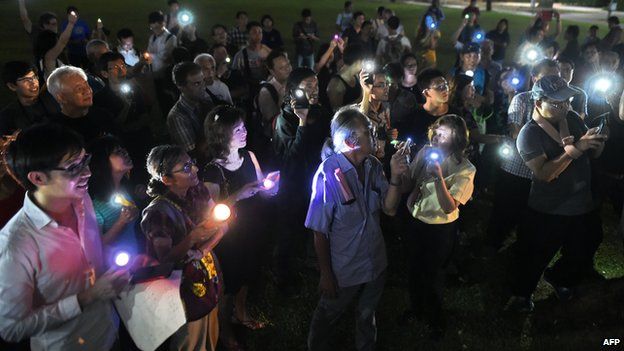
    Supporters gather at the speaker's corner during a vigil for 16-year-old student Amos Yee who is in prison in Singapore on 11 May 2015

    Mr Goh sees Amos Yee as “a true litmus test for Singapore’s maturity in a post-Lee Kuan Yew world”.

    “During [Lee’s] funeral, I thought Singaporeans behaved in a very mature fashion – calm, reflective, thoughtful, forgiving. There is some irony that Amos’s case has perhaps revealed quite the opposite.”

    Still others believe it is a sign of a changing Singapore, whose strict hate speech laws have been criticised for muting critical discussion on such topics.

    “We have a new generation that needs the space to be themselves, to express divergent views,” said Mr Law. “As a society, we need to give them that space and not stifle them.”


    Source: www.bbc.com

  • Do Not Support LGBT Movement In Singapore If You Do Not Understand The Global LGBT Agenda

    Do Not Support LGBT Movement In Singapore If You Do Not Understand The Global LGBT Agenda

    Hi Friends,

    Pink Dot is round the corner. Saw the new video, quite emotive.

    Please think twice before you decide to throw in your support. All the talks about diversity, tolerance and love sounds all well and good. They are but empty rhetoric. The real issues are deeper than what you can see. It is not as simple as just letting two people doing what they want to do behind closed door.

    Pink Dot is part of the global LGBT movement. Part of their agenda is to hijack the schools and influence the sexuality education. They want to tell your children that sodomy is acceptable. They want schools to teach that your child can choose which gender they want in a sexual relationship. They want your children not to limit themselves to the opposite gender when looking for a relationship. This is part of the reality of this movement.

    If you do not fully understand this movement in the global context, please refrain from throwing your support to something that you are not familiar with. If this movement succeed in Singapore, all of us will have to live under the consequences of its success. Are you aware of the consequences?

    The picture below is taken from a document used by pro-LGBT organisation AWARE in 2009. For two years they used it to conduct sexuality education to secondary schools. MOE issued a statement after terminating their service, “In particular, some suggested responses in the instructor guide are explicit and inappropriate, and convey messages which could promote homosexuality or suggest approval of pre-marital sex.”

    http://www.moe.gov.sg/…/…/moes-statement-on-sexuality-ed.php

    http://www.birminghammail.co.uk/…/parents-launch-petition-s…

    http://www.christian.org.uk/…/parents-anger-over-explicit-…/

    http://www.telegraph.co.uk/…/Parents-lose-right-over-sex-ed…

    http://globalnews.ca/…/alberta-parents-soon-cant-pull-kids…/

    https://www.lifesitenews.com/…/lesbian-i-use-math-class-to-…

    https://www.youtube.com/watch?v=4qyDLdixTRk


    Michael Lee

    Source: We are against Pinkdot in Singapore

  • Ustaz Azhar Idrus: Forbidden In Islam To Celebrate Mother’s Day

    Ustaz Azhar Idrus: Forbidden In Islam To Celebrate Mother’s Day

    PETALING JAYA: Now recirculating on social media is a video recorded in 2012 of Terengganu-based Ustaz Azhar Idrus calling on Muslims to disregard Mother’s Day and denouncing it as a Christian festival.

    In the 3.47 minute video, Azhar speaks to a crowd, warning them of the celebration’s supposedly Christian roots, saying it was linked to the Mother of the Church, the Virgin Mary.

    “The movement began in the early 19th Century, applying to the church and the government to declare this day a public holiday,” says Azhar, who then explains that the movement had asked churches in 1862 to note it in church calendars as a Christian celebration.

    “Mother’s Day has been declared a public holiday in all Christian nations; this is why it is forbidden to celebrate Mother’s Day,” says Azhar.

    “On that day, people will give a ‘mother cake’ to their mother, and they do this once a year. But Islam teaches us to be generous with mothers throughout the year.”

    He pointed out that the Chinese did not celebrate Deepavali, and the Japanese, Awal Muharram.

    “They (the Japanese) will not celebrate Awal Muharram because they know it is a Muslim festival. The Mexicans celebrate Christmas and not Maulidur Rasul,” says Azhar.

    “The Canadians do not celebrate Thaipusam,” The Star quoted him as preaching in the video.

    Mother’s Day was founded in America in the 20th century by Anna Jarvis, the daughter of Civil War peace activist Ann Jarvis, who cared for wounded soldiers on both sides of the Civil War and created the Mother’s Day Work Clubs to address public health issues.

    Following her mother’s death, Anna campaigned to make Mother’s Day an officially recognised holiday in the States. Following her efforts, Mother’s Day was officially recognised as a national holiday in 1914, set on the second Sunday of May.

    Rampant commercialisation and marketing soon brought it to the rest of the world.


    Source: www.freemalaysiatoday.com

  • Divide In Malaysia Laid Bare By Cross Furore

    Divide In Malaysia Laid Bare By Cross Furore

    KUALA LUMPUR — The protest by a group of Muslims in Selangor who called for a new church to remove a cross outside its premises has drawn a strong reaction from a broad coalition of moderate Muslims and politicians, exposing the rift between ultra and moderate Muslims and prompting the Cabinet to announce that the police will launch an investigation.

    Malaysian society has become increasingly polarised along religious lines in the past few years. In particular, the growing politicisation of religion means that, going forward, one can expect pushback from the majority of Malays, who are moderate in orientation, analysts told TODAY.

    In announcing the Cabinet’s decision yesterday, an under-pressure Prime Minister Najib Razak said the Sedition Act or other existing laws could be used against the protesters. “The protesters should have discussed with the church, instead of taking actions that have created worry and restlessness in this multiracial country,” he said.

    “The people must abide by the country’s laws and practise respect of other religions, as enshrined in the Constitution. We also need to have an attitude of tolerance and mutual respect among communities of different religions,” Mr Najib added.

    The protesters were roundly criticised since the incident, notably by a group of former Malay high-ranking civil servants, also known as the G25. “Firm action must be taken against the ignorant, intolerant Muslims who protested for the removal of a cross from a church,” said the G25 yesterday.

    The moderate group added that the protesters’ actions were an embarrassment to Islam and proved that they were ignorant of the tenets of their own faith, which preached tolerance and respect for all religions.

    The Muslims Professional Forum also denounced the protest, saying that this “mindless act of hatred and incitement against another religion’s place of worship has no place in Islam and deserves unreserved condemnation”.

    Dr Ooi Kee Beng of the Institute of Southeast Asian Studies, noted that the protest was a “serious provocation”.

    “Since race has slowly become ineffective as a way of polarising society to strengthen certain parties’ hold on power, it has over the last few years become the fashion to use religion as the means by which the division of Malaysian society can continue,” he told TODAY. “What this cynical process means is that an attack on the idea of cultural pluralism and tolerance has been sustained for several years … At some point, Malaysian society, especially the majority of Malays who believe pluralism is the basis of social peace in Malaysia, has to push back.”

    On Sunday, about 50 people gathered outside the church to demand the removal of a cross affixed to the building. The protesters reportedly said the presence of a cross in the Muslim-majority area posed a challenge to the religion and could sway the faith of the youth.

    The cross was taken down by church leaders a few hours later.

    Yesterday’s Cabinet decision came after remarks by Home Minister Ahmad Zahid Hamidi on Monday that the protest was seditious and that the government would take action. Putrajaya updated and strengthened the Sedition Act this month to crack down on people inciting racial and religious disharmony.

    Police chief Khalid Abu Bakar received a barrage of criticism from both sides of the political divide for his initial reluctance to launch a sedition probe, indicating that there was no element of sedition as the demonstration was not against Christianity.

    From the opposition end, Democratic Action Party (DAP) secretary-general Lim Guan Eng yesterday said that failing to take any action against the protesters would “put an end to any talk of moderation at the international stage” by Mr Najib.

    Mr Henry Benedict Asirvatham, Malaysian Indian Congress (MIC) liaison committee deputy chairman for Penang, yesterday said the incident had “put a black stain in our country’s multiracial and multi-religious image”. The MIC is a component party of the ruling Barisan Nasional.

    “There is a worrying trend within the United Malays National Organisation (UMNO) ruling party to politicise religious issues,” said Dr Mohamed Nawab Mohamed Osman of the S Rajaratnam School of International Studies.

    “UMNO is currently in a weak position and seeks to survive. There are elements within the party who will use racial and religious issues to position themselves. Some extremist political groups have been gaining traction in some segments of society because of how well the Chinese and Indians had effectively organised themselves during the last election. There is fear among the Malays that the Chinese will use the (opposition) Pakatan Rakyat to their benefit, even though there is no Chinese Prime Minister.”


    Source:www.todayonline.com

  • Uproar Over Church In Selangor Increases Pressure On Malaysian PM Najib Razak

    Uproar Over Church In Selangor Increases Pressure On Malaysian PM Najib Razak

    An uproar over a protest on Sunday by a group of Muslims in Selangor demanding the removal of the cross of a church has put more pressure on embattled Malaysian Prime Minister Najib Razak.

    Netizens, politicians and lawyers condemned the protest in a Malay-Muslim majority residential area in Petaling Jaya, and pressed the government to take action against the protesters and protect minority rights.

    Home Minister Ahmad Zahid Hamidi yesterday called the protest seditious and vowed that action would be taken against the offenders, contradicting an earlier assertion by the country’s police chief that the protesters’ actions were not seditious.

    “Of course action is to be taken. I am very colour-blind. The police are very colour-blind. Action has to be taken or will be taken against them (the protesters),” Mr Zahid, told the media yesterday.

    About 50 people had gathered outside the new church on Sunday, demanding the removal of the cross affixed to the house of worship on the grounds that it was challenging Islam and could sway the faith of young Muslims. Among those present at the protest was Mr Abdullah Abu Bakar, the older brother of police chief Khalid Abu Bakar, along with several other members of the ruling United Malays National Organisation (UMNO) party.

    The cross was taken down by church leaders a few hours after the protest.

    At a news conference yesterday, Mr Khalid dismissed any suggestions that the protest was seditious. “We do not see it as seditious as it did not touch on Christianity but only on the location of the church,” he said, adding that his brother was present only to help manage the situation.

    Mr Abdullah, an UMNO branch chief, also said in a statement that the UMNO members were present to mediate, adding that they managed to stop some of the more radical residents who had threatened to remove the cross had the church not done so itself.

    This was not the first time a protest has been held against a church.

    In November last year, a Muslim group also organised a demonstration to protest the construction of the four-storey church in Petaling Jaya.

    Ms Haniza Mohamed Talha, an opposition lawmaker of the district where the protest took place, criticised the behaviour of the protesters. “(The protesters) assume that the faith of Muslims is so fragile that just by looking at a cross, they will be driven away from Islam,” she said. The Council of Churches Malaysia claimed the protest was politically-motivated to stir up religious tensions in Selangor.

    In condemning the protest, the council’s general-secretary Dr Hermen Shastri said it was not surprised that such an incident had taken place yet again in the state, which is ruled by the federal opposition coalition, Pakatan Rakyat. “It is obvious that there is a political agenda behind such acts from certain quarters, who are out to instigate and increase inter-religious tensions in the state,” he said. He urged the authorities to “take firm measures against anyone who seeks to disrupt the worship of others, and who seeks to act above the law by imposing their religious views upon people of other faiths, by show of mob force”.

    Mr Tony Pua, a lawmaker from the Democratic Action Party, called on UMNO lawmakers who recently voted in support of the amendments to the Sedition Act to make their stand known to the protesters. “Will the above case only go to show how the Act was constructed strictly targeted against non-Muslims while Muslims who infringed on the rights of others will get away scot-free?” he said.

    Malaysia strengthened its controversial sedition law earlier this month, imposing a minimum jail term of three years and allowing the government to block online media deemed to be seditious. The toughening of the Sedition Act comes after a crackdown in which scores of people have been detained under the law in recent weeks.

    Mr Najib has come increasing pressure in recent months over a series of controversies, including the state investment vehicle 1Malaysia Development Bhd (1MDB), which has amassed a RM42 billion (S$15.6 billion) debt.

    Sunday’s protest poses another headache for Mr Najib, following several recent cases that have heightened religious tensions with Malaysia’s Christian minority population. Last week, 320 Malay-language bibles were seized because they used the word “Allah” to refer to God. Earlier this year, Catholic newsweekly Herald was also banned from using the word “Allah” in its publications.


    Source: www.todayonline.com