Tag: Conservative

  • Saudi Arabian Woman Arrested For Indecent Dressing

    Saudi Arabian Woman Arrested For Indecent Dressing

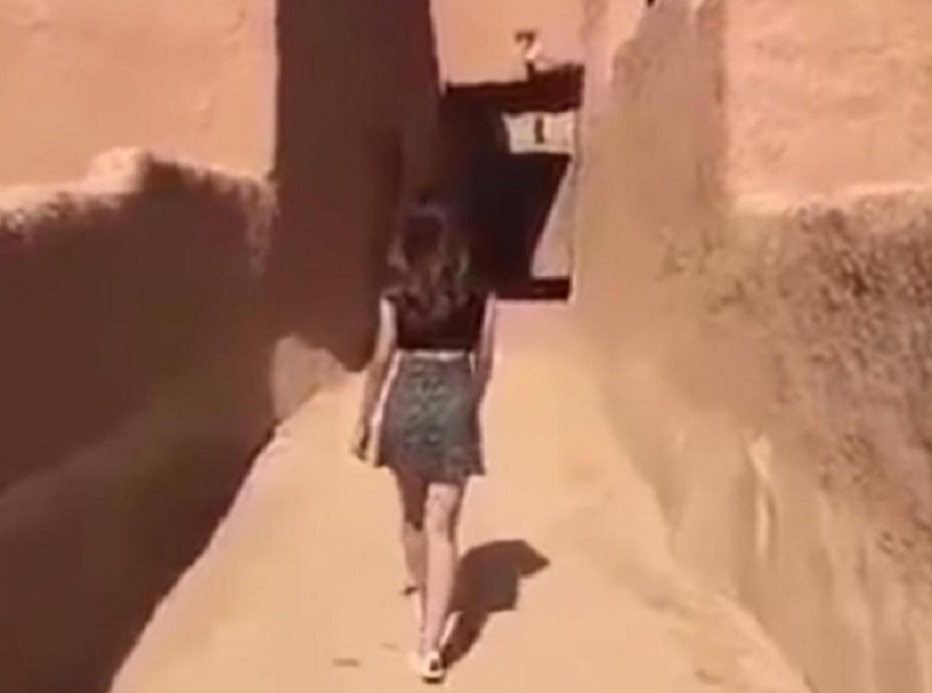
    A young woman in Saudi Arabia has been arrested by police for wearing “suggestive clothing,” Saudi state television station Al Ekhbariya reported Tuesday.

    The brief clips, originally posted to the social network Snapchat over the weekend by a popular user named Khulood, show the woman walking through an ancient fort in Ushayqir, a village in Najd province about 95 miles from the capital, Riyadh.

    The woman wears a skirt that stops above her knees and a top that shows her midriff; her head is also uncovered.

    Such an outfit runs afoul of conservative Islamic ideas about women’s dress that are prevalent in Saudi Arabia. The country legally requires women to cover themselves while in public by wearing an abaya, a loosefitting cloak. Traditionally, Saudi women are also expected to wear some kind of hijab or head covering, and some opt to cover their face with a niqab.

    Although foreigners are usually exempted from such rules and Saudi women often find ways to skirt them, many religiously conservative Saudis feel strongly about them.


    Source: www.independent.co.uk

  • Jakarta Election Results A Victory For Prejudice Over Pluralism?

    Jakarta Election Results A Victory For Prejudice Over Pluralism?

    The long, divisive campaign for governorship of Indonesia’s capital city Jakarta is finally over, with unofficial results showing a decisive victory for the challenger Anies Baswedan over the controversial incumbent governor Basuki Tjahaja Purnama (popularly known as Ahok).The Conversation

    The election was the most politically significant regional election in Indonesia’s history because it wasn’t just about choosing the chief executive for the city’s 10 million citizens.

    Rather, it became a referendum on the future of Indonesia’s ethno-religious diversity and tolerance after unwanted intervention by a number of radical Islamist groups, most notably the Islamic Defenders Front (FPI).

    The blasphemy campaign against Ahok

    These groups accused Ahok, a Chinese Indonesian who is Christian, of blaspheming last September by mocking a Qur’anic verse that allegedly calls for Muslims to reject non-Muslims as their leaders. Ahok criticised unnamed religious clerics (ulama) for using verse 51 of the Surah Al-Maidah that advises Muslims to avoid aligning with Christian and Jews.

    FPI and its allies managed to obtain a religious ruling (fatwa) from the Indonesian Ulama Council (MUI) declaring that Ahok was guilty of committing blasphemy against Islam. They then sponsored a number of anti-Ahok rallies in Jakarta, the largest of which, held in November 2016, attracted approximately 2.5 million protesters.

    Under pressure from these groups, the Indonesian government opened an investigation against Ahok and tried him for blasphemy. The trial was adjourned a week before the election.

    Anies, a very astute politician, quickly capitalised on anti-Ahok accusations, by seeking and receiving an endorsement from Habib Rizieq Shihab, FPI’s supreme leader. He also started to portray himself as an “Islamic candidate” to win the support of Jakarta’s Muslims, who comprise 85% of registered voters.

    The strategy seems to have worked, as an Indo Barometer poll in February indicated more than half of Jakarta’s voters would not vote for Ahok because they believed he had committed a blasphemous act against Islam.

    They reached this conclusion despite a number of Islamic scholars saying that the Qur’anic verse in question must be seen in the context of warfare between Muslims and non-Muslims during the early Islamic period. And that it had nothing to do with how Muslims should choose their leader.

    The race between the two contenders was very tight, as indicated by a reputable Saiful Mujani Research and Consulting (SMRC) poll, which showed Anies leading Ahok with a margin of 1% (47.9% vs 46.9%), with up to 5.2% of voters still undecided.

    The campaign took an ugly turn when an elderly woman, who had voted for Ahok during the first round and subsequently died, was allegedly denied a Muslim burial. And an Islamist activist made a Facebook post stating it would be religiously permissible for any women voting for Ahok during the run-off election to be gang-raped.

    Police had to tear down a number of banners placed in mosques across Jakarta discouraging their members to vote for Ahok during the runoff.

    Implications of the election results

    The election has serious implications for the future of Indonesian politics. Anies’ victory means he is in a stronger position to mount a challenge against President Joko Widodo in 2019, as a candidate of the Great Indonesia Movement Party (Gerindra), or with another opposition party.

    A young, telegenic politician who has widely touted his Islamic credentials, Anies is perceived by Jokowi as a more formidable opponent than “old guard” elite figures, such as retired General Prabowo Subianto and former president Susilo Bambang Yudhoyono, who are both widely expected to be contenders during the 2019 presidential election.

    But more importantly, Anies’ victory is another sign of the growing Islamisation of Indonesian politics, which has been on the rise since the country made its democratic transition in 1998.

    This phenomena can be seen throughout Indonesian society, from the promotion of Islamist prayer groups (pengajian) and study circles (halaqah) in public university campuses throughout the country; the proliferation of Indonesian women wearing Islamic veils (hijab); and the rapid increase in local regulations restricting alcohol consumption and the rights of religious minorities.

    There seems to be an ideological and political convergence between Islamist groups such as FPI (an association of approximately 100,000 hardline Islamists with close ties to the Indonesian security apparatus) and Hizbut Tahrir Indonesia. This latter is known for its advocacy for a global caliphate.

    Members of both groups are developing a close relationship with the conservative elements of the Nahdlatul Ulama NU) and Muhammadiyah, Indonesia’s two largest Muslim organisations with generally moderate political leanings. They claim membership by 60 million and 30 million people respectively.

    The MUI fatwa against Ahok was signed by Maaruf Amin, who, apart from being the council’s general chairman, is also NU’s supreme leader (rais aam).

    The groups have also cooperated to demand the implementation of shari’a regulations (perda shari’a) by local governments throughout Indonesia. And there are now 442 such regulations in place in over 100 cities and districts.

    These regulations require women to wear hijab in public, prohibit the consumption of alcohol and prostitution, and declare a number of Islamic minority sects, such as Ahmadis and Shiites, to be illegal within their respective localities. The groups have also encouraged acts of violence against both minorities over the past decade or so.

    Rising Islamism and the renewed prejudice against ethnic and religious minorities pose a danger to the pluralist outlook enshrined in Indonesia’s official founding principles, which are collectively known as Pancasila. Made from the Sanskrit word for “five”, panca, and the Javanese for “principles”, sila, Pancasila states: “The one God system (monotheism), just and civilised humanity, the unity of Indonesia, democracy and social justice for all.”

    These principles have underpinned equality for all Indonesia’s ethnic and religious groups since the country’s founding in 1945. Indonesian founding fathers who created Pancasila meant to give equal political and economic opportunities to all Indonesians irrespective of their ethnic and religious background.

    Unlike Indonesia’s neighbour Malaysia, Pancasila grants no special status to Muslims and instead gives official religions status to a number of religions (Islam, Christianity, Hinduism, Buddhism, and Confucianism). It gives them equal legal recognition, and grants their members full religious freedom. Most significantly, adherents of all religions are free to run for and occupy any public office.

    By creating these accusations against Ahok, the Islamists have refused to recognise the legal rights of Indonesia’s ethnic and religious minorities to run for public office. Ahok’s loss means that Indonesia’s ethno-religious diversity is the biggest casualty of this highly polarising election.

    Alexander R Arifianto, Research Fellow, Indonesia Programme, S. Rajaratnam School of International Studies, Nanyang Technological University


    Source: www.theindependent.sg
  • MDA To Take Action Over Same-Sex Kiss In Les Miserables

    MDA To Take Action Over Same-Sex Kiss In Les Miserables

    A kissing scene between two male actors has been removed from the musical Les Miserables after complaints from members of the public.

    In a statement to The New Paper today (June 11), a spokesman for the Media Development Authority (MDA) confirmed that action will be taken against the production for the breach of licensing conditions.

    The spokesman said: “The inclusion of the same-sex kiss was not highlighted in the script when it was submitted to MDA for classification.

    The performance was thus given a ‘General’ rating.

    Upon receiving feedback from members of the public, MDA reviewed the performance and confirmed that the scene was present.

    MDA advised the applicant that the inclusion of this particular scene meant that the performance had exceeded the ‘General’ rating issued.

    Under our classification code, such a scene would fall under an ‘Advisory’ rating.

    The applicant decided to remove the scene so as to keep the ‘General’ rating for the rest of its run.

    MDA will take action against this breach of licensing conditions


    Source: www.tnp.sg

  • A Confused Muslim, Once Again

    A Confused Muslim, Once Again

    I found myself sucked into a debate while having breakfast at a mamak restaurant recently. It all started with a friendly chat about the call by Penang Opposition Leader, Jahara Hamid to remove a Taoist shrine from Armenian Park in Georgetown.

    “You are a Muslim. Tell me why Muslims do this?” asked an uncle who joined me for my morning nasi lemak.

    “Apparently they are confused,” I replied with a chuckle.

    “I don’t think so. This is something they are doing on purpose. You should know – you are a Muslim.”

    Getting somewhat defensive, I blurted, “Not all Muslims are the same.”

    “So you don’t practice your religion?” the uncle shot back.

    Realising the conversation had taken a serious turn, I tried explaining: “I do practice my religion to the best of my ability. But that is not what we are talking about here.”

    “It is precisely what we are talking about. The lady who wanted the shrine to be removed; the man who wanted ‘No Pork’ signs to be banned, the group who wanted the cross taken down – you all have the same faith. You all read the same Holy Book…”

    “I disagree. You can’t judge everyone based on the conduct of a small group of Muslims. I do not go around persecuting people. I do not go around telling people how to live their lives. I support freedom and human rights. I am no extremist. Most Muslims are not extremists.” I was clearly upset by now.

    “Girl, you follow your Holy Book and so does the confused Muslims and the extreme Muslims. If all Muslims accept the one and only Holy Book and live by it, they are no different from one another. They are all extremists – including you.”

    “I disagree. I do not condone discrimination, violence and terrorism. Islam is not a religion of violence. Islam is a religion of peace,” I argued, as the uncle had gotten on my nerves with his blanket judgements.

    “Your Holy Book promotes violence. There is even a verse saying: ‘Go and kill.’ Now how can a religion which promotes killings be a peaceful religion?”

    “There are more than six thousand verses in our Holy Book – why emphasise on the negatives? Why aren’t you talking about the messages of kindness, love and compassion in most of the verses?” I countered, not realising that I had raised my voice in the process.

    The uncle laughed, “Girl, religion is not like a plate of mee goreng you order at a mamak shop. You don’t get to tambah pedas or kurang pedas; tambah taugeh or takdak taugeh; tambah telur or tambah ayam. You can’t be selective of which content suits you and drop those you disagree with.”

    The uncle got me thinking. If a good Muslim accepts every single verse in the Holy Book without any argument, does that make me, a cherry-picking liberal Muslim and a moderate, a bad Muslim?

    I went home that day, quite confused.

    There are approximately 30 million people in Malaysia, 60% of whom are Muslims. If a mere 1% of Malaysia’s 18 million Muslims are extremists, why is it that we haven’t witnessed violence or crime perpetrated by some 180,000 extremists?

    Clearly, that could mean only one thing – extreme Malaysian Muslims don’t even make up 1% of our Muslim population. That makes me wonder – why then did the uncle get so worked up over a tiny number of people?

    More importantly, if 99% of Malaysian Muslims are non-extremists, why haven’t we seen even 1% of the 17,820,000 non-extremists fighting against extremism in our country?

    Maybe that’s what makes us – the non-extreme, moderate ones – bad Muslims. We do not fight injustice and cruelty. We are after all, moderates – in thinking and behaviour. We can talk for hours about Arabisation, Islamaphobia, Zakir Naik, Zionist and Shariah law. But when it comes to fighting extremism and terrorism, we hide behind our moderate robe. That’s the problem with being a moderate Muslim. We tolerate nonsense.

    Perhaps that is also why we moderates like to insist that Islam is a peaceful religion – it allows us to justify our laid back attitude. In response to any extreme movement, we, the moderates peacefully make a peaceful statement, clarifying how peaceful Islam is, so we can get back to our peaceful lives, sipping kopi O at Kedai Kopi Ahmad.

    In conclusion, although I do not agree with the uncle on most counts, I believe he got one thing right – we are not good Muslims. As long as we tolerate nonsense, the moderates are equally as bad as the extremists.


    Source: www.freemalaysiatoday.com

  • A Brief Checklist Of Who Madonna Has Offended

    A Brief Checklist Of Who Madonna Has Offended

    Madonna’s much-hyped Rebel Heart concert at the National Stadium tomorrow night could be remembered as the hottest gig of the year, or as the most contentious, depending on how you see it.

    The most recent flap: the statements from the Roman Catholic Church here and the National Council of Churches of Singapore, urging believers to reconsider attending the show and not to support those who “denigrate and insult religion”.

    We look back at all the times the 57-year-old US pop icon caused a commotion in her three-decade career.


    PHOTOS: KEVORK DJANSEZIAN, YOUTUBE, INSTAGRAM

    WHEN MTV Video Music Awards (VMA) performance of Like A Virgin (1984); Like A Prayer music video (1989); Confessions concert tour performance of Live To Tell (2006)

    WHAT She got down and dirty on the stage in a white wedding dress and crucifix accessories while singing Like A Virgin; her Like A Prayer music video had burning crosses and Madonna making out with a black saint; and she hung on a cross wearing a crown of thorns while delivering Live To Tell live.

    WHO Catholic groups and leaders, the Vatican and Christian conservatives. Pepsi, which used the song Like A Prayer for its commercial, cancelled plans to broadcast and dropped its contract with Madonna.


    PHOTOS: KEVORK DJANSEZIAN,YOUTUBE, INSTAGRAM

    WHEN MTV VMA performance of Ray Of Light (1998)

    WHAT She sported Hindu holy markings on her forehead while performing sexually charged dance moves.

    WHO Religious group World Vaishnava Association and some Hindus and yogis


    PHOTOS: KEVORK DJANSEZIAN, YOUTUBE, INSTAGRAM

    WHEN MTV VMA medley (2003)

    WHAT She kissed US pop princesses Britney Spears and Christina Aguilera suggestively on the lips during a medley of songs including Hollywood and Like A Virgin.

    WHO Parents Television Council and media critics


    PHOTOS: KEVORK DJANSEZIAN, YOUTUBE, INSTAGRAM

    WHEN Justify My Love music video (1990)

    WHAT Guest-starring Madonna’s then-boyfriend, model Tony Ward, it had nods to voyeurism, sadomasochism and bisexuality.

    WHO Major US TV networks that banned it for being “near-pornographic” and “unfit for broadcast”.


    PHOTOS: KEVORK DJANSEZIAN,YOUTUBE, INSTAGRAM

    WHEN MDNA concert tour (2012)

    WHAT During a video collage for the song Nobody Knows Me, the face of Marine Le Pen, a French far-right politician and leader of French party National Front, appeared on screen with a swastika superimposed on her forehead.

    WHO Le Pen and National Front party members, who threatened to sue Madonna if she went ahead to use the image in her concert in Nice, France. Madonna subsequently removed the swastika from the video and replaced it with a question mark.


    PHOTOS: KEVORK DJANSEZIAN, YOUTUBE, INSTAGRAM

    WHEN Girl Gone Wild video (2012)

    WHAT The raunchy black-and-white clip contained scenes of grinding, naked men in stiletto heels, same-sex kisses, an implied orgy and Madonna in a bondage suit.

    WHO YouTube viewers who rated it as “inappropriate”. The video-sharing site then slapped it with an age restriction, allowing only those aged 18 or older to watch it. Madonna was also blocked from uploading the video onto her Vevo account.


    PHOTOS: KEVORK DJANSEZIAN, YOUTUBE, INSTAGRAM

    WHEN Coachella Music Festival (2015)

    WHAT She locked lips with a stunned Canadian rapper, Drake, for a good three seconds on stage during the latter’s headlining set. At the 29-year-old’s invitation, she made a cameo appearance when he performed one of his songs titled Madonna.

    WHO Likely Drake himself, who – rather amusingly – appeared repulsed and horrified after the intense snog. And probably Drake’s fans too, who created a slew of hilarious memes mocking “grandmother” Madonna for “sucking the life force” out of their idol.


    Source: www.tnp.sg