Tag: culture

  • Will Geylang Serai Lose Its Malay Cultural Identity After The $3.2 Billion Facelift?

    Will Geylang Serai Lose Its Malay Cultural Identity After The $3.2 Billion Facelift?

    Will Geylang Serai lose the Malay cultural identity that we always had after this big ‘rejuvenation’? Take a look at some of the reactions from the Malay community.

    “In my opinion, Geylang Serai has really lost its Malay identity unlike Chinatown and Little India which represents the Chinese and Indian communities here in Singapore. During festive seasons, we can also spot CNY decorations along 1KM, Tanjong Katong Complex etc. And Joo Chiat Rd area are just filled with nightclubs, massage parlours, bars etc. Heard that there will be new a CC next to Geylang Serai Market? (we have 3 CCs nearby) Also, with the latest massive development by Lendlease, what is left of Geylang Serai area and for our future generations to come?” – Brader Faisal

    “Tu la hari tu naik cab Abang taxi pon cakap Geylang ni tak ada apa2, tempat Melayu makin lama makin dorang kecilkan” – Brader Gamo

    Betul tu jgn patah semangat demi pelapis & cucu cicit kita. Wahai peniaga2 musiman melayu islam bersatu lah anda utk berniaga di Geylang nanti di Ramadan akan dtg. Klu byk berserek kan berniaga di Bazaar lain (Tampines & Wdlands) tentu lah Geylang Serai jadi sepi. Mmg waktu OneKM mula naik Developer yg saya kebetulan temu janji ada berkongsi yg strategy dia orang ia lah akan commercialise kan Geylang Serai so… meaning akan kurang wajah kampong geylang serai klu peniaga kita tdk berkumpul di daerah sendiri.” – Sis Hana Roza

    Union kene pasang strategi.. suarakan pandangan kpd Presiden kak limah.. Kami mahukan Malay Street(peniaga2 melayu,pelancong2 boleh dtg, ada persembahan kebudayaan melayu, halal food)…” – Brader Fadzil

    “Jangan tengok geylang serai saja..seluruh singapura yang asal nya negeri melayu sudah berubah menjadi negeri etnik tionghua..dlm nusantara..” – Brader Salim

    I only have this to say – when the Temenggong signed Singapore over to the British in a “in perpetuity lease”, it was game over for the Singapore Malays. Just like the Native Americans and the European settlers of North America. Talk of Singapore being Tanah Melayu – is just that ; empty talk. Today Singapore is largely Chinese and they have a strong grip on the economy too. Instead of looking back with nostalgia and regret – its better to worry and plan for the future. I agree with Muhammad Noor Othman. What is left – is Islam. Hold on to that coz we are now in the End Times (Akhir Zaman).” – Brader Syed


    Image result for park place residences

    (Photo credit: theparkplace-residence.com)

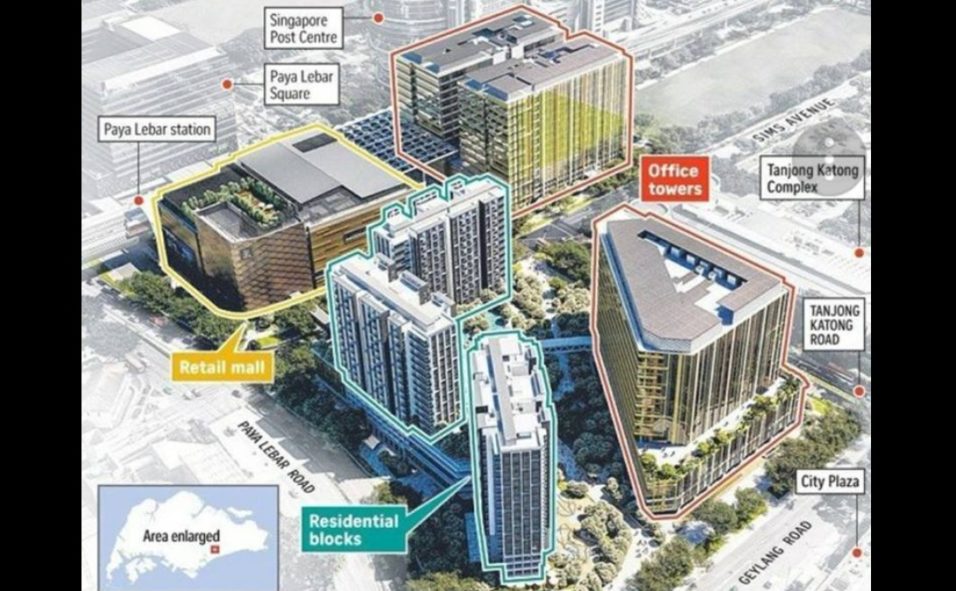
    Park Place Residences (Paya Lebar) is part of a massive $3.2 billion project by Australian Developer, Lendlease. The mega project, Paya Lebar Quarter, comprising of office space, shops and private housing, will be spread across seven buildings on land the size of eight football fields. There will be a retail mall, three office towers and three residential blocks all connected to Paya Lebar MRT. Watch the video.


    Rilek1Corner

  • Commentary: Things Will Remain As They Are Until The Majority Wakes Up And Get Real

    Commentary: Things Will Remain As They Are Until The Majority Wakes Up And Get Real

    Those calling for resignation of senior staff must be dreaming. If even the tragic accident which caused the death of two young staff did not lead to any resignation, do you expect any senior staff to resign over this recent accident?

    Are you not aware that they have a culture of forgiving themselves and their chosen ones?

    Budget overruns of hundreds of millions (YOG) and gross overpayment to consultants for designing a small rubbish dump are also forgiven.

    Things will remain as they are until the majority wakes up and get real.


    Source: Mohamed Jufrie Bin Mahmood

  • Call To Preserve Unique Singapore Malay Culture

    Call To Preserve Unique Singapore Malay Culture

    Malays in Singapore have their own special version of Malay culture, which melds with the country’s multiracial setting, and the community must put in greater effort to grow and preserve this unique culture, said Environment and Water Resources Minister Masagos Zulkifli.

    He made this call yesterday as he announced new plans for Malay grassroots groups under the People’s Association to focus on building stronger bonds within the community, and between the community and other races.

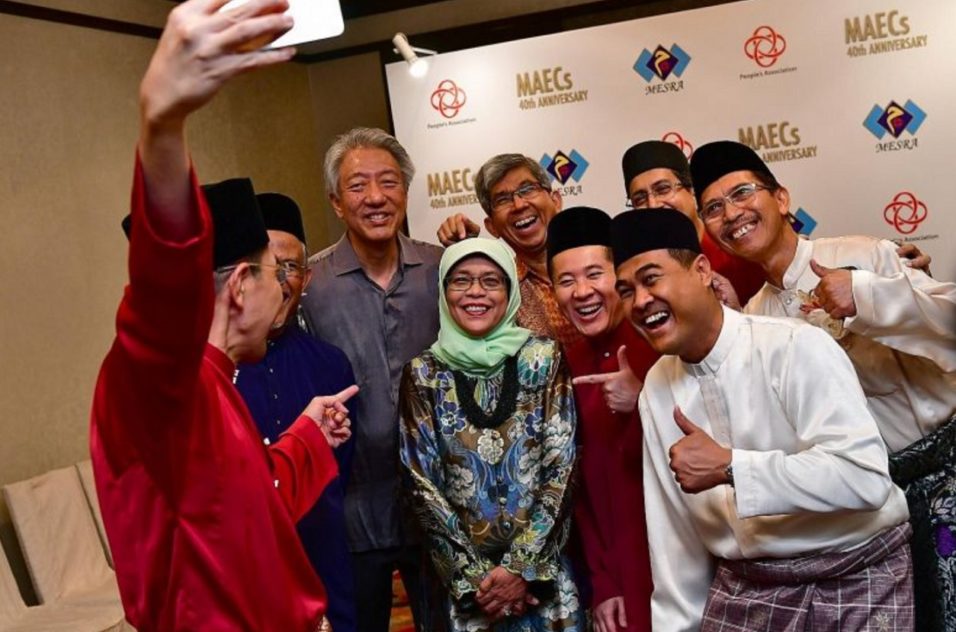
    Speaking at a dinner celebrating the 40th anniversary of the Malay Activity Executive Committees (MAECs), Mr Masagos said the local Malay identity provides a “bulwark against the threat of incoming doctrines which are… very inimical to our multiracial society”.

    He noted in a speech that external influences have threatened to erode this culture, adding that some local traditions have come under attack by extremists.

    He pointed to how they have labelled the Malay wedding practice of persandingan, where newlyweds sit together on a dais, as having Hindu influences. Some have also claimed that the Arab way of dressing is “more superior” to the local Baju Melayu.

    “Extremists know they must first supplant our confidence in our identity, both in our religious practice and culture, before they can replace it with one of their own,” he said.

    He urged people to guard against such insidious influences, saying that failing to do so could result in the erosion of Malay culture and the rejection of local teachings of Islam that embrace harmony.

    He added that Malay Singaporeans should be confident of their cultural and religious practices.

    The 97 MAECs and their coordinating body, the Malay Activity Executive Committees Council – known by its acronym Mesra – can also help to guard against this threat of radicalism and exclusivism, he said, by helping to foster a sense of cohesion among the different races. Mr Masagos is adviser to Mesra.

    The committees, which were formed as Malay cultural groups in 1997, will expand their focus to “get people out into common spaces, where people across all walks of life have the opportunity to interact and get to know one another”, Mr Masagos said to about 900 MAEC members and community partners.

    As part of this effort, Mesra will also be managing programmes in the upcoming Wisma Geylang Serai, a new five-storey civic centre in Paya Lebar slated to open next year, which will be a hub for Malay heritage.

    Senior Minister of State for Defence and Foreign Affairs Maliki Osman, who will lead the initiative, said the centre will host the annual Hari Raya Bazaar and Hari Raya light-up, and also work with the National Arts Council to bring in cultural groups, among other things.

    He added that he hoped the new hub will help preserve and grow the Malay culture and become a space where people of all communities will “gravitate” to learn about Malay heritage.

    Deputy Prime Minister Teo Chee Hean, who also delivered a speech in Malay at the dinner, welcomed the plan by the Malay-Muslim community to “work more closely with all communities to build a more secure, cohesive multiracial and multi-religious Singapore”.

    He added that all communities here can see the significant steps the Malay-Muslim community has taken to counter exclusivism, extremism and radical teachings.

    “I am glad that other communities in Singapore have expressed their support and solidarity with our Malay-Muslim community… All communities have to reach out, strengthen understanding and build trust,” he said.

    Yesterday, eight MAEC members were given awards for their contributions to the community.


    Source: http://www.straitstimes.com


  • How Malays Define Malayness? Well Truth Is Its Very Confusing And Inconsistent

    How Malays Define Malayness? Well Truth Is Its Very Confusing And Inconsistent

    So how does one define who is or isn’t Malay? Having actually researched this for my thesis for the past two years, please let me share with ya’ll SOME of what I’ve learned.

    How Malays define Malayness has always been head-scratchingly confusing to those who are not Malay and even to us who identify as Malay in Singapore, it’s blatantly inconsistent. It is something of a pet passion of mine, probably because people keep assuming I’m chinese. Also, why is Malayness confusing? This is because there are actually competing definitions of Malayness. Dr. David Tantow identifies three which can be found in Sg:

    1) there is the Islamic ummah, which basically imagines ALL Muslims in the Malay archipelago regardless of ethnicity as being part of the larger Malay community (basically, it’s: you are Arab? Pakistani? Well, hello, welcome, cuz as long as you Muslim, you my bro). Apparently, This emerged as kind of an identity-based counter to Western imperialism and colonialism in the 19th and early 20th centuries but which has now gotten a pretty bad rep because talk about a southeast Asian caliphate now (which is what this definition alludes to) and people will be like, eh, don’t become Isis leh, I call police.

    2) Then, for the second, we have Malayness defined by cultural signifiers and codes, where we talk about people who practise Malay customs (adat), speak the Malay language (Bahasa), and practise Islam (agama). These three thingies form the basis of whether someone is either Malay (Melayu) or if that person has “enter (has become) Malay” (masuk Melayu). What confuses people about THIS definition is that it does NOT take genetic heritage into account. Basically, it’s: oh, you have Pakistani parents? But you now speak Malay, love motorcycles, know how to eat nasi ambeng, and go Friday prayers? Then we same-same Melayu lah bro.

    3) The third definition is the one Mendaki and the gahmen loves cuz it’s the simplest one; using parentage/ancestry or “genetic and territorial qualifiers”. It’s really just, oh, your father is Malay, your mother is Malay, then two plus two equals four cikgu. It’s the most exclusive kind of Malayness but also one that people who are not Malay are least confused by. Also, can anyone spell “administrative convenience”?
    (Source: www.tandfonline.com/doi/abs/10.1080/13639811.2012.725553)

    4) THEN, as if these three ways of defining Malayness is not enough, we’ve not even touched on the fact that “Malay” also refers to an umbrella term for “the Malay races”, which is when we further divide Malays up into whether they are Minang, or Bawean (Boyan), or Javanese, or Bugis, even Filipinos and Orang Asli,etc, etc, oh so many many, many of which have their own languages, customs, even religious practices, some of whom are chill with being called Malay and others who are less chill because of reasons. All of them are represented in singapore so JOY.

    5) THEN, as if I don’t have a migraine already, not only are all these different ways of defining Malays competing with each other, they are COEXISTING in some kind of strange equilibrium because, you know, we Malays don’t have enough problems in our lives. It’s why some of us say, Wah, this Marican cannot Bahasa Melayu, is he really Melayu (second definition)? Then with Khan, whom no one has criticised for not being able to speak Malay, people are like, eh, he Pakistani ancestry means he’s not Malay right (third definition).

    6) THIS EQUILIBRIUM SHIFTS, because Malays cannot duduk diam-diam, between each other but also internally within the three definitions as well. For example, increased religiosity in recent decades means many Malays absolutely require someone to be Muslim to be considered Malay while others like the 1960s Malay nationalists placed a premium on customs and heritage. Before that, there was also the phrase “Bahasa jiwa bangsa” (language is the soul of a nation) which was a huge draw for the malay intelligentsia because they ardently believe that MALAY LIT IS MORE LIT THAN YOUR ROKOK. It’s only really with the (racist) British system of colonial administration, and later on with the (rac-Er-problematic) CMIO system that the third definition really became much more dominant in the lives of Malays in sg. All in all, these shifting lines evolve to adhere to historical and cultural changes.

    7) So, really, what I am trying to say is defining who is Malay and how has been one long historical ?&$?? that has resulted in the inconsistency many people are now seeing in how the Malay community is treating the candidates. ALSO, AND MOST IMPORTANTLY, it has resulted in me extending my MA Programme by one semester, WHICH LIKE WAHLAO NI MELAYUNESS MAKAN MELAYU KE PE, incidentally. Now, with this development in the Presidential Election, this headache is finally going to be passed on to, as it usually happens here, a committee. I’m kinda looking forward to what they’re gonna say. For research purposes. Of course, they could just use the simplest, most boring way which is the third, genetically defined one, which will disqualify Khan. But this would leave us with Marican who many Malays would like to instinctively disqualify because of the second definition.

    Of course, likely, both will be disqualified because of the 500 million dollar in whatever equity rule, neatly avoiding this headache, which will mean, happily, that this migraine will continue, resulting in more MC days for my Malay brethren and me.

    Disclaimer: While Malay identity is important to my thesis, it’s not the main subject I am investigating for my research project. As such, what I know is limited and no doubt incomplete. So please feel free to add in any gaps or correct any inaccuracies as you spot them.
     

    Source: Hidhir Razak

  • Seeking Forgiveness For Any Wrongdoings; A Yearly Hari Raya Practice

    Seeking Forgiveness For Any Wrongdoings; A Yearly Hari Raya Practice

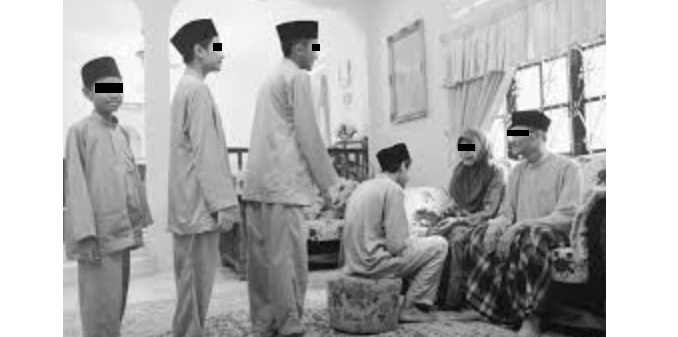
    This is one of the yearly Hari Raya practices from our culture that I truly believe in and treasure. Recently, there were many debates about its relevance and importance. Many who do not fully understand the rationale behind the action will simply brush it off as insignificant to the point of it being almost a ridiculous practice. I beg to differ in opinion.

    While I agree that we have to apologise for our mistakes to the ones we hurt as soon as we have made them and not wait to do it during Hari Raya, we may not always be conscious or aware of our wrongdoings. Others may not be open enough to point out our mistakes/wrongdoings/transgressions/misdeeds and would rather keep the hurt to themselves.

    So, as we celebrate the blessed day with a fresh outlook in life filled with positivity and hope after the cleansing of the mind, body and soul during Ramadhan, it is only logical and befitting to ask others for their forgiveness for any or our wrongdoings whether they were done intentionally or otherwise…consciously or unconsciously. The very reason why we always start the seeking of forgiveness dialogue with “Kalau (if) ada salah dan silap sengaja atau tidak (there is any wrongdoings done intentionally or otherwise), TERkasar bahasa dan perbuatan (unintentional misdeeds and harsh words), TERmakan dan TERminum (unintentional consumption of food/drinks without others’ permission)….”. When we seek forgiveness, we learn to let go of our ego and realise that we are not above everyone else. When we forgive someone, we learn that we are not above God who is ever-willing to forgive no matter how big our sins may be.

    #tolongajaradatdanadabpadaanak2sekarang
    #hapuskanlahsifatterlaluego
    #bukankahislammengajarkitasupayabermaafmaafan
    #bersihkanhati
    #peringatanuntukdirijuga


    Source: Rasimah Jar