Tag: education

  • Mufti: Beware Of Messages That Misquote The Quran, Prophetic Sayings And Traditions To Justify Acts Of Violence

    Mufti: Beware Of Messages That Misquote The Quran, Prophetic Sayings And Traditions To Justify Acts Of Violence

    Singapore’s top Muslim leader has called on his community to be wary of messages that misquote the Quran as well as prophetic sayings and traditions to justify acts of violence.

    In his Friday (Sept 29) sermon delivered at all mosques here, Mufti Fatris Bakaram squarely refuted messages in ISIS’s recent propaganda video featuring Singaporean fighter Megat Shahdan Abdul Samad – and highlighted how they have grossly distorted Islamic teachings.

    The 39-year-old, who has been fighting on the frontlines in Iraq and Syria for four years now, had in the clip urged others to join him on the the terror group’s path of destruction, calling this “the path of the prophets”.

    Shahdan also claimed that Muslims must be hostile to believers of other faiths, and claimed he had answered the call of jihad and was under the leadership of a caliph.

    He also believed that anyone who followed ISIS and died while fighting for the terror group would die a martyr, noted Dr Fatris.

    “All of this is completely wrong. Islam has never considered the killing of innocent lives as jihad,” he said. “Islam does not allow for violence and oppression to prevail, places of worship to be destructed and heritage sites to be destroyed and blown up.”

    Those who participated in these crimes are under the “skewed impression” they will die as martyrs.

    And even worse, said Dr Fatris, they justify these heinous acts by misquoting Islam, the Quran and prophetic traditions.

    “It is obvious that what is being committed by ISIS is not just a crime towards Islam, but towards the global community,” he added.

    The Mufti made clear that ISIS’ actions are fundamentally against ethics and guidelines taught by the Prophet Muhammad.

    Dr Fatris said: “Now, more than ever, we will need to ensure that ourselves, families, and our beloved community have the religious resilience to challenge the messages that violates Islamic teachings and endanger the lives of humanity.”

    It is the responsibility of every Muslim to understand religious texts comprehensively, and the community should not simply and uncritically accept information from unknown sources without verification, he added.

    “Failure to comprehend the context of religious texts can lead to problematic and inaccurate interpretations,” said Dr Fatris, pointing out that various verses in the Quran have specific context, and cannot be applied to all circumstances.

    He added: “Applying these texts that are meant to be specific in nature to any situation is considered a deviance.”

    Dr Fatris urged the community to find out where and from whom their family members are obtaining religious instruction from in the hopes of protecting them from deviant teachings.

    The Islamic Religious Council of Singapore (Muis) in a statement on Friday expanded on Dr Fatris’ sermon, pointing out the problematic aspects of the ISIS video.

    Among other things, it highlighted how Shahdan intended to encourage and justify violence against non-Muslims, even when Muslims live in peace and harmony among them – which “goes strongly against the Quranic principle of reciprocating peace and harmony”.

    It added: “What Megat Shahdan has done is therefore blasphemous and un-Islamic, as it taints and distorts the intentions of our prophets to suit ISIS’ violent narratives.”

    Shahdan had parroted ISIS doctrine of encouraging Muslims to migrate to “Islamic territories”, noted Muis.

    “However, credible Muslim scholars worldwide have always maintained that Muslims should continue to be contributing citizens and co-exist harmoniously with other communities in diverse, multi-religious societies,” it said, adding that scholars in both the classical and contemporary periods, have said that there is no need for Muslims to migrate if they can practise their religion where they live.

    In Singapore, it said, the community is privileged to have the Administration of Muslim Law Act, which helps guide, support and ease religious life here.

    The Association of Adult Religious Class Students (Perdaus), citing the ISIS video as well, also released a statement on Friday, saying it rejects and condemns any expressions of religious violence and hatred.

    It believes an “open, consultative and evidence-based discussion on sensitive issues” is the way forward, and stressed the imporatnce for both Muslims and non-Muslims to learn about Islam from credible teachers under the Asatizah Recognition Scheme.

    Perdaus added that it regularly ensures teachers’ and students’ understanding and practice of Islam are deeply rooted in the local context.

    “We strongly believe that an Islamic education with an accredited institution and under credible teachers is an essential part of life in multicultural Singapore and should be made accessible to all,” it said.

    “Education plays a critical part in stomping out radical ideas and teachings, especially amongst those who have no one to turn to for answers.”


    Source: http://www.straitstimes.com
  • Muslim Mother: This Is Why A Madrasah Education Is As Good As Any Schools In Singapore

    Muslim Mother: This Is Why A Madrasah Education Is As Good As Any Schools In Singapore

    Whenever I tell my non-Malay/Muslim friends (or even some Muslim friends) where my children are schooling, a common reaction would be, “Do they cover the same syllabus?” “Are they on par with the national schools?” My answer would always be a resounding “Yes!” and then I’ll proceed to share a bit more about their school.

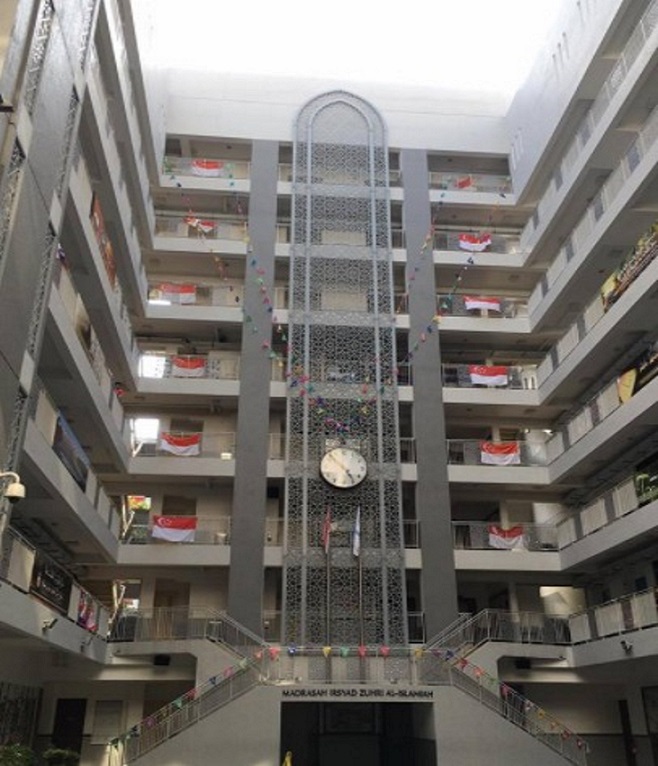
    But when I read a comment by some guy online about how Madrasah students only learn Arabic and English (not even Malay??) as if they are undergoing some kind of ‘Arab colonisation’, I felt the need to share more about what at least one of our local full time Madrasahs – Madrasah Irsyad Zuhri – is like.

    📙Admission 📁
    When the kids are in K2 (or at 6yo that year) in April, they will have to sit for an entrance test which comprise of written and oral papers for English, Maths, Malay and Arabic. Applications tend to exceed the number of vacancies available by more than 100%, so it is a very stressful test for parents actually! That half or less than half that got in really did by the Grace of God.

    📕 Curriculum 🗂
    At primary school, these are their subjects:
    ✏️English language (based on latest MOE syllabus, STELLAR and all)
    ✏️Mathematics (based on latest MOE syllabus)
    ✏️Science (based on latest MOE syllabus)
    ✏️Malay language (based on latest MOE syllabus)
    ✏️Arabic language
    ✏️Al Qur’an
    ✏️Tarbiyyah (Islamic knowledge, consisting of Islamic history, theology, jurisprudence and Islamic social studies – one per term)

    As for the first four subjects, MOE-approved textbooks and workbooks are used. The books for the Islamic subjects are locally published in consultation with and under the supervision of the Madrasah Education branch in MUIS.

    📗 Enrichment and CCA 🤗

    1. They have what they call ‘whitespace’ (2 periods) weekly, where they get to experience different activities (one per term, different progs for different levels) not limited to:
    📎 Art programmes
    📎 ICT lessons
    📎 Aikido
    📎 Gymnastics
    📎 Leadership programmes
    📎 Robotics
    📎 Sports and games
    and the list goes on

    2. After-school enrichment classes may include mathematical problem solving classes and English/Malay writing workshops, among others. There is also the Tahfiz (Quran memorisation) class that students can enrol in.

    3. A plethora of interesting CCAs are highly sought after and students even had to ballot to get a place in CCAs such as:
    👍 Archery
    👍 Junior Masterchef
    👍 Taekwando
    👍 A variety of sports – soccer, badminton, swimming, netball
    👍 Robotics
    👍 Khat (Arabic calligraphy)
    and a few others

    4. They are not left out in international/national competitions such as ICAS, Maths Olympiads, robotics competitions, Babble and Speak, etc.

    5. The P5 camps are usually in training centres/campsites in Malaysia for a more rigorous/interesting outdoor experience. I heard there’s also overseas CIP in the pipeline for them.

    6. Once or twice a year, the p3-6 students will have a 2D1N Mukhayyam, a spiritual retreat filled with motivational talks, reminders and night prayers (Tahajjud).

    📘Teachers 👩🏻‍🏫
    Teachers for the four PSLE subjects comprise of both NIE-trained teachers (ex teachers in MOE schools) and teachers trained in education from local and overseas universities/institutions. They also attend short courses/teacher conferences organised by NIE as well as publishers here. Teachers for the Islamic subjects are qualified ustazs and ustazahs who graduated from Islamic institutions/universities locally and abroad too.

    At this point, I must say I have much respect for all the teachers in the Madrasahs, for their sincere dedication and love for the students. If you already feel that the students are going through a lot, imagine the teachers! May Allah reward all the teachers with the best of rewards!

    📙 Assessments 📋
    The P1s and P2s have bite-sized assessments for English and Maths but CA1, SA1, CA2 and SA2 for all other subjects. Other levels have all four main assessments for all subjects. Yes, it is stressful for both kids and parents! 😅 But we survived, and will continue to survive these ‘tests’ on our mental and spiritual strength!

    📕 PSLE 📝
    The P6s will take the same PSLE papers for the four main subjects on the same dates and times as the other P6 students in Singapore. What I always admired is their love and care for the P6 students in terms of their spiritual, mental and physical preparation for the exams. Will share more when the time comes.

    PSLE results? 100% passes for a few years running and mean score has always been above national average, Alhamdulillah. May it continue that way, Aameen!

    📗School hours 🕢
    Assembly begins at 7.30 am but classes start at around 7.55 am. Lessons continue till 2.25 pm with 1 recess break (@ canteen) and 2 snack times (in class). At 2.25 pm, they proceed to the adjacent mosque for Zuhr prayers till about 3pm (on Fridays they join the mosque jamaah for Friday prayers and end the day after that). Yes, the kids are very tired (and hungry) at the end of the day, but as many Madrasah grads would say, these are the things (on top of the many subjects and assessments, and climbing of stairs) that mould them into stronger individuals. I pray the same for my children!

    Of course, the day does not end there when they have after-school activities/enrichment/CCA/remedial.

    They enjoy the same gazetted school and public holidays in Singapore.

    📘National Education 🇸🇬
    Here, students also learn to love their country. One of the chapters in their Arabic textbooks is about the late Mr Lee Kuan Yew, narrating his achievements in bringing up Singapore. In their annual Social Studies project, there was a year where the P2s did a scrap book on the different kinds of food unique to the different ethnic groups in Singapore. The P3s did on important landmarks/symbols of Singapore and the P4s did on past leaders of Singapore, with the aim of instilling love for the country. During the recently celebrated Racial Harmony Day, there was an inter-class competition which requires each level to decorate the classes according to a certain ethnic group in Singapore. These projects and programmes certainly raised their awareness about the different cultures and races in Singapore.

    📚📚📚🖇🖇🖇📚📚📚📐📐📐📚📚📚
    I hope this sharing creates more awareness on the kind of education our local full-time madrasah students are getting. There are different reasons why Muslim parents may decide to enrol their children in one – mine is a mixture of them all:
    📚To provide them with a holistic education which encompasses Islamic education as well – either to groom them into religious leaders with great foundation in academic knowledge, or into Muslim professionals grounded by their Islamic knowledge.
    📚To allow them to study in an Islamic environment.
    📚To allow them to wear uniform that properly covers what they need to cover once they reach puberty (we prefer to start young though).
    📚To provide them with more options/pathways in education in the future – be it the academic or religious pathway.

    What is clear is that, we have no intention of grooming them into narrow-minded, exclusive citizens or worse, into radicalised Muslims for whatever purpose. With the kind of education they are getting, I am more than confident that they can integrate well with the society and will be important assets to the nation too!

    The above is based on my knowledge of the system as a parent (please do NOT treat this as official info on the Madrasah!) If you are a staff from the Madrasah, pls feel free to comment on any inaccurate information and I’ll gladly edit it. (My apologies for sharing all these without consulting any of you!) While this information may not be representative of the other full time Madrasahs in Singapore, I believe that they largely operate in the same way. At least where the academic subjects are concerned 🙂.

    There are of course many other things about the Madrasah that I may not have shared here, but these are the basic info. May the Almighty continue to bless all Madrasahs with prosperity and progress!


    Source: Sri Aisyah

  • This Bro Was A Street Fighter, Now He’s A Top Graduate Of Singapore Poly

    This Bro Was A Street Fighter, Now He’s A Top Graduate Of Singapore Poly

    Growing up, Mr Muhammad Alfiz Kambali never took an interest in his studies. Due to troubles at home, he often found himself mixing with the wrong crowd and was a fixture in street fights during his teenage years.

    “Fights over various issues were common between my parents. The atmosphere was tense at home and I sought comfort in bad company,” said the former Bedok South Secondary School student. “Street fights served as a means to channel my anger.”

    Mr Alfiz, now 28, has come a long way since, emerging as one of the top graduates at Singapore Polytechnic (SP) this year.

    Last week, he graduated from the integrated events and project management diploma course with a perfect 4.0 grade point average (GPA), and was awarded the Tay Eng Soon Gold Medal and Cityneon Events Gold Medal.

    “I am not as young as my classmates, and I knew what I wanted to achieve when I enrolled in this course,” he said. “For me, I did not have the luxury of time to repeat or go back to school again. I knew that I had to put in more effort compared with my secondary school days in order to succeed.”

    Mr Alfiz left secondary school with an O-level certificate in 2006, but did not fare well at the national exam. He needed to retake some subjects in order to qualify for a polytechnic course. Finding it troublesome to do so, he decided to work instead.

    For two years before his national service commitment as a firefighter, he took up various jobs such as sorting letters and parcels, as well as working part-time at a coffee shop in Beach Road. After NS, he continued to work for another year.

    Desiring a better future for himself and his family, he eventually decided to go back to school.

    At 22, he did a Higher Nitec course in business studies (events management) at the Institute of Technical Education, where he graduated with a perfect GPA of 4.0.

    Mr Alfiz was motivated to further his studies, after seeing how hard his father worked to support the family. “I thought that I could do my part and help him,” he said.

    He took up the integrated events and project management diploma course at SP in 2014, at the age of 25.

    Unfortunately, his father died of an illness before Mr Alfiz could begin his polytechnic education. “It did affect me, and I was not sure if I should carry on with my further studies,” he said.

    “However, my family and friends encouraged me, and I carried on.”

    Despite receiving offers from Nanyang Technological University and Singapore Management University, Mr Alfiz plans to work first before pursuing further studies.

    He said work experience is important in the events management line. “Working also allows me to better utilise the skills I have picked up in the classroom,” he added.


    Source: www.straitstimes.com

  • Boys Sit At School Canteen Before Royal Rumble Breaks Out

    Boys Sit At School Canteen Before Royal Rumble Breaks Out

    This story was submitted via Web contribution form.

    Stomper Merketa sent Stomp a video showing a student assaulting another at what looks to be the canteen area of a school.

    In the video, both students can be first seen holding on to the hands of each other while sitting on a bench.

    One of them then prodded the belly of his counterpart who was bigger in size.

    Thereafter, the latter stood up and rained a series of punches on the other student, causing his spectacles to fall off.

    The victim fell to the floor, and his attacker proceed to sit on him hold him in a headlock with his legs after giving him a few more punches.

    Other students around the duo told the physically bigger student to stop, but he paid no attention to their calls and continued attacking his schoolmate.

    As he was doing so, he can be heard saying vulgarities and asking the victim to ‘tap out’.

    At the end of the video, the larger student got up and left the other on the floor.

    It is unclear what led to the fight or what happened thereafter.


    Source: www.stomp.com.sg

  • Teacher Calls Out Student For Racist Comments, Class Learns Meaning Of Majority Privilege

    Teacher Calls Out Student For Racist Comments, Class Learns Meaning Of Majority Privilege

    There are a few things I don’t abide in my classes.

    One of them is racism. Today in class I pulled a boy out of class because he called one of his classmates “死黒人” (it literally translates to “die black person” but colloquially it’s more accurately translated to “stupid black person”, and is typically used on people who have dark and tanned skin, not necessarily just African Americans).

    This kid was from a majority race in Singapore, and I called him out on it. I told him people of his race were literally being abused and faced racism daily overseas, and that he was taking advantage of the safe environment here where he’s one of the majority. I told him that saying sorry to his friend was not enough, that he shouldn’t do it again.

    Don’t we all know that’s not going to happen.

    So I addressed the class on this. Acknowledged that I have said racist things before years ago, and that I have also been the target of racism right here in sunny Singapore. And that if you can’t even respect your friends and peers (because that’s what it boils down to), then how can you expect others to respect you.

    Pretty sure most of it fell on deaf ears, given that they are a class that has trouble respecting themselves, and with very probable self-esteem issues.

    It is so, so painful to see the world the way it is. To see kids behaving that way because we as adults tell them (through our behavior and the words we say) that it is okay. That it is normal to have pre-conceived (negative) notions of what different cultures or races or ethnicities are, or do, or have. It is tiring and exhausting trying to re-educate these kids into thinking that everyone deserves respect.

    The very fact that we NEED to RE-EDUCATE them about that is, in itself, appalling.

    And no, this isn’t just at the secondary school level either. I had to address a similar issue while teaching a primary 2 class this morning, when they didn’t react to 2 ethnic dances I mentioned we would be learning, but started giggling and making noise when I mentioned the third.

    Every day I realize how broken our world is, and how we are the ones who broke it. But shouldn’t we also be trying to help fix it?

    Sarah
    A.S.S. Contributor

    Source: www.allsingaporestuff.com