Tag: education

  • Curse Of The Stanford Duck Syndrome

    Curse Of The Stanford Duck Syndrome

    When Stanford University medical student Tarub Mabud, 24, gets together with his fellow students, they never talk about how hard they study or the challenges they face with their course work.

    “It’s an unwritten rule, when you hang with med school friends, you don’t talk about med school,” he said.

    It has become part of the school culture for students to pretend to be gliding effortlessly through their courses, when they are actually paddling furiously to stay afloat.

    A term has even been coined for this behaviour: Stanford Duck Syndrome.

    While the syndrome is not a proven medical condition, the pressure to keep up appearances could cause students to feel added stress and, in extreme cases, develop mental health issues such as depression and anxiety, psychologists and counsellors told The Sunday Times.

    Stress in elite American universities, especially exacerbated by behaviour like the Stanford Duck Syndrome, has come under the microscope in recent weeks after Singaporean student Ouyang Xiangyu, 26, was charged with four counts of poisoning her lab mates at Stanford.

    She told police that she had been to see a counsellor and psychiatrist last year, and that she was suffering from depression, stress and insomnia.

    At the University of Pennsylvania (U Penn), a 19-year-old freshman committed suicide last year, and reports said her death was linked to the stress of having to maintain good grades. In February this year, her university, which launched a task force last year after two consecutive suicides, released a report which recommended addressing a perceived perfectionist culture among students.

    “Such perceptions may lead to pressures to succeed both academically and socially, that may be unrealistic and lead to feelings of being overwhelmed,” said the report.

    Students have also identified a phenomenon similar to the Stanford Duck Syndrome. Those with “Penn Face” put on a perfect front to hide any emotions – be it stress or sadness – that they might feel.

    But Mr Manud, the medical student who studied at U Penn before heading to Stanford in California, on the west coast, said he did not feel the pressure to keep up appearances on the east coast.

    “On the east coast, it’s a point of pride to not be sleeping – you’re a badass. Here, it’s different… There are times when people are going to feel stressed by work but have to keep up a facade.”

    Some students believe the Californian sunshine and the image of students wearing T-shirts and shorts make everyone feel like they should be calm and relaxed all the time.

    Said Ms Rachel Peters, a physical therapist who graduated from Stanford in 1997 and still works on campus: “You always see people in their bikinis on the lawn. They are lounging in their bathing suits, but they are actually studying.”

    While there are no studies to prove it, Vanderbilt University professor of psychology Steven Hollon said he “wouldn’t be surprised” by the east coast-west coast divide. “It would certainly fit the ambience,” he said.

    But “having to put up the image of perfection is just one more source of stress on top of the work load”, said Mr Kevin Kruger, president of Naspa, an association for student affairs administrators in higher education.

    Across the United States, an increasing number of college students are reporting severe mental health issues.

    Of more than 200 counselling centre directors who were surveyed in the National Survey of College Counselling Centres, 94 per cent said recent trends pointing to a greater number of students with severe psychological problems are apparent on their campuses. The centres also reported that 26 per cent of students were on psychiatric medication last year, up from 17 per cent in 2000.

    Many students “do not handle stress well”, said Ms Amy Lenhart, president-elect of the American College Counselling Association (ACCA).

    Part of it has to do with the different parenting styles that have emerged, she added.

    There are “helicopter parents” who hover excessively around their children tending to their every need, and “trophy kids” – a term used to describe the generation of children unaccustomed to failure – receiving a trophy even for participating in an event.

    “They don’t have the resilience and coping skills that previous generations have,” said Mr Kruger.

    “There is also pressure to get a good job because of the increase in tuition and student debt, which has added to the level of stress among students,” he added.

    A survey by the American College Health Association covering nearly 80,000 students and released last year showed that in the previous 12 months, 86 per cent of respondents felt overwhelmed, 54 per cent felt overwhelming anxiety and about 32 per cent were so depressed that they found it difficult to function.

    Mr Rusty Selix, executive director of policy and advocacy at the Mental Health Association in California, said stress is a major cause of depression and anxiety.

    “For busy graduate students, not getting enough sleep in itself can cause depression and anxiety,” he said.

    Another stress-inducing behavioural pattern that counsellors, psychologists and students raised is the “imposter syndrome”, a phenomenon found both in an academic and professional setting.

    It is a feeling of inadequacy often felt by bright, successful people, who believe they managed to fool others into thinking they are more intelligent than they believe themselves to be. As a result, they often fear being “found out”.

    Said Mr Francisco Gimenez, 28, a biomedical informatics graduate student at Stanford: “It was talked about a lot in the first year. You feel you’re not good enough, seeing everyone else doing amazing things.”

    “Many feel like they do not belong, or they are not worthy, especially those in elite schools,” added Mr Kruger.

    ACCA’s Ms Lenhart said this might be more pronounced now because of social media, where young people are “constantly being evaluated by their peers and they feel like they are under a microscope”.

    But students should never feel like they have nowhere to turn to.

    Ms Lenhart said schools have outreach programmes to make sure students know of the counselling services available, and there is also the National Depression Screening Day, which is an opportunity for students to connect with counsellors for treatment.

    A therapist can help students recognise negative thought processes and encourage them not to isolate themselves.

    “They need to know feelings of depression are real – it is not something just in their heads,” said Ms Lenhart.


    Source: www.straitstimes.com

  • Chee Soon Juan: Let SDP Reform And Modernise Education System

    Chee Soon Juan: Let SDP Reform And Modernise Education System

    Our schoolchildren are driven to psychological despair as they struggle to cope with their schoolwork and exams: 22% of Singaporean children between 6-12 yrs thought of killing themselves. Many children actually commit suicide as a result.

    Of those who survive, the majority are conditioned to hate books because they associate reading and learning with exams. Experts warn that such a system deprives society of creativity and innovation, hurting our economy in the longer term.

    Even PAP MPs have voiced their concerns about the tuition culture but have not the courage to point out that it is the education system put in place by their party that is driving parents and pupils to such desperate lengths.

    If elected, SDP MPs will work to reform and modernise our education system which is stuck in the past.

    The recent mathematics question, now popularly called the Cheryl’s Birthday problem, seems to have amused (and stumped) the world. It first appeared on the Internet when it was reported as primary 5 level question.

    The problem is that such difficult questions are not a rarity in exam questions for primary schoolchildren. These questions are meant to identify top performing students so that the Government can groom them for high-paying state positions.

    Such a narrow practice of education feeds the fear in parents that their children’s future well-being is tied to doing well in exams. This drives them to absurd levels of expectations where they engage expensive private tutors to help their children perform – even to the extent of engaging tutors to do their children’s homework.

    The MOE is only too happy to allow such a system to carry on because the billion-dollar tuition industry enables it to out-source the teaching of pupils to the private sector.

    All this comes at a horrendous price. Our schoolchildren are driven to psychological despair as they struggle to cope with their schoolwork and exams:

    • 22% of Singaporean children between 6-12 yrs thought of killing themselves.
    • The no. of children warded for “aggressive, suicidal or hallucination tendencies” at IMH jumped by 35% between 2005-2010. Mental health professionals attribute these problems to academic stress.
    • One in three students say they sometimes think that life is not worth living because of the fear of exams.

    Many children actually commit suicide as a result. One is 10-year-old Lysher Loh who jumped to her death when she fared poorly in her mid-year exams. (Read Why do we do this to our children?)

    Of those who survive, the majority are conditioned to hate books because they associate reading and learning with exams. Experts warn that such a system deprives society of creativity and innovation, hurting our economy in the longer term.

    In fact, studies show that overloading our pupils with work and tuition harm, rather than help, their school performance and acquisition of life-skills.

    Even PAP MPs have voiced their concerns about the tuition culture but have not the courage to point out that it is the education system put in place by their party that is driving parents and pupils to such desperate lengths.

    Let’s stop the madness already. If elected, SDP MPs will work to reform and modernise our education system which is stuck in the past. Specifically, we will:

    1. Remove PSLE. As pointed out, the stress of exams inflict horrific psychological trauma on our children. What’s more, it is not an intelligent approach to assess the abilities of primary-school students on a single exam.

    2. Cultivate creative minds. Build confidence in children by helping them adopt an attitude of independent thinking, willingness to make mistakes, and persevere in the face of failed attempts.

    3. Reduce syllabus, broaden curriculum. The syllabi for existing subjects will be reduced while subjects such as music appreciation, speech and drama, literature, etc. as well as periods for students to collaborate and interact to develop creativity will be introduced to provide a well-rounded curriculum.

    4. Reduce class size. The SDP will reduce class size in our schools to 20 pupils/class from the current 40 to provide students the individual attention they need to succeed.

    5. Scrap school and class ranking. Comparing exam results and ranking students and classes will detract from the real purpose of education which is self-improvement and self-actualisation.


    Source: http://yoursdp.org

  • Rote Learning Is Not The Way To Learn Science

    Rote Learning Is Not The Way To Learn Science

    From ‘Only one right answer to science questions?’23 Feb 2015, article by Amelia Teng and Pearl Lee, ST

    EXPLAIN how the hard, bony body of a seahorse could be an advantage. The right answer, according to one Primary 6 science teacher, is: “It protects the seahorse from injury and reduces the chances of predators successfully feeding on it.”

    But the child who wrote “It acts as an armour that protects the seahorse from predators” was told that her answer was wrong. This was one of several examples thrown up by parents, who have complained recently that primary school science teachers are too rigid in marking open-ended questions, and are emphasising rote learning over the understanding of concepts.

    This, despite schools having shifted to an inquiry-based learning approach in science since 2008. With the approach, pupils are encouraged to ask questions, analyse data and come to their own conclusions.

    Several parents wrote to The Straits Times Forum page earlier this month, calling for schools to be more flexible. Most said their children were unduly penalised for answers that had the same meaning as the correct ones, but did not contain the right “key words”.

    The children had been told by teachers to stick to key phrases and words found in textbooks, in order to get full marks in assignments or tests.

    Here’s another Primary 3 head-scratcher for you:

    What is the difference between a bird and a lion?

    If you said the ‘bird has feathers but the lion does not’, you’re wrong. You’re also wrong if you said ‘The bird can fly but the lion can’t’, ‘birds evolved from flying dinosaurs but not lions’, or even ‘birds poop on cars but lions poop on the ground’ (assuming the question involves you staring at a picture of a bird and a lion). The correct answer, according to a parent complaining to the ST Forum earlier this month (‘Good science=Poor English’, Feb 5 2015) is ‘The bird has feathers but the lion does NOT HAVE FEATHERS’, which basically means the same damn thing as your original answer, except annoyingly repetitive. (Well if you want to be even more specific: a bird has feathers but a lion has fur, not feathers).

    Clearly, the student knows what he’s talking about, that a lion does not have feathers, but the science teacher here doesn’t give a hoot about your ‘understanding’ if it does not fit into the template answer scheme, even if the same statement in a composition about bird and lions would make your English teacher squirm in her seat, and accuse you of trying to make up the 500 word quota with redundancies. The parent summed it up perfectly in his letter: “Is there rigidity in the teaching of science? It would certainly appear so (that there is rigidity in the teaching of science)”. Take that, Rigidity!

    Not convinced that teachers can be anal about science answers? Here’s another puzzler on animals.

    You could be thinking of the following possible answers:

    1) Both the bull and the lion give birth to their young
    2) Both the bull and lion poop and pee
    3) Both the bull and lion can kill you
    4) Both the bull and lion are mammals

    ALL OF THE ABOVE ARE WRONG. (The answers are ‘4 legs’, ‘have hair’, or ‘similar body shape’ i.e something you can actually see from the illustration). The thing that you should be staring hard at isn’t the actual drawing, but the phrase ‘STUDY the animals BELOW’. Gotcha.

    Let’s up the ante with a dreaded multiple choice question about the properties of a light bulb.

    Now read the last option carefully before you make your choice. If you chose ‘all of the above’, you are interpreting D as ‘the bulb lights up only when electricity passes through it’. If you chose ‘A, B and C’ you read it as ‘light energy is the only energy that is given off when electricity passes through it’. The correct answer happens to be the latter. Answer D, in the spirit of the other animal questions, happens to be the grammatical equivalent of the rabbit/duck gestalt optical illusion. Given the ambiguity of this shitty question, no student should be penalised for seeing a rabbit when the answer scheme says duck.

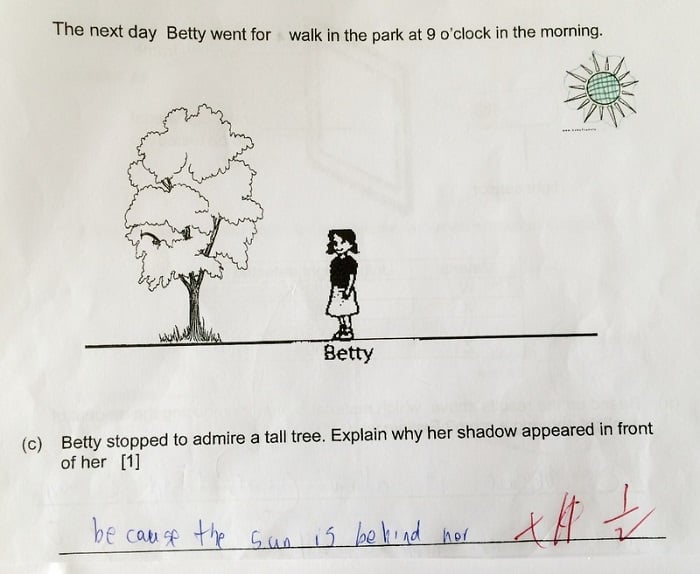
    Do you know how a shadow is formed? Here’s one student’s answer to a puzzle that has tickled the intellect of many an ancient Greek philosopher.

    The complete answer is ‘Because the sun is behind her and she is blocking the path of the light’. You know what this obsession with ‘complete’ answers will do to our kids? They’ll never be able to complete their paper on time because they’d want to add details like ‘because light travels in straight lines and Betty is an opaque human being and she will generate a penumbra and umbra depending on the angle and intensity of the sunlight’. Just to play safe. Except that some teachers will still mark you wrong for ‘trying to be clever’ when penumbrae and umbrae are not taught until you’re in secondary school. If you mention anything about photons or the particle-wave duality you may be suspended from school altogether.

    But back to the seahorse question. If I were grading the student I’ll not only let it go, I would also give her BONUS marks for using her imagination and drawing a figurative analogy between ‘hard skin’ and ‘armour’. By our school standards, this paper published in the rather obscure ‘Acta Biomaterialia’ journal is pure BULL. Its title?Highly deformable bones: Unusual deformation mechanisms of seahorse armor(Porter et al).

    All this nitpicking over ‘key words’ will not only kill our children’s love for science, but also restricts how individuals grasp concepts, punishing those who, well, ‘think outside the box’. A student who sees beyond 4 legs and digs deeper into the taxonomic characteristics of mammals vs birds is given zero marks vs another who memorises ‘key words’ because his tuition teacher said so. Flowery language, like ‘armour’, is not ‘scientific’ and has no place in a science paper, they say. Well try describing DNA to laymen without ‘unscientific’ analogies like zippers and enzyme/cell receptor interactions without using ‘lock and key’.

    Final question: What’s the difference between a robot and a typical Singaporean Science student?

    Answer: The robot needs electricity to recharge but the student does not need electricity to recharge.


    Source: http://everythingalsocomplain.com

  • Pelajar Madrasah Al Arabiah Al Islamiah Nurul Iffah Baharudin Cemerlang Di Peringkat GCE ‘O’

    Pelajar Madrasah Al Arabiah Al Islamiah Nurul Iffah Baharudin Cemerlang Di Peringkat GCE ‘O’

    LIMA tahun lalu, Nurul Iffah Baharudin muncul sebagai pelajar terbaik Madrasah Al-Arabiah Al-Islamiah bagi Peperiksaan Tamat Sekolah Rendah (PSLE) dengan agregat 244 mata.

    Tahun ini, beliau mengulangi pencapaian cemerlangnya dengan menjadi pelajar terbaik madrasahnya bagi Peperiksaan Sijil Am Pelajaran (GCE) Peringkat ‘O’.

    Anak sulung lima beradik itu meraih gred enam mata bagi L1R4 (untuk kemasukan ke politeknik) dengan lapan kepujian.

    Nurul Iffah, 16 tahun, mendapat gred A1 bagi Matematik, Bahasa Arab, Sains Gabungan, Bahasa Melayu dan Pengetahuan Agama Islam (IRK) serta gred A2 bagi Bahasa Inggeris, Matematik Tambahan dan Geografi.

    Keputusan cemerlang itu adalah hasil ketekunannya mengulang kaji pelajaran selama tiga jam setiap malam bukan setakat dari awal tahun lalu malah dari sejak memulakan pengajian di sekolah menengah.

    “Saya pastikan saya mengulang kaji pelajaran secara konsisten.

    “Saya akan pastikan saya belajar setiap hari dari 7 hingga 10 malam. Saya akan turut mengikut jadual pembelajaran ini pada hujung minggu kecuali jika saya tiada di rumah,” kata anak pasangan pembantu juruukur dan suri rumah itu.

    Nurul Iffah, yang mendapat tempat pertama di dalam kelas bagi setiap peperiksaan sejak menengah satu berkata beliau tidak meletak apa-apa sasaran bagi peperiksaannya namun berharap melakukan yang terbaik agar dapat memasuki politeknik.

    Beliau ingin melanjutkan pengajian dalam bidang perakaunan atau sains kerana meminati Matematik dan Sains.

    Nurul Iffah, yang mengikuti kelas tuisyen bagi mata pelajaran Bahasa Arab, berkata ramai orang, terutama ibu bapanya, menjangka beliau akan mengulangi kejayaan yang diraih dalam PSLE dan muncul sebagai pelajar terbaik madrasahnya sekali lagi.

    “Tahun lalu, pelajar terbaik dari Madrasah Al-Arabiah Al-Islamiah, yang juga pelajar madrasah paling cemerlang, mendapat gred A1 dalam lapan mata pelajaran. Ibu bapa saya menggalakkan saya cuba mendapat keputusan serupa. Saya tidak berasa tertekan sebaliknya menganggap ia satu motivasi,” katanya.

    Nurul Iffah kini bekerja sebagai pembantu guru tadika sementara menunggu keputusan kemasukan ke politeknik.

    Beliau bercita-cita menjadi guru sekolah menengah dan mengajar mata pelajaran Matematik atau Sains kelak.


    Source: http://beritaharian.sg

  • Tommy Koh: I Am Disturbed By The Inequality In Singapore

    Tommy Koh: I Am Disturbed By The Inequality In Singapore

    Dr Tommy Koh has revealed that the poverty rate in Singapore can be as high as 33 percent in Singapore and 60 percent of university students come from families which cannot earn enough to survive.

    “I am disturbed by the inequality in Singapore,” Dr Koh wrote in an opinion piece in The Straits Times on Jan 3.

    “We have one of the highest Gini coefficients in the world. I am unhappy that many of our children are growing up in poverty. About a third of our students go to school with no pocket money to buy lunch.”

    Indeed, the poverty rate in Singapore has been estimated to be as high as 30 percent. National University of Singapore economist Tilak Abeysinghe has also calculated that 30 percent of Singaporeans cannot earn enough and have to spend 105 percent to 151 percent of their incomes.

    “As a trustee of two education trusts, I am reminded each year of the large number of needy students in our schools and tertiary institutions. I was shocked when the president of one of our universities told us recently that 60 per cent of his students need financial assistance,” Dr Koh also said.

    Indeed, a Straits Times survey had shown that two-thirds of middle-income households in Singapore are able to earn enough only to spend on basic necessities and nothing else.

    “At the other end of the spectrum, I am worried about the growing number of the elderly poor. Many of them are in poor health and have inadequate savings. Many of them live in loneliness, having no family or been abandoned by family and relatives,” he said.

    It is indeed the case that over the past few years, there have been a growing number of stories of how older Singaporeans have chosen to die because they cannot afford their medical fees.

    What Dr Koh say is not new but it is the first admission from someone who is close to the establishment to have detailed these facts.

    Today, Singapore has risen to become the most expensive country and city in the world.

    But Singaporeans still continue to earn one of the lowest wages among the developed countries in the world. In fact, there is still no minimum wage in Singapore – one of only 10 percent of countries in the world not to have one.

    In 2012, Dr Koh also wrote in an article comparing the GDP per capita of Singapore with the Nordic countries. Singapore’s GDP per capita was on par with the Nordic countries, but wages are drastically different.

    Dr Koh revealed that cleaners in Singapore would only earn $800 when cleaners in the Nordic countries would earn between $2,085 to $5,502, or several times more.

    However, because Singaporeans also have to pay for the highest cost of living in the world, this has also meant that Singaporeans have the lowest purchasing power among the developed countries.

    Dr Koh had then also written, “The truth is that we pay these workers such low wages not primarily because their productivity is inherently low, but largely because they are competing against an unlimited supply of cheap foreign workers.

    “The solution is for the State to reduce the supply of cheap foreign workers or introduce a minimum wage or to target specific industries, such as the hospitality industry, for wage enhancement.”

    It is debatable whether the government has done so. The government has said that the basic wages of cleaners will be increased to $1,000 every month and for security guards, this will be increased to $1,100 but the new base salary will only take effect in 2016 for the latter.

    However, critics argue that $1,000 or $1,100 is still insufficient when Singaporeans have estimated that a minimum wage of $1,700 or more would be necessary to have the most basic of living in Singapore.


    Source: www.therealsingapore.com