Tag: emergency

  • Khoo Teck Puat Hospital: Sister Is Not Family, Get Out Of A&E Room

    Khoo Teck Puat Hospital: Sister Is Not Family, Get Out Of A&E Room

    Dear A.S.S. Editors

    Here’s the story about my terrible experience at KTPH. My Brother was rushed to the A&E at KTPH due to high fever, severe vomiting and chest pains. We arrived at the Hospital at 4am. While waiting, my Father asked the nurse “around what time can my Son see the doctor?” And the nurse simply glared at him and walked away.

    My Brother was still vomiting non stop and had hyperpehia due to severe pains. Did X-ray and blood test. Doctors couldn’t diagnose the problem and suspect that it is food poisoning and said that maybe can be discharged at 4pm.

    At 9am, my Brother was finally warded to the EDTU and put on IV drip. My brother’s right hands were ice cold so we asked the nurse, and the nurse said “you touch my hand, my hand also very cold.” laughed and left. So we had no idea what was going on and we waited patiently for the results.

    Finally at around 5pm, results came out. Doctor say it might be food poisoning but it cannot be confirmed. What? Then, proceeded to say that his white blood count is too high and have to do blood test again. Cannot be discharged and have to stay until tomorrow morning for further observation.

    At around 8pm the doctor said that the test results are out, the blood count has been reduced slightly but not enough to be discharged. And the x-ray shows that my Brother’s left shoulder is dislocated and have to do second x-ray. What?

    Brother was then wheeled to do the second x-ray and then the x-ray was cancelled because another doctor said it wasn’t necessary because it is just “flexible joints” and my Brother can be discharged. And that we had to wait 1 hour to get the MC and the discharge summary.

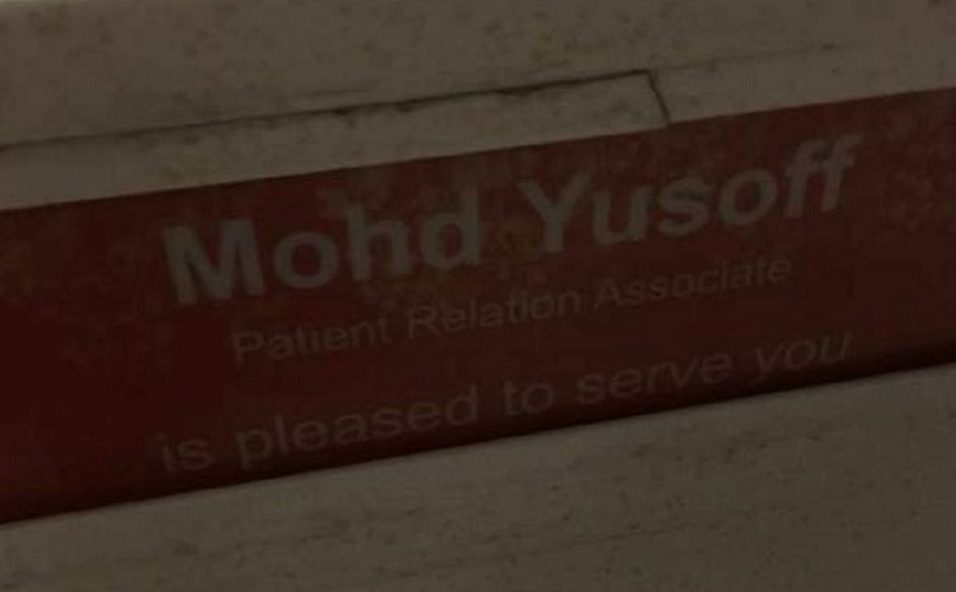
    While waiting, A&E patient relation associate Mohd Yusof came in and suddenly asked my Mother if she’s the parent. Then he asked me “who are you?” I said I’m the Sister. He said “Sister is not family, you get out” So I said “huh? Sister is family. We are waiting for him to be discharged, he will be discharged soon.” And he said “no, Sister is not family, you get out. doctor can just talk to the Mother”

    So I had to wait outside because apparently “Sister is not family” at Khoo Teck Puat Hospital. Absolutely ridiculous. Terrible terrible experience at KTPH and will never go back again.

    Upset Family Member
    A.S.S. Contributor


    Source: www.allsingaporestuff.com

  • Malaysian PM Najib Razak Calls Trip To Hawaii “Golf Diplomacy”

    Malaysian PM Najib Razak Calls Trip To Hawaii “Golf Diplomacy”

    KOTA BARU (THE STAR/ASIA NEWS NETWORK) – Malaysian Prime Minister Najib Razak has explained that his private trip to Hawaii to meet US President Barack Obama was a diplomatic gesture that will benefit the country.

    Mr Najib said there was nothing unusual about the trip and described it as “golf diplomacy”.

    “This has been a common practice even by previous prime ministers including during Tunku Abdul Rahman’s administration.

    “I was personally invited by Obama and it is hard for me to turn it down as it has been scheduled much earlier,” he told a news conference at Sultan Ismail Petra Airport on Saturday.


    Source: www.straitstimes.com

  • The PAP’s “aim number one” 60 years ago

    The PAP’s “aim number one” 60 years ago

    The People’s Action Party (PAP) was formed on 12 November 1954.

    This year thus marks the party’s 60th anniversary.

    According to the PAP Facebook page:

    “Lee [Kuan Yew] formed the socialist People’s Action Party (PAP)… with a group of English-educated middle-class colleagues and pro-communist trade unionists…”

    The next year, 1955, the PAP nominated five candidates for the Legislative Assembly elections. Described as “action candidates” by The Singapore Free Press then, four of the five were:

    actioncandidates

    And before the PAP was officially formed, in fact one month before – on 28 October 1954 – the Straits Times reported the party’s aims as a political organisation.

    The Straits Times reported the PAP’s “aim number 1” as:

    “The repeal of the Emergency Regulations heads the list of aims and objects of the People’s Action Party…”

    The PAP, however, never did repeal the Emergency Regulations.

    The Emergency Regulations were the precursor to the Internal Security Act (ISA) which the PAP Government, after it came into power, used to arrest and jail its political opponents, including those which it had partnered with – such as the “pro-communist trade unionists” – when it formed the party.

    According to this online entry:

    British colonial Malaya introduced the Emergency Regulations Ordinance 1948 on 7 July 1948 during the Malayan Emergency in response to a Communist uprising and guerrilla war. The regulations allowed the police to arrest anybody suspected of having acted or being likely to act in a way that would threaten security without evidence or a warrant, hold them incommunicado for investigation, and detain them indefinitely without the detainee ever being charged with a crime or tried in a court of law.

    The successor to the Emergency Regulations Ordinance, the Preservation of Public Security Ordinance 1955 (“PPSO”), was introduced a result of the 1955 Hock Lee bus riots by the Labour Party government in Singapore. There was strong opposition to the PPSO by the party then in opposition, the People’s Action Party (“PAP”).

    In 1958, Lee Kuan Yew of the PAP accused the Lim Yew Hock government of using the PPSO to stifle political dissent.

    In 1960, three years after Malaya’s independence, the Emergency was declared over. However, the Malayan Internal Security Act 1960 (“ISA”) was passed in place of the PPSO with much of the same powers. During parliamentary debates on the Act, Malayan Prime Minister Tunku Abdul Rahman stated that the ISA would only be applied against only the remaining Communist insurgents. The Malayan Communist Party and its insurgents eventually surrendered in 1989.

    Nonetheless, the ISA was retained in Malaysia.

    The drafter of the Malayan ISA was Hugh Hickling, a British lawyer, author and professor.

    In 1989, he commented that he “could not imagine then that the time would come when the power of detention, carefully and deliberately interlocked with Article 149 of the Constitution, would be used against political opponents, welfare workers and others dedicated to nonviolent, peaceful activities”.

    Nonetheless, he commented that he supported review of the ISA but it was not for him to say if the law should be scrapped, as “you’ve got a multi-racial society [in Malaysia] in which emotions can run high very quickly”.

    When Singapore joined the Federation of Malaya in 1963, the Malayan ISA was extended to Singapore. The Act was retained in Singapore even after its separation from Malaysia in 1965. The current version of the Act is known as Chapter 143 of the 1985 Revised Edition.

    In 1991, then deputy prime minister Lee Hsien Loong said the government “will seriously consider abolishing the Internal Security Act if Malaysia were to do so”.

    Source: National Library Archives

    In September 2011, Malaysia announced that it was repealing the ISA.

    A month after Malaysia’s announcement, Singapore’s deputy prime minister Teo Chee Hean, told Parliament on 19 October 2011, that “[for] the foreseeable future, Singapore will need a law containing provisions like those in the ISA, including preventive detention, to empower the Government to pre-empt and prevent serious threats to our security.”

    “The precise form the law takes may evolve with time and circumstances,” he said. “But for the present, the ISA is a shield that we need that protects us against these threats, allowing us to deal with them swiftly and effectively before they cause us serious and possibly permanent harm.”

    The PAP’s “aim number 1” at its founding – to repeal the security laws – thus remains unfulfilled.

    Among the PAP’s other pledges at its founding 60 years ago was “[the] restoration of the right to assemble in public; for any purpose that does not intend force’.”

    Public assembly in Singapore remains banned, unless a police permit is granted.

    Straits Times, 28 Oct 1954

    Straits Times, 28 Oct 1954


    Source: www.theonlinecitizen.com
  • Local Malay Supports Barisan Nasional Blames His Ancestors for M’sia-SG Separation

    DO YOU AGREE WITH THE AUTHOR WHO BLAMED HIS MALAY ANCESTORS FOR MALAYSIAN-SINGAPORE SEPARATION?

    395145_342944102470425_605289139_n


    https://www.facebook.com/wall.shafieeamir
    https://www.facebook.com/wall.shafieeamir

    SHOULD WE BLAME OUR ANCESTORS? OR SHOULD WE BLAME BOTH SINGAPORE AND MALAYSIA FOR THE SEPARATION?

    On Aug 7, 1965, both parties signed the separation agreement. It was ratified at an emergency sitting of the Malaysian Parliament, which was hurriedly convened on Aug 9. In Singapore, at a televised press conference on the same day, Lee said the separation was for him “a moment of anguish”. He was so “emotionally affected” he broke down in tears, and the conference was terminated.

    procla_01
    http://www.nas.gov.sg/archivesonline/article/proclamation-of-singapore
    procla_02
    http://www.nas.gov.sg/archivesonline/article/proclamation-of-singapore
    http://www.malaysianbar.org.my/echoes_of_the_past/the_separation_of_singapore.html
    http://www.malaysianbar.org.my/echoes_of_the_past/the_separation_of_singapore.html


    Source: The Malaysian Bar, National Archives Singapore