Tag: employment

  • Fake Diplomas And Degrees From Real Malaysian Universities Being Sold At RM1,000 To RM3,000

    Fake Diplomas And Degrees From Real Malaysian Universities Being Sold At RM1,000 To RM3,000

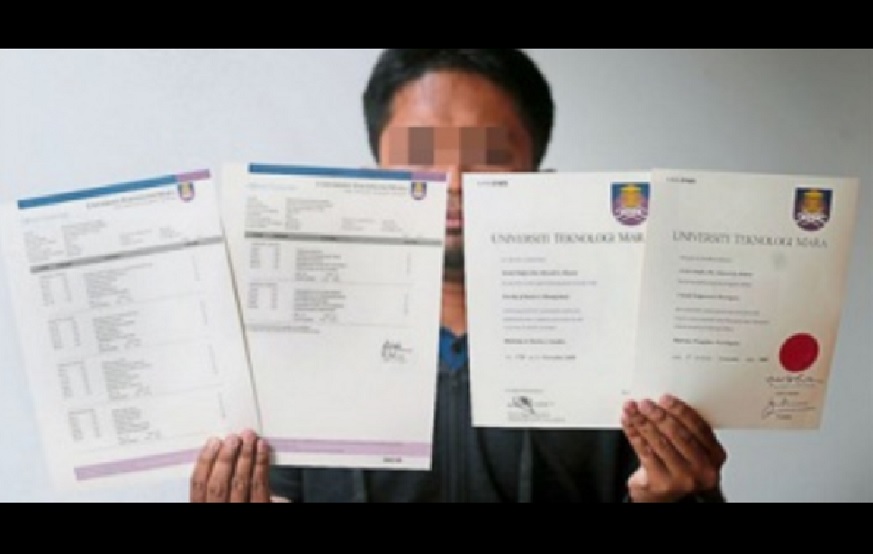
    A syndicate operating in Puchong, Selangor, has been selling fake academic scrolls to the public, according to an expose by the China Press (2 Oct).

    A reporter from the newspaper went undercover as a potential buyer and contacted the syndicate that had been blatantly promoting its services on Facebook.

    The syndicate is offering fake certificates from Universiti Teknologi Mara (UiTM) and SEGi College.

    According to China Press, a fake diploma scroll from UiTM is sold at RM1,000 and a forged degree scroll at RM2,000. It charges RM2,000 for a phony diploma, RM3,000 for a forged degree or a fake Master’s Degree from SEGi.

    The syndicate claimed that the fake certificates are bilingually produced and they bore the seal of the institution as well as the signature from the chancellor.

    Customers can choose from 30 programmes available at the universities and they will receive a scroll plus a transcript in two days. The fabrication process only takes two hours and the package will be delivered a day after via mail.

    Customers are warned that the fake certificates are only good for employment in the private sector. “This is because government departments are strict, they will look into everything. You should know that your fake academic qualifications are not in the system, since the certificate you’re holding is fake,” the syndicate said.


    Source: http://www.thesundaily.my

  • Chee Soon Juan: Taking Us Over The Cliff

    Chee Soon Juan: Taking Us Over The Cliff

    HERE’S A SENTENCE that risks boring you to tears if only because you’ve read it so often: Technological advancement is taking place so rapidly that entire industries, not just jobs, are going under.

    But before you roll your eyes and yawn, understand this: Unless you’re the guy sitting at the top of the system that makes the rules and I mean at the very top your posterior is going to be the one closest to that boot marked ‘RETRENCHMENT’.

    Focus for a minute: Uber is going with driverless taxis, Deliveroo is looking to using drones to make its food deliveries, and MacDonald’s is experimenting with automation to let customers create their own burgers. Property agents, stock brokers, receptionists, cashiers and sales assistants are becoming surplus to requirements as buyers and sellers directly transact their business through the Internet.

    Even higher-end professionals like accountants, lawyers and medical professionals are not in the safe zone: Sophisticated tax software will eliminate the need for accountants, court cases can be fought with the employment of artificial intelligence in place of attorneys, and surgeons replaced with robots which can carry out intricate operations at lower costs.

    The discussion is not whether workers are replaceable but how rapidly the process is taking place. In 1998, the Kodak Co. employed nearly 150,000 workers. Today, Facebook, managing how we share photographs through Instagram, has only 10,000 employees – about 7% of what Kodak used to employ. In the 1970s, the American communications giant AT&T had 750,000 employees under its belt. Today, Google dwarfs it in market value but hires only 55,000 people.[1]

    The way things are trending, huge swathes of the population are going to be rendered workless resulting in an increasingly jobless economy. When that time comes (and it’ll be sooner than you think), the idea of a Universal Basic Income would have to be contemplated. But that is a discussion for another occasion. (In the meantime, read Alex Au’s discussion on this topic here.)

    Not only is the world changing, the pace is also quickening. Today’s Google, it’s executives fret, could become tomorrow’s ‘there once was this giant corporation’ story if the company does not constantly innovate.

    Progress is driven by the obsession to develop new technology – an obsession embedded in the cultures of advanced economies where freedom of thought fuels debate and creative destruction.

    Falling behind

    Think about it. Now think about Singapore.

    We are neither productive nor innovative; we make nothing that the world wants to buy. Yes, we’retops when it comes to using technology but that’s not what is going to make us competitive. The fact that we – to adopt the commonly used slang – suck at inventing new technology is what is going to be our undoing.

    We’re falling behind and, with each passing year, going to fall even further behind if nothing changes.

    What can we do? More immediately, what should we not continue to do? For one thing, let’s stop cobbling together committees made up of establishment folks, conducting discussions in PAP echo-chambers and writing fanciful reports that say much but achieve little.

    ​It was the Economic Review Committee in 2003, the Economic Strategies Committee in 2010 and the Committee for Future Economy in 2017. Each one liberally employed buzzwords like ‘innovation’ and ‘entrepreneurship’ and ‘knowledge economy’ as if merely repeating them will magically transform our economy.

    The groupthink meant that what’s really needed to cultivate an innovative culture – one, dumping the state-dominated economic model, two, reforming the media, and, three, revamping the painfully out-dated education system – were not examined.

    Whistling past the graveyard

    On the first point: In an economy whose domestic sector is overwhelmed by Government-linked companies (GLCs), how are entrepreneurs going to emerge?

    The sector comprises several hundred conglomerates and their subsidiaries and employs tens of thousands of workers. But surveys tell us that GLC executives do not possess the requisite leadership skills especially when it comes to taking risks and motivating workers.[2] Is it any wonder then that our labour productivity grows sideways?

    To top it off, the overall performance of the sector is largely inscrutable, that is, until they go bust (Neptune Orient Lines) or come close to it (Keppel Corp and SembMarine).

    The argument that GLCs are a viable and necessary part of the corporate landscape is borne more out of the PAP’s autistic pronouncements than hard evidence. The case for Temsek Holdings to divest its portfolio has never been more pressing.

    Yet, the government’s strategy seems to be one of whistling past the graveyard.

    A secret formula?

    The mass media is another area in need of a desperate makeover. The PAP is, however, betting the farm that it can transform Singapore into a society on the cutting edge of research and innovation while clinging onto 1960s standards of state censorship and citizen intimidation.

    Maybe it knows the secret formula to squaring this circle. But with ministers telling us that flooding on our roads is a once-in-50-years phenomenon, we shouldn’t hold our breaths.

    If we are going to nourish creativity, we must upgrade minds. If we are going to upgrade minds, we must discard state control of the media. We must encourage open exchange of ideas, intelligent debate, free expression and questioning minds.

    How long more are we going to delude ourselves and deny the fact that the most innovative societies are also the most open and democratic ones?

    (The third area that needs reform is our education system which I discuss here and will not repeat in this essay.)

    There is a steep price to pay if these reforms are not undertaken soon. Even if a political epiphany miraculously descends upon the PAP today and its leaders awake to implement the much-needed changes, it would take another generation for results to actualise.

    Yet, where there should be urgency, only calm pervades. It is, tragically, the calm of a sedated populace, and it is in this state that we will walk over the cliff with the PAP.

    1. People get ready: The fight against a jobless economy and a citizenless democracy, Robert W McChesney and John Nichols, 2016, Nation Books, New York.
    2. 40% of S’pore workers rate their bosses low: study, The Business Times, 1 October 2004


    Source: www.cheesoonjuan.com
  • New Mom Returned From Maternity Leave Only To Be Forced To Resign, MOM Powerless

    New Mom Returned From Maternity Leave Only To Be Forced To Resign, MOM Powerless

    Dear Gilbert,

    I have just return from my maternity leave and was told by my boss that I will be handling more decision making work. I enquired about my appraisal report and bonus and she mentioned that it was submitted.

    However, on Monday when I went back to work I was informed by my HR manager that company is laying me off. I will be terminated by the Company. This totally came as a shock to me. I asked for the reason of this decision but she was unable to tell me. When I enquired about my bonus due to me she could not give me an answer too.

    I have spoken to MOM regarding my case and there’s nothing much that MOM indeed can do. My horrid Company has turned the scenario around now and instead of terminating me, they force me to sign a Resignation letter stating I request to resign immediately and Company has agreed.

    This also needs me to pay the Company 1 month’s notice! Company has issued me a bonus (which is actually a payment in lieu to me for terminating me immediately).

    Upon reading MOM’s reply to me, I was feeling helpless hence in such situation without aid, I have to just agreed to their terms or risk not getting my notice payment in lieu. I have to stress that no additional compensation was offered to me apart from the notice period payment in lieu.

    My manager stressed to me that I either accept the Termination letter or risk not receiving the 1 month’s notice payment in lieu. She also mentioned going to MOM is useless. As what they did is all in line with the MOM’ legislation, which they have seek their lawyer’s advice.

    I agree to shaming this Company so that other local job seekers will not fall prey to this Company, terminating people at whim especially when they are near to getting their anniversary bonus. However, I am worried that this might involve me in a possible lawsuit.

    Rgds,

    Jasmine


    Source: www.transitioning.org

  • Technicians, Engineers, Among Hard-To-Fill Job Positions

    Technicians, Engineers, Among Hard-To-Fill Job Positions

    More employers are having problems filling job vacancies, a worldwide survey has found, reflecting the mismatch in jobs and skills that government leaders recently highlighted while addressing the rising number of layoffs.

    The Talent Shortage Survey, released on Tuesday (Oct 18) by workforce solutions provider ManpowerGroup, showed that sales representatives, engineers, technicians, accounting and finance professionals, as well as drivers are the top five jobs in Singapore that are not being taken up.

    More than 42,000 employers in 42 countries were surveyed and 40 per cent of them have trouble filling jobs — the highest level in nine years.

    Slightly more than half of the employers here (51 per cent) reported facing difficulty in filling jobs, a jump of 11 per cent from last year, the survey showed.

    (Click to enlarge)

    These employers said that the top reason for that is the job-seeker’s lack of experience (22 per cent), or the candidate was looking for more pay than offered (21 per cent), or there was a lack of or no applicants (17 per cent).

    To address this shortage, 52 per cent of the employers here are offering training and development to existing workers, ManpowerGroup said in a press release, while 47 per cent are paying higher salary packages to recruits.

    The Government’s latest labour market report showed that there were more job-seekers than the number of job vacancies available, and in the first half of the year, professionals, managers, executives and technicians made up about 56 per cent of layoffs.

    In Parliament last week, Manpower Minister Lim Swee Say addressed this problem in the job market, saying there is a need to minimise the mismatch in jobs and skills, given that many job-seekers have higher expectations and aspirations, and do not want jobs that have been newly vacated by others. Deputy Prime Minister Tharman Shanmugaratnam also said last month that Singapore faces “a big task” in matching people to jobs and in reducing the mismatches in workers’ skills and what jobs require.

    Ms Linda Teo, country manager of ManpowerGroup Singapore, said: “Upskilling our Singapore workforce is critical to ensure organisations have the skills they need to accelerate performance and everyone has access to the opportunities on offer.

    “The best organisations know this, which is why we’ve seen a marked rise in the number of businesses focusing on training and development to fill talent gaps. We expect to see this number grow.”

    In the Asia-Pacific region, almost half of the employers (46 per cent) report hiring difficulties, with Japan, Taiwan and Hong Kong reporting the most challenges.

    The survey found that, overall, employers worldwide are looking inside their organisations for solutions to tackle this rapid change in skills requirements, with more than half choosing to develop and train their own people. This is a big increase from last year’s survey, when just 20 per cent of employers prioritised training and development to fill roles or find new skills.

    For the first time globally, the IT sector found itself among the top five spots for industries with hard-to-fill roles, and IT businesses are reporting the most marked talent shortage in a number of years.


    Source: www.todayonline.com

  • Brother’s Barber Holdings Give Ex-Offenders A Fresh Start

    Brother’s Barber Holdings Give Ex-Offenders A Fresh Start

    He saw his sister making a turnaround after her jail stint for drugs, and wanted to help ex-offenders like her.

    Brother’s Barber Holdings, owned by duo Noor Izwan Noor Jali and Zen She Yikai, both 28, is one of the organisations collaborating with the Singapore Anti-Narcotics Association (Sana) to offer work training for ex-offenders.

    Starting September, the company will be holding a one- to three-month basic haircutting training for ex-offenders for free.

    The owners’ desire to help ex-offenders is very close to the heart – Mr Izwan’s sister is an ex-offender.

    She first started sniffing glue and abusing crystal methamphetamine (Ice) when she was 15, and went to jail in her early 20s.

    Mr Izwan said: “When she came out of prison, she really changed. She started working odd jobs, and now heads her own business.”

    “If my sister can change, so can other people,” he added.

    The duo, who met while working at Jean Yip Salon, said they have many friends who are ex-offenders.

    “We know how easy it is to go back to their old ways, and our training would hopefully give them a clearer sense of purpose,” said Mr Noor.

    Training for their basic haircutting course will take place at Sana and at their barber shop at PPT Lodge 1B Workers Dormitory at Seletar North Link, a foreign workers’ dormitory.

    Each batch of six participants will be given an allowance of $200 per month to sustain themselves before finding a permanent job.

    Training takes place three times a week, lasting five hours each session.

    JOBS

    Graduates from the course are welcome to join any of Brother’s Barber Holdings’ outlets – other than the Seletar outlet, there is one at Tuas and another at Woodlands.

    The Central Narcotics Bureau reported that 3,343 drug abusers were arrested in 2015, a 6 per cent increase from 2014.

    More than two-thirds of the new abusers arrested were below the age of 30.

    Ice and heroin were the two most commonly abused drugs.

    Mr Noor also explained why he and his partner decided to set up shop in a foreign dormitory.

    He said: “When we worked at Jean Yip Salon, we often saw foreign workers glancing our way. We thought of bringing the hair salon experience to them.”

    Their services include haircut, colouring, rebonding, highlighting, and scalp treatment.

    The shop now sees about 100 customers on weekdays and 200 customers on Sundays, mostly foreign workers.

    “Unlike in regular hair salons, we can talk about anything with them. They are more than happy to share about their family, marriage plans,” said Mr Noor.


    Our training would hopefully give them a clearer sense of purpose.

    – Mr Noor Izwan Noor Jali


    Source: www.tnp.sg