Umno information chief Tan Sri Annuar Musa says that iconic singer Sheila Majid, who tweeted about the rising cost of living, was mistaken.
The Barisan Nasional Backbenchers Club portal reported Annuar as saying that much of what Sheila said was not true.
“A lot of it is wrong, because this is not her field,” said Annuar.
However, he said that he respected the views and responses of the rakyat and would have a positive attitude about it.
“We must respect the voices out there, we must give them our attention, and the Government must be positive about it,” he said.
On Tuesday, Sheila tweeted her disappointment about the rising cost of living which many Malaysians are facing.
“Food is expensive, the ringgit is weak, the cost of living is high and jobs are scarce,” read part of her tweet.
Sheila also said that many Malaysians want the Government to focus on getting the country back on track.
Earlier Wednesday, Puteri Umno executive committee member Khaidhirah Abu Zahar took a jab at actress Fathia Latiff at the Umno annual general assembly here.
“If she really wants to talk about the struggles of the people, then go on the ground like Puteri Umno. If she just wants to simply type words using her smartphone, then there’s no need,” said Khaidhirah.
“There’s no need to meddle in government affairs,” Khaidhirah said in her speech at the assembly.
In a recent Instagram post, Fathia had posted a tribute to former prime minister Tun Dr Mahathir Mohamad, saying that his contributions to the country seemed to have been forgotten.
And so yday before iftar, I brought my kids to Geylang just for them to get something which they want to eat before Ramadhan ends. We have yet to stepped in Geylang and maybe yday shall be the first and the last we went there Do not favour the atmosphere anymore
But what was most shocking is firstly, I gave them $50 to buy what they want to buy. Upon reaching home, I asked, how much they spent and my boy replied $40. The moment when they placed their food on the table, I began questioning the price of individual food coz I don’t see anything much on the table…coz I thought if it’s $40 then the table must be full right?
Mummy goes screaming when he pointed a plate of small Rainbow bagel with a meat in between that comes with curly fries and it cost him $15
Whattttt????!!!!! This is just Super crazy! And Mr Husband Faizal Kasiran says…”They sure know their target audience!” Haizzzzz…..
I am so disappointed. Very very disappointed…it’s not about the food and my boy but it’s just about the seller whose reaping lots of profit in this beautiful holy month
And yah….I just couldn’t get over it till now….so utterly upset
In one of the most expensive countries in the world to own a car, Peter Chiu is finding a novel way to pay for one.
The 58-year-old retired policeman rents a car in Singapore, drives three to four hours a day for Uber Technologies Inc. to cover its cost, and has a shiny Honda Vezel the rest of the time for his personal use. Hiring a vehicle to work for Uber is becoming a more common sight in the city-state, where Chiu’s SUV costs more than a BMW M3 luxury sports sedan does in New York.
“Buying a car in Singapore is so expensive,” said Chiu. “If you want to drive around to cover expenses, that is quite easy. And any extra money you get, that’s more income for you.”
New technologies are not only disrupting traditional industries in Singapore — a trend that Prime Minister Lee Hsien Loong said will force the economy to transform — but also changing consumers’ behavior as they try to cope with rising costs and unemployment at a six-year high.
“Uber is another avenue for employment,” said Brian Tan, an economist with Nomura Holdings Inc. in Singapore. “It makes the labor market more efficient, because it provides you with an alternative career. You don’t need a special license for that.”
A Honda Vezel like Chiu’s typically sells for more than S$100,000 ($71,000) in Singapore, almost four times the price in the U.S. On top of taxes, car owners in the city state are forced to buy permits — called Certificates of Entitlement — which are limited in supply and auctioned by the government to help curb road congestion and pollution. At the most recent offering this week, the permit cost S$50,789 for the smallest vehicles.
Rental Surge
Chiu drives six days a week for Uber, just enough to cover the S$500 weekly cost of his vehicle, which he rents from Lion City Rentals, a local subsidiary of the car-hailing company. He doesn’t mind the part-time work or the traffic in a country that’s smaller than Rhode Island in the U.S.
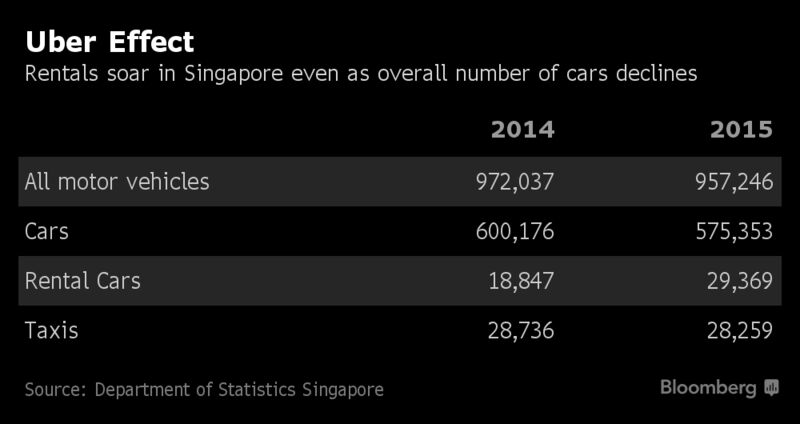
Between 2014 — the year after Uber began operating in Singapore — and 2015, the number of rental cars in the country soared more than 50 percent to 29,369, surpassing the number of taxis on the road, according to official data. Even so, the total vehicle population decreased by 1.5 percent.
Simon, a 45-year-old former property agent who preferred to give his first name only, rents a Toyota Corolla and drives for Uber four hours a day at most. A slump in home sales since the government began imposing measures to rein in prices has pushed many in the industry to seek other sources of income, including ferrying commuters around the island for Uber.
Simon said his main job now is making “alternative investments” and the Uber gig allows him to have a car of his own to use on weekends, when he makes trips about 20 kilometers (12 miles) across the border to Malaysia with his wife and two kids. The journey has an added cost-saving advantage: he buys gas for his car in Malaysia, where it’s cheaper.
Uber is using auto rentals and financing to attract and retain drivers around the world, as are rivals such as GrabTaxi Holdings Pte in Singapore and Lyft Inc. in the U.S. While for many drivers, earning an income may be the main reason they turn to the ride-hailing companies, in Singapore, having the car may be just as important.
“It makes a lot of sense to rent a car,” said Tang Kin Yee, 53, whose main job is in commercial photography and advertising. Business was slow last year and he started driving for Uber to supplement his income.
He now rents a Honda Vezel and is thinking about driving for Uber full time.
The Public Transport Council (PTC) and the Land Transport Authority (LTA) have approved proposals from taxi companies and ride-hailing app Grab to implement surge pricing in the form of flat fares for trips booked via mobile applications.
In a joint media statement, PTC and LTA said: “The companies have informed LTA and PTC that this will be introduced as an additional option for commuters to book a taxi, on top of the current metered fare taxi bookings. We have no objections to the proposals.”
Just like private hire cars booked via Grab and Uber, the cost of a taxi trip booked through a mobile app will vary according to demand. Peak hour trips will cost more, while off-peak trips will cost less.
Separately, SMRT Taxis has inked an exclusive partnership with Grab to enable all SMRT taxi drivers to use Grab as the only ride hailing app for taxi bookings. Both companies are also collaborating to offer customers dynamic fixed fares for taxi trips booked via Grab. This lets customers know the fare for their intended trip before the start of the journey.
According to a Grab spokesman, “Dynamic fixed fares are displayed upfront, and already accounts for travel time, distance, booking fees, and real-time demand and supply for taxis. SMRT taxi drivers who accept bookings via this new Grab service enjoy fixed, competitive fares for their service.”
Metered fares continue to apply for street-hail pickups as well as phone and GrabTaxi bookings.
Managing Director for SMRT Taxis and Private Hire Services, Tony Heng, said: “The market has evolved and matured significantly, and more customers are now open to having dynamic fixed fares for their taxi rides. This partnership with Grab allows us to keep the pricing for our services competitive, catering to different customer needs and preferences.”
Melvin Vu, Head of GrabTaxi Singapore, added that Grab has been engaging the authorities since December on implementing dynamic fixed fares for taxis. “The current taxi fare model does not account for real-time passenger demand and driver supply, which often means that passengers pay a surcharge even when there are many available taxis within the vicinity. Dynamic fixed fares ensure that taxis are better utilised throughout the day and passengers enjoy more affordable rides based on real-time market demands, while not eliminating metered fares.”
Singapore’s market cooling measures have been effective in reducing the prices of HDB flats and private homes over the past few years, but housing costs here are still seen as too high, revealed findings published by a global report last month.
According to the 12th Annual Demographia International Housing Affordability Survey, Singapore has a “seriously unaffordable” rating of 5.0, no change from last year’s survey.
The report used the median multiple indicator, which is the median house price divided by gross annual median household income, to rate housing affordability across 367 cities in nine countries.
A grade of 3.0 and below is considered affordable, 3.1 to 4.0 (moderately unaffordable), 4.1 to 5.0 (seriously unaffordable) and 5.1 and over (severely unaffordable).
Despite being seen as expensive, the report noted that “Singapore has been far more successful in controlling housing affordability than in markets that have followed the British urban containment model”.
Specifically, the HDB was recognized for ramping up the supply of new flats and reducing new home prices.
“One strategy has been to increase what are effectively “across the board” subsidies for all new houses (not counting special grants, such as for first home buyers).
“Should the present policy continue, it is likely that resale house prices will rise slower or even fall in the future, improving Singapore’s housing affordability,” said Demographia.
Eligible first-time buyers of new HDB flats currently enjoy up to $80,000 in housing grants, comprising up to $40,000 in Special CPF Housing Grants and up to $40,000 in Additional CPF Housing Grants.
Meanwhile, Hong Kong has the least affordable housing in the world, with a median multiple of 19.0. This rating is also the highest recorded in the 12 years of the Demographia Survey.