Tag: expensive
-

Are Tickets For The AFF Suzuki Cup Too Expensive?
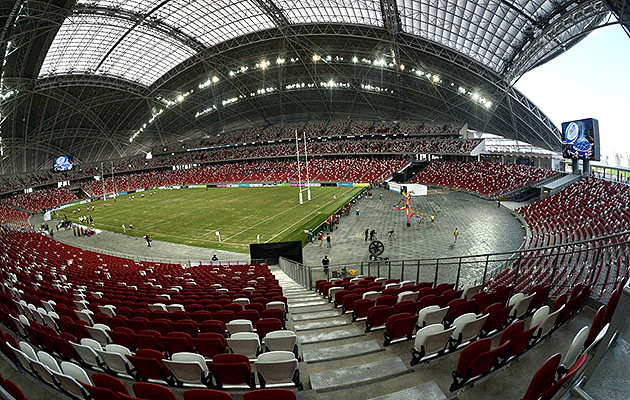
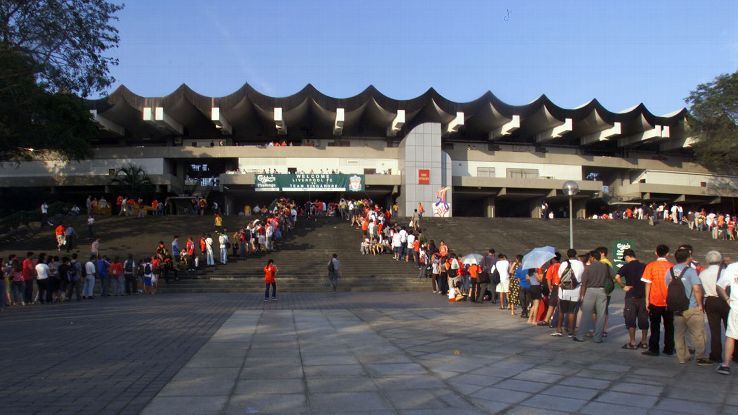
Singapore began its defense of the ASEAN Football Championship or Suzuki Cup with a 1-2 loss to Thailand at the National Stadium yesterday. While I’ll leave others to comment on the performance, I’ll instead comment on the facility itself. You can read the match report here:To begin with, the pitch is hardly in ideal condition for what is the region’s biggest tournament and probably the only one where Singapore can take part in and hope to win silverware. While it’s not uncommon for new stadiums to have a ‘not so perfect pitch’ – even Wembley Stadium faced the problem initially, the fact remains that few international stadiums would have a brand new stadium with patches of sand and general unevenness.The new National Stadium is fast becoming an arena for foreign teams, other sports and concerts, and not for local athletes and football.And with 2 other group games and 2 more final fixtures, the pitch is not going to get any better. It’s a travesty that so much has been spent only for it to be wasted. This pitch is a goner, the only way will be to tear it up after the competition is over and re-lay a new set of grass, which would have to grown elsewhere. I do hope that this is already in the pipeline.Baihaikki Khazan lamented the effects of a soulless new National Stadium, a view shared by many.But this is not the biggest issue. A few weeks after its opening, national player Baihaikki Khaizanremarked in this Instagram post, that while the new stadium is fantastic with ‘its bells and whistles’, it lacks the soul of its predecessor. There’s no Kallang Roar to be had and this was turning out to be a stadium for ‘concerts.’Singapore played Thailand yesterday in a stadium marked with a large swathe of empty seats.And judging from yesterday’s crowd, the stadium was barely half-full, there appears a ring of truth in his assessment. So yes Juventus played here, and so did a Neymar led Brazil against a Honda led Japan, but in both games it was priced out of the reach of most ordinary Singaporeans. Yes, there were some cheaper tickets, but still expensive compared to prices in the past and elsewhere. The majority of tickets and the better seats in the middle, were not cheap.Snaking queues for tickets outside the old National Stadium. You won’t see this sight in a hurry at the new stadium, if prices are gonna remain exorbitant.Is this a stadium for the rich and upper middle-class? What is the Singapore Sports Council, the FAS and the stadium’s operator trying to do? Get their money back as soon as possible or make a handsome profit? The Suzuki Cup is the region’s premier tournament and Singapore are the defending champions. In past tournaments, the stadium would be filled to the brim, even with live telecast of games. Just take a look at yesterday’s game, tickets were going at $48, $38, $28 and $18. You expect ordinary Singaporeans to fork out a minimum of $18 to watch a football game? Is money growing on trees or readily available on our pavements?We grudgingly accept that F1 and major tournaments like the WTA Finals featuring the world’s best will have expensive price tags and ticket prices, but not for football featuring Singapore. It should not always be about profit and recovering costs. Some events can and should cost the state money. Are we living in Singapore or Bangladesh? Can’t the Govt underwrite part of the costs, or the respective bodies not price tickets too highly and get a rebate from the Govt?Most Singaporeans can only dream of watching F1 races, even though its held in Singapore. But okay we can excuse that, F1 has always been expensive and is a sport usually associated with the rich. But football? Our national sport? Even the friendlies before the tournament at YishunStadium cost $12. An ordinary uninspiring stadium like Yishun and you charge $12? A former national player I spoke to was shocked at the price. This is a rip-off, just as yesterday’s prices were.Borussia Dortmund’s iconic Westfalen Stadion is always full for Bundesliga, Champions League and Germany internationals. And their cheapest tickets cost less than the $18 for the Suzuki Cup. And Germany like Singapore is a rich country.Even the Bundesliga charges lower for their games. You can watch Bayern Munchen and Borussia Dortmund at around 5 Euros (standing). For the equivalent of S$18, you can be assured of a seat, and that’s top class football. What’s the SSC and FAS trying to prove?Unless the operator is sacked and replaced by a local who understands the passion and means of ordinary Singaporeans, then the National Stadium will continue to be a rip-off and a soulless stadium for the rich, for concerts and for foreign teams to come play for a fee. It cannot be considered a National Stadium for Singaporeans.* Post was first produced by http://anyhowhantam.blogspot.com.auSource: www.allsingaporestuff.com -

Cannabis Worth $33,000 Found In Car Engine Compartment At Woodlands Checkpoint
SINGAPORE – About 1kg of cannabis was seized by immigration officials, and a suspected smuggler arrested at the Woodlands checkpoint on Saturday, Nov 22.
A routine check on a Malaysia-registered car had turned up a block of the suspected cannabis in the engine compartment.
The Central Narcotics Bureau (CNB) was alerted at 1.05pm on Saturday.
The driver of the car, a 37-year-old Malaysian man, was arrested, CNB said in a statement on Sunday.
Source: www.straitstimes.com
-

Refinancing Your Home Loan To Meet CPF Minimum Sum
Home for Danny Tay is an HDB four-room flat in Simei that he and his wife Lynette bought for S$401,000. They’ve been living there for the last three-and-a-half years and it’s also home to their young children, Thaddeus and Judah.
Like many Singaporeans, Danny initially took up an HDB Concessionary Loan, which had an interest rate of 2.6 per cent per annum. But when the 37-year-old engineer heard about the POSB HDB loan over a year ago, he felt he would be in a position to enjoy greater savings.
An easy decision, thanks to lower interest rates
He decided to refinance and signed up for the POSB HDB loan, as it offered him significantly lower interest rates.
Said Danny: “In terms of interest per year, I am saving S$1,960, thanks to the reduced interest rate of 1.8 per cent per annum from 2.6 per cent per annum^.
“I was attracted by the guaranteed interest rate of not more than 2.6 per cent per annum for the first 10 years of the loan.”
For Danny, refinancing with the POSB HDB Loan was a straightforward decision.
The lower interest rates mean that Danny’s monthly repayments were reduced greatly.
He was able to reduce the tenure of his home loan from 30 to 20 years while paying a similar amount each month.
“I kept part of the extra savings (from the reduced monthly payments) in my CPF account to help me meet the CPF minimum sum amount.”
Doing so also allowed him to take advantage of the higher interest rates offered by the CPF Ordinary Account.
Said Danny: “If I can save S$1,960 a year, I will be saving S$19,600 over the first 10 years of the loan^^. After 10 years, about half of my housing loan should be paid up.
“Even in a worst-case scenario in which interest rates increase significantly after 10 years, my loan amount would still be reduced tremendously.”
Too good to pass up
Danny was so satisfied with the savings he’s enjoying that he has shared his story with his friends.
“I’ve recommended the POSB HDB Loan to six friends and three have signed up so far. I am glad I took up the loan early to enjoy the benefits while interest rates were low.”
This is the eighth story in a 10-part collaboration between TODAY and POSB. Visit www.todayonline.com/voices/posb to read this story online.
^The HDB Concessionary Loan rate is 2.6 per cent per annum at the time of publication.
^^POSB HDB Loan interest rates are capped at prevailing CPF Ordinary Account (OA) rate which is at 2.5 per cent per annum at the time of publication. Details on CPF OA rate are available on the CPF Board website.
Deposit Insurance Scheme
Singapore dollar deposits of non-bank depositors and monies and deposits denominated in Singapore dollars under the Supplementary Retirement Scheme are insured by the Singapore Deposit Insurance Corporation, for up to S$50,000 in aggregate per depositor per Scheme member by law.
Source: www.todayonline.com
-

Being a Singaporean Is NOT Easy!
It ain’t easy being Singaporean.
Your life is run by a series of acronyms like ERP, COE, CPF, PSLE, NS, PMS; you have to endure the relentless tropical heat; you have nothing to read butThe Straits Times; your national culture consists of shopping and whining (I’m nothing if not patriotic); and it’s still considered a crime to strangle Gurmit Singh. You get called names like ‘little red dot’, ‘useless piece of snot’ and even Jacky Chan craps all over you. Let’s face it, when a man who made his living jumping around like a monkey says you have “no self-respect”, well, it ain’t been a good week.
But still, you try. The great Romantic poet John Keats once wrote:
It matters not what the crowd bays
Or what the angry gods may say
For all that matters is the heart
And the values you cling hard
What beautiful lines. It means that regardless of what people may say or think about you, what matters is what you believe in. Words deserving of colourful embroidery indeed. Ok, I completely made the lines up. Keats never said that. I could have looked him up but I really can’t be bothered. Laziness is one of my many charms. But don’t let that take anything from the message. It’s still pertinent.
And so I try, as a citizen, to narrow the gulf between our national values and what we do as a country. After all, if morality means practicing what you preach, then being a great country means practicing what you teach. Under George Bush, America tore up their Constitution, practiced torture, invaded the wrong country and became the pariah of the international community. Under Barack Obama, America is heeding the call of its ideals and founding principles and, in the process, is becoming great again.
I think a little red dot can be great too. I think greatness is not limited to the measure of size and might, but the loftiness of one’s ideals and one’s faithfulness to them. By this definition, Singapore can be great.
And so I turn my eyes towards our ‘Shared values’. Phrases like “Nation before community and society above self” ring so sweet. They stir up a sense of pride deep inside. They make me want to do something. Oh shut up, it’s true. They really do make me want to give of myself.
But then I see our ministers’ legendary salaries and their need to “facilitate the recruitment and retention of the quality of talent we need for the government and public sector.” My enthusiasm becomes more flaccid than an 80 year old man in a cold shower.
What about Shared value #3 -“Community support and respect for the individual”? Pretty uncontroversial, we can’t go wrong here. 377A, AWARE new exco, Thio Su Mien – enuff said.
What about Asian values and Confucian ethics ? I think to myself, well, perhaps cynicism aside, the clarion call to be moral, ethical and righteous, regardless of their political intent, is worth heeding. My cynicism is about to slip away when I also recall our on-going manufacture of landmines, their sale to war-torn countries, our economic dealings with the Myanmar junta, our medical offerings to Robert Mugabe, and most recently, our welcome of North Korean President Kim Yong Nam. Ah well, you know what they say, we’re just a little red dot and must look out for our national interests.
Pragmatism is a wonderful device. It allows you to do anything you want, however you want, and then blame it on reality. It’s an excuse for abandoning higher morals and ethics without looking like a dick. It makes you a man because you’re seen to be ‘realistic’ and ‘grounded’. It’s the ultimate backstage pass, allowing you to bypass everyone to get straight to the goodies. And being pragmatic also means that you have to pretend to have values, whether shared or of the Asian variety because there are idealistic saps out there who, believe it or not, romanticise principles. It’s just pragmatic to be an ethical Confucianist.
It’s hard being Singaporean. It’s damn hard. Screw it. I’m going shopping.
Article first appeared on groundnotes.wordpress.com
Source: www.allsingaporestuff.com
-

Are HDB Flats Affordable For Low-Income Singaporeans?
Can a Singaporean who earns $850 a month afford to buy a Housing Board flat?
Mr Mohammad Charlie Jasni says yes.
The odd-job labourer earns that amount, and he and his family will be moving into a new two-room HDB flat in Punggol by the end of the year.
He had successfully balloted for the 45sq m build-to-order unit in August 2009.
It cost $99,220, but because he earns less than $5,000 a month, he qualifies for a government housing grant that gives him $40,000 to offset the flat’s price.
This means he has $59,220 left to pay, which he will do using his Central Provident Fund (CPF) savings.
He and his wife already have about $40,000 in their CPF accounts, and this will grow as he continues to work.
Based on HDB’s calculations, he needs to pay a monthly housing instalment of $83 over 30 years.
‘By paying the $83 out of my CPF, it means I have that little more for daily expenses,’ said Mr Charlie, 33.
He is currently living with his wife and two children in a two-room rental flat in Beo Crescent. They pay $44 a month for that flat.
They are excited about their upcoming home and are already discussing renovation ideas and shopping for furniture.
‘It is good to have a home of our own,’ he said.
Mr Charlie’s story puts a face to a statistic that has been debated in the last week.
In Parliament last Thursday, Deputy Prime Minister Tharman Shanmugaratnam revealed that ‘a family with $1,000 income can now, through our housing subsidies, purchase a small flat’.
He was responding to Workers’ Party member Gerald Giam’s comments about Singaporeans being unable to afford a flat.
The minister’s remarks sparked off much discussion in both cyberspace and coffee shops alike. Some wondered how $1,000 could buy anyone a flat, given that sum was hardly enough to support a family’s daily living expenses.
The next day, National Development Minister Khaw Boon Wan explained that Mr Tharman was referring to a new two-room flat.
He added that the subsidised price of such flats was about $100,000 if the applicant was a first-time buyer. He would also be entitled to housing grants of up to $60,000.
The net selling price would thus be $40,000, and the monthly mortgage payment can be fully paid from his CPF contribution, Mr Khaw said.
In response to queries from The Straits Times, the HDB said it was unable to say how many households earning $1,000 a month own two-room flats. But it pointed to how that it has two schemes that target low-income, first-time buyers.
The Additional CPF Housing Grant Scheme (AHG) benefits households whose income is not more than $5,000 a month. The maximum grant quantum is now $40,000, and it benefits 8,000 households every year, said the HDB.
The Special CPF Housing Grant (SHG) is given to first-timer families earning up to $2,250 a month to buy a small flat. Those earning $1,500 or less get a $20,000 grant. SHG is over and above regular housing subsidies and the AHG.
The HDB estimated that about 700 tenants currently renting flats under the Public Rental Scheme can benefit from the SHG if they decide to buy a flat. To date, the scheme has benefited 53 households who have bought two-room flats.
The HDB also gave The Straits Times five recent case studies of households with monthly income of about $1,000 who bought two-room flats. Four managed to buy new flats with the help of both housing grants. The fifth used only AHG as SHG had not been implemented when he bought his flat.
Out of the five families, three were rental tenants who have bought a new flat without taking any loan because they used the housing grant and their own CPF savings. The other two were families currently living with relatives who have bought new flats using both grants and their CPF savings.
In one case, a couple who lived in a rental flat bought a new flat in Bukit Panjang. At the point of applying for a flat, their monthly income was $900.
The flat cost $106,350. They got the maximum total housing grant of $60,000 – $40,000 AHG and $20,000 SHG. This, together with their CPF savings, meant they did not have to take any loan.
In another case, a man and his mother bought a new flat in Sengkang for $117,750. They got $60,000 in grants, and took a 17-year loan with a monthly instalment of $131.
Schemes to help with expenses
THE Straits Times visited five blocks of two-room flats in the Woodlands and Ghim Moh areas this week and spoke to people in over 30 homes.
Most of the residents there were renting their units.
Of the four who owned their flats, one had downgraded from a four-room unit, while three others had downgraded after selling their previous flat in the Selective En Bloc Redevelopment Scheme.
Among those renting, many were in their 60s and 70s and retired. They said they do not have much in their CPF or bank accounts, which is why they cannot buy their own units.
Madam Tan Chui Eng, in her 70s, and her husband, Mr Teo Kim Wee, in his 80s, said they have been living in a two-room rental flat in Ghim Moh for six years.
Most of the money in their CPF accounts has been used for medical expenses, they said. They have three daughters who pay their monthly rental of $61 and utility bills. ‘Of course, we would like to buy our own flat, but we cannot afford it,’ said Madam Tan in Teochew.
MPs said that with grants and other assistance schemes, households earning $1,000 should be able to afford a two-room flat.
Mr Vikram Nair, an MP for Sembawang GRC, said he knows of such households who rely on CPF contributions to finance their purchases.
As to whether $1,000 is enough for a family to survive, he said there are public assistance schemes, such as GST vouchers and Workfare Bonus, which can help low-income families cope with daily needs.
Mr Liang Eng Hwa, MP for Holland-Bukit Timah GRC, said regardless of whether they buy a flat, low-income households have little cash on hand. But rather than use cash to pay rent, ‘why not use the CPF to pay for a flat?’
‘The cash they save by not paying rent may not be much, but still it gives them that little more for daily expenditure,’ he added.
For odd-job labourer Mr Charlie, every bit saved helps to pay for living expenses. His wife does part-time administrative work.
He did not think he could afford a flat ‘but when HDB re-introduced two-room flats again, I felt that perhaps I could afford one’.
In 2006, HDB resumed construction of two-room flats after 20 years, to give more housing options to low-income households.
He decided to wait a bit because he wanted to build up his CPF account first. Now that he has bought a home, he feels the pressure of maintaining his CPF account so that the flat can be paid off.
‘Some companies are cutting back on manpower and I’m scared that I may lose my job,’ he said.
But he does not regret buying the unit. He hopes to pass the flat – or a bigger one should they ever upgrade – to his children.
How he pays for his flat
Monthly income: $850
Total household CPF: $40,000
Cost of build-to-order flat in Punggol: $99,220
Additional CPF Housing Grant Scheme: $40,000
Remaining cost of flat: $59,220 ($99,220 less $40,000)
Estimated monthly instalment for payment: $83 for 30 years
Deduction from CPF: $83
Cash outlay: $0
_________________________________________________
Housing help for low-income families
THE Housing Board (HDB) offers two grants to low-income families so they can buy their own flats:
- Additional CPF Housing Grant Scheme (AHG)
THIS was introduced in 2006 to help lower-income Singaporean families buy their first HDB flat. It is targeted at households with incomes of not more than $5,000 a month.
The size of the grant is based on the applicant’s average gross monthly household income. The grant varies between $5,000 and $40,000. Households earning $1,500 or less a month will get $40,000.
AHG is an additional subsidy over and above the regular market subsidy and CPF Housing Grant. Both new and resale flat buyers are eligible for AHG.
It offsets the purchase price of the flat, thereby further reducing the loan a flat buyer needs to take. It is estimated to benefit 8,000 households a year.
- The Special CPF Housing Grant (SHG)
THIS was introduced last year as an additional grant for first-timer low-income families earning up to $2,250 a month, so they can buy a small flat from the HDB.
The SHG is given out over and above regular housing subsidies and the AHG. Households earning $1,500 or less a month will get $20,000 in SHG. About 700 tenants currently renting flats under the Public Rental Scheme can benefit from the SHG if they choose to buy a flat.
Source: http://www.stproperty.sg