AWARE is organising a 3-Part Ramadan talk on Gender in Islam, and first session is on 4 July.
AWARE will be holding a series of presentations and discussions about the works of prominent Islamic scholars and their views on gender in Islam.
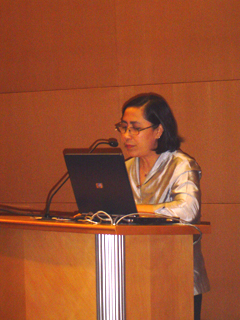
Dr Azhar Ibrahim Alwee, NUS and member of The Reading Group
Session 1: Malay Ideas on Women by Dr Azhar Ibrahim (Senior Visiting Fellow, NUS)
Throughout Malay intellectual history, there were several strands of thinking pertaining to gender and women’s role within the socio-cultural, political and religious spheres of the Malays. This presentation will highlight some of these thinking through early proponents of the modern era, such as Syed Sheikh al-Hadi, to later thinkers such as Hamka, Khadijah Sidek and the prominent Muslim feminist group, Sisters in Islam.
Friday, 4 July 2014
AWARE Centre
6.30pm to 9.30pm
Register for Session 1 here!
Assoc Prof Noor Aisha Abdul Rahman, NUS & member of The Reading Group
Session 2: Muslim Personal Law and Citizens’ Rights: The Case of Singapore
by A/P Noor Aisha Abdul Rahman (Head, Dept of Malay Studies, NUS)
Prevailing discourse on multiculturalism tend to focus on its merits in protecting the cultures and traditions of minority groups within the framework of the politics of accommodation. Less discussed are its implications on the rights and autonomy of members of the groups themselves who may be adversely affected by the arrangement. This presentation will focus on the problems arising from autonomy granted to the Muslim community of Singapore to determine its personal law, on some segments of the community, particularly in the arena of the Muslim law on marriage, divorce and inheritance.
Friday, 11 July 2014
AWARE Centre
6.30pm to 9.30pm
Register for Session 2 here!
Mohamed Imran Mohamed Taib is a social activist with The Reading Group, Singapore.
Session 3: Challenging Patriarchy: Early Reformist Responses
by Mohamed Imran (Associate Research Fellow, NTU)
Feminism and the struggle against patriarchy is not a new phenomenon in Muslim society. This presentation will trace some of the early ideas on feminism to the Egyptian context of Islamic reform in the late 19th and early 20th century. In particular, the ideas of seminal figures such as Rifa’ah al-Tahtawi, Muhammad ‘Abduh and Qasim Amin will be discussed.
Friday, 18 July 2014
AWARE Centre
6.30pm to 9.30pm
Register for Session 3 here!
Individual price: $8 for 1 person/session
Pair price: $14 for 2 persons/session Price includes cost of catered food.
Prayer space is provided.
The WearWhite movement is a social media initiative inviting Muslims to return to our natural disposition (fitrah) and the Sunnah (way) of Prophet Muhammad (Peace Be Upon Him).
The movement’s genesis was from our observations of the growing normalization of LGBT in Singapore. However, we recognize the conduct and it’s support among Muslims is due to the lack of understanding and connection with Islam and our fitrah. We thus came together initially with the expressed purpose of reminding Muslims not to participate in the LGBT event on 28th June.
The movement encourages a return to the values as guided by Islam. These values include prioritizing the family and marriage, responsibility and justice and fair dealings.
The initial campaign emphasizes a return to natural relationships as found in Islam. Given the clarity in Islam on the nature and conduct of family relationships, marriage between a man and a woman forms the basis of the family.
We hope to continue promoting family focused campaigns throughout the year. These campaigns will hopefully strengthen the family unit and result in healthy relationships. We also call for a return to fitrah through reconnecting the Muslims especially the youth, back to Islam and clarifying key concepts such as freedom and rights in Islam.
WearWhite supporters have indicated that some of the other family oriented campaigns they would like to promote in the near future include developing respect and recognizing responsibilities among family members as guided by the Prophet Muhammad.
It is our hope that this campaign helps bring Muslims back to our fitrah and reconnect us with the Sunnah of the Prophet.
Let us return to family. Let us return to fitrah.
ABOUT WEAR WHITE
WearWhite is an informal grassroots movement that has come together to help Muslims return to their natural disposition.
As a social media initiative, it has no membership or institutionalised committee. WearWhite supporters discuss initiatives, gain advice and suggestions and develop family oriented plans. These initiatives are centred around developing family relationships as guided by the Sunnah of Prophet Muhammad.
Individuals provide support based on their expertise and capabilities.
Given the holistic nature of Islam and it’s beautiful exhortation to goodness, we do not limit the invitation to or against any specific group. Our invitation is for the return to fitrah in its entirety and for all humanity.
WearWhite is launching our initiative with a call for Muslims to attend the first Terawih prayer on 28th June 2014 in white.
At first glance, the statement issued by “members of civil society”, which is signed by 217 individuals and 9 organisations like Maruah, AWARE and the Free Community Church, appears to stand for a side advocating for the love and care of LGBT individuals.
In their statement, they quoted values like democracy, justice and equality; called for a dialogue to foster understanding and tolerance; used words like compassion and knowledge and contrasted it against ignorance, hatred, prejudice and discrimination.
They make a Samaritan out of everyone who attends PinkDot and vilifies those who have campaigned to wear white.
Welcome to the art of persuasion, called rhetoric.
Only thing – rhetoric might not always be true. As its purpose is persuasion and not truth, it does not have to base itself on facts.
Being scientifically grounded or truthful is not the goal of rhetoric.
Hence, as great sounding as it can be, it is often meaningless and insincere, if you are willing to examine in-depth what is said.
With persuasion as an end in itself, rhetoric is also often exploitative.
Yes, feelings will be stirred, words associated with human rights and dignity like discrimination, prejudice, equality and justice will often be used. With little discernment or lack of understanding to a certain issue, most people would almost certainly be persuaded.
If you aren’t persuaded, then you might be made to feel guilty, ignorant or bigoted for going against humanity.
Rhetoric is so powerful that it can make good look evil and evil look good. One of the best examples of how rhetoric was used, “or misused”, in the history of mankind was Hitler. Hitler was a charismatic speaker skilled in rhetoric. He was so good that he used religion to justify the holocaust.
But remember, rhetoric has no care for sincerity and truthfulness. If I can claim a religious affiliation to lend support to my cause, why not? I can be a Christian, Muslim, Buddhist, Humanist, or a mix of everything! But my professed faith is not a true faith that I practice in sincerity.
In one of the statements from the “civil society”, they said that pitting religious believers against those holding secular beliefs is a “false dichotomy”, as many religious leaders and organisations both in Singapore and around the world have expressed support for LGBT equality.
I do not intend to contest this statement, but I find it real funny that just months ago, it is likely that these same activists were ostracizing the religious, and polarizing the HPB’s FAQs saga as an “us” vs “them” debate.
The same activists were probably the ones who portrayed this dichotomy in the hope of getting Singaporeans on middle ground to be disengaged in the HPB saga – telling the average Singaporean that unless you are a religious fanatic, you should not be bothered with public morality.
Now, the stakes are changed. In an attempt to win more to their side, they are now all encompassing, welcoming all Singaporeans, from the middle ground to the religious, unto their side. Inclusivity, so it claims.
But is there any real meaningful sense we can take home from the pink rhetoric – inclusivity, diversity and tolerance?
To be truly inclusive, why not invite the wearwhite participants to PinkDot?
If you are truly diverse, why unrelentingly seek to redefine marriage and change the natural fact that family is made up of one man, one woman and their offspring/s?
If you are really tolerant, why force upon society your views and jump on those who disagree by labelling them as homophobes, bigots or ignorant, uneducated people who discriminates?
The answer is simple. There is no real meaning or sincerity to the terms inclusivity, diversity and tolerance. It is just rhetoric meant to persuade, impress and sound “high class”, so people would feel they are educated, informed and compassionate by agreeing with it.
The whole PinkDot movement, done carnival-style to attract, with performances, music and speeches; self-reported attendance; on the surface promotes diversity, inclusivity and the freedom to love, but deep underneath, is really garnering support to change our social mores by altering our law and policies.
And the organisations and individuals pushing for it are likely believers of the sexual rights movement. It is a movement that began with America’s sexual revolution in their 1960s, based on the fraud science of Alfred Kinsey. Proponents of the sexual rights movement prize sex as a right, and believe all forms of moral restraints on sex are ridiculous. They stand on the opposite end from those who prize morals as a critical pillar for societal well-being.
Proponents of the sexual rights movement do not accept the proven historic fact that public morality affects society gravely. They also do not agree with the principle that since a society is made up of people who appointed a government to maintain order and harmony, law therefore exists primarily for public good. From this perspective, the famous philosopher H.L.A Hart declared the state’s important role to legislate for or against morality: “The aim of making an act criminal is to announce to society that these acts are not to be done and to secure that fewer of them are done.”
Therefore, it is no wonder that the 3 named organisations of the “civil society” – Maruah, AWARE and Free Community Church – are all well-known activist groups that push for sexual rights and sexual freedom above other forms of human rights. These organisations will definitely be tolerant towards any extent of sexual freedom, but expect their tolerance to end with any suggestions of values, societal restriction or moral restraints. Here’s a post on how tolerant sexual rights activists can be if they do not agree with you.
So don’t be fooled by mere appearances, even if one might appear like a loving Samaritan. The thing they really love is the sexual rights agenda. It wouldn’t matter if you are an LGBT – if you stand for morals, or if you could compromise their agenda, be prepared to be ostracized by them.
As in the words of a faithful PinkDot attendee, who revealed that there are “hierarchies within the ‘LGBT community’”: “It is unfortunate that (as exemplified by Pink Dot) the ‘LGBT community’, in its pursuit to be accepted by mainstream society, has chosen the less noble path of presenting an elite… At last we now know what is meant by the stated vision of an “inclusive” society – that the gay/lesbian elite be “included” by the mainstream. The celebration of true diversity – the non-elite within the “LGBT community”, is sorely lacking and, in this case, deliberately avoided.”
Now, to distinguish my speech from rhetoric, I shall provide some facts, meaningful analysis and evidences that informed groups of Singaporeans have raised as concerns regarding the agenda to promote “freedom to love”.
For example, an often heard but under analysed point of paramount concern, is the fact that the rates of STD and HIV infection among the gay community remains unimaginably sky high.
It must be noted that these are not statistics that happen out of the blue.
In 2006, HIV infection through heterosexual sex was 222, more than double that by homosexual sex, which was only 109. By 2011, infection by homosexual sex has overtaken that by heterosexual sex.
This trend where HIV infection among an extremely small community overtakes the rest of the population has persisted since then.
Last reported, in 2013, HIV infection rates by heterosexual sex have dropped to 181, while that by homosexual sex has risen to 247 – HIV infection among this subculture is now 35% more than the rest of the population!
If the statistics have not already shocked you, I invite you to take an analysis of this picture, so you may imagine the details.
Firstly, these are not ordinary statistics. They are statistics with direct behavioural causes. Think – what kind of behaviours, attitudes or lifestyles, could have caused such unimaginable statistics? A lifestyle which promotes love?
How much love today do we see among heterosexual communities? How many couples do we know really lead exemplary lifelong loving relationships?
Most people I have talked to would say that there are few. Most people are aware that among heterosexual communities, there is a great amount of cheating, betrayal, promiscuous behaviours.
If this is the love portrayed by the heterosexual community, what would you expect to be the “love” in the gay subculture – considering their rate of HIV infection is more than 20 times that of the heterosexual community?
Remember that statistics don’t lie. And these are statistics that tell a story – stories that are truer than that told by PinkDot’s advertising campaigns, propaganda videos, rousing speeches and plain rhetoric published all over media. Freedom to love is never really about the freedom to pursue monogamous lifelong relationships as what their rhetoric and propaganda portrays. It has always been to legalize sodomy so that all that is desired sexually by this subculture can be expressed in unrestrained manners, legally and freely.
But it will not stop here.
Once sodomy is legalized, expect genderless marriage to be pushed. Some activist claim that they are only fighting against the criminalizing of sodomy. Don’t be fooled by this insincere rhetoric. Fact is, not one activist will be able to promise that genderless marriage will not be pushed if 377A is repealed. Why is this so? Because it is not in anyone’s prerogative to decide what other activists would do. Even if one activist decides not to push for genderless marriage, he can’t say that for all activists.
While all minorities, including the LGBTs, are as entitled as anyone else to basic human rights, it is quite a different thing altogether to promote any group’s private beliefs or preferences – culminated into practices and cultural behaviour, into mainstream society. Every form of practice and behaviour promoted into mainstream affects the society; hence, in all fairness, must be subjected to objective analysis and scrutiny.
Fact is, there can never be a total acceptance of all kinds of beliefs and behaviours. Some beliefs clash fundamentally.
Non-acceptance of a group’s practices or behaviour does not necessary mean intolerance or discrimination.
377A discriminates against an act (not a person). It is an act which should be judged based on its own merit – an act of which whether you are homosexual or heterosexual, you are capable of committing, hence not discriminatory to homosexuals alone. And by its own merit, sodomy is an act that raises real health issues, as already highlighted above.
Freedom to love? What if the Geylang community comes out and demands for it? No limits! Legalize every sex. Reduce the age of consent of sex with minors (and this is exactly what will be pushed for if 377A is removed)! What if they hold carnivals in colours and get celebrities to endorse their events. What if they meet with government officials and push for our laws to be removed. How would society react? Accept their proposal? Embrace their ideology?
Of course we will say no. Because we know that the love that they are talking about, is not quite the monogamous, lifelong, wholesome and healthy love that we imagine it to be.
Likewise, we have to look beyond the pink rhetoric, and note how incredibly little evidence, facts or statistics they bring to the table of dialogue. And how quick they are to dismiss the facts we bring to the table – with rhetoric. They cite reasons like stigma, lack of condom awareness, as the reasons for their high HIV infection rates – all of which are invalid and false arguments.
If I can blame someone for all my problems, I will never have to take any responsibility for my attitude and actions; I will be able to advance my agenda without ever needing to account for these problems I cause.
Not as if society wants to stop them from having their fun privately, but they choose to, very publicly, impose upon society to embrace their “freedom to love”; unrelentingly push for changes to long established social norms and mores; seek to redefine marriage and family that will bring harm to children and religious liberty.
They cry foul and demand for public acceptance, while refusing to accept public accountability for the implications of their actions e.g. health concerns. Normal citizens like you and I are made to pay, while they unceasingly lobby and push their agenda.
For this reason, I believe wearwhite has to exist. Largely also because conservative Singaporeans have no confidence that our ministers and MPs still do care for the moral fabric of our nation.
I personally too, will be wearing a white top as a private protest this 28 June. In fact, for as long as PinkDot is held each year, I will wear white on the day of pink.
Singapore Islamic Scholars & Religious Teachers Association (PERGAS)Singapore Islamic Scholars & Religious Teachers Association (PERGAS)Singapore Islamic Scholars & Religious Teachers Association (PERGAS)Singapore Islamic Scholars & Religious Teachers Association (PERGAS)