Tag: food

  • Someone Alleged That Pork Was Mixed With Chicken Meat At Halal Certified Makan Thai! @ Sembawang

    Someone Alleged That Pork Was Mixed With Chicken Meat At Halal Certified Makan Thai! @ Sembawang

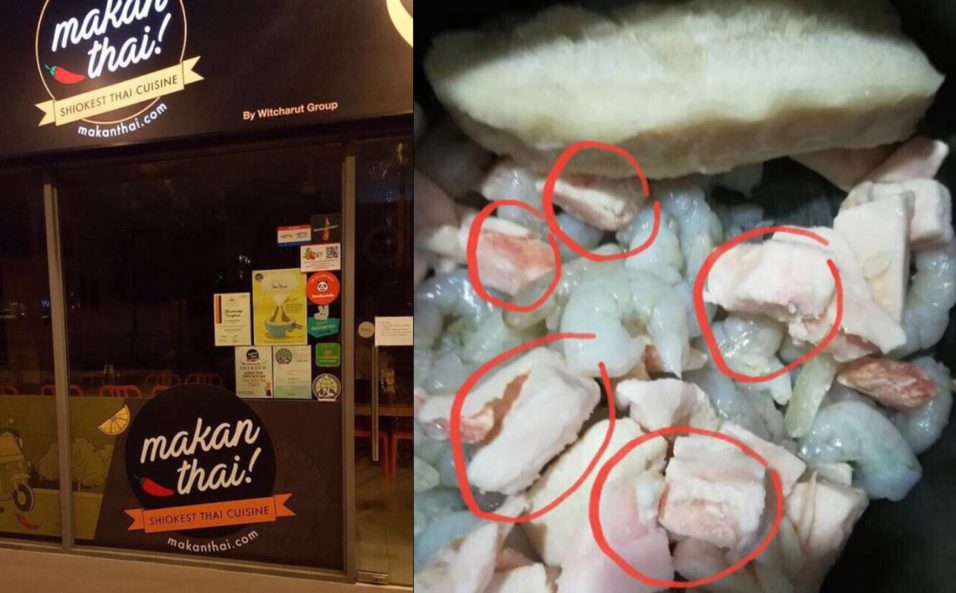
    FB user Fyeeda Fiz made a post on her timeline. In the post, she alleged that the MUIS halal certified restaurant Makan Thai! at Sembawang mix pork with chicken meat for dishes that they served in their menu. She uploaded 5 photos of food items and the shop details to back up the claim. According to her, the staff has made a report with MUIS.

    In her post she wrote:

    “Staff dah buat report kat Muis
    Tolong viralkan MAKAN THAI YANG BERSIJIL HALAL DARI MUIS “TIDAK HALAL”
    Perhatikan yang diambil dari dapurnya yang berupa daging dan lemak babi bercampur aduk dengan daging ayam dan lain2 yang akan disediakan dlm menunya Ini yang di victory 8 kat sembawang pasal staff melayu yang kerja di sana”

    Photo 1: The shop.

    Photo 2: Pork mixed with chicken meat.

    Image may contain: food

    Photo  3: After processed.

    Image may contain: food

    Photo 4: The minced mixed meat.

    Image may contain: food

    Photo 5: Sample food item by the shop.

    Source: Fyeeda Fiz

  • Malays And Indians Need To Change Their Eating Habits To Fight War Against Diabetes

    Malays And Indians Need To Change Their Eating Habits To Fight War Against Diabetes

    For Malay food vendor Aida Manapi, 50, the tastiest ayam penyet (smashed fried chicken) must be crispy and glistening, and there is only one way to cook it — “deep fried”. And when it comes to roti prata, no one serves it by being stingy on ghee (clarified butter), said stall vendor Senthilvel Vedachalam, 43. Such traditional methods of cooking or serving Indian and Malay favourite dishes, along with mindsets that they have to be cooked in a certain way for best results – have made it difficult for many hawkers and home cooks to change the way they prepare these dishes. For them, unlike Chinese dishes, one cannot produce a healthier, yet still tasty ayam penyet or roti prata by simply using less oil, salt or sauce. But change they must if the two communities are to win the war against diabetes, which Prime Minister Lee Hsien Loong described as a “health crisis” for Malays and Indians during his National Day Rally (NDR) on Aug 20.

    Mr Lee also shared some sobering figures, noting that six in 10 Indians, and half of Malays above age 60 are diabetic, compared to 2.5 in 10 for the Chinese. With the fight against diabetes in Singapore being stepped up, community leaders and some members of the Malay and Indian communities have called for more targeted measures to deal with the problem. One area that needs to be addressed is their eating habits, even though those interviewed acknowledged that it will be an uphill task. Mr Rathinasamy Murugesan, owner of Greenleaf Cafe, an Indian restaurant in Little India, pointed out that many Indians eat a lot at one go, three times a day. They also tend to prefer 9pm dinners, which are close to bedtime, and need to round off their meals with a satisfying, sugar-rich dessert.

    “My Chinese friends would take the Indian sweet, and (throw up) because it is too sweet for them, but we Indians can take four or five of those,” said the 44-year-old. Getting these people to change their eating habits, even when they know that such practices heighten their risk of getting diabetes, will not be easy, he added. Taxi driver Hartono, 56, is one of those who find it difficult to change his eating habits even though he is a diabetic. He loves the rendang that is chock-full of coconut milk, and believes that Malay food should be all about “the colour and spice”. He finds such Malay dishes much more attractive than the “bland” soups, steamed food and stir-fries common in Chinese cooking.

    While his wife, a nurse, and his doctor often chide Mr Hartono for his food choices, the man himself finds it just too hard to give up his beloved buffets and nasi briyani. After losing weight during the fasting month by eating mainly cereal, it was “back to square one” after the Hari Raya season, no thanks to all the feasting during festive gatherings and wedding banquets. “The doctor talks like it’s very easy (to change), but our lifestyle is not like the Chinese lifestyle. For them, they go qigong, they go exercise … Our culture is different, we like to gather and cook, go picnic, go makan… You see (the Malays) carrying their pots to Changi Village to go there to eat, sleep, swim (all day),” he said.

    Some hawkers mentioned that their patrons are often not in favour of replacing the coconut milk in their dish with low-fat milk, as suggested by PM Lee in his NDR speech. When hawkers ask patrons if they would replace the coconut milk in their dish with low-fat milk, a common reaction is: “Sure not nice… So thin,” said Madam Salama Salim, 52, summing up her customers’ sentiments on why they do not like low-fat milk. Even though her Malay food stall at Our Tampines Hub offers healthier options, she feels obliged to go “full flavour” because of demand.

    For Madam Mizrea Abu Nazir, 45, “nasi lemak would not be nasi lemak” without coconut milk, and her stall usually uses two litres of coconut milk to cook a large pot of the rice. Her family owns the popular Mizzy Corner Nasi Lemak at Changi Village. While she does not mind cutting down on coconut milk on request at special events, the reality is that people often ask for “more”, rather than less. “In our lontong, ayam lemak, most of the cooking is about using a lot of coconut milk and oil. At the moment, I don’t (see the need to change) because everyone is still enjoying what they eat… That’s how it is,” Mdm Mizrea said.


    ‘GO TO WHERE THEY ARE’

    While anecdotal evidence seems to suggest that there is a lack of healthier choices for the Malay and Indian communities, the Health Promotion Board (HPB) said that popular Malay and Indian dishes such as mee soto, thosai masala and puttu mayam (steamed rice flour noodles) with dhal curry are among 63 types of dishes “among our everyday hawker fare that are already lower in calories”. The HPB’s current approach is to work with the managing agents for new hawker centres to encourage stall owners to offer healthier options progressively for Singaporeans.

    As of mid-August, there are over 3,100 stalls across 67 hawker centres and 450 coffee shops in Singapore, offering at least one healthier option in their menus, the HPB said, without revealing how many of those are Malay and Indian stalls. On its part, since 2016, the HPB has scaled up efforts tailored for the Malay and Indian communities in its awareness programmes by working closely with mosques, temples and community partners such as Mendaki, Mendaki, Jamiyah, Muhammadiyah and Our SWAMI Home. The board has also expanded its partners to include both the Malay and Indian activity executive committees, which organise activities at community centres.

    The Hindu Endowment Board (HEB), which holds annual health fairs at Sri Srinivasa Perumal temple in Serangoon, told TODAY that it sees a big need to ramp up efforts to promote health-screening and awareness among the Indian community. About 3,000 have been screened at the fairs over the past three years. Noting that current efforts are “not sufficient”, the HEB’s chief executive officer, Mr T Raja Segah, said discussions are underway to improve the health screening’s follow-up system, and hold more health fairs at community centres. However, to truly nip the problem of unhealthy food habits of the ethnic minorities in the bud, more needs to be done, such as “to go to where they are in the communities… See what their lifestyle is there (and) introduce changes there”, said Ms Julie Seow, a life coach at Touch Community Services’ diabetes support arm.

    For example, after failing to get Malay beneficiaries to attend its group sessions, the organisation, recognising how “communal” the Malays are, started a Malay support group. “They don’t come singly,” she said. Dr Fatimah Lateef, a Member of Parliament for Marine Parade GRC, said a long-term solution to the problem is to make diabetes risk-management “family-initiated”. She called on mothers to be “ambassador for change” in their day-to-day cooking. In her own home, Dr Fatimah shared, there is “absolutely no sugar, no salt, no oil”. Instead, she uses spices, chilli, lemon and lime to bring out the flavours. “The first thing that (people) ask is,‘Then what do you eat? Are you suffering?’ People have a (misconception) that they need to have all these to have good and nice food”. However, no one complained about her no-sugar-no-salt-no-oil food when her relatives come to her house during Hari Raya, Dr Fatimah added.


    Source: Today
  • Advisory: For Those Planning To Visit Bazaar Geylang

    Advisory: For Those Planning To Visit Bazaar Geylang

    Amaran Bagi Yang Nak Ke Bazaar Geylang.

    Amaran #1

    Barang siapa yang nak ke Bazaar Geylang, walaupun tu status Facebook awak, elakkan dari menaip status yg berbau kebodohan tahap gaban. Elakkan dari menaip status seperti,

    “ALAMAK!!! Amacam boleh jumpa dekni kat sini plak!”.

    Ingat. Awak tu bukan Ronaldo atau Beyoncé. Jangan nak feeling ‘famous’ dan orang tak boleh terjumpa atau tegur. Ni Bazaar Geylang! Orang Melayu Muslim mesti lah turun sini. Kalau taknak orang yang kita kenal jumpa pergi taman haiwan!

    Amaran #2

    Barang siapa yang nak pergi Geylang untuk tangkap handsome dan jambu, please make sure muka handsome dan jambu. Jangan step pergi Geylang dgn sebab,

    “I nak beli dendeng ahh…”.

    Padahal nak tangkap handsome. Pada minah2 yg nak tangkap jambu kat Bazaar Geylang, bedak muka dengan warna tengkuk make sure tonasi jangan lari banyak! Foundation mata tak payah nak tarak mcm gila. Nanti orang ingat Kai Kai dan Jia Jia dah susah! Takut nampak beruang panda kat Bazaar!

    Amaran #3

    Harap sesiapa yang ke Bazaar Geylang sabar dengan kesesakkan orang di sana. Jangan jadi bangang tanya kat Facebook ‘kenapa ada ramai orang sey?’ Ini Bazaar Geylang! Kalau nak senyap dan takde orang, pergi kubur! Library these days pon dah bising…

    Amaran #4

    Pada minah2 baru nak 7Up, jangan feeling orang tgh tgk kan muka awak yg Mak masih cucikan seluar dalam dengan menaip status yg berbunyik,

    “Stoppit seyyy dari tadi tengok aku! Irritz purgh!”.

    Eh Bangau! Mungkin dia tengok kau pasal beberapa perkara. Antaranya,

    a) Muka kau mcm orang dia kenal.

    b) Kau pakai baju low-cut neckline nya tapi masih tak nampak apa-apa (Tipah tertipu!)

    7) Mata yang tengok kau tu juling air.

    KALAU TAKNAK ORANG TENGOK, PERGI DUDUK BELAKANG ESBOK RUMAH MAK KAU DAN TOLONG MAK BUAT KUIH BADAK BERENDAM!

    Muka dah macam ikan cium-cium ada hati nak feeling orang tengok…TUIKK!!!! 😂😂😂

    PS: Saya tak marah. Saya cuma keluarkan lendir aje


    Sumber: Di mana-mana (:

    #peacenowar #R1C #ramadanbulanyangsuci

  • Ariffin Sha: Malay/Muslims Must Stop Racist Remarks On Ramadan Bazaar Geylang Issue

    Ariffin Sha: Malay/Muslims Must Stop Racist Remarks On Ramadan Bazaar Geylang Issue

    The ‘Ramadan’ Bazaar isn’t some special zone reserved for only Muslims and/or Malays. Many patrons and stallholders are not Malay. Anyone, regardless of their race, is entitled to their own opinion of the things on offer there. Whether they think it is overpriced fluff or worth the hype has absolutely nothing to do with race.

    I can’t help but notice a trend where minorities all too readily play the race card in situations where race is immaterial. We must dispel the notion that only the majority race is capable of racism. In situations like this, identity politics must be called out.


    Source: Ariffin Sha

  • Buddhist Lodge Derma 25 Tan Beras Menjelang Ramadan

    Buddhist Lodge Derma 25 Tan Beras Menjelang Ramadan

    Semangat menghulurkan derma dan mengagihkan habuan kepada masyarakat Melayu/Islam Singapura bagi persiapan Ramadan sudah dimulakan sejak 2011 oleh badan agama Buddha, Singapore Buddhist Lodge.

    Sejak enam tahun yang lalu, badan agama tersebut tidak putus-putus mendermakan beras berpuluh-puluh tan kepada beberapa buah masjid di sini.

    Tahun ini tidak terkecuali. Badan agama tersebut mendermakan sebanyak 25 tan beras yang akan diagihkan kepada masjid-masjid bagi persediaan bubur menjelang bulan puasa nanti.

    Jumlah itu juga lebih tinggi berbanding 23 tan yang diberikan pada tahun lalu.

    DERMA BERAS SEBAGAI PERSEDIAAN JELANG RAMADAN

    Acara pembahagian beras yang diadakan di Masjid Ba’alwi hari ini (17 Mei) turut dihadiri MUIS, yang akan mengagihkan beras tersebut kepada masjid-masjid di Singapura.

    Encik Paiman Supangat, Pengerusi Eksekutif Masjid Al-Muttaqin, berkata bahawa secara purata antara 200 hingga 300 orang datang ke masjid setiap hari pada bulan Ramadan untuk berbuka puasa di masjid-masjid yang kecil.

    Namun, bagi masjid yang lebih besar, bilangan mereka yang berbuka boleh mencecah hingga lebih antara 800 hingga 1,000 orang.

    Bagi Masjid Ba’alwi, beras yang didermakan itu akan turut diberikan kepada keluarga miskin, di mana setiap keluarga akan diberikan 5 kilo beras.

    SEMANGAT MEMBERI PERKUKUH HUBUNGAN SILANG AGAMA

    (Gambar-gambar: BERITAMediacorp)

    Habib Hasan al-Attas, imam Masjid Ba’alwi, berkata bahawa semangat memberi daripada badan agama lain kepada masyarakat Melayu/Islam adalah sesuatu yang membanggakan.

    “Sebagai sebahagian daripada umat Islam Singapura dan organisasi-organisasi Islam yang lain, saya mengucapkan terima kasih kepada Buddhist Lodge kerana memberikan kami peluang untuk menerima sumbangan beras untuk diberikan kepada orang yang berpuasa dan mereka yang kurang berkemampuan.

    “Pendermaan ini merupakan satu perkara saya berasa bangga kerana umat Islam di sini dihormati oleh kaum-kaum lain kerana mereka melihat umat Islam pada bulan puasa bekerja keras untuk memberi makan kepada orang-orang yang berbuka puasa, tidak kira mereka yang kaya mahupun yang kurang berkemampuan, dan juga tidak melihat kepada kaum yang berlainan. Semangat kekitaan inilah yang kita harus terus pegang, galakkan, dan kukuhkan,” katanya.

    Cik Lee Chin Chin, seorang anggota Buddhist Lodge berkata, semangat memberi itu penting khususnya dalam konteks Singapura, di mana penduduknya datang daripada berlainan agama dan kaum.

    Cik Lee juga percaya bahawa sebagai sebuah masyarakat majmuk, kita tidak harus membeza-bezakan agama antara satu sama lain.

    Baginya: “Setiap masyarakat dapat melakukan yang terbaik, jika masyarakat secara menyuluruh melakukan yang terbaik.”

    SEMANGAT MEMBERI KEPADA MASYARAKAT MELAYU/ISLAM BERMULA DARI AYAH

    Tradisi dan usaha memberi kepada masyarakat daripada kaum dan agama yang berbeza itu dimulakan oleh mendiang Encik Lee Bock Guan, yang merupakan mantan pemimpin Buddhist Lodge, menurut Habib Hassan dan anak perempuannya, Cik Lee.

    “Semangat ini bermula daripada usaha mendiang Encik Lee Bock Guan, yang merupakan mantan ketua Buddhist Lodge yang meninggal dunia beberapa tahun yang lalu. Tetapi kita bersyukur kerana puterinya dan persatuan ini tetap menegakkan apa yang beliau telah asaskan. Beliau cukup prihatin terhadap masyarakat Melayu/Islam di Singapura,” kata Habib Hassan.

    “Bapa sangat terlibat dalam perkara- perkara silang agama dan keharmonian antara kaum. Beliau melihat betapa pentingnya masyarakat hidup bersama, terutamanya di Singapura, di mana masyarakatnya terdiri daripada pelbagai kaum dan agama,” kata Cik Lee.


    Source: http://berita.mediacorp.sg