Tag: growth

  • Sounding The Alarm: The PAP Needs To Face Up To Economic Reality

    Sounding The Alarm: The PAP Needs To Face Up To Economic Reality

    In his Lunar New Year message this year, Prime Minister Lee Hsien Loong referred to the global economic distress, saying: “The Government is watching the situation closely. We do not expect a severe downturn, like the Global Financial Crisis in 2008.”

    Finance Minister Mr Heng Swee Keat, likewise, played down the looming crisis, going so far as to say that Singapore’s externally oriented industries will experience a “subdued performance” and, even then, only for the short term, reflecting “modest growth” in the global economy.

    A cursory review of the analyses coming out from the global business sector paints a picture quite different. Granted some of these reports are speculative and alarmist but there is a considerable amount of data pointing to a more severe, even alarming, picture.

    China’s weakening economy, slumping oil prices, collapse of the commodities market, and signs of an economic slowdown in the United States are all contributing to an ominous outlook ahead.

    The Baltic Dry Index, which measures the transportation cost of raw materials, has dropped to a record low and falling – the lower the index, the slower the global trade. In fact, demand has been so bad that ships are being scrapped faster than they’re built.

    William White, the Swiss-based chairman of the OECD’s review committee and former chief economist of the Bank for International Settlements (BIS) warns that the current situation is worsethan what it was in 2007.

    White, who had warned about the 2008 crisis before it happened, blames the situation on high debt levels. The debts, incurred through easy credit since the last crisis, have “reached such levels in every part of the world that they have become a potent cause for mischief.”

    Much of this debt has been incurred by the corporate sector in Asia with Singapore leading the charge. As a percentage of GDP, Singapore has the highest private debt among emerging markets.

    This has led analysts to wonder out loud whether these corporate debts are serviceable in light of the economic downturn. Law firms in Singapore are even warning that rising bond defaults are looking ominously like those in the crises of 2008 and 1998. Bad loans in the country reached a six-year high in 2015 with our economy facing “escalating risk on multiple fronts”.

    All this has an negative knock-on effect for the rest of the economy. Our non-oil domestic exports fell nearly 10 percent in January this year – its third consecutive month of contraction. The oil-industry is doing even worse with petrochemical exports plunging 18.3 percent.

    This has resulted in lay-offs; announcements of retrenchments from banks, IT firms, oil-companies, news portals, etc have become the staple in our daily news.

    The downturn has inevitably caused much pain in the property sector. Dozens of real estate agencies have gone bust with thousands of property agents leaving the industry. A glut of undersold condominium projects with many more coming on in the pipeline have depressed housing prices.

    Homeowners are also feeling the brunt of the crisis. Nearly 80 percent more financially distressed homeowners in Singapore are putting up their properties for auction. (This development is not surprising given that Singapore has one of the highest level of household borrowing relative to GDP in Asia.)

    Bad as the housing market is, business is even worse for commercial properties. There is already excess capacity in prime office space with millions more square feet of new supply coming into the market this year. Rental, having fallen 15 percent in 2015, is expected to nosedive by a further 10 to 20 percent in 2016.

    Clearly, with the way things are going, the economy is not, according to Finance Minister Heng, just “subdued”. It is time the government faces up to the increasingly dire situation here and, to the extent that its actions do not continue to dig a deeper economic hole, start taking steps to put things right.


    Source:www.cheesoonjuan.com

  • Experts Point The Way Forward For Singapore Economic Growth

    Experts Point The Way Forward For Singapore Economic Growth

    Economists, government leaders and opposition politicians all agree Singapore must jettison its development model of “extensive growth” based on factor accumulation – the addition of more labour, talent and capital to the singularly scarce resource, land, that defines our territorial space.

    We must, like other developed countries whose ranks we supposedly lead on many metrics, rely on productivity increases to deliver output growth at a much lower but more sustainable rate of 1-3% per year.

    From our own experience and that of other rich countries, we know this is a difficult and long-term task requiring considerable behavioral adjustments at the individual and household as well as business and government policy levels.

    Our recent survey of numerous labor market studies* shows low labor productivity has characterized Singapore’s economic growth as long ago as the early 1970s and as recently as the last several years. The heavy reliance on imports of foreign labor has depressed wages for low-wage citizen workers, contributing to our higher income inequality (income-only Gini of 0.46, not including wealth inequality which is typically higher) and poverty rates (20 to 22%) compared with other rich countries.

    Cutting back on labor imports can deliver productivity increases in sectors such as construction, retail and F&B where our productivity greatly lags that in other rich countries. But the cutback will be painful for businesses and households whose profits and consumption have been subsidized for too long by cheap labor imports. Our capacity for imitation, flexibility and innovation should help us adjust at least as well as other developed countries.

    Productivity increase – producing more with less – is not the only way to income (not just output) growth and higher living standards and better consumer welfare for Singaporeans. The shares of our GDP derived from wages and devoted to household consumption are very low (35-40%) compared with other developed countries, where they typically range from 55% (Korea) to 75% (U.S.). Rebalancing our economy away from export-and investment-driven growth to consumption, and from state-to market-driven development (as China is also trying to do) will mean that a higher proportion of income from GDP will flow to Singaporeans.

    Domestic demand can also be increased through more social transfers, which in Singapore is again very low compared with other rich countries. Public spending as a proportion of GDP in Singapore is half that of many developed countries – 20% versus over 40% – and lower than it was in our first three decades. Recent budgets have increased government subsidies for health care (Medishield Life), training (SkillsFuture) and the elderly (Pioneer Generation and Silver Support). But these are narrowly tied to specific expenditures, many occurring primarily in the public sector, and so do not promote spending by a broader base of consumers (the majority who are neither poor nor elderly nor likely to need or want skills training) that could create demand for a wider range of goods and services to be provided by private entrepreneurs.

    Besides directly improving citizen welfare, social transfers reduce inequality and increase domestic demand as net recipients are mostly lower-income earners who have a higher marginal propensity to consume than the wealthy. More transfers are affordable given Singapore’s large accumulated public sector surpluses—which represent decades of transfers from households to the government chiefly via CPF mandatory contributions, annual budget surpluses, and off-budget user charges by statutory boards and GLCs.**

    In Singapore’s early decades, these transfers enabled the rapid construction of world-class infrastructure, provision of efficient public services and, most importantly, affordable housing for 85% of the population, without incurring government budget deficits and public sector debt. They also arguably contributed to citizens’ over-investment in housing relative to other assets, and relative to the consumption of other (non-housing) goods and services.

    As a result, Singaporeans are “asset-rich but cash-poor”. This phenomenon poses problems for the support of a rapidly-ageing population as well as the housing and living standards (and perhaps fertility and emigration rates) of younger Singaporeans.

    Restructuring the Singapore economy requires not just microeconomic resource reallocation to increase productivity at the firm level. Macroeconomic rebalancing and institutional change to boost domestic demand are critical too. Cost reduction must form part of this transformation – with reduced property prices and rental costs as a necessary component, as well as reduced fees and user charges for transportation, utilities and other basic needs. Together with productivity increases, this rebalancing will preserve and even enhance Singapore’s international competitiveness.

    Reducing the numbers – and we recommend an absolute reduction and not just a slower inflow – of foreign workers will remove this longstanding disincentive to increasing productivity, and also reduce excess demand pressures on property and infrastructure congestion. Wages of lower- and medium-skilled Singaporeans will rise, boosting consumer demand. The selective importing of foreign talent should continue, focusing on permanent immigrants who will stay with us for the long haul to build our nation.

    There is much that Singaporeans need to do to ensure a smooth transition to becoming a fully First World nation. In terms of labour, we could revert to doing more for ourselves – like “keeping Singapore clean” which we used to do without armies of short-term low-wage foreign cleaners picking up after us. Equalising gender relations within the family could raise our female labor force participation (58%) to the higher rates (65%) prevailing in many other developed countries. We could also reap what some call the “gender equity demographic dividend” of higher fertility found in developed countries with better gender equity.

    In terms of capital, we could invest our savings in productive assets and entrepreneurial ventures (including enterprises catering to the services needs of our fellow Singaporeans such as working parents and the elderly) rather than devote them disproportionately to property speculation in the hopes of earning monopoly rents and unproductive capital gains.

    Slower GDP growth with an absolutely falling number of foreign workers can improve the welfare and quality of life of Singaporeans. The challenge is to adopt a development strategy based on realistic expectations of productivity gains, reduced non-labor costs, higher market wages and consumer spending, and larger but sustainable social transfers.

    *Pang Eng Fong and Linda Lim, “Labor, Productivity and Singapore’s Development Model”

    ** Mukul Asher, Azad Singh Bali and Chang Yee Kwan, “Public Financial Management in Singapore: Key Characteristics and Prospects”

    Both in Singapore Economic Review Vol. 60 No. 3 (2015), Special Issue on A Fifty-Year Retrospective on the Singapore Economy

    Pang Eng Fong is Professor of Strategic Management (Practice) at the Lee Kong Chian School of Business, Singapore Management University. Linda Lim is Professor of Strategy at the Stephen M. Ross School of Business, University of Michigan.


    Source: https://sg.news.yahoo.com

  • The Singapore Exception

    The Singapore Exception

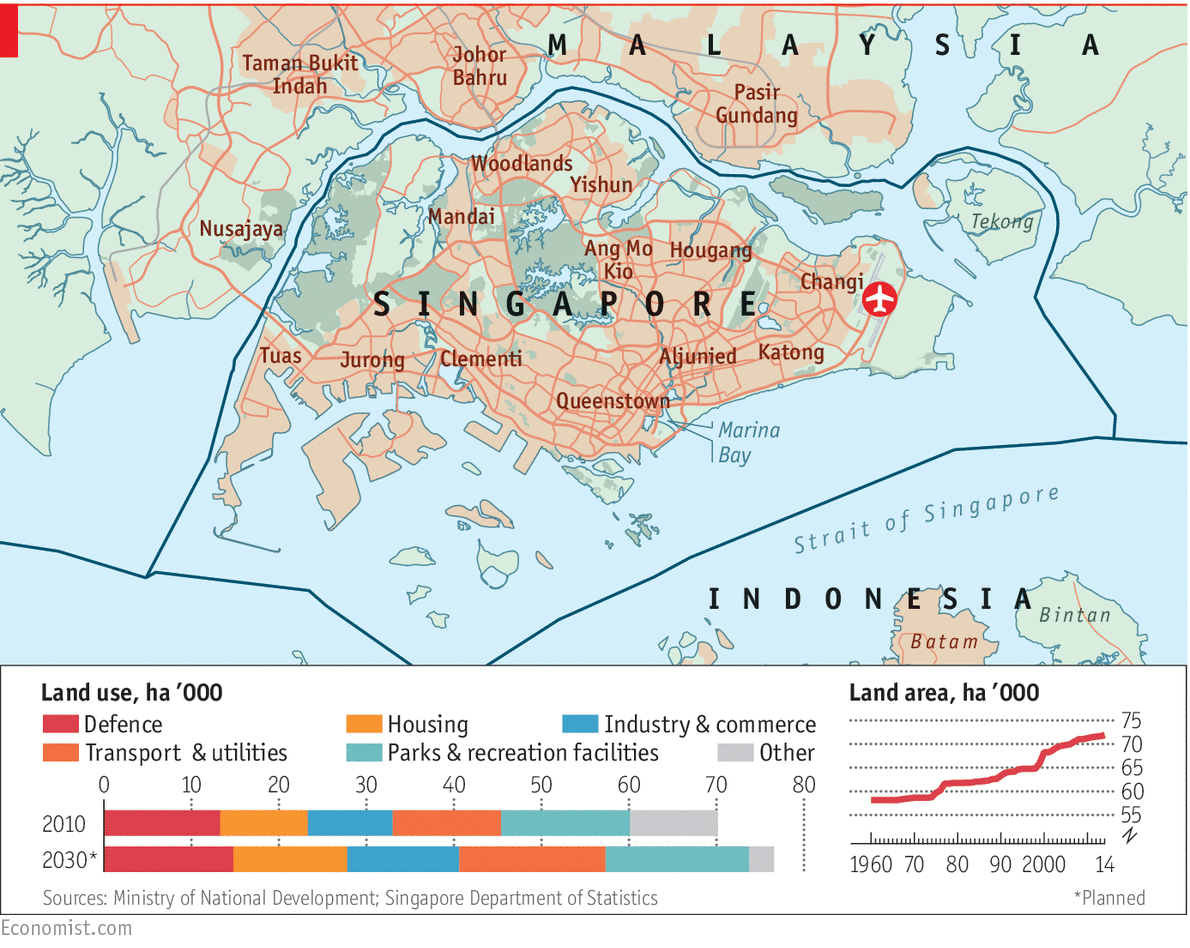
    AT 50, ACCORDING to George Orwell, everyone has the face he deserves. Singapore, which on August 9th marks its 50th anniversary as an independent country, can be proud of its youthful vigour. The view from the infinity pool on the roof of Marina Bay Sands, a three-towered hotel, casino and convention centre, is futuristic. A forest of skyscrapers glints in the sunlight, temples to globalisation bearing the names of some of its prophets—HSBC, UBS, Allianz, Citi. They tower over busy streets where, mostly, traffic flows smoothly. Below is the Marina Barrage, keeping the sea out of a reservoir built at the end of the Singapore River, which winds its way through what is left of the old colonial city centre. Into the distance stretch clusters of high-rise blocks, where most Singaporeans live. The sea teems with tankers, ferries and container ships. To the west is one of Asia’s busiest container ports and a huge refinery and petrochemical complex; on Singapore’s eastern tip, perhaps the world’s most efficient airport. But the vista remains surprisingly green. The government’s boast of making this “a city in a garden” does not seem so fanciful.

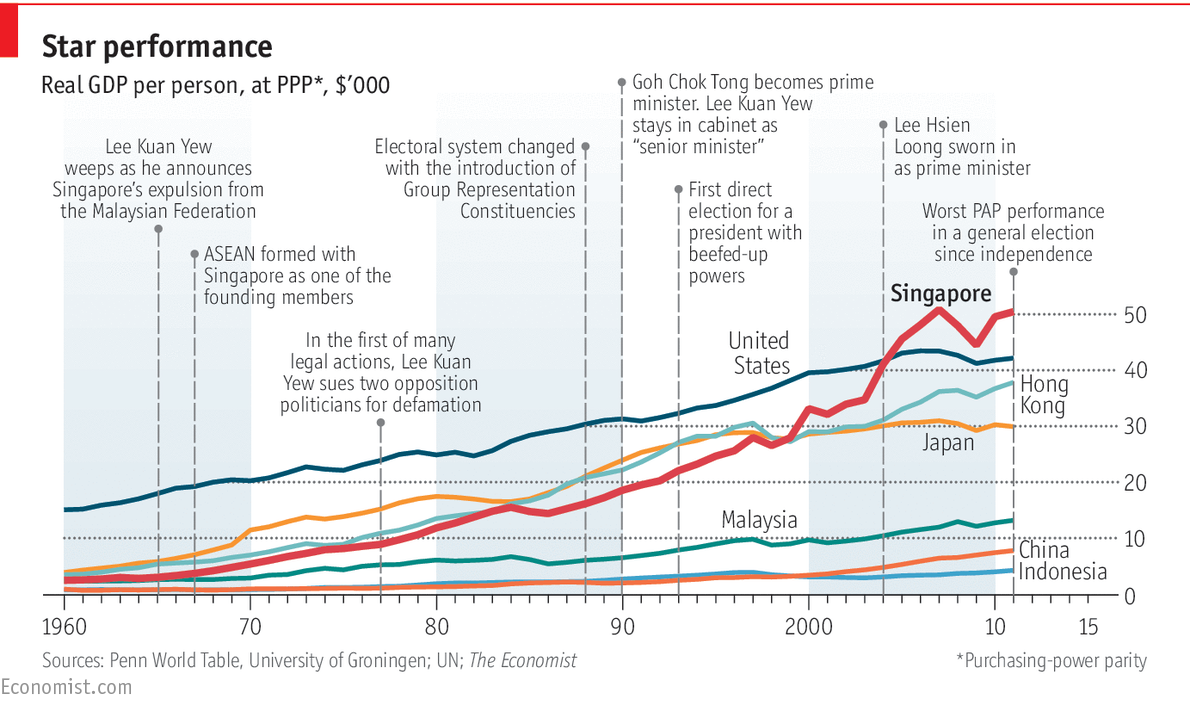
    Singapore is, to use a word its leaders favour, an “exceptional” place: the world’s only fully functioning city-state; a truly global hub for commerce, finance, shipping and travel; and the only one among the world’s richest countries never to have changed its ruling party. At a May Day rally this year, its prime minister, Lee Hsien Loong, asserted that “to survive you have to be exceptional.” This special report will examine different aspects of Singaporean exceptionalism and ask whether its survival really is under threat. It will argue that Singapore is well placed to thrive, but that in its second half-century it will face threats very different from those it confronted at its unplanned, accidental birth 50 years ago. They will require very different responses. The biggest danger Singapore faces may be complacency—the belief that policies that have proved so successful for so long can help it negotiate a new world.

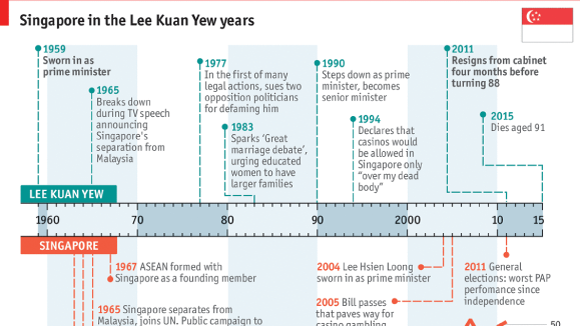
    In 1965 Singapore was forced to leave a short-lived federation with Malaysia, the country to its north, to which it is joined by a causeway and a bridge. Lee Kuan Yew, Lee Hsien Loong’s father, who became Singapore’s prime minister on its winning self-government from Britain in 1959, had always seen its future as part of Malaysia, leading his country into a federation with its neighbour in 1963. He had to lead it out again when Singapore was expelled in 1965. By then he had become convinced that Chinese-majority Singapore would always be at a disadvantage in a Malay-dominated polity.

    Mr Lee’s death in March this year, aged 91, drew tributes from around the world. But Mr Lee would have been prouder of the reaction in Singapore itself. Tens of thousands queued for hours in sultry heat or pouring rain to file past his casket in tribute. The turnout hinted at another miracle: that Singapore, a country that was never meant to be, made up of racially diverse immigrants—a Chinese majority (about 74%) with substantial minorities of Malays (13%) and Indians (9%)—had acquired a national identity. The crowds were not just mourning Mr Lee; they were celebrating an improbable patriotism.

    Lee Kuan Yew himself defined the Singapore exception. As prime minister until 1990, he built a political system in his image. In line with his maxim that “poetry is a luxury we cannot afford,” it was ruthlessly pragmatic, enabling him to rule almost as a (mostly) benevolent dictator. The colonial-era Internal Security Act helped crush opposition from the 1960s on. Parliament has been more of an echo-chamber than a check on executive power. No opposition candidate won a seat until 1981. The domestic press toes the government line; defamation suits have intimidated and sometimes bankrupted opposition politicians and hit the bottom line of the foreign press (including The Economist).

    Singapore, it is sometimes joked, is “Asia-lite”, at the geographical heart of the continent but without the chaos, the dirt, the undrinkable tap water and the gridlocked traffic. It has also been a “democracy-lite”, with all the forms of democratic competition but shorn of the unruly hubbub—and without the substance. Part of the “Singapore exception” is a system of one-party rule legitimised at the polls and, 56 years after Mr Lee’s People’s Action Party (PAP) took power, facing little immediate threat of losing it. The system has many defenders at home and abroad. Singapore has very little crime and virtually no official corruption. It ranks towards the top on most “human-development” indicators such as life expectancy, infant mortality and income per person. Its leaders hold themselves to high standards. But it is debatable whether the system Mr Lee built can survive in its present form.

    It faces two separate challenges. One is the lack of checks and balances in the shape of a strong political opposition. Under the influence of the incorruptible Lees and their colleagues, government remains clean, efficient and imaginative; but to ensure it stays that way, substantive democracy may be the best hope. Second, confidence in the PAP, as the most recent election in 2011 showed, has waned somewhat. The party has been damaged by two of its own successes. One is in education, where its much-admired schools, colleges and universities have produced a generation of highly educated, comfortably off global citizens who do not have much tolerance for the PAP’s mother-knows-best style of governance. In a jubilant annual rally to campaign for lesbian, gay, bisexual and transgender (LGBT) rights on June 13th, a crowd estimated at 28,000 showed its amused contempt for the illiberal social conservatism the PAP has enforced. Younger Singaporeans also chafe at censorship and are no longer so scared of the consequences of opposing the PAP.

    The PAP’s second success that has turned against it is a big rise in life expectancy, now among the world’s longest. This has swelled the numbers of the elderly, some of whom now feel that the PAP has broken a central promise it had made to them: that in return for being obliged to save a large part of their earnings, they would enjoy a carefree retirement. And it is not just old people who have begun to question PAP policies. Many Singaporeans are uncomfortable with a rapid influx of immigrants. These worries point to Singapore’s two biggest, and linked, problems: a shortage of space and a rapidly ageing population.


    Source: www.economist.com

  • Slow Wage Growth Likely To Persist

    Slow Wage Growth Likely To Persist

    For those who have placed the blame for slow wage growth squarely on cheap imported labour, this year’s headline figures in manpower would have been sobering. Despite sharp pullbacks in manpower inflows in the past few years — to the extent that the percentage of vacancies being filled by Singaporeans rather than foreigners this year hit its highest level since 2011 — average pay cheques, after adjusting for inflation, grew by only 0.4 per cent amid tight labour market conditions.

    And if Singapore’s struggles with boosting productivity persist, the picture on the wage growth front next year is unlikely to be any rosier, said economists, especially given the poor global economic outlook. The impending cessation of the Wage Credit Scheme (WCS), which subsidises firms for pay raises, will add another chokehold, they added.

    “Companies don’t want their margin to be squeezed. They want to save more, hold on to a profit margin, to prepare for the next year when there’s no more WCS,” said UOB economist Francis Tan. “Once you increase the wages, it will be hard to move them down again. And if … the workers are still not as productive as you want them to be, it can be quite dangerous for the existence of the company.”

    Labour productivity contracted 0.8 per cent year-on-year in the third quarter, worse than the 0.3 per cent fall in the first half, figures from the Ministry of Manpower showed. The first half of last year registered a 1.3 per cent decline, but this improved to 0.8 per cent growth in the second half.

    The repercussions of flagging productivity, as the International Monetary Fund (IMF) has warned, could extend to the whole of the Republic’s economy. With the tightening of the tap on foreign workers pushing up wages more quickly than productivity, not only will firms pass on the higher costs to consumers, but Singapore’s potential growth and competitiveness could also suffer a blow, the IMF said.

    DBS economist Irvin Seah noted: “Businesses are unable to pursue more orders because of this labour crunch. This will also prevent them from increasing their top-line, unless the productivity of the existing manpower is able to improve.”

    Besides sluggish productivity growth, OCBC’s Ms Selena Ling said companies face pressure from higher rental costs. Singapore is expected to top the rental forecast for Asia-Pacific cities, with a 25 per cent increase in office rents from this year to 2019, based on a report from property consultancy Knight Frank in September.

    In adjusting to these costs, business will take into account the differing flexibility of the various types of business costs. Between rental and wage costs, wages provide a “little bit more room for negotiation”, said Ms Ling.

    Agreeing, Mr Tan said many companies have been moving towards higher variable components in wages to help buffer against economic cycles.

    Workers who benefit from WCS — those earning below S$4,000 — are not considered as vulnerable as low-wage workers. But given the modest growth prospects next year, some economists speculate that the Government could extend the scheme.

    “At this moment, it looks like the United States is showing signs of much more broad-based sustained recovery, while the rest of the world is in different stages of recovery and slowdown,” noted CIMB Research economist Song Seng Wun.

    Mr Seah, however, noted that the WCS, which represents a form of government transfer, was never meant to last and that the more sustainable approach to boost workers’ pay is to equip them with the right skills.

    “Although I think our fiscal policies are gradually becoming more socialistic in nature, I think the Government has continued to emphasise the need for self-sufficiency and the notion of meritocracy,” he said. “I think such principles should continue to remain the hallmark of our economic policies.”

    Indeed, firms have had no choice but to pay more in the stretched labour market, which workers have been quick to capitalise on.

    “And it’s not just the blue-collar workers, but the senior and middle management too,” said RecruitPlus Consulting’s managing director, Mr Adrian Tan.

    Mr Erman Tan, president of the Singapore Human Resources Institute, added that firms will face pressure to keep wage growth at least on a par with inflation. Core inflation, which indicates the rise in everyday out-of-pocket costs, has been estimated at 2 to 3 per cent next year, higher than the 2 to 2.5 per cent expected this year.

    “Inflation is still putting pressure on staff. Firms have to make sure staff have the peace of mind to work, so you can change work procedures, change mindsets and invest in automation, leading to improvement in productivity,” he said.

    There has at least been one bright spark this year in the push for wages to grow because of productivity improvement. In September, the cleaning industry became the first to adopt a skill-wage ladder as a criterion to secure licensing, representing a breakthrough in lifting the pay of a group of workers who have seen their income stagnate. The Progressive Wage Model was also announced for security guards and will be implemented in 2016.


    Source: www.todayonline.com

  • Lee Hsien Loong On Population Growth Of Native Singaporeans

    Lee Hsien Loong On Population Growth Of Native Singaporeans

    Lee Hsien Loong was also asked about Singapore’s low birth rate, and he admitted the government’s pro-family incentives are “still not enough”. In comparison to his father, Lee said he is “much inferior to him in this matter — what he dares to say, I may not dare to say”.

    “We have encouragement, which is important, we also pay close attention to early childhood education and childcare services,” he said. “This is because many women want to continue working after childbirth, so who will take care of the children when that happens? … That is why we are opening more childcare centres, and are grooming more kindergarten teachers. But it is still not enough.”

    >He also spoke about Singapore’s casinos, and how his father previously opposed it, saying the elder Lee supported the policy later on because “the world changed, so we have to change too”.

    “But we think of ways to protect our people, to prevent them from spiralling down with gambling addiction,” he said, saying that in the four years since they opened, the number of Singaporeans who gamble is not increasing, and has stayed at about 20 per cent of the country’s casino visitors.

    Source: https://sg.news.yahoo.com