Tag: harmony

  • Almakhazin SG: What Is PAP’s Tudung Policy Really All About?

    Almakhazin SG: What Is PAP’s Tudung Policy Really All About?

    The hijab ban is not because interracial harmony or relationships.

    The ban…which Masagos Zulkifli supported..

    Is about a group of secular fundamentalists trying to control Islam.

    Two nights ago, PAP Minister, Masagos Zulkifli justified his party’s ban of the hijab.

    He claimed that the ban is part of the PAP’s way of ensuring harmony by making every community sacrifice what is important to them.

    He is not alone in the PAP in making such comments.

    Former Prime Minister, Goh Chok Tong said the hijab affects integration.

    Yaacob Ibrahim claimed it is problematic.

    But the claim that the hijab affects harmony or integration does not stand scrutiny.

    According to Assoc Prof Lily Zubaidah Rahim

    “To date, the government has not provided any empirical evidence to support the presumption that allowing Muslim headscarves in primary and secondary schools impedes national unity.

    Indeed, some school principals contend that students who had donned the tudung in the past did not disrupt social integration in class.”

    If harmony and integration are not the reasons for the hijab ban..

    then what is?

    Lily Zubaidah argued the “no-tudung policy for Muslim schoolsgirls bears many similarities to Turkey’s headscarf restriction policy…

    Both states exhibit secular fundamentalist and authoritarian tendencies…”

    As Lily Zubaidah noted “An Naim has observed that this form of authoritarian state secularism is ‘often designed to enable the state to control religion…”

    The PAP’s ban is not about a creating a multiracial, multireligious Singapura.

    It is about a group of secular fundamentalists trying to subjugate Islam.

    Reference:
    Rahim, Lily Zubaidah. Governing Islam and regulating Muslims in Singapore’s secular authoritarian state. Murdoch university. Asia research centre, 2009.


    Source: Almakhazin SG

  • Damanhuri Abas: Government’s Policy Of Religious Harmony Based On Mutual Tolerance And Acceptance Is A Failure

    Damanhuri Abas: Government’s Policy Of Religious Harmony Based On Mutual Tolerance And Acceptance Is A Failure

    During the malay program ‘Bicara’, Minister for Environment and Water Resources, Masagos Zulkifli reiterated the continuation of the discriminatory policy that has prevented the employment of Malay/Muslim women who wants to don the Tudung/Hijab in jobs such as nursing and other uniformed group services. Throughout the program, the Minister tried his level best to defend the continuation of the discriminatory policy on several grounds in order to justify it.

    His reasoning ranges from the need to be sensitive to the feelings of other races, namely the majority Chinese population which he implied will be upset when they see Malay/Muslim women donning the Tudung/Hijab as nurses, police officers, military personnel, etc., right up to the fear-mongering scenario of the potential opening a Pandora box of misunderstanding and conflict that may lead to undesirable consequences such as racial conflicts for reasons that he deemed too sensitive to be shared to the public. It is unbelievable that a Minister reasoned almost similarly to a US politician that recently justified the call to ban the entry of all Muslims into his country on grounds that its better to play safe than sorry because Islamophobia is justified.

    It is indeed disappointing to hear such unsubstantiated and almost simplistic justification by a person in the position of a Minister in a public broadcast in this time and age essentially addressing the very community that feels discriminated against and who has tolerated patiently to see wisdom from the government to discontinue the archaic policy that has essentially outlived its shelf life.

    In truth, Singaporeans of all races have grown accustomed to the presence of Tudung wearing Muslim women in public. They are present as teachers in our schools, as employees in the public and private sectors too and raises no concern whatsoever. The implied suggestion that their presence is undesirable on grounds that essentially are Islamophobic are disrespectful to those women specifically and insulting to the whole Muslim community in Singapore.

    It is dishonest of the Minister to mention that any attempt to challenge this outdated discriminatory policy as dangerous and fiddling with religion and politics. The reality is the Minister and the government is precisely politicizing the issue by not dealing with it as a discrimination matter. Instead of addressing the growing anger and frustration of the community being discriminated against by this policy, the Minister chooses to confuse it by comparing the government so-called stand on the LGBT community as further justification. The comparison and a zero-sum approach vis-à-vis the LGBT community, to the issue of discrimination against Muslim women wanting to don the hijab for uniformed group is disingenuous.

    Once again, Singaporeans must honestly ask ourselves whether the efforts of the government all this years to ensure the growth and maturity of our different races and religious communities to mutually tolerate and accept one another and celebrate both our similarities and our differences, has indeed succeeded. By one Minister after another highlighting evidence of failures, it only supports the view that the policies aimed to unite our different communities are flawed and have not produced the desired results and thus have to be reformed and changed to reflect the present times where the communities are no longer separated like in the past and the majority of us, the common folks do live together in HDB flats and chat and interact with one another harmoniously.

    Finally, the Malay community has been quoted by 2 studies done by the government’s own think-tank institution namely the Lee Kuan Yew School of Public Policy and the Institute of Policy Study as being the most tolerant and accommodating of all communities when it comes to acceptance of diversity and differences. Maybe it is time that the focus of the effort to educate our society on tolerance and understanding be on the majority community rather that on the minority. Only then, wisdom based on grounded evidence will prevail instead of baseless justification that borders on political expediency.


    Source: Damanhuri Abas

  • Mizi Wahid: Respect And Tolerance Is Important Whichever Mazhab You Follow

    Mizi Wahid: Respect And Tolerance Is Important Whichever Mazhab You Follow

    I majored in Islamic Law for my degree. And one of the things we learned about was on Mazhabs (which essentially refers to Schools of Thought). My biggest takeaway from it was not of obsession towards one particular school of thought, or even the rejection of all.

    Instead, the most profound lesson I gained, was from appreciating the beautiful character of the scholars who were the “founders” of their Mazhab.

    Their individual opinions differed. Their reasonings weren’t the same. And the criteria used for the process of deriving rulings and arriving to conclusions were varied.

    But some things stood out amidst the differences. Respect. Tolerance. Mercy. Objectiveness. And humility.

    Were there disagreements? Yes. But there were also compliments. Were there conflicting ideologies? Yes. But there were no expectations to appease.

    For those who know me well enough will tell you, that I’m not the kind of person who likes to keep lessons confined to one discipline (and you may be too). First, I’ll try to see where else in the world am I seeing something similar taking place. And secondly, how these lessons can be applied in other parts of my life.

    What I’ve discovered is that in every area of our work and relationships, there are Mazhabs.

    When young parents believe in raising their own children a certain way, while their parents or in-laws believe in doing it differently. After all, “You ended up OK today.”

    When nursing mothers who believe in doing things 100% natural, disagree with those who are a bit more flexible – things can get pretty nasty. My wife has shown me some of the “discussions” in some group pages. Imposing views – is an understatement.

    When you find it uncomfortable seeing others posting photos or updates about personal religious practices, but you are fine posting updates about your new bag, new car, new house, your voluntary work, or an unplanned good deed that you did today. Mazhabs.

    When certain entrepreneurs believe strongly in working long hours and over the weekends, while others believe in the chill-by-the-beach concept – again, just different Mazhabs. Those who hustle feel alive when they do. While the other group simply believes that their businesses should be giving them more life, instead of draining it all away.

    So, in politics you see Mazhabs. In leadership you see Mazhabs. In school you see Mazhabs. In healing and medication you see Mazhabs. The list goes on and on.

    I must add that scholars of Mazhabs respect and acknowledge their peers because they know that the opinions are based on sound research, a trusted process, and the integrity of the individuals. I just hope that respect, mercy, tolerance, and humility will prevail in the end.

    ps/ for those who don’t subscribe to a particular school of thought, Lo and Behold! That is also a Mazhab

    ‪#‎whatsyourmazhab‬


    Source: Mizi Wahid

  • Analysts: Critical For Diverse Views To Be Heard

    Analysts: Critical For Diverse Views To Be Heard

    The need to refresh the political system as Singapore’s circumstances change highlighted by President Tony Tan in his opening address to the 13th Parliament last night (Jan 15) caught some political observers’ eyes, as they suggested the Government could tap new approaches to better capture the full spectrum of diverse perspectives on the ground.

    While they acknowledged the Government’s efforts to this end, in terms of dialogues and public consultations, the analysts said going beyond these existing initiatives would go towards Dr Tan’s call for Singapore to stay cohesive and move forward together.

    Calling for views to be gathered from avenues beyond Government-endorsed dialogues, such as blogs, forums or civil society, former Nominated Member of Parliament (NMP) Siew Kum Hong said: “There needs to be the recognition that disagreement, dissent and conflict are not necessarily unhealthy, as without those things, we are doomed to fail.”

    “If you want to be fully inclusive, bring (these groups) in and engage them on their own terms.”

    In the face of greater diversity of views in society, changing Singaporeans’ mindsets is also important, said former NMP Eugene Tan. Singaporeans also need to be open-minded when considering different perspectives and allowing robust debate could help drive this mindset change, he added.

    “(Diverse views) reflect a society that is becoming more complex … The only way you can deal with it is for people to be able to engage in robust debate … and not treating the differences in values as existential challenges,” said the Singapore Management University law don.

    Institute of Policy Studies’ deputy director Gillian Koh noted, however, that a government-society partnership is not without challenges since ideas being pushed for may be driven by personal interests.

    “The argument should be done with integrity and for that purpose and not with some hidden agenda … We want shared governance, but this is the real danger of that shared governance going wrong,” she said.

    The experts also cited a list of other possible tweaks when it comes to refreshing the political system, including expanding the Non-Constituency MP slate and changing the selection process for NMPs.

    Smaller Group Representation Constituencies could also be instituted, they said.

    On the five key aims set out by Dr Tan for Parliament’s new term, the political observers flagged the focus on renewing the economy as the most pressing concern to Singaporeans.

    Not only will Singaporeans be keeping close tabs on how the Government rejuvenates the economy, Associate Professor Tan said they will look at how the authorities will help those who could emerge as “losers” with economic restructuring.

    Dr Alan Chong from the S Rajaratnam School of International Studies also flagged the dark clouds over the economy now, citing the stock market turbulence in China and the US Federal Reserve raising interest rates.

    The economy and urban infrastructure like transport are naturally closely-watched as they are tangible aspects that will affect daily lives, he added.

    Assoc Prof Tan said security is also likely to be one of the Government’s top priorities, given the string of Islamic State terror attacks, including most recently in Jakarta two days ago.

    “(The Government will) want to assure not just people living here but people who are invested in Singapore, people who might want to invest in Singapore,” he added.


    Source: www.todayonline.com

  • Janil Puthucheary: Racial Harmony Cannot be Taken For Granted

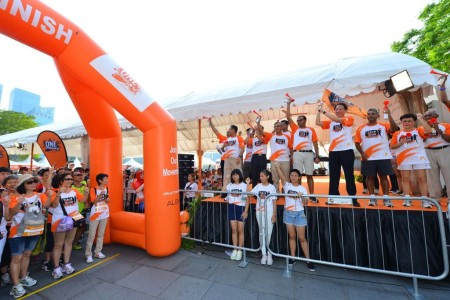
    At the sidelines of the Orange Ribbon Run 2015 that marked 50 years of racial harmony in Singapore, Chairman of OnePeople.sg, Dr Janil Puthucheary shared with Popspoken that he feels racial harmony in Singapore is “really quite exceptional” but “is not something to be taken for granted”. A whopping 7,000 people participated in the third edition of the Orange Ribbon Run – an event organized by OnePeople,sg, a national body that promotes multiracialism in Singapore. The event saw the support of Team Singapore athletes including former Olympian, Mr. C. Kunalan, SEA Games 2015 athletes and players from the Football Association of Singapore.

    When we probed further on how racial harmony could be promoted, Dr Janil replied, “There’s no one single approach… We organise different types of dialogues, debates and discussions about the issues of racial harmony, religious harmony and moving beyond this, tolerance and trust is our mission. So we are talking about it. We are talking about it, and we are encouraging people to think about it and to believe that this is something worth fighting for, worth standing for.”

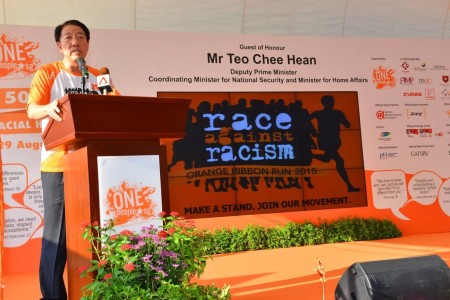
    Guest-of-Honour (GOH) Mr Teo Chee Hean, Deputy Prime Minister (DPM) and Coordinating Minister for National Security and Minister for Home Affairs flagged off the Orange Ribbon 3.5km Fun Walk along with Dr. Janil Puthucheary, Chairman of OnePeople.sg and Orange Ribbon Run’s ambassador, Mr.C Kunalan (last from right)

    On how rising racial tensions in neighbouring Malaysia affecting Singapore, Dr Janil noted, “Well, you know, our political structure in Singapore is such that we can’t play racial politics. That was something that was set up in 1965, very deliberately. And I think it’s something most Singaporeans – almost, I believe, all Singaporeans – believe it’s a strength that we have in our nation. That people are not going to get support if they try to feed into racial anxieties, if they try to stir up racial tensions, and it amounts to some degree of agitation.” He believes that our political structure is mature enough to move away from a model of having to “appeal to, engage with, and serve the broad middle ground of most Singaporeans, if not all Singaporeans.”

    11707865_10156055475295451_8815350489409281522_o

    We all share a common humanity: DPM Teo

    Mr Teo Chee Hean, Deputy Prime Minister (DPM) and Coordinating Minister for National Security and Minister for Home Affairs graced the event.In his speech, heCREDITED the government for progress made in the sphere of racial harmony.

    He touched upon the government’s success of deliberate policy making (e.g. bilingualism, common education system, integrated housing, fairness in the workplace etc), which has succesfully resulted in cohesively integrating people from different backgrounds.

    DPM Teo also rallied the crowd to open their hearts and minds, and come together as one people. He believes that reaching out to another to understand someone better, will definitely bring people closer together. At the same time, he cautioned against people with their own “agendas” who try to “accentuate” differences.

    Everyone sharing a ‘common humanity’,was to him, something worthwhile to celebrate. It is hence imperative for us to think about how we can enlarge the existing areas we have in common “and not allow anyone who wants to accentuate differences to succeed in dividing us,” said DPM Teo.


    Source: http://popspoken.com