Tag: investments

  • SDP: We Repeatedly Warned About UBS Investment

    SDP: We Repeatedly Warned About UBS Investment


    The recent announcement that the GIC stood to lose in excess of $5.6 billion comes as no surprise. The Swiss bank had been plagued with problems and the SDP had warned on at least five separate occasions against the GIC investing in it.

    1. As early as 2009, the SDP warned:

    “Either Dr Tony Tan (who was the GIC’s executive director then) knew about the developments and problems that UBS was facing and chose to ignore them, or he had no clue that trouble was brewing in and around the bank. Which is worse?” (link)

    2. We repeated the warning one month later:

    “The GIC put in US$10 billion into UBS which later announced a US$19 billion write-down. UBS admitted to helping to defraud the US Government and was made to pay substantial amounts in fines. Is this how our best and brightest in the Government practice due diligence?” (link)

    3. Dr Chee Soon Juan cautioned a third time that year:

    “The latest revelation is that Citi, UBS, Merrill and Barclays had all invested in the Bernie Madoff scam. Mr Madoff ran the biggest Ponzi scheme in corporate history and duped his investors to part with nearly US$50 billion of their money. In fact UBS is being sued in France by a wealth management company for its involvement in the Madoff madness.” (link)

    4. When UBS got into further financial trouble in 2010, the SDP again sounded the alarm:

    “But instead of learning from its mistakes, Mr Ng Kok Song (then GIC’s Chief Investment Officer) doubled down and said in 2009 he that he still had ‘confidence’ in the ‘long-term prospects’ of the investment. This confidence seems quite misguided.” (link)

    5. In 2011 during the Presidential Election, we raised the matter yet again:

    “Either (candidate) Dr Tony Tan knew about the developments and problems that UBS was facing and chose to proceed by putting money into it anyway, or he had no clue that trouble was brewing in and around the bank. Whichever it is, the incident does not back up Dr Tan’s boast that he is the experienced guardian with the ability to, in his words, see ‘the dark clouds over the horizon coming on.’” (link)

    These warnings, however, fell on deaf ears as the GIC continued to pour money into the troubled bank only to belatedly cut its losses 10 years later.

    The recklessness and incompetence of this government has resulted in a massive loss of billions of dollars of the people’s money. As Chairman of the GIC, PM Lee Hsien Loong cannot remain silent on this matter.

    A public inquiry is wholly appropriate and necessary at this juncture.


    Source: http://yoursdp.org

  • Saving For Retirement

    Saving For Retirement

    Most Singaporeans hope to live comfortably after retiring, seeing friends and doing activities they enjoy. For many, however, that hope can be shattered by financial concerns.

    More than half of residents here feel their financial preparations for a comfortable retirement are inadequate, according to the latest HSBC Future of Retirement Survey, with many saying they haven’t saved enough or have too much debt. The Blackrock Investor Pulse similarly found that 72 per cent of Singaporeans are concerned about not being able to retire comfortably, while research by NTUC Income showed that 33 per cent of non-retirees haven’t even started planning for retirement.

    Yet life doesn’t need to be this bleak. By taking small steps today, you can start on your way towards saving enough to retire comfortably.

    HOW MUCH YOU NEED

    The first step is to figure out how much you actually need. As national financial education program MoneySense puts it, “first things first – identify your retirement needs and goals so you know what you are planning for.” A good way to do this is to visualise your retirement and ask yourself what you want to do when you retire.

    Once you know your goals, you can use simple estimates or more sophisticated financial calculators to determine how much you need. Many experts estimate that retirees will need 60-to-70 per cent of their pre-retirement income to live comfortably. For example, a person with the average household income here of $2,500 per month would need $1,500-$1,750 per month.

    Financial calculators can help you determine even more precise amounts. A calculator from insurance company Aviva estimates that a 50-year-old who plans to live a simple lifestyle after retiring at age 65 would need to save about $499,000 so that they have $2,775 per month, for example, while a 25-year-old would need to save about $977,000 because inflation will result in their needing $5,482 per month. The calculator asks about the lifestyle you prefer and then gives details about how much you’ll need for food, transport, clothing and other expenses.

    While these amounts might seem daunting, investment management company Vanguard says that “getting to a million might not be that hard if you know the secret: time. If you give your savings enough time to grow, you’ll only need relatively small investments of money to wind up with a pretty big balance.” Vanguard calculated that you can have $1 million by age 65 if you save $4,500 each year starting at age 20. You’ll need to save $9,000 per year if you start at age 30, though, and a hefty $18,000 per year if you start at age 40.

    START SAVING

    The key to a comfortable retirement, then, is to start saving early. Yet saving is often much easier said than done.

    The NTUC Income survey also showed that although two-thirds of non-retirees between 25 and 59 years old have started financial planning for retirement, prioritising saving amongst the young is impeded by short and mid-term financial commitments as well as a lack of knowledge. Tips from experts can overcome the inertia.

    Vanguard, for example, suggests setting up automatic transfers from your salary or bank account every month to ensure that you save consistently, and then looking at your account only once or twice a year to make sure you are sufficiently diversified.

    NTUC Income suggests avoiding debt, saying that “debts are one of the biggest threats to your retirement plan. The more you spend on repaying your debts, the less you have to save up for retirement.”

    INVEST YOUR MONEY


    Making the most of your money is important too. If you save $500 per month starting at age 25, for example, you would have about $295,000 by the time you’re 65 if you earn 1 per cent per year on your money or about $766,000 if you earn 5 per cent per year.

    Rather than just putting money into a time deposit that may earn less than 1 per cent, then, DBS Bank suggests that a wiser way of investing is to divide your money among a variety of safe and risky assets. “Safer assets (like our CPF and bonds) can help to offset losses from the riskier assets like stocks.” Putting at least part of your retirement funds into higher-yielding investments can indeed help you earn higher returns and have enough money for retirement.

    Investment management firm Blackrock similarly suggests considering different fund products to diversify your assets. “Singaporeans demonstrate a preference for purchasing equities and bonds directly but could be missing out opportunities to easily achieve a diverse portfolio through exchange-traded funds (ETFs) and mutual funds.”

    An easy way to invest is to put a fixed amount each month into several ETFs, such as the ABF Singapore Bond Index Fund or the Nikko AM Singapore STI ETF, which you can easily do through banks or brokerage firms here.

    By starting to save early and consistently investing some of your funds in assets with higher returns, you can overcome the concerns about not having enough and start on your way to a retirement you’ll truly enjoy.


    Source: TODAY Online

  • Why I No Longer Trust GIC (PAP) With My CPF

    Why I No Longer Trust GIC (PAP) With My CPF

    It is a fact that an unbelievable number of our CPF investments are underwater. I am doubtful GIC is a shrewd fund manager.

    The PAP has not been able to convince thinking Singaporeans that our CPF scheme is not a scam. To do so would require GIC to disclose all its investments and I suspect many will prove to be deeply embarrassing.

    Singaporeans who are still unconvinced can analyse the 281 investments on this list. It’s of course not a complete list but if there’s any evidence of GIC’s superior performance, please share the information. I have already posted some wiped-out CPF investments and will continue to do so as objectively as our mainstream media.

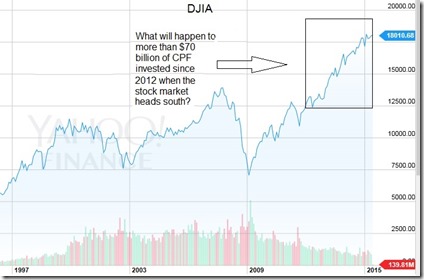
    Investments exceeding $1 billion will soon become the norm due to the legislated retention of humongous amounts of our CPF, ie the total amount of CPF balances doubled from $136 billion to $275 billion during the last 7 years. GIC is aware of the “inflated prices across all asset classes” but is forced to invest (risk) about S$20 billion of CPF monies annually. It is a fact that economic ‘growth’ post Global Financial Crisis has been built on a mountain of debt.

    DJIA long-term chart
    Source: Yahoo Finance

    Most stock market indices, such as Germany’s DAX, have been hitting new highs since 2 years ago. Perhaps our multi-million dollar GIC directors do not believe that stock markets are cyclical in nature?

    Source: Yahoo Finance

    GIC is not a nimble investor and frequently goes in for the kill. It is a major shareholder in many foreign companies, with stakes of more than 5%. When a financial crisis hits, GIC will not be able to exit when stock prices are plunging due to a lack of liquidity. In a prolonged economic downturn, divestment by a major shareholder like GIC will result in gargantuan losses.

    A recent example is its 63% investment in Nirlon. GIC’s Plan B = wipeout.

    Unaccountability THE problem with GIC (PAP)

    The 2 biggest investment blunders in GIC’s history are UBS and Citigroup. No one has been held accountable as if the combined 7-year S$25 billion investment is loose change.
    Lee Kuan Yew justified GIC’s bad investments by merely stating “..we went in too early. This is the part of the ride”.
    Lee was actually taking us for a ride because GIC was not investing in solid businesses but speculating for capital gains. Solid businesses make profits, declare regular dividends and the share price naturally heads north.

    UBS AG long-term chart

    Source: ft.com

    Citigroup long-term chart (divide share price by 10 due to reverse stock split in 2011)

    What’s so good about investing in a company whose share price has dropped 90% from 9 years ago?

    GIC did make some money from its Citigroup investment but this has nothing to do with good judgement as many have come to believe. It was entirely based on luck. As confirmed by its current share price, Citigroup was horribly mismanaged, ie it had taken on excessive risks with the possibility of bankruptcy.

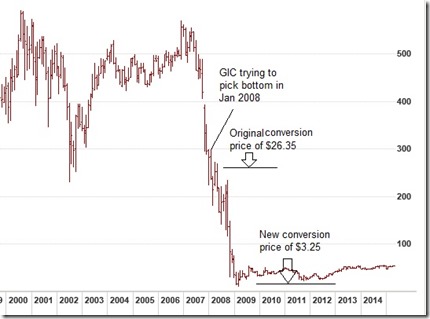
    GIC had invested in Citigroup notes with a 7% coupon payment at a conversion price of $26.35. To prevent its bankruptcy, the US government bailed out Citigroup and the original conversion price wasreduced to $3.25. Without the reduction, GIC would be sitting on massive unrealised losses of more than 60%.

    The point to note is GIC had not expected Citigroup to be:
    – a candidate for bankruptcy
    – its ‘attractive’ conversion price of $26.35 to be reduced by 87% to $3.25
    – US taxpayers to bail out its investment.

    Is this then not some sort of ‘tikam-tikam’ investment? Should anyone have faith in a fund manager who makes money by hoping for the best?

    GIC has invested about S$25 billion in Citi and UBS whose net return is close to zero after 7 years. Can GIC’s smaller investments be expected to perform well when it has proven to make lousy judgements on much bigger investments?

    The GIC board may not be involved in the day to day investment decisions but they certainly had beenconsulted before $25,000,000,000 of our CPF and reserves were invested. By not holding any director accountable, it appears the government has condoned risky behavior. GIC has therefore not learnt any lesson form its mistakes and CPF members should expect more losses when the next financial crisis hits.

    GIC’s returns cannot be confirmed

    The payment of CPF interests does not confirm GIC has been able to earn a 20-year 4.1% annualised real rate of return. Without providing a proper set of accounts, no CPF member should believe GIC’s data blindly. The payment of CPF interests was likely to have been from our reserves.

    Government absorbed ‘losses’ 8 out of 20 years?

    Last year, DPM Tharman told parliament that “in eight out of 20 years, GIC’s returns were lower than the rate promised to CPF members, but the Government absorbed the losses”. Why then were our reserves used 8 times without Parliament or the President being informed?

    To claim that “the Government absorbed the losses” is at best a half truth because CPF member are also taxpayers. Assuming a CPF interest rate of 4% with GIC’s rate of return at 2%, we have:

    GIC (2%) + Govt (2%) = CPF (4%, also taxpayers)
    GIC (2%) + Taxpayers (2%) = CPF (4%, also taxpayers)

    The government is not a separate entity and is funded by taxpayers. All CPF members are taxpayers and we are effectively paying ourselves. There are no losses by the government.

    Singaporeans are being forced to pay for an underperforming GIC, our ‘professional’ fund manager. In a true democracy, GIC would have been history.

    Understanding NIR framework confirms my suspicions

    The PAP has tried to confuse the public by introducing complicated schemes and frameworks. Few would then bother to question the government or understand its motives. But it is not really that difficult to understand when we focus on key words.

    The PAP currently supplements our budget with (1) up to 50% of the long-term expected real returns on the (2) relevant assets under the Net Investment Returns framework:

    (1) PAP wants the public to keep guessing its “up to 50%”, which could mean anything from 1% to 49%. “Long term” could mean 10-year or 20-year which again PAP is not being upfront. Words which are meaningless to the public confirm PAP’s intent to conceal information.

    PAP wants to prevent public knowledge of our reserves, money which belongs to citizens but somehow we aren’t supposed to know.

    Bear in mind this is not income earned from investments but expected future earnings. In a bad year where investment income is insufficient, PAP will be able to spend money which has not been earned, ie from our reserves. Neither does it need to inform the president nor consult Parliament. Read post by andyxianwong with links to other blogs.

    (2) Relevant assets are defined under the Constitution as the “assets managed by GIC and MAS, minus the liabilities of the Government (which include SGS and SSGS) and MAS. In short:

    MAS + GIC assets – (SGS + CPF) = Relevant assets

    The ability to determine the returns on relevant assets means the PAP (MAS?) must have known the actual investment returns earned by SGS and SSGS (CPF).

    Conclusion

    It is not possible that PAP does not know the actual CPF investment returns. When the government uses the excess return above the CPF rate to fund government expenditures, money which rightly belongs to me, I feel I have been cheated.
    In order to avoid disclosing actual CPF investment returns, the PAP has created a smokescreen of half-truths.
    The non disclosure of material information on CPF and the unaccountability of GIC have made it impossible for me to trust GIC (PAP) with my CPF. Do you?


    Philip Ang


    Source: https://likedatosocanmeh.wordpress.com