Tag: Islamic law

  • Brunei Is An Islamic Country Practising Islamic Law, Is it Wrong?

    Brunei Is An Islamic Country Practising Islamic Law, Is it Wrong?

    “In your countries you practice freedom of speech, freedom of press, freedom of religion, etc. It’s in your constitution. It’s your political system, your national identity, your rights, your way of life.

    In my country, we practice a Malay, Islamic, Monarchical system and we’re going to start practicing the laws of Islam, Shari’ah Law. Islam is in our constitution, our national identity, our rights, our way of life.

    We may find loopholes in your laws and justice system, and you may have found ours, but this is our country. Just like you practice your right to be gay, etc. for this world you live in now, we practice our rights to be Muslims for this world and the Hereafter.

    This is an Islamic country practising Islamic Law. Why don’t you worry about your kids being gunned down in schools, worry about your prisons being unable to accommodate convicts, worry about your high rate of crimes and DUIs, worry about your high suicide and abortion rate, worry about whatever it is that you should be worried about there.

    Many religions are against homosexuality, it’s nothing new. The moment you hear that Islam and Muslims making a stand and trying to reaffirm their faith, you judge, you boycott, you say that it’s wrong, it’s stupid, it’s barbaric.

    Again, go back to those worries that you should focus on I’ve mentioned earlier. Is it not wrong to legalize deadly weapons, is it not wrong to allow unborn babies to be killed, is it not wrong to allow a lifestyle that results in AIDS and discontinuation of the next generation?

    Why do you care so much what’s happening here in an Islamic nation when you didn’t even bat an eyelid about the Syrians, Bosnians, Rohingyas, Palestinians, etc. Thousands are being killed there and you don’t care, not one is killed here under this Shari’ah Law, and you make a big fuss, even when the citizens here who are directly affected by it, accepts it with peace. Punishments may be harsher but it does not mean it’s easier to be carried out. There are processes to go through before an actual conviction. We are fine with it, we are happy.”

    Government of Brunei Darussalam
    May 2014

    #bruneisyariahlaw #proudtobebruneians #worldstandforbrunei


    Source: The Saucy’sside livecook BN

    Rilek1Corner

  • Saudi Arabia Quietly Spreads Its Brand Of Puritanical Islam In Indonesia

    Saudi Arabia Quietly Spreads Its Brand Of Puritanical Islam In Indonesia

    When Ulil Abshar-Abdalla was a teenager in Pati, Central Java, he placed first in an Arabic class held at his local madrasa. The prize was six months of tuition at the Institute for the Study of Islam and Arabic (LIPIA), a Jakarta university founded and funded by the Saudi Arabian government. At the end of six months, LIPIA offered him another six. He stayed on.

    After that, it offered him four more years of free tuition to obtain a bachelor’s degree in Islamic law, or shariah. He accepted that too. In 1993, after five years at LIPIA, he was offered a scholarship to continue his studies in Riyadh. He finally said no.
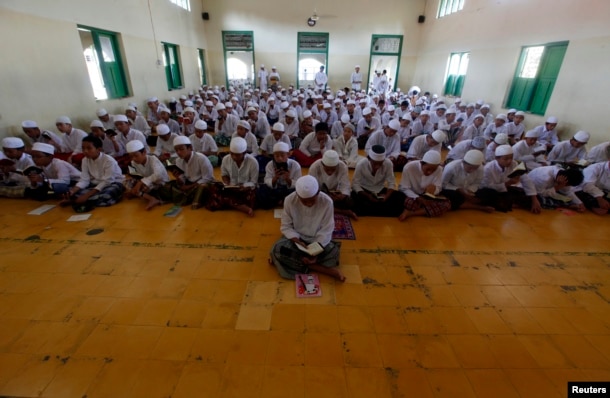
    FILE - Students pray during the first day of the holy month of Ramadan at Al-Mukmin Islamic boarding school in Solo, in Indonesia's Central Java province, August 1, 2011.

    FILE – Students pray during the first day of the holy month of Ramadan at Al-Mukmin Islamic boarding school in Solo, in Indonesia’s Central Java province, August 1, 2011.

    “Once you accept that, you’re on their payroll for life,” Abshar-Abdalla told VOA. “But they made it awfully easy to stick around. I’m from a poor family, and it was quite tempting… I think they managed to pull a few good minds from my generation that way.”

    Since 1980, Saudi Arabia has been using education to quietly spread Salafism, its brand of puritanical Islam, in Indonesia, the world’s most populous Muslim nation. The two main arms of this effort are LIPIA and scholarships for higher education in Saudi Arabia.

    Salafism is an ultra-conservative reform movement that advocates a return to Koranic times. LIPIA teaches Wahhabi Madhab, a strain of Salafi Islam expounded by the medieval Sunni theologian Ibn Taimiyah.

    “Saudi alumni” are now visible in many arenas of Indonesian public life, holding positions in Muhammadiyah, the Prosperous Justice Party, and the Cabinet. Some have also become preachers and religious teachers, spreading Salafism across the archipelago.

    The effects of Saudi Arabia’s massive soft power exercise on the Indonesian citizenry are just starting to become clear.

    ‘The most important post in Jakarta’

    The nexus of Saudi educational diplomacy is the religious attaché, a special office affiliated with its embassy in Jakarta. The office grants scholarships for students to study in Saudi Arabia, although the current attaché, Saad Namase, refused to confirm how many students were involved.

    “We don’t really work with the Indonesian government,” said Namase. “We just try to strengthen cultural ties between our two countries by, for example, holding Quranic recitation competitions.” On the topic of scholarships, he said many countries, including the Netherlands and the U.S. offer scholarships to Indonesian students and the Saudi program was just one among many.

    FILE - A teacher gestures during an Islam personality class during the holy month of Ramadan at the Al-Mukmin Islamic boarding school in Solo, Indonesia Central Java province, Aug. 2, 2011.

    FILE – A teacher gestures during an Islam personality class during the holy month of Ramadan at the Al-Mukmin Islamic boarding school in Solo, Indonesia Central Java province, Aug. 2, 2011.

    “The Saudi religious attaché is the most important post in Jakarta,” said Abshar-Abdalla, who now runs the Liberal Islam Network. “It is the portal for all Saudi efforts to influence Indonesian culture.”

    The attaché’s office also pays the salary of prominent Salafi preachers and supplies Arabic teachers to boarding schools across Indonesia, according to Din Wahid, an expert on Indonesia Salafism at the Syarif Hidayatullah State Islamic University in Jakarta.

    Beyond the attaché’s office, several Saudi Arabian universities directly offer scholarships to Indonesian students.

    One reason the Indonesian government is unlikely to present roadblocks to Saudi cultural expansion is its precarious annual Hajj quota, according to Dadi Darmadi, a UIN researcher who focuses on the annual pilgrimage to Mecca.
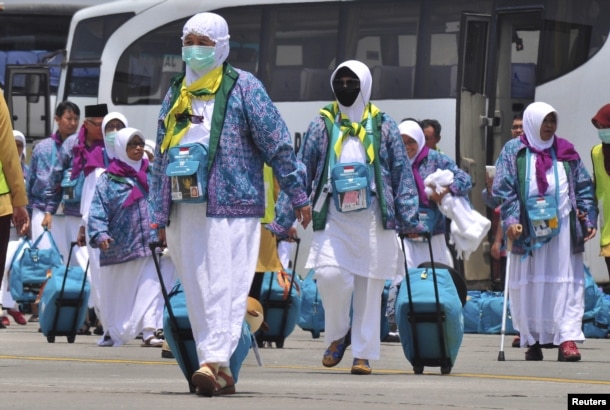
    FILE - Indonesian Haj pilgrims walk towards their flight at the airport in Solo, Central Java province, Indonesia, Sept. 17, 2015, in this photo taken by Antara Foto.

    FILE – Indonesian Haj pilgrims walk towards their flight at the airport in Solo, Central Java province, Indonesia, Sept. 17, 2015, in this photo taken by Antara Foto.

    “We were just granted 10,000 extra Hajj permits this year, which is still a drop in the bucket considering Indonesia’s population of 203 million Muslims,” said Darmadi, “I think Indonesia would hesitate to antagonize Saudi Arabia and prompt cuts to that hard-won quota.”

    Divergent paths

    Hidayat Nur Wahid, a member of Indonesia’s House of Representatives and a leader of the right-wing Prosperous Justice Party (PKS), is one of the most prominent national politicians who have passed through Saudi universities. He studied, through a series of scholarships, for an undergraduate, master’s and doctorate degree in theology and history of Islamic thought at the Islamic University of Medina.

    FILE -- In this July 5, 2013 file photo, worshipers visit the Prophet's Mosque in Medina, Saudi Arabia.

    FILE — In this July 5, 2013 file photo, worshipers visit the Prophet’s Mosque in Medina, Saudi Arabia.

    “The majority of Islamic texts are in Arabic, which is why I wanted to study in Saudi Arabia,” Nur Wahid told VOA. “Plus, the spirit of the Prophet Muhammad animates Medina. I enjoyed my years there.”

    Nur Wahid said he was not exposed to radicalism or “anti-social” teachings in Medina. “We just learned how to be good Muslims. And it’s a misconception that everyone who studies in Saudi Arabia becomes a preacher or religious teacher. Many graduates become officials or politicians like me.”

    “Since it is the place where Islam originated, many students think that Saudi Arabia represents authentic Islam,” researcher Din Wahid.

    Saudi theology had the opposite effect on Abshar-Abdalla, who gradually grew disenchanted with the Salafi movement during his five years at LIPIA.

    “Although I had some short-lived enthusiasm for that simplistic theology, I found it to be puritanical at its core,” said Abshar-Abdalla. Instead, he started to read various other Islamic texts on his own, including Sufi and Shia ones, and eventually founded the Liberal Islam Network (JIL) in 2001.

    Ironically, he himself was once recruited for the student movement that would develop into PKS. “I was invited for a rafting trip in Bogor one weekend at university, and I realized they were trying to get me to join Tarbiyah, the embryo of the current PKS party,” said Abshar-Abdalla. “I sort of ran in the opposite direction.”

    Extremist connection

    Although Saudi-educated preachers in Indonesia might be causing a subtle rightward shift in national ideology, a more immediate concern is whether Salafi teachings encourage terrorism or extremism.

    “By and large, I think not, because official Salafism is quietist, or apolitical, in order to preserve the authority of Saudi royalty in its homeland,” said Wahid. “That being said, when this ideology migrates back to Southeast Asia, all bets are off.”

    One prominent example of non-quietist, or jihadist, ideology is the Salafi-influenced Ngruki pesantren in Solo, Central Java, which has incubated a number of known Indonesian terrorists.

    And Zaitun Rasmin, a graduate of Medina Islamic University, was one of the chief organizers of the hardline demonstrations against the governor of Jakarta in late 2016. “He’s an example of an Indonesian Salafist who is unconcerned with being ‘apolitical,’” said Wahid.

    Wahid’s point is that, for all the resources Saudi Arabia is directing towards Indonesian students, it remains to be seen how exactly Salafi ideology evolves in its new Southeast Asian context. “There are three ‘flavors’ of Salafi ideology: quietist, political, and jihadist. We don’t know what exactly it looks like in Indonesia. All we know is that it’s here, and it’s growing.”


    Source: VOA

  • What Is Islamic Law? — Jahaberdeen Mohamed Yunoos

    What Is Islamic Law? — Jahaberdeen Mohamed Yunoos

    It may sound ironical to ask the question what is “Islamic law” in the 21st century when it is generally thought that the body of what constitutes Islamic law has already been crystallised and settled.

    If indeed it has crystallised into a recognisable and unchangeable body, then it is logical that there would only be one universal Islamic law. However, an observation of Islamic law between various countries and even between various states in Malaysia would evidence the fact that the laws are not uniform.

    It would seem that what is Islamic law is still developing, in a state of flux and diverse. Shariah, on the other hand is a separate concept altogether.

    Every Muslim would agree that Islam is a simple religion. The pillars of Islam are said to be only five that is, declaration of faith or the syahadah, the daily five times prayer, fasting in the month of Ramadan, payment of the zakat and the performance of the pilgrimage by those who can afford it.

    However, Islam is seen not only as a religion in the typical sense but also as way of life that is complete and encompasses every aspect of our life.

    In other words, Muslims believe and accept that Islam provides the necessary guidance and imposes certain obligatory behaviour in order to achieve the pleasure of God in this life and the next.

    It is this belief that has lead the scholars of Islam to discern principles, precepts and law affecting life from the scriptures and the Sunnah of the Rasul.

    Thus, began the role of the jurists or scholars of law in interpreting and developing various legal, social, economic and religious laws, conducts of behaviour and so on for the Muslim. These active role of the jurists began some many decades after the passing of the prophet.

    I believe they reflected the intellectual response to the needs of a growing civilisation to derive various legal principles and codes of conduct necessary to create an orderly society consistent with the understood commandments of Allah in the Quran and the injunctions of the Sunnah.

    It is from such need and environment that the development of usul al fiqh or Islamic jurisprudence took place.

    In Islamic jurisprudence history, the al madhahib or schools of law that became famous are the Hanafite, the Malikite, the Shafi- ite and the Hanbalite though there were also other schools in the history of Muslim jurisprudence.

    It is important to pause at this stage to reflect and note that prior to the development of these schools of jurisprudence, the primary source then for Muslims was simply the Quran and the Sunnah of the Prophet.

    With the development of the schools of jurisprudence, therefore, the primary sources of Islamic law expanded to become the Quran, Sunnah, Ijma’ (consensus of the jurists) and Qias (judgement upon juristic anology).

    Later, other secondary sources of Islamic jurisprudence were developed. Hence, there clearly was liberalisation of the sources from which Islamic jurisprudence began to expand and develop.

    Any modern lawyer will appreciate this development as law is considered to be a “living creature” that develops as life and its circumstances change and develop.

    However, it is worrisome whether some conservative scholars today are fully aware that no human being’s interpretation of Allah’s will can be absolute because only Allah alone is the Absolute Interpreter.

    If this point is correct and properly understood then “Islamic law” as developed and developing can be relevant to contemporary situations and the very understanding of what embodies “Islamic law” can undergo fresh perspective without departing from its fundamental adherence to the Quran and most authentic Sunnah.

    In the history of Muslim jurisprudence, a study and consideration of what are the objectives of the Shariah also too place. From a modern perspective, this would be an inevitable development.

    The great university professor and scholar of Islam Imam Al Ghazali identified five essentials of the maqasid or the objectives of Syariah namely, preservation of religion, human life, the faculty of reason, progeny and material wealth.

    As to whether or not the objectives or the maqasid should be limited to five is a subject of vigorous debate among the scholars.

    Later scholars have added on to these five for example, the attainment of justice. This debate is understandable and in fact encouraging because life is constantly evolving with new experiences, new sets of circumstances, higher levels of knowledge, information and technology and discovery of new facts.

    Hence, the perception and understanding of life today cannot be limited to the experiences and perception of life by previous scholars alone.

    After all, Muslims believe that the law giver is Allah and any scholar cannot have a claim to monopoly of interpreting Allah’s intent, however knowledgeable he may be acclaimed to be.

    It can, therefore, be seen from the discussion that “Islamic law” is in a state of development as is the case with many other aspects related to Muslim thinking such as political Islam, Islamic economics and so on.

    The field of Islamic law and jurisprudence has become a complex discipline and Muslims must be careful that the legalistic aspect of Islam does not overshadow the spiritual and moral aspect of the religion such that it stifles faith or creativity of the individual Muslim in particular and the society in general.

    In the context of Malaysia, as a Muslim, it is my hope that contemporary Muslim scholars maintain an open mind within the principles of the Quran and the most authentic Sunnah when they discuss and try to apply the Islamic law as developed by classical jurists who, without doubt has made great and laudable efforts.

    There is sufficient evidence in Muslim jurisprudence history that the classical jurists never claimed their interpretations and their views to be beyond criticism or rejection if it is not consistent with the Quran, most authentic Sunnah or not relevant to the times.

    In this regard it may be helpful to realign our Muslim outlook, for example, to evaluate whether some of the legislation that has been passed by our Parliament are in fact consistent with the primary sources of Islamic jurisprudence and hence “Islamic”.

    This may be a better and useful approach than trying to impose classical formulation of laws in contemporary settings which are different.

    If my argument is correct, this may lead to a more holistic understanding of what Shariah is unlike the current trend that what is defined as “shariah laws” are the only ones that are “shariah.” With this approach, probably large segments of what is now classified as “civil laws” may qualify as “shariah.”

    I opine that the government’s effort to introduce the idea of Shariah compliance is a step towards this direction in the long run.


    Source: themalaymailonline