Ah Hui, is everything alright at your end? What are you doing now? Did you receive those latest gadgets we sent to you? There are those games that you wanted so much but we didn’t buy for you because they were so expensive… and the computer that you have been asking for… are they useful to you at wherever you are now?
Don’t worry about us, everyone in the family is alright. We miss you a lot… if you are able to read this message, do come into our dreams and let us know that you are alright too…
And ya, before I forget, the Ministers are saying that you molested a girl? They are saying you followed the girl to her block and went into the lift with her, and molested her? Now it rings a bell… I recalled you said there was this girl staying at neighboring block, you like her and that she is cute… Is she the one? You couldn’t have molest her, we do not believe you will do such thing. The Ministers said there is CCTV recording in the lift… perhaps this CCTV recording can eventually help to clear your name. Daddy will seek justice for you. Let’s us wait patiently for the CI, let us not speculate further…
People wrote to us, saying very nasty things about you… saying that you are a molester because the Minister mentioned in Parliament that you probably will receive nothing more than a warning. People jumped into conclusion that you are guilty… that you are now guilty of a crime that you may not even have committed! But Ah Hui, daddy has taught you to be a reasonable person. What is right, we fight for it. What is wrong, we admit it. Do not point fingers at anyone for now, let the investigation be completed and let the judge do his findings. All you need to know now is, we believe in you and we love you!
I am utterly disappointed by the Minister for Home Affairs (who is also the Minister of Law, which I always feel is totally inappropriate as it may constitute a conflict of interests but this article is not about this) Mr. Shanmugam’s statement made in parliament with regards to the case of Benjamin Lim Jun Hui.
Instead of addressing the many valid pertinent concerns raised by the public, on and off-line, he has put up a barrage of fire attacks at The Online Citizen (TOC) and the President of Law Society, Mr. Thio Shen Yi with totally irrelevant petty details of bickering.
Whether there were 4 or 5 policemen went to the school, wearing police uniforms or plain clothes are really irrelevant to the pertinent questions asked by TOC, Mr Thio and the public at large.
It is even more ridiculous for the Minister to cast doubts on TOC’s intent by raising the fact that it has reported that the Police refused to comment on the matter when approached!
For whatever reasons the police refused to comment (such as those reasons presented by the Minister himself), it should just say so when TOC asked them! A good and competent Public Relations Officer from the Police would have made simple comment like “We cannot comment on this case as internal investigation is still ongoing.” or “We cannot comment on this case as there will be Coroner Inquiry, please wait for the result of Coroner Inquiry”…etc.
The total ignore or silence from the Police is smacked of either arrogance or complete incompetency in Public Relations communication.
The Police has its own Pubic Relations officers. If the Police refused to answer to TOC’s inquiries, then the Minister cannot blame the TOC for reporting so (the truth that the police refused to comment) and the public will have their own discretion to form their own opinion.
So my dear Minister, it is the FAILURE of Police Public Relations officers in responding to the matter in timely manner that created public perception, not TOC. TOC merely reported the NO RESPONSE from the police!
It is of course the prerogative of the Police in keeping silence but it must also understand that keeping quiet will have its consequences and implications.
By the way, the Main stream media also reported 5 officers went to the school! Please lah! Why not fire at the Main stream media as well?
As for the President of Law Society, the point made was the necessity of the police making the arrest at the school! So, don’t try to divert from this pertinent question by going into the irrelevant bickering. Do you think it is appropriate or necessary for the police to send 4 or 5 police officers to the school to make the arrest?
There are more important questions raised by the public and I expect the Minister to address them, instead of using diversion tactic to dodge from these questions and public anger:
1) Does the Minister think it is RIGHT (never mind if it is legal or not) for policemen to go to school to arrest students who are just suspects of crimes?
2) Does the Minster think it is RIGHT (never mind if it is legal or not) for the police to interrogate minors without the presence of guardian or legal representative? In fact, is it right for police to deny legal representation or aid to suspects, regardless of age, during interrogation?
These are the two important issues raised by the President of Law Society and they are valid questions to be addressed fully. These questions raised does NOT constitute sub judice but it is of GREAT PUBLIC INTERESTS.
I hope the Minister could address these real issues instead of wasting time trying to divert attention to inconsequential minor details and bickering.
Oh, by the way, the poor boy was just investigated but NO OFFICIAL JUDGMENT has been made about him just yet. I do not understand why the Minister would insinuate him as “guilty” in parliament just because, according to the police interrogation, he “confessed” to the crime. His confession could be contested in court if there was really a court case but unfortunately, he won’t have that trial now. So I would urge the Minister not to put judgment on the poor dead boy in parliament even though he is also the Minister of Law, but he is not the judge nor the case has been heard.
In 2009, the Straits Times reported that Minister for Law K Shanmugam had warned his party members in an editorial in Petir, the PAP’s newsletter, that “younger voters can erode its dominant position should the party fail to convince them that Singapore…needs a strong leadership and a political system that allows for effective and speedy decisions to be made”.
Mr Shanmugam felt that for the PAP to prolong its power, it needed to “provide greater political education for Singaporeans, in particular, students”.
Another Straits Times report said that Mr Shanmugam proposed that schools teach “comparative political systems” but to do this in the context of “improving the Government’s effectiveness in reaching out to younger Singaporeans”.
This is why the SDP applied to the Ministry of Education (MOE) to allow us to conduct talks with students and to present another point of view. The MOE, however, says that “schools are neutral places for learning and not platforms for partisan politics”. The SDP documents here how biased and partisan history and social studies textbook are.
Educate students about politics, says Shanmugam
By Zakir Hussain
Straits Times
19 December 2009
For 50 years, the PAP has stayed in power because it has delivered progress to the people, its leaders often point out.
But Law Minister K. Shanmugam feels younger voters can erode its dominant position should the party fail to convince them that Singapore, more than most countries, needs a strong leadership and a political system that allows for effective and speedy decisions to be made.
He gave this warning to his party members in an editorial in the latest People’s Action Party bi-monthly magazine, Petir.
Mr Shanmugam appears to have his eye on the clock when he issued his word of caution, saying no political party had stayed in power continuously for more than 70 years.
The way for the PAP to outlive this record, he feels, is to provide greater political education for Singaporeans, in particular, students.
However, he said: ‘The education should not trumpet the virtues of any particular system.’
Instead, students should be taught, among other things, how political systems work in different cultures, the impact of geographical and social factors on societies and why city states rise and fall.
‘This will make people look carefully at the liberal democratic model and help them decide which aspects best suit Singapore,’ he said as he set out how the PAP can communicate better its message that Singapore needs good governance and that only the PAP can deliver it.
His concern comes at a time when a younger generation of better-educated voters feels the political process and system in a democratic state should be based on the Western model of liberal democracy.
Mr Shanmugam and government leaders reject the view, arguing that the best systems are those that fit the society they govern.
‘Not every aspect can be transplanted in toto across cultures, without regard to different economic, social and geostrategic situations,’ said the Law Minister.
It is a position he has argued vigorously in favour of in the past three months: first to a group of international lawyers meeting here in October, then the Harvard alumni in Singapore last week, and now, PAP members.
Mr Shanmugam, who is also Second Home Affairs Minister, said the PAP’s message had resonated with the older generation who experienced the turmoil of Singapore’s early years.
‘But the collective memory of this is not as strong among newer generations, whose viewpoints will increasingly influence the political process,’ he added.
Younger Singaporeans may therefore believe that the Western model of liberal democracy can be adopted without trade-offs, he said.
‘Singaporeans are entitled to decide whether they want the trade-offs.
‘And if the majority chooses slower development and a lower quality of life, and is willing to accept more tensions within our society in return for changes in the political system, then so be it,’ he said.
‘But that choice must be an informed one,’ he added.
There are a couple of pictures of masajid in Singapura with red banners with the wishes “Happy Chinese New Year”.
There seems to be quite a lot of Muslims who are upset with these banners.
As a matter of principle, I do not have a problem with the banners or wishes.
As to its permissibility in Islam, I leave that to the scholars to decide.
If we believe that there is khilaf in this issue, then we have to respect the decision of those who believe it is haram and those who believe it is not.
However, I have several questions for the two masajid involved:
1. Did they similarly put up banners last year?
If they did, then it is fine.
2. If they did not put up banners last year, why put them up this year?
Are these banners in response to K Shanmugam Sc‘s comments?
It will be terribly disappointing if these banners were put up to appease a politician.
If they were only put up this year because of a politician’s comments, then where is the dignity and firmness of the Muslims?
Do we make decisions and fatawa to please others?
I hope the committee members of these two masajid can assure us that the banners were similarly exhibited last year.
And not only this year, to appease a politician who criticised Muslims.
The above is what most Singaporeans woke up to on 20 Jan 2016 in this article here.
I am a Singaporean Muslim and my family have been in Singapore since the late 1800s. (Yes, Singapore was built from the ground up by Arabs, Malays, Europeans, Persians, Jews, etc. – not just the current majority Chinese) We helped build this country to what it was and still is – an outpost of rational modernity where people from all corners of the world can come to work on their business, freely practice their faith and build a home together that we could be proud of.
I would first like to address the headline of this Article. The TODAY Newspaper – with this one headline – has in my eyes reduced its integrity as a newspaper to that of a tabloid the likes of The New Paper. When its copies are given out for free it means its value is less than the paper its printed on. At the very least, The New Paper has to be bought.
Why do I say this? The writer SIAU MING EN who can be contacted here, has decided to sensationalise the speech. Now I know for a fact the Editor may also have a role to play in this so i reserve judgement on being solely the fault of the writer. This writer took it upon himself to write an article that effectively misrepresents the Minister’s words and alienate the local Muslim population at one go – how efficiently stupid.
When our country is facing a rising tide of intolerance from many faiths – the TODAY newspaper felt that selling more newspapers was more important that communicating as effectively and calmly as possible an issue that is inherently sensitive.
It in fact hid is the sub-header the following line
This tells me, as a graduate in Mass Communication, that the article was MEANT to inflame and outrage and therefore receive more attention – a tactic only used by the basest of journalists.
The TODAY newspaper, by allowing this article to be published, is effectively nothing more than a money chasing fear-mongerer.
Now I would like to pursue the text of what was ascribed to Minister Shanmugam. According to the article:
A sentiment among some younger Muslims that sending greetings to friends on other religious festivals or reciting the National Pledge and serving National Service are at odds with their faith.
I am supposing that the Minister Shanmugam has access to data that we are not exposed to but once again the writer has chosen not to furnish or pursue such details. This communicates that whatever the Minister said is true – something we as Muslims in Singapore recognise to be wrong. So I issue this challenge to both the Minister Shanmugam and Siau Ming En to furnish the data behind how much exactly of this rising tendency exists and what part of the Muslim population truly are at comfort with living together with peoples of other faiths.
The article also highlights portions of the speech –
…a developing trend is being watched with concern by the Government: A sentiment among some younger Muslims that sending greetings to friends on other religious festivals or reciting the National Pledge and serving National Service are at odds with their faith.
As religiosity sweeps the world, the Muslim population here is also growing “somewhat more distant” from the rest of the community, partly due to influences from the Middle East. Some people also feel that the democratic elected governance system here is “incompatible with Islam” and Singapore should be part of a caliphate, he added.
“These are worrying trends, and if these sentiments become widespread, the Muslim community that grows apart from the mainstream is not good for the Muslim community and not good for Singapore, with serious long-term implications,” said Mr Shanmugam.
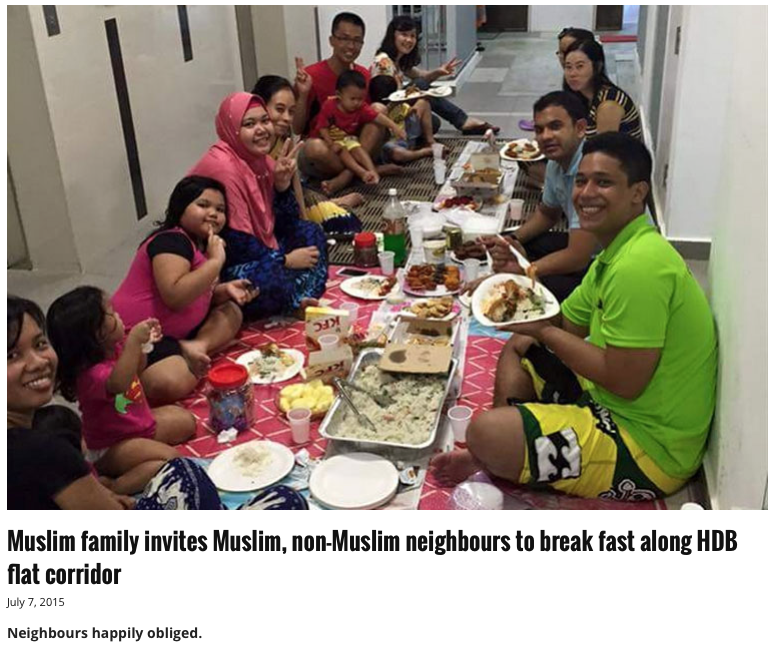
As a Muslim, I see far more Muslims sending greetings to friends to other faiths than not. In fact – the majority of Muslims here laugh at those who insist on not sending greetings because of a misplaced ideal of religiosity. It is ridiculous because it isn’t who we are as a people. In fact we welcome the opportunity to engage with our non-Muslim neighbours as evident in the picture below:
The article on this actual overwhelmingly neighbourly behaviour of Singaporean Muslims can be found here.
With regards to the Muslim population here being influenced by Middle Eastern influences – I must agree to this statement. Religion whether in the Middle East or any other part of the world – is still the same religion. The only difference is cultural influences. For example, there is a rising trend of believing what works in Saudi Arabia should work in Singapore. This idea is empirically false. The geo-politics, history and cultural nuances between the Middle East and South East Asia couldn’t be more apart from each other. On this respect – I find it amusing that Muslims in Singapore are increasingly seen to ditch their own culture, even their cultural dress in order to dress themselves like Middle Easterners so as to be more religious. The idea that your cultural dress influences your piety is a laughable construct. For this – the Muslims in Singapore are wrong.
The article, only after pointing out the Muslims as examples of growing intolerance, goes on to say that the current model for Muslims in Singapore is a successful one and that we should cherish it. In media, we understand what is referred to as attention span. The average reader doesn’t read beyond the fourth paragraph. In this respect anything positive about our Muslim population only appeared after 5th paragraph.
Why are the above points on how the article was written a great disservice to Singapore? The immediate impact was the Muslims taking a defensive posture, demanding data and statistics to back up the statements in the article. This puts the Minister who is in charge into a difficult position because it doesn’t clearly portray his stand on the issue. It also pits non-Muslims and Muslims at odds into a game of finger-pointing. It makes talking more difficult and accusing far easier.
Ultimately it points out the the Today newspaper is more interested in sensationalising news than taking into consideration what impacts how and what they publish might have on the social fabric of our country.
To Muslims I say this – stop being the victim. You are not. Stand up and be counted amongst those who value life and peace. To the non-Muslims I say this – before easily drawing the lines in the sand consider that there is more to be had without doing so.