Tag: kampong glam

  • ‘Mompreneur’ With 2 Sons, Running 3 F&B Businesses

    ‘Mompreneur’ With 2 Sons, Running 3 F&B Businesses

    Despite having her hands full with two young children and two food and beverage (F&B) businesses, Singaporean Tasneem Noor Smidhagen, 36, decided to have a new “baby”.

    In June, she opened Lickety Ice Cream & Waffles in Bussorah Street in Kampong Glam.

    Lickety, which has a Scandinavian decor of pastel pink and mint green, boasts an Instagram-worthy pairing of egglet waffles with ice cream.

    Ms Tasneem and her Swedish husband, Mr Joakim Smidhagen, 45, are also behind Fika Swedish Cafe and Bistro in Beach Road and European artisanal bakery Konditori, located next to Lickety.

    Aside from handling the operations of the businesses, the “mompreneur” has to fulfil her duties with her two sons, aged five and six.

    She told The New Paper: “I just learnt how to take care of my different priorities at different times.”

    Fika Swedish Cafe and Bistro, opened in 2009, was her first venture in the F&B industry.

    Prior to that, the visual communications graduate from Temasek Polytechnic spent eight years in publication design.

    The inspiration for Fika came about when the couple felt the need for such a Swedish restauranthere, while the idea for Konditori grew from wanting the desserts served at Fika to be made in their own bakery.

    The offerings at Konditori are done in small batches and handmade daily. The best-sellers include red velvet croissant, fresh cream semla buns and pain aux chocolat.

    The birth of Lickety, however, was spontaneous.

    Ms Tasneem said: “I thought Lickety should look more alive (than its sister stores) and embrace all things young and fun to attract the younger crowd.”

    Out of the 30 flavours available, the stand-outs are Lingonberry Swirl, Red Velvet and Dark Angel, which boasts chunks of chocolate bread from Konditori.

    Ms Tasneem, who in 2015 won the Spirit of Enterprise Award, which honours local entrepreneurs operating small and medium-size businesses, admitted that her F&B journey has not always been smooth-sailing. One of the main challenges she faced was staffing.

    Her advice for budding F&B entrepreneurs? Stick to your branding.

    Referring to Fika, she said: “Do not follow trends all the time. There are other ways to improve while staying true to your branding. For example, salted egg yolk is ‘in’ right now, but I cannot have that on my menu, because I cater specifically to people who want an authentic Swedish experience.”


    Source: http://www.tnp.sg

  • Do You Know The Men Who Gave Their Lives During The Battle For Singapore

    Do You Know The Men Who Gave Their Lives During The Battle For Singapore

    As we commemorate the 75th anniversary of the Fall of Singapore.

    THE MEN WHO GAVE THEIR LIVES FOR THE BATTLE OF SINGAPORE

    “The ruse having failed the Japanese, about two hours later, staged a determined attack in overwhelming strength. Although the defenders fought bitterly with grenade and automatic weapons they were unable to hold the hill. Many of the men and all the officers ( except Second-Lieutenant Abbas ) died in the close and at times hand-to-hand fighting which developed.

    A number of the captured survivor were massacred by the Japanese. Lt. Adnan who, along with his brother officers, fought gallantly in this action was shot down and bayonetted by the enemy. His body was then hung upside down from a nearby tree; no one was allowed to cut it down for burial.

    All the other Company posts having been overrun, Lieutenant Abbas – the only surviving officer – tried to save the remnants of his platoon from virtual extinction. The Japanese were outflanking and closing in from the front and the wide drain of burning oil at the rear blocked his retreat. He and four of his surviving men fought their way to the drain and leapt through the wall of flame. Two fell into the blazing oil and were pulled out badly burnt. The remainder including Lt. Abbas eventually reached Battalion Headquarters where the grim fate of ‘C’ Company was made known.”

    – From ‘History of The Malay Regiment’ by Dol Ramli*, published in Singapore, 1955.

    *Tan Sri Dol Ramli was born at Dunlop Street and grew up in Tasek Utara ( Farrer Park ). He received his early education at the Kampong Gelam Malay School before admission to the Raffles Institution and later at the Raffles College. The book above was based on his academic research whilst he was at the University Malaya ( Singapore ). He is regarded as the Father of Malaysian Broadcasting.


    Source: Khir Johari

  • Where Malay Royalty Once Lived And Worshipped

    Where Malay Royalty Once Lived And Worshipped

    You can say this was a “glam” kampung, given that it used to be where Malay royalty lived, but Kampong Glam, also called Kampong Gelam, is probably named after a tree.

    Still, Kampong Glam stands as a glamorous attraction today, with its Middle Eastern eateries and trendy fashion shops.

    Beyond these modern additions, sitting grandly in the heart of the enclave are two historic monuments – the Istana Kampong Gelam and the Masjid Sultan.

    The Istana Kampong Gelam was the palace of Sultan Hussein Shah, the 19th-century ruler of the Johor Sultanate which Singapore was part of, while the Masjid Sultan next door had been constructed shortly after upon his request.

    The two grand buildings serve as a reminder of the Malay royalty who once ruled the area.

    The Sultan’s original residence was a timber structure built on stilts in the traditional Malay style.

    According to the National Heritage Board’s (NHB) Preservation of Sites and Monuments division, the present two-storey brick-and-mortar structure was completed in 1843 and commissioned by his son and heir Tengku Mohammed Ali.

    The building’s design reflects both classical European and traditional Malay architecture.

    The round arches at the entrance porch showcase the European design influence, while its layout corresponds to Malay Limas house typology, where the main entrance leading to the main house is connected to an annexe where the kitchen would traditionally be located.

    Meanwhile, the Masjid Sultan, or the Sultan’s Mosque, was originally a single-storey brick structure built in the 1820s.

    Almost a century later, it was in need of repairs and a new mosque was planned. Irish architect Denis Santry from local architectural firm Swan and Maclaren was commissioned for the rebuilding project spanning 1924 to 1928.

    He designed it in an Indo-Saracenic style, which offers a mix of traditional Indian and Islamic elements.

    The mosque features two gold onion domes, and the base of each dome is adorned with glass bottle ends collected from poor Muslims as donations.

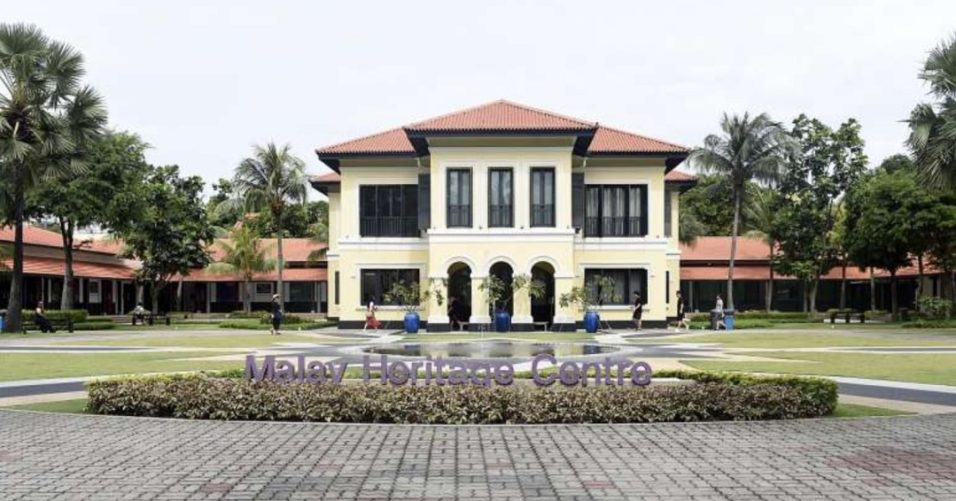
    These monuments are key in telling the larger story of early Singapore, said Ms Suhaili Osman, assistant curator of the Malay Heritage Centre, which now occupies Sultan Hussein’s former palace.

    For instance, porcelain plates dug up from the compound of the Istana Kampong Gelam bear the insignia of ceramic producers from Asia and Europe such as J. & G. Meakin of England. This reflects how the area near the Kallang Basin had thrived as an emporium, with goods from across the globe, in the 19th and 20th centuries.

    Chinese, Jawi and Dutch East India Company coins, also unearthed during two archaeological surveys in the early 2000s, further underscore the cosmopolitan nature of Kampong Glam as well as its economic importance.

    Ms Suhaili said the artefacts “prove that there are more layers to Singapore’s story beyond the traditional narrative of its early beginnings as a sleepy fishing village”.

    According to heritage conservation expert Johannes Widodo, an associate professor at the National University of Singapore, the Kampong Glam compound was laid out based on Hindu and Buddhist mandala symbol principles.

    The mosque and royal graveyard in Jalan Kubor functioned as its crown and the palace was its body, while a market town and old settlement stood as its feet.

    The Istana Kampong Gelam palace compound itself was allotted to Sultan Hussein, after he and Temenggong Abdul Rahman signed a treaty with Sir Stamford Raffles for the British East India Company to set up a trading post here on Feb 6, 1819.

    But to diminish the power of the royals, the British sliced up the area, with Victoria Street and North and South Bridge roads cutting through the place.

    In 1999, the Government announced that the Istana Kampong Gelam would be conserved.

    Some 79 beneficiaries and tenants, including Mr Tengku Shawal, the seventh-generation descendant of Sultan Hussein, were awarded a total of $350,000 a year for 30 years.

    The former palace was restored after its residents moved out and it was turned into the Malay Heritage Centre in 2005.

    The centre, which is managed by NHB in partnership with the Malay Heritage Foundation, houses six permanent galleries.

    Mr Harneis Hadir, general manager at the Malay Heritage Centre, said it aims to provide all communities that go through its doors “a holistic and well-rounded cultural experience”.

    He said visitors can look forward to the annual Malay CultureFest and a special exhibition on the Bugis community this year.

    The Masjid Sultan, meanwhile, took home the Urban Redevelopment Authority’s Architectural Heritage Award last year for its $4.6 million restoration, which included a fresh coat of paint for its golden domes and the addition of elderly- friendly facilities such as a glass lift.

    The mosque won in the restoration category which honours work done to sensitively repair and restore heritage buildings.

    The chairman of its board of trustees, Mr Mohamed Patail, 65, said the restored monument has attracted both worshippers and tourists far and wide.

    On the congregants, he said: “They feel a sense of belonging to the mosque, which is one of the oldest in Singapore. They also come here for a nice family outing – pray at a historically significant mosque, walk around the enclave and then eat at one of the nasi padang stalls.”

     

    Source: ST

  • Al-Habib Syed Alwi Bin Muhammad Alhabshi Meninggal Dunia

    Al-Habib Syed Alwi Bin Muhammad Alhabshi Meninggal Dunia

    Assalamualaikum. Dengan dukacita, saya sampaikan berita Al-Habib Syed Alwi bin Muhammad Alhabshi baru saja meninggal dunia. Moga dia ditempatkan dengan orang-orang yang beriman dan tergolong dalam golongan orang-orang yang soleh. Al-fatihah.

    Jenazahnya akan dimandikan pukul 8 pagi di address berikut. Tempat di mana akan solat jenazah mungkin di rumah atau di masjid sultan. Solat Janazah will be at 10-1030am at Masjid Sultan

    Address rumahnya:
    Blk 143 lorong 2 Toa Payoh #03-186
    Spore 310143


    Source: Shafiq Bublé

  • Beggars Descend On Kampong Glam

    Beggars Descend On Kampong Glam

    Every Friday during the Muslim fasting month of Ramadan, beggars from Malaysia and Indonesia, and as far away as Bangladesh, India and Pakistan, descend on Kampong Glam.

    As many as 50 or 60 show up near the Sultan Mosque, and shopkeepers say the number can swell to more than 100 in the days leading up to Hari Raya Aidilfitri, which falls this year on July 17.

    They say the beggars can collect up to $150 a day, and those with disabilities pocket considerably more.

    There are more women than men, and they go from shop to shop seeking alms rather than approach passers-by.

    Sultan Mosque management board chairman Mohamed Patail told The Sunday Times: “This is a seasonal menace. Lots of people give alms during Ramadan so these beggars take advantage of that. But we don’t encourage begging.”

    When The Sunday Times visited Kampong Glam last Friday morning, there were no fewer than 56 beggars over a two-hour period. The number shrank after noon.

    Most were women from Batam, some with young children, and they moved about in groups of two or three. Six men from India went from shop to shop together.

    Shopkeepers said that the women, aged from their 20s to 60s, come from Johor or Batam to Singapore, and beg with either children or an elderly person in tow.

    Some are day trippers, while others stay for as long as their visa allows. Some are known to sleep on the streets in Little India and Geylang Serai.

    There are fewer men, mostly from the Indian subcontinent, and they often claim to be raising funds for mosques and religious groups back home.

    Ms Safia Anwarden, who runs a souvenir shop near Sultan Mosque, said: “Some of the Indian and Pakistani men say they have a daughter back home and don’t have enough dowry to marry her off. So they ask for help. Or they claim to have many children at home.”

    One Indonesian woman in her 60s told The Sunday Times she was from Pekan Baru and that one of her three adult children was mentally ill. She claimed that this was her first Ramadan begging trip here, and she needed to support her mentally ill son.

    Ramadan is the peak begging season as Muslims are encouraged to give alms to the poor during this time, even though the Islamic authorities discourage begging.

    The foreign beggars show up on Fridays all year round, but in smaller numbers.

    A regular known to Kampong Glam shopkeepers is a Malaysian woman who appears with three children aged between two and 13.

    She said she is married to a mechanic and comes on Friday mornings with her children, going back at night. Some days, they head here in the afternoon after her children return from school.

    She claimed she begs to help a sick, old Singaporean aunt.

    The beggars approached were coy about revealing their earnings, but shopkeepers said they could collect up to $150 a day.

    At Geylang Serai, where Ramadan beggars also appear, two disabled beggars are known to collect quite a lot more.

    A Malaysian woman in her 50s who lost both legs in an accident appears every few months and stays for up to two weeks each time.

    A Joo Chiat Complex shopkeeper said she can collect more than $500 in half a day on weekends. The man, who declined to be named, said: “She paid one of the shop assistants $50 just to look out for her. She was afraid people would snatch her takings.”

    An Indian national in his 40s who walks with difficulty is also a frequent visitor to Geylang Serai during Ramadan. A mosque employee said he collects coins totalling $200 to $300 each day, and exchanges them for notes with nearby hawkers.

    Kampong Glam shopkeepers said they want to help the poor, but the large number of beggars and the attitude of some can be off-putting. Some beggars go from shop to shop and do not leave until they get some money. Others demand $5 or $10 and make snide remarks if they do not get it.

    Many shopkeepers set aside coins to give the beggars who show up on Fridays.

    An employee of Jamal Kazura Aromatics said: “For the elderly, we give $1. For children, we usually give 40 cents.” The shop also buys 50 packets of nasi briyani to give beggars on Fridays.

    Businesswoman Lisa Anjum said she once offered to hire a beggar from Johor to clean her shop, which sells carpets and Turkish lights. But the 40-something woman declined the offer.

    “She told me she had no time,” she recalled.

    “I think it is easier to make money from begging than working. I feel they are taking advantage of Singaporeans’ generosity.”


    Source: www.straitstimes.com