Now is the time to make fun of Lee Kuan Yew before they make it illegal. For goodness sake, he is not my founding father.
“We’ve built a nation with our hands, the toil of people from a dozen lands” – this was what the National Day Song in 1990, One People, One Nation, One Singapore, started with.
So before we go all crazy over one man, let’s not forget that it is the hard work of each and every Singaporean that made Singapore happen. And unless we are going to protect each and every Singaporean, there is no need to change the law to protect one single individual, especially not a dead one.
Do you know what this means? This means that in future, if anyone wants to write a book or make a movie to talk about Lee Kuan Yew and the atrocities that he had done, they wouldn’t be able to do so and the PAP can criminalise them if the PAP wants. This law would allow the PAP to whitewash the truth about what Lee Kuan Yew did.
Don’t let the PAP pass or change the law to cover their own ass.
If the PAP so believe in self-reliance, then let’s stop relying on the over-glorification of one man and please start running the country.
There are more important things to do, like reducing poverty and income inequality, and increasing wages for Singaporeans, rather than spend meaningless time evangelising over one man. It’s mortifying.
The Government is looking at introducing legislation to protect the name and image of the Republic’s founding Prime Minister, the late Mr Lee Kuan Yew, against commercial exploitation and misuse.
Culture, Community and Youth Minister Lawrence Wong revealed this while speaking to the media at the sidelines of the National Community Engagement Programme Dialogue on Saturday (May 23).
Mr Wong said the move comes as many members of the public have raised concerns over the misuse of Mr Lee’s name.
Mr Wong said: “I should make it very clear that the intent is not to restrict people from coming up with their own creative ways to pay their tribute to Mr Lee. Our intent is in line with public concerns.”
Mr Lee Kuan Yew’s death on March 23 triggered an outpouring of grief in Singapore. Some also came up with creative ways to pay tribute. However, it seems not all were well-received by the public.
Mr Wong said: “The first example that you can easily see was what happened with the company that tried to do the buns, right? So again at that time there was a lot of public reaction about how this was distasteful and it was commercially exploitative and it was probably bad and not the right thing to do.
“There have been concerns of people, also of potentially printing T-shirts, selling them with his name and images, and figurines that can be sold for profits or commercial gain.”
So the Culture, Community and Youth Ministry is looking at safeguards, even though there are already some similar laws in place.
The minister said there are already existing laws to regulate the use and display of national symbols, such as the Singapore flag and anthem. This comes under the Singapore Arms and Flag and National Anthem Act, which states how Singaporeans can use the symbols to identify with the nation.
The Act also seeks to ensure that national symbols are treated with dignity and respect. Mr Wong said one possibility is to expand the Act to include names, and his ministry is studying provisions in other countries.
Mr Wong said: “There are similar provisions in their Act which go beyond crest, and anthem and flag. Some of the other countries, like Australia and New Zealand, cover names as well, specific names which they think ought to be accorded the status of a national symbol and ought to be protected particularly against commercial exploitation.
“And so we are looking at these different examples. We have not decided whether we should have a separate law or whether we should expand the current SAFNA but we are looking at the possibilities now.
“In the other countries that we have seen, the provisions are there and then they would gazette the names in a separate gazette so that they can add on if and when the need arises, so they have a list of names which they protect but the provisions are the same, so we can do similarly.”
Mr Wong said the legislation will not restrict the public from coming up with creative expressions of tribute to Mr Lee.
He said: “There is a very clear distinction between somebody who does it for charitable reasons – somebody who does it to pay tribute without making a profit out of it – and an individual or company that’s doing this specifically for profit, for commercial gains. I think there is clear distinction and I think it is not difficult to distinguish between the two.”
Mr Wong said it is not a total ban, but a restriction where approval is required. “So there can be variations of it. We are still studying it, so there can be ways where you could put safeguards,” he added.
Mr Wong said the aim is to ensure Mr Lee’s name and image are used in appropriate ways.
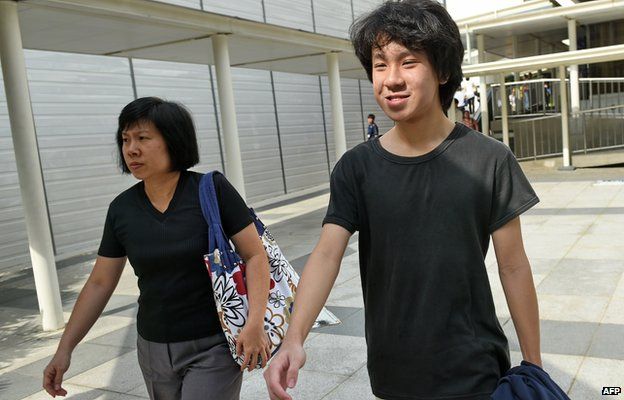
Dressed in a black T-shirt and khaki shorts, Amos Yee cut an unassuming figure when he showed up at the Singapore State Courts on 17 April.
The 16-year-old was facing serious criminal charges – some of which he would be convicted of on 12 May. They were of wounding religious feelings, harassment and posting obscenities. But the teenager breezed past reporters, munching a banana.
This is Amos, the enfant terrible who has fascinated and infuriated Singaporeans ever since he was arrested in March over a Youtube video.
To his mother, he is just “different”, a child born in the wrong place. But to many others he is seen as the boy who dared to insult Lee Kuan Yew.
Jeers and cheers
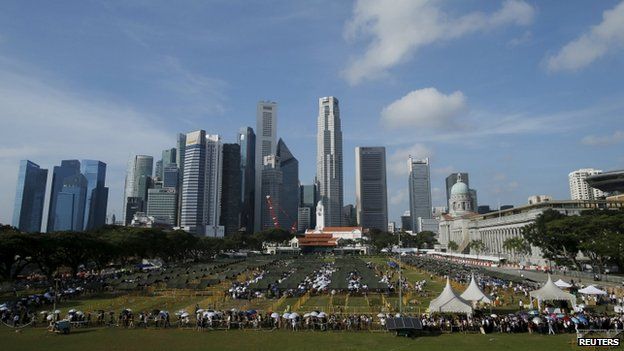
On 23 March Singapore lost Lee Kuan Yew, the deeply respected former prime minister seen as the country’s founding father.
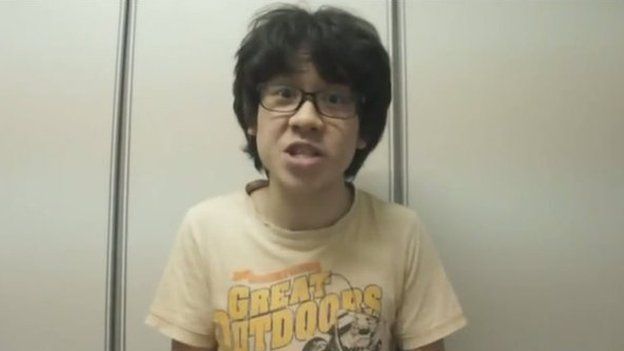
Days later, Yee posted his video, titled Lee Kuan Yew is Finally Dead! – becoming one of the few Singaporean voices openly criticising Lee’s legacy.
He likened Lee to Jesus Christ, and criticised Christians in general, a serious crime in a country which has seen race riots in the past and takes a zero-tolerance approach towards insults of race and religion.
Later, he posted a crude cartoon depicting Lee having sex with Margaret Thatcher, a personal and political ally of Lee’s.
At least 30 people lodged police reports; he was swiftly arrested and charged.
Since then, Yee has attracted insults and death threats.
But he has also earned praise and support from those who see him as a free speech advocate.
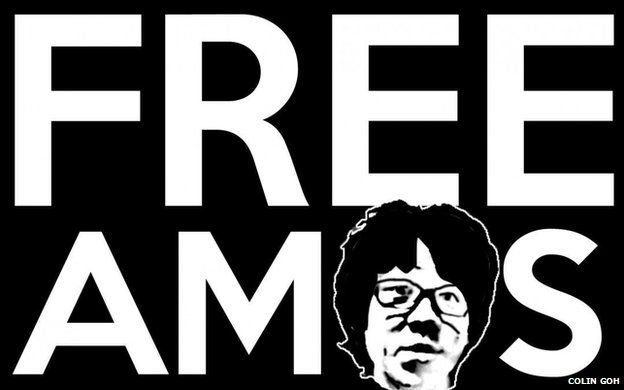
Several strangers stepped up to act as his defence lawyers and post bail. A local humorist started a campaign calling for leniency with a blog post titled Je Suis Amos.
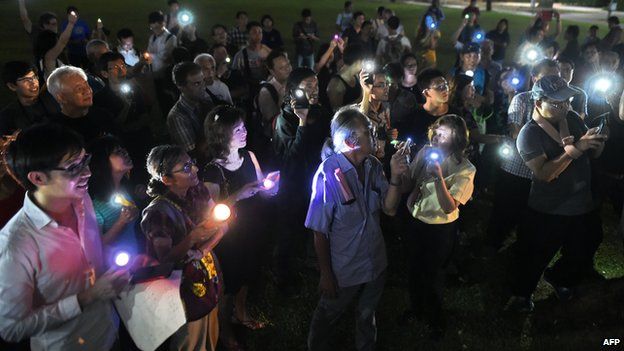
Another blog detailing his quirky outfits went viral, as did jokes about “Famous Amos”, referencing the US cookie brand. Dozens held a vigil on the eve of the verdict.
Sociologist Tan Ern Ser said some may have agreed with him but disapproved of his “show of disrespect”, while others marginalised by Lee’s policies were “inclined to see someone who dares to openly speak up against the system as a kind of folk hero, and worthy of praise”.
‘So different’
Yee’s mother, Mary, told the BBC that her son was “a fantastic child, perhaps born in the wrong country”.
She described him as a precocious boy who loved reading and making videos. He won awards in a short film contest and acted in a local movie.
But he cut short his studies, and in a blog described how he struggled to fit in at school, where he had few friends.
The media has seized upon the fact that Mrs Yee took her son to see a psychiatrist after he posted his video. But his mother insisted that it was just a health check, and that the test results were “fine”.
Generational anxiety
Perhaps one reason Yee has become the object of deep fascination is his utter lack of remorse.
In recent years, Singapore has seen several people torn apart online for offensive posts. Faced with public fury, these people without exception have apologised,gone into hiding, or even left the country.
In contrast Yee broke bail spectacularly by not only reposting his material but also unleashing a torrent of Facebook and blog posts criticising his bail conditions. He pleaded not guilty to his charges during his trial.
Such unrepentant insouciance, and the fact that he insulted a founding father, may have tapped into a recurrent anxiety among Singaporeans that a younger generation, having known only prosperity, takes the country’s stability for granted.
This may be why the slapping of Yee on 30 April by a stranger, as he arrived at court, drew not just shock but also approval in some quarters.
Many denounced it as vigilantism, and the attacker jailed for three weeks, also being publicly condemned by the law minister.
But Singapore remains a place where corporal punishment is still seen by some – including the state itself, which sentences people to caning – as an acceptable form of discipline.
The 49-year-old attacker argued in court that he only slapped Yee because as an elder, he wanted to teach him a lesson.
There were those who thought “it’s about time the boy got his comeuppance”, while some did not condone the violence “but they’re still gleeful that [the attacker] did what they have an urge to do themselves if they could or had the guts to”, noted one blogger.
Wave of emotion
The state made it clear that it was prosecuting Yee for his remarks about Christians, not his criticism of Lee – a harassment charge for his anti-Lee comments was dropped.
But it was those Lee comments which sparked the most public anger.
Many Singaporeans accept Lee was a controversial figure, and comments criticising him are not new. At any other time, an anti-Lee rant by a teenager may have at most caused weary eye-rolling or jokes.
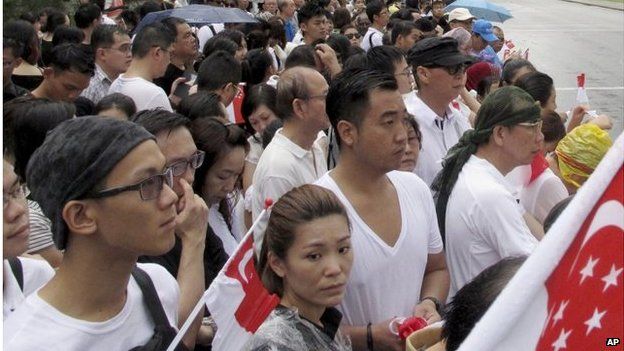
But when Lee died, the city state saw an unprecedented wave of emotion overcome its normally stoic citizens, as they lost the man seen as their anchor.
“Sensitivities were high after Mr Lee’s passing and also, I don’t think the vast majority of Singaporeans have a nuanced grasp of the discourse of free speech… or about the proportionality of criminal sentencing,” said Colin Goh, the humorist behind the campaign for Yee’s release.
‘Lack of boundaries’
Youth counsellor Vincent Law, who treated Yee and posted bail for him, said he did so because he wanted to show that as a Christian he was not offended by the video.
He said Yee was “like any 16-year-old rebellious kid”, who is “challenging authority, feeling he has to fit in a mould and conform to society’s norms”.
“He’s very intelligent, bright, pleasant and courteous… But he lacks a sense of boundaries and empathy for other people. He says he has to be honest and cannot compromise.”
Mr Goh sees Amos Yee as “a true litmus test for Singapore’s maturity in a post-Lee Kuan Yew world”.
“During [Lee’s] funeral, I thought Singaporeans behaved in a very mature fashion – calm, reflective, thoughtful, forgiving. There is some irony that Amos’s case has perhaps revealed quite the opposite.”
Still others believe it is a sign of a changing Singapore, whose strict hate speech laws have been criticised for muting critical discussion on such topics.
“We have a new generation that needs the space to be themselves, to express divergent views,” said Mr Law. “As a society, we need to give them that space and not stifle them.”
It’s been 40 days since Amos Yee was arrested and he has spent some 15 days in remand since then. Following the 2-day trial which ended yesterday, this 16-year-old boy is currently languishing in a Changi Prison cell awaiting the court verdict which is expected next Tuesday. One can only imagine how he must be feeling and how surprised he must be that his 8-min video rant against Lee Kuan Yew has exploded in such an unimaginable way that has brought out the worst and the best in Singaporeans and even drawn international attention to how intolerant a society we have become and how insensitive our system is in the treatment of a child.
Yes, lest some forget, he is still a child not an adult according to the United Nations Convention on the Rights of the Child (UNCRC) which defines child as persons under age 18. If any adult disagrees, please ask yourself if you truly felt like an adult when you were 16.
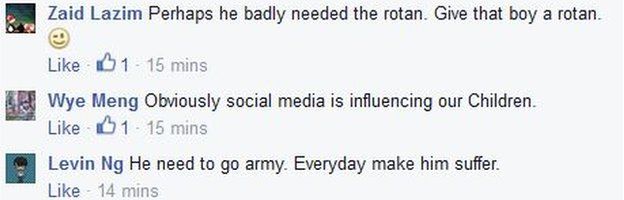
Over the past month we have witnessed a shocking level of intolerance and vindictiveness in the overblown response to the video. Yes the timing of his video soon after LKY died was bad, yes he did say things that were rude in his rant against LKY and this offended SOME fervent fans of LKY and SOME Christians. But many, including Christians and Catholics, have also spoken up to say they were not offended. Yet, for this one short video, which he did to get people thinking about political issues, Amos and his family have been subjected to all sorts of indignities and sufferings including online abuse by adults who should know better.
Ironically, Amos had said in an opening line in his video that “Lee Kuan Yew is a horrible person because everyone is scared, everyone is afraid that if they say something like that they will get into trouble which, to give Lee Kuan Yew his credit, that was primarily the impact of his legacy”. All that has happened to Amos since then is reinforcing this view as zealous supporters of LKY seem hellbent on continuing this oppressive legacy.
Let me now list the trials and tribulations that the kid and his family have suffered since he his video posting on March 29:
1) Amos has been mob-lynched online by numerous adults with many making inappropriate filthy sexual threats including some wishing that he gets buttxxxx (raped) in prison and a PAP grassroots leader even wrote that he wants to cut Amos dick and stuff it into his mouth.
2) Thirty two, yes 32, police reports were filed against him including by well-known diehard grassroots supporters of the PAP. None of these people have appeared as witnesses in court.
3) Amos was arrested on March 30 within a day of his video posting and was handcuffed and shackled in the presence of his grandparents. At least 8 police officers went to his house to arrest this boy. Why so many? Why was he treated like a felon?
4) He was given what his lawyers have argued as unreasonable and disproportionate bail terms which include a total ban on him posting anything on social media (though the AGC sniped that he can still shop online) and an initial bail amount of $20,000 (which btw is half of the bail amount imposed on Filipino Ello who had made seditious insults against Singaporeans). The amount was upped to $30,000 after Amos broke bail terms by posting comments online protesting against the bail conditions
5) He was assaulted by an adult male outside of court with a heavy strike to his face which caused his eye to be swollen. Despite being arrested a week ago, the assailant’s identity and photo has NOT been publicly disclosed. Shockingly, many Singaporeans cheered the repulsive attack including establishment types like grassroots leaders and well-known bloggers. Their rationale for cheering? He deserved it. Yet, would any of these people allow strangers to slap or hit their child even if their child had misbehaved obnoxiously in public? Not at all.
6) And at the public court hearing over the past two days (May 7 and 8), a pale and skinny Amos shuffled in with hands cuffed, legs shackled in heavy chains while wearing a shirt with the word PRISONER emblazoned on the back, shocking those seated in the public gallery. The shackling and cuffing, I understand, is a police protocol for all those held in prison even if in remand. Isn’t it time to review this SOP for children and the frail elderly?
7) To add insult to injury, the media including The Straits Times have misreported several facts and tried to paint Amos’ mum as uncaring and the boy as a psychopath with mischievous and misleading headlines that screamed “Loonie!” just because the court had wanted him to undergo psychiatric counselling in exchange for reviewing the bail terms. For the record, Amos’ mum Mdm Toh said she had taken Amos for counselling to understand why he seemed “too daring” and feared nothing, and not to find out if he was insane. The boy is brilliant and cocky but he is no psychopath. As his lawyer Alfred Dowell reminded the public – he is just a boy, don’t demonise him!
8) Just yesterday, TODAY newspaper ran a terribly misleading and wrong headline that added to the family’s humiliation when it claimed falsely that Amos was asked by his church to leave. The truth is he gave up practising his faith as a Catholic when he chose to be an atheist.
9)Since he was charged on March 31, Amos would have spent a total of 18 days in jail by the time he is brought out in chains again to hear the court verdict next Tuesday. This includes the time he spent in prison before he was bailed out by the kind soul Vincent Law (who said he had absolutely no regrets doing so) and the time that he went back to remand after breaking the bail terms by posting comments online.
Yes all the above, and more, has happened to Amos. And he is just a 16-year-old boy.
Amos has been charged with making offensive remarks about Christians and circulating an obscene image. He has pleaded not guilty to both charges against him. Initially, he faced a third charge for making comments about the late Mr Lee Kuan Yew that were deemed likely to cause distress to Singaporeans, but this was stood down although the prosecution can still charge him for it in future if they so decide.
I understand that some people were upset by the video made by Amos. But as his defence lawyers argued in court, there is no proof that Christians were hurt by what Amos said. Some were upset but many more were not.
As for the supposedly obscene line drawing of LKY and Margaret Thatcher, Amos’ lawyersraised the point that one must consider if there was an intent to deprave and corrupt such as causing titillation for the image to be considered obscene. IMHO, no one looking at that drawing will be titillated.
Everything that has happened to Amos would be very considered traumatising even for adults so what more for a child? Even though his lawyer has claimed Amos is in high spirits, even though many people admire the boy’s seeming resilience in the face of such adversity, no one knows how he really feels beneath the stoic facade. There may be major longer-term repercussions as this draining saga may affect Amos’ mental development and physical health, destroy his future in Singapore and wreck his family and social relations.
The crux here is – there has been a dramatic overkill in response to what Amos did. Why should Amos and his family be traumatised in such a manner? Did he something that was so terrible and evil to warrant all that has happened to him? Online lynching, cheering when he was assaulted, 32 police reports, jail time? Seriously??! Would any of his haters feel the same way if all this happened to their child?
Yes, he was disrespectful in his comments on LKY and on Christianity but surely any rational person can see that such comments from a child will not wreak LKY’s reputation nor destroy the strong religious harmony which has been built over many decades in Singapore? There are many much, much worse comments made online about LKY and religion over the years and yet both survived unscathed.
While I am saddened by the pettiness and vindictiveness, I am also heartened to see many people speaking up for Amos. Many have expressed shock at the lynching and jeering. I too was taken aback when some friends, who are normally compassionate and kind, rejoiced gleefully when Amos was assaulted. Whatever happened to their compassionate and understanding heart? Where is the universal principle of love, forgiveness and kindness preached by their religions? Isn’t their reaction completely at odds with what they preach?
If one teenager’s online rant can draw this kind of rabid response, and if nothing is done to temper the mindset of such people, Amos’ case could well set a precedence. It may embolden the ultra conservative and ultra sensitive to take even more atrocious actions against any and every person/website/blog who/that posts anything that may be deemed offensive to them. Some may want to take personal/political/religious advantage of the very grey and broad Protection from Harassment Act and sedition laws.
Having drawn blood from getting Amos arrested and charged, will the self-righteous group become even more intolerant? Is this the kind of Singapore we want? Is this the kind of intolerant and uncompromising society we desire for us and our children? Will this not fracture our fragile harmony as one people?
So much has been said by our Government about the need to be a kind, tolerant and gracious society. We are exhorted to be gracious and accepting of all different races, religions and nationalities. Yet, how are we treating a child who is somewhat different from the norm here? What are we seeing in the treatment of Amos?
I worry for our country if this sort of mob mentality and intolerance takes root. I hope good sense will prevail and that our Government leaders will do the right thing to rein in any zealous and unjustified mob lynching and work on building a more tolerant and open-minded society.
Let’s now put things in context. Amos is not a bad kid, not by a long shot. He did well in his studies, he has won awards for his creative work, he does not smoke, drink or do drugs and he has never committed a crime. His only “sin” that seems to offend some people is that he is very different from the norm as defined by society here. He speaks his mind bluntly, he has an unusually deep interest on socio-political issues for one so young and he has an exceptional brilliance and an ability to think critically that could make some adults uncomfortable. What he lacks for now is maturity and the ability to think strategically to survive in this world.
Amos and his family have already paid a heavy price for his one video rant. The boy needs time to grow up and understand life. He needs guidance and counselling to become wiser and to learn how to navigate this complex world in a mature way. What he does not need is vindictive abuse and immature jeering from adults who should know better. He also does not deserve to be broken and destroyed all because he made one video that pissed off some overly sensitive people.
“There can be no keener revelation of a society’s soul than in the way which it treats its children.” – Nelson Mandela
My life changed on March 23 when Papa died at the age of 91. As he aged and his health failed in the five years prior to that, I took his welfare into account in every decision I made. His death was hardly unexpected; yet, Papa’s passing affected me more than I had anticipated.
I had not travelled alone since 2009 after he asked me to accompany him on his working trips. After Mama died in October 2010, Papa’s health deteriorated. So I restricted my travels abroad to the ones where I could accompany him as I was concerned about his fragile health.
Following Papa’s funeral, I was not feeling up to a distant trip so soon. But friends encouraged me to attend a week-long meeting organised by the American Academy of Neurology in Washington DC, which began on April 18. After that, I would visit a close friend living in Ithaca, New York.
I was hesitant about the trip as I was spent. My muscles were stiff and my body ached. In fact, I remained this way until the day I left Singapore some two weeks later. I travelled in spite of my misgivings because I decided that I needed to prove to myself I was capable of being as daring and reckless as in the past when I travelled alone.
The journey lasted more than 24 hours. But amazingly, when I landed in Washington DC, I no longer felt stiff or sore and was not hobbled by jet lag either. So I checked into the hotel, washed up and changed into a pair of running shorts and T-shirt – and jogged to the meeting’s venue at a convention centre to register and attend the lectures.
As lectures started at 6.30am from the second day, I decided to run instead of walk to the venue in order to save a few more minutes for sleep. I would also run back and forth from my hotel to the venue to attend the lectures.
By embarking on such shuttle runs three to four times daily, I clocked an average distance of at least 10km a day. What made these runs more challenging was that I had to cross busy streets and step up and down the sidewalks, often in the dark.
At the meeting, I tried to absorb and remember new information and concepts. The regimen I constructed kept my mind away from dwelling on the loss of Papa, except at night when I was trying to sleep. I was moderately cheerful during the day. Learning combined with exercise has always had an anti-depressant effect for me. So I felt as if I was 40 years old once more during the meeting.
After the conference, I travelled to Ithaca to stay with a close friend. She, too, had lost a loved one recently. I thought we could console each other.
My friend is four years older and I call her jie jie (“elder sister” in Mandarin); in fact, being motherly is a more accurate description of her behaviour towards me. And when she greeted me, I had an immediate and overwhelming sense of belonging.
My stay with jie jie was the downtime I needed. I occupied my time with routine – grocery shopping, gardening, twilight walks and drives to scenic sanctuaries. It was early spring in Ithaca, and life was returning after an apparently harsh winter. Daffodils and hyacinths were in full bloom, and the trees were starting to leaf out.
My friend remarked that the changing of the seasons seemed to reflect the cyclical nature of life and death. For me, it was reassuring just to have the sense of continuity, the familiarity of
a beautiful Ithaca, and the comfort of an enduring friendship. While this was a welcome change of scene, it was hard not to turn my thoughts to Papa. But unlike the period of two weeks prior and two weeks after his death, thinking of him now evoked a dull ache that was replacing the sharp pain I felt previously.
I suspect this ache will always remain, but perhaps to a lesser degree as time passes.
I will move on, I have to. But as a friend who had experienced the passing of his parents long ago recalled, that sense of loss and the ache will never completely disappear.
But today, the sun was out, and as I ran up my friend’s driveway, the budding trees and flowers greeted me. We went for a walk at my favourite waterfall, Taughannock Falls, where I have asked my friend to scatter my ashes after I die. But for now, life is sweet.
My way of coping with my father’s death is to be grateful that my parents lived happy lives. Old photographs of Mr and Mrs Lee Kuan Yew together, young and obviously in love, and more recent ones taken in their eighties and evincing mutual affection, remind me of what my father said when he saw me sorting through pictures of himself and my mother. “How lucky I have been,” he remarked.
Yes, my parents were lucky until Mama’s devastating stroke in 2008. Subsequently they suffered, as anyone who has lived for so long usually did in the last few years of their lives.
Still, 60 years of happiness surely outweigh a brief period of suffering. As I see it, my parents were fortunate to have been able to spend their final years in their marital home, a privilege rare among couples.